

Planning an Orchard
I have 40 acres in Central East Texas, Zone 8a. I have a young pear tree in my yard that is doing well and I want to add peaches, plums, and apples for personal consumption. I previously lived in South Texas and grew lots of citrus, so I have some experience, just not so much with the afore mentioned fruit trees.
Here is the problem: My soil is about 6" of red dirt, fairly loose and loamy, and then it becomes compact red clay and it's hard as a rock during the summer.
My solution: is to scoop out 18-20" deep with my tractor front end loader, perhaps keeping the topsoil on site, and replacing the heavy clay part with a much looser soil from another part of the property. I expect to enrich the soil with bagged organic mulch/fertilizer.
I hope I can create a more favorable root zone in this way, without creating a "pot-in-the-ground" as I would do by digging a big round hole by hand.
Any suggestions/thoughts?
I already have a young pear tree that seems to be doing fairly well by planting more in keeping with the typical, big, irregular hole and put all the original dirt back in....but I think the pear is more tolerant of non-ideal soils?
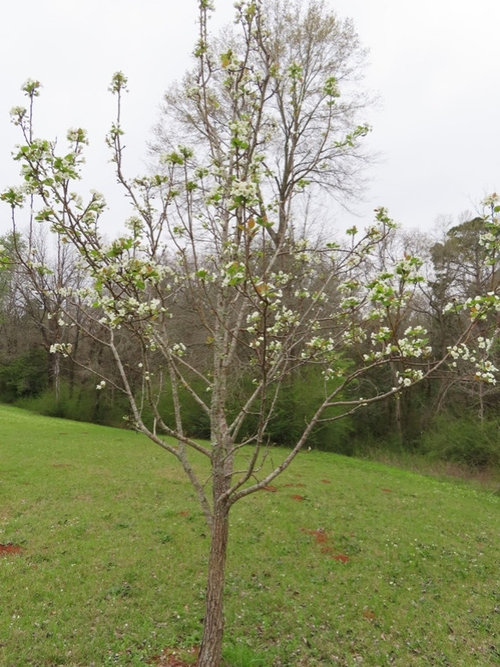
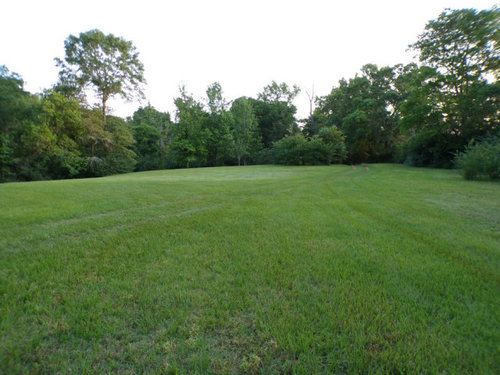
Here is the pear tree and the overall site for the orchard. The site is on a hill that slopes gently off to the side.
I have lots of other questions regarding addition of organic material, sloping/mounding the planting, for organizing the different fruit, and input on the very best flavor/texture of fruit to choose (for my area) so please check in again later!
Thanks!
Comments (42)

John 9a
Original Author6 months agoI just visited a local nursery this morning and found what seemed to be a very nice variety of fruit trees that are supposed to have been selected for growing in my area. I will probably return and take down a list of the varieties so I can research the desirability of the fruit and facilitate my ultimate selection. I can share the varieties here once I get the list and folks can weigh in on favorites. We get 600 - 700 frost hours here.
I can get firm/hard, tasteless fruit from the store, so my goal is to grow fruit with a focus on flavor and texture for eating off the tree, not shippability.- 6 months ago
You should contact your county agent for guidance. I think you are selling your soil short. If it can be excavated with a front loader (track loader excepted) it isn't excessively hard.
John 9a thanked klem1 Related Professionals
Colorado Springs Landscape Architects & Landscape Designers · Winston-Salem Architects & Building Designers · Honolulu Landscape Architects & Landscape Designers · Tallahassee Landscape Contractors · Missoula Home Additions · Savannah Landscape Architects & Landscape Designers · Eau Claire Landscape Architects & Landscape Designers · Concord Landscape Contractors · Chambersburg Landscape Contractors · Petersburg Landscape Contractors · Morgantown Landscape Contractors · New York City Landscape Contractors · Augusta Stone, Pavers & Concrete · Lufkin Stone, Pavers & Concrete · San Antonio Stone, Pavers & ConcreteJohn 9a
Original Author6 months agoklem, thanks, I hadn't considered the county agent. He might have some first-hand knowlege for the area.
I think I COULD just plant the trees without the extra work but I would like to do what I can to improve the site if it will speed growth/reduce stress/improve production.
John 9a
Original Author6 months agogardengal, you touched on one of my future questions regarding mounding the soil. I would expect mounding to exacerbate drought effects (my logic) but would seem to benefit aeration and reduce stress during very wet periods. My best growing citrus tree was planted in a 10' X 10' raised bed at the home I sold in more southern Texas.
I called the ag guy and he's out of town for the week doing stock shows. Yes, those folks are usually experts in LOTS of different topics.
Regarding the bucket effect. I think I have enough ground slope to drain the bottom of the "bucket" downhill.
I feel like I should get at least some trees in the ground since I'm well into my planting time. I plan to experiment with the concept and I'll report my findings and hopefully either skip the concept for the next set of trees, or modify as seems expedient.John 9a
Original Author6 months agolast modified: 6 months agoWell, I hoped to get the trees in the ground today since we have a nice rain tomorrow but I just didn't have time.
Good, bad, or ugly, here is what I did. Some things I'm quite happy with, others, maybe not so much, but I think it's better now than it was, at least for two or three of the four holes I prepped.
There was about twice as much loamy topsoil nearest the existing pear tree. The other three holes had a lesser amount.
Using the tractor to dig the first hole. The loader is 6'6" wide so that's the width of the holes I dug. With all of the driving back and forth to take the clay to another location (improving the pasture road) and bringing back loads of topsoil from another area, the job took most of the day. Otherwise, I might have tried digging deeper or doubling the width.
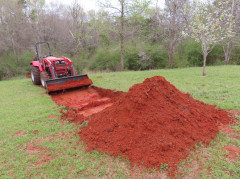
The topsoil looks great to me!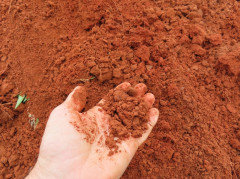
Here is the deeper clay. It's probably pretty fertile but I don't want my trees fighting to push roots into this stuff. Even with what I did, I suspect the roots will get to the clay layer.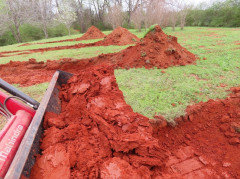
All four holes dug. The piles of dirt are a combination of topsoil from the shallow part of each hole, and additional topsoil I got from another part of the property. I had already stokpiled most of this topsoil while I was doing some previous road work.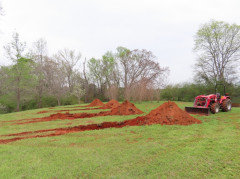
And pushed the soil into the holes and created a low, broad mound for each. The mound should help reduce effects of sinking as the new soil settles, and hopefully the mound will add some effective hole depth.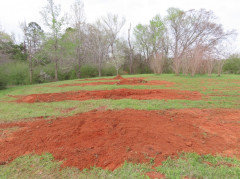
I picked up some 0.5-0.5-0.5 composted cow manure to blend into the soil for each tree. I plan to use 2 cu ft for each tree, mixed into the soil I remove before planting the tree. I hope to do some additional reading between now and then to see what planting tips I can get.John 9a
Original Author6 months agolast modified: 6 months agoPlanting technique question:
The nursery I'll buy my trees from has peaches that are 4-5' tall in...oh man I'm not sure...maybe 2-gallon pots. Should I soak and gently remove most of the potting media (I assume shredded bark) from the roots prior to planting? I used to do this for citrus to reduce air pockets and to help open up pot-bound roots.
I saw notes regarding cedar rust in another thread. I have juniper in the area so I'm thinking I'll skip apples, at least for now, and maybe include a plum or two with the peaches. Is there any reason to alternate peach, plum, peach, plum in this row, or will they cross-pollinate better immediately adjacent? I have seen commercial citrus goves in Mexico with a non-citrus between citrus, reportedly to reduce pest spread.
 6 months ago
I'm confused. Why would you come to this forum with a topic you admit you are unfamiliar with, ask for advice and having received very valid advice from several sources, ignore it completely?
Just wondering.
John 9a thanked gardengal48 (PNW Z8/9)John 9a
Original Author6 months agoI applied 17 years of experience in growing citrus in heavy clay soils. I appreciated the input and I proceeded with the concepts from yours and others comments, believing that the depth of the topsoil and the density of the clay were variables I had the best data on. The first hole had probably 6 inches of topsoil and I think I could have planted a tree there with, or without mounding up additional soil, per your comment. The second hole, maybe, but probably not the last two holes. I would rather risk creating the bucket effect, knowing I do have a little permeability (from a previous onsite wastewater perc test) than plant my tree directly in a smaller bucket/hole. The top soil was about 3-4" in the last two holes so I would have had to create a rediculously high mound or dig into the clay layer. I suspect I play with a balance where mounding soil is beneficial to keep roots in drained soil but at some point I would deal with difficulties in keeping an overly mounded soil wet enough during the summer.
Bottom line, my soil doesn't match the ideal on the label so I tried changing it.- 6 months ago
If you continue your research, I believe you will find that your concerns about planting shallowly and mounding "good" soil over the rootball are unfounded. All reputable sites advocate it. However, you will find countless sources that caution against amending planting holes (clay soils or not), planting deeper than the depth of the existing rootball or fertilizing a newly planted tree (wait a full growing season first).
And the roots of even very young or small trees are remarkably strong. They WILL penetrate the clay and quite easily.
John 9a thanked gardengal48 (PNW Z8/9) John 9a
Original Author6 months agolast modified: 6 months agogardengal, your input is very good and I'm sorry to have frustrated you. That's completely unqualified.
What I'm struggling with is my soil doesn't even come close to this I pulled from the Wikifarmer library...and it seems to echo other sources:
"The peach tree prefers middle, well-drained sandy loam soils and around 4 feet (1.2 m) deep. Heavy soils are unsuitable because they promote physiological anomalies like foliage chlorosis and decrease production. "
I'm sure I'm not sharing anything you don't know but maybe it helps make sense of my thought process. Plants do seem to overcome shortcomings in the "requirements" we have prescribed to them and I saw that with my citrus. But, it was frustrating watching little trees grow slowly, or just hold their own. They were in very compact Beaumont Clay and my yard was so wet it had crawfish mounds all over. Some trees did very well in spite of the lack of any soil resemblence to the label "requirements." My frustrations there lead me to want to try something different here. I did dig really big holes there, by hand, mixing in organics I hoped would create aeration routes. I already mentioned that my best growing tree was in a raised bed planter and that's the concept you are trying to beat into my head I think, but I m concerned there will be no place below for the peach tree's roots to go as it grows to full size. I hope my holes here are big enough to minimize some of the issues more typical holes researchers would be referencing. Time will tell on that but one way or the other, my planting habit is going to fail either, or both, the label and the "big bucket" concept at least to some degree. My site is on the crest of a long hill so I'm partly depending in that to help to drain water from the "buckets" I may have created.
Today is rainy, with maybe over an inch in the forecast, so hopefully that will begin to settle the soil I put back in the holes. Once I was done raking the soil into a nice low mound, I think I have roughly 6" of soil above the original elevation and probably 12-18 inches of soil below the original elevation. I hope to visit the nursery and get a list of the peach and plum varieties they have and do some Googlesearch to pick four varieties to plant.
I can see that growing peaches and plums is going to be a continuation of the work and frustrations of citrus. Looks like I'll be adding a few more diseases to the easel but just maybe I won't have to deal with freezing.
John 9a
Original Author6 months agolast modified: 6 months agoThus far, I haven't seen any notes on whether to shake loose the potting media prior to planting the tree in the ground...peaches and plums. The obove site did briefly describe removing (minimal) spiraling roots to open up the root ball during planting.
 6 months ago
You should talk to your local extension, they will know your conditions. Most people don't have ideal conditions. The chances are good that you can grow some fruits, but not others. Perhaps some varieties cope better with your soil. You can also consider bush fruits. I love currents, unfortunately illegal in my state. Blueberries, raspberries, blackberries, strawberries will all need less depth. You can get thornless raspberries and blackberries. Then there are kiwis and passionfruit.
Second, you can consider dwarf trees. They should have smaller, shallower rootstocks. a super dwarf apple tree might work if regular apples don't. Apricots and some plum varieties come in smaller form. And if you have critters, the small ones are easier to net, although I've failed to critter-proof my very small peach.John 9a thanked SigridJohn 9a
Original Author6 months agoAt some point I hope to add some of those other options. Blueberries are commonly grown in this area and I would love to have some. I'm trying to get a few fruit in the ground this season and add as I have time. Unfortunately, my time is largely involved in building a garage...and eventually the house.
I'm afraid critter-proofing will be a huge challenge. There is at least one very problematic squirrel who has already completely pruned off all of last year's pear crop. It was probably for the better since the pear tree is still quite young but I would like for it to set/ripen some fruit this year....and I am kind of in love with that particular squirrel. I'm thinking I will have to select a few pears and wrap them in chicken wire once they begin maturing. I'm trying not to think about the future trees.
John 9a
Original Author6 months agoResearching peach varieties is SO frustrating! With thousands of varieties, there don't seem to be any reasonably complete tables comparing frost hours, disease resistance, and, most importantly, details on texture/firmness/flavor for eating off the tree. Most descriptions of edibility have a very generalized statement like "eat fresh or use for canning and baking." That's not helpful in the least...what else would you do with a peach?? I've yet to find a description like, "only eat in the yard or over the sink or you will drip sweet, sticky, juice from this soft, easily bruised peach all over everything."
I'm leaning toward Florida King and Sam Houston.
Other varieties they have are Redskin, Elberta, Belle of Georgia, Sentinel, and Loring. I am shying away from "firm" peaches and those with frost hour requirements over 700. Unfortunately, even those traits seem to be variably described from site-to-site and I assume are sub varieties with the same names??
- 6 months ago
Texas extension service has a guide on figuring out if your soil is suitable for fruit or nut trees.
John 9a thanked Sigrid John 9a
Original Author6 months agolast modified: 6 months agoPlums seemed a little easier to research but I encountered much the same lack of resources with flavor/texture profiles along with frost hours and disease resistance...and pollenation needs.
I'm thinking I'll choose Santa Rosa (edited) and Methley for chill hour compatibility and flavor.
Other varieties the nursery has include Morris, Bruce, and Ozark Premier.
John 9a
Original Author6 months agoSigrid, I assume the perc test for orchards has different protocol than for onsite wastewater field lines but my soil failed suitability for subsurface onsite wastewater disposal. The sanitary engineer got a real workout with his core sampler too. Suitable or not though, I'm going to try some trees and see how things go.
It's going to be after the fact, but I plan to try contacting the county extension agent again. He's out of town for the week.
John 9a
Original Author5 months agoI picked up the trees last week and waited until after this morning's heavy frost to plant them. In the meanwhile, I was happy to find some bagged leaves on someone's curb, and I picked up some coffee grounds (in tub below) at a local coffee shop. I had lots of grounds left so they went to a local garden for compost.
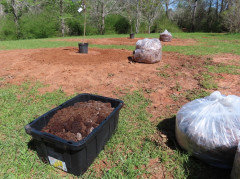
Also this past weekend, I added more topsoil to the planting mounds to hopefully reduce some of the concerns Gardengal expressed regarding the creation of effective buckets in the ground by digging down and replacing clay from the holes with topsoil. I hope there is enough overlayment now to raise much of the root zone above any pooling of water in the clay "bucket" and there is certainly a large diameter of topsoil for the root systems to enlarge in for several years before encountering clay.
I sprinkled a light layer of coffee grounds well away (24") from each tree and incorporated the grounds into the soil with a rake. I hope I have the grounds far enough from the tree that they will be composted and available for the roots when they reach the grounds after a season or two of growth. I didn't add anything to the soil I removed and replaced around each tree.
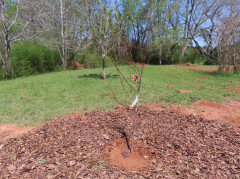
Here are the four trees planted. Now to enjoy watching them leaf out! They were all in bloom a week or two ago at the nursery.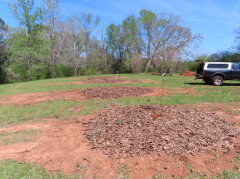
John 9a
Original Author5 months agolast modified: 5 months agoRight! I'm hoping to add a few more trees once I get some other things checked off my to-do list.
The Santa Rosa plum has some tiny plumlets. I may leave one or two if they don't self dehisce.
 5 months ago
You'll probably have great success despite ignoring conventional advice. All of your amendments should be placed above ground---not mixed into the soil. Tree roots that don't have to struggle to reach nutrients are content to just circle around your planting hole. It's called the oasis effect. You want your tree roots to extend as far as they're naturally inclined, not laze around the planting hole. (See Klem.)
One minor point---you can't apply enough coffee grounds to worry about negative effects---unless they form a rain-impenetrable crust. Worms love them., which is nice.John 9a thanked annpat- 5 months ago
I meant to add that enthusiasm and pleasure in labor makes for success, I think, so it's always nice to hear someone excited about a new project. I love planning a new bed or garden.
John 9a thanked annpat - 5 months ago
I occasionally get worked up and excited then start,stumble,stagger,fa*t and fall then wind up just lazeing around (or laying around) the hole daydreaming.
- 5 months ago
I know! You 're perfect to demonstrate the effect. It came to me while I was trying to describe it. "It's kind of like Klem wandering around his livingroom with the remote all day."
John 9a
Original Author5 months agoThanks for the comments and encourgement. I am enjoying checking on my trees each day and watching the young leaves continue to unfold/mature. I thought the peaches had already bloomed at the nursery but I'm thinking it was the plums I was recalling in bloom. Anyway, the Florida King peach is about to bloom.
I understand the "make the roots work for it" concept. I assume that's why we should wait until the second year to fertilize.
I had thought coffee grounds could be used heavily but, on doing some reading, most of the resources I saw indicated they are pretty high in nitrogen (not sure how high) and can lower the pH too much if used heavily. So, I opted to place well out from the planting as an ammendment to soil the roots may reach in a year or so. We have a local coffee shop that puts the grounds on the ground near their dumpster for locals to pick up at will. I have heard coffee grounds can be an ant deterrent but there are fire ants living in the grounds....so much for that concept.- 5 months ago
"They" say nowadays that used grounds have a neutral pH---and your fruit trees will benefit from the slow release nitrogen. Take all you can get, and add them to your compost pile. How are you watering your new trees? You must have said.
John 9a thanked annpat John 9a
Original Author5 months agolast modified: 5 months agoOops, sorry for the slow response.
Good to know about the coffee grounds on the pH. I wonder if it matters if it's espresso or drip. I do plan to get more since there are a lot available and no one else seems to be using them.
On the watering regime, I'm watering once each morning and watering the soil outside the small berm that holds water near the tree...and then I'm adding probably 1/3 - 1/2 gallon of water inside the berm to filter down into the existing roots. It's been bright sun and around 85F so I'm perhaps watering more than I would if it were cooler or partly cloudy. I hope to reduce watering to get just a little wilt (not sure how well I can pull that off) as soon as I get a feel for how well I got the soil incorporated into the root ball. Prior to planting, I used the spray nozzle and removed an inch or so of potting mulch from the root ball so the outer roots would be in soil after planting.
So far, no signs of stress but maybe saw just a little wilt on the Santa Rosa plum...very minor though.
If it's thought best, I can still insert a PVC pipe near each planting. So far, I haven't seen a reason to add it.
BTW, the two peach trees are still leafless. so they aren't so easy to evaluate. The Fla King has put out 3-4 blooms.
- 4 months ago
Your instinct to “improve the hole” makes sense—but in clay soils, it often backfires.
What you created is very close to what growers call a “bathtub” or “bucket effect”:
- Water drains quickly through your loose soil
- Then hits dense clay → slows or stops
- Roots sit in wet soil → stress, rot risk
Even on a slope, clay can still perch water.
👉 So the advice you got (plant native soil + mound up) is considered best practice for a reason.
John 9a
Original Author4 months agoFunny you should comment very recently. I just got through taking update photos to share and have them edited and named for uploading. I did just write a response regarding the bathtub effect but it was deleted by an slight touch on my touchpad laptop and I just don't feel like re-typing. Technology is so frustrating.
So, it's just over a month since planting the trees and they are doing fairly well I think. The root zones are all above the clay line so it will take some years I think before any conclusions can be made regarding my ground modifications.
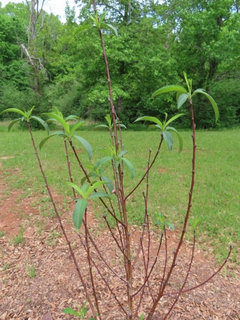
The foliage is difficult to see since everything in the background is super green right now. I included one general and one closeup for each tree.
The Methley Plum - looks very healthy but only a small amount of new growth since planting.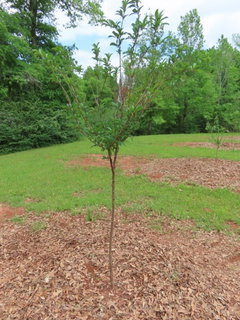
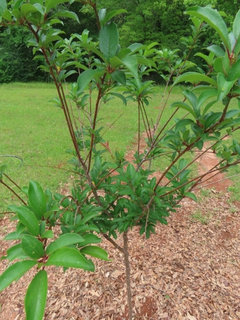
The Florida King Peach - has put out lots of leaves and looks healthy. It bloomed after planting and has now switched to leaves.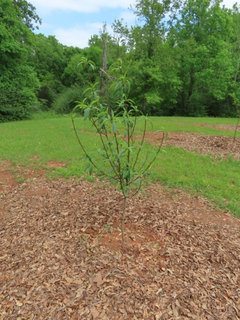
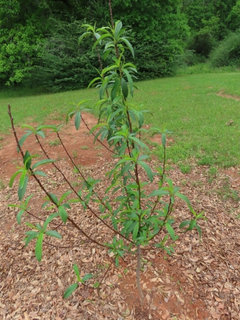
Santa Rosa Plum - this one is putting out LOTS of new growth and is the best looking of the group. It actually held two plums and I plan to let them ripen. If I like them, I'll have an earlier notion on what trees to add.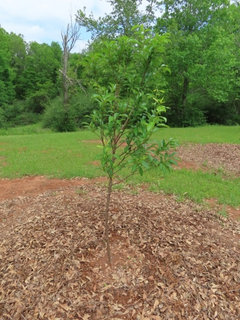
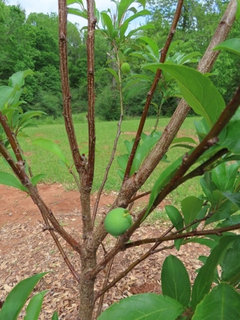
Sam Houston Peach - this one is the weakest in the batch but it's leafing out now and hopefully it will continue. There are lots of buds along the branches. I guess one of any group has to be the slowest. I don't have any clues why it's slower. Hopefully just setting up roots or maybe just a later leafing variety.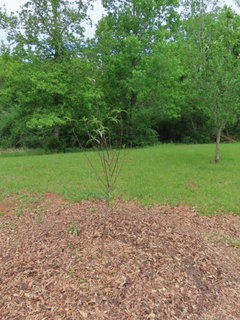
John 9a
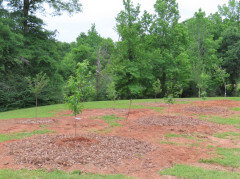
Original Author4 months agoAdded three more peach varieties (Georgia Belle, Sentinel, Lorig) and a Tam-0-Pan persimmon. Nine trees now. Biggest research problem I have encountered is getting out-of-hand eating descriptions. Most of the sites are promoting the trees so they say everything is great! I did find one site with a 1-10 scale for sweetness, acidity, flavor, and I think texture. I assume the biggest market out there is the commercial grower planting and replanting orchards. They seem to mostly want varieties of peach that will pack, ship, and keep well on the store shelf. Stores are selling rock-hard peaches. I want a peach that bruises easily because it's soft and juicy when ripe.....I want juice to run down my arm when I eat a peach. Those varieties are hard to find.
Ok, here is the look with the new trees. There is so much greenery in the background it's difficult to get a good angle on the fruit trees.
John 9a
Original Author4 months agoWow, this forum is dead. Hope the citrus forum hasn't gone the same way. It was super busy 5-10 years ago.
- 4 months ago
According to my experience and by looking at the picture, you will be very lucky if you get a couple of fruits in your mouth. Sorry for the rain on your parade.
The main problem is the forest around. It means that all kind of tree's deseases, pests and parasites from wild trees your fruit trees will get. It means that you have to spray them constantly , like farmers do in fruit farms.
The second problem is squirrels, birds and deer. They will get your fruits before they ripe to even grocery hard stage.
The only fruits you could put in your mouth are persimons. I didnt grow your variety, but I have japanees persimons - huyi and jiro. They are perfect, no trouble to care about them, and super sweet.
Any hard peaches that I've bought from stores or local farms after couple days in room temp become soft, sweet and jucy .John 9a thanked avgusta_gw  4 months ago
"Wow, this forum is dead. "
AI seems to be replacing the exchange of experienced information and advice between real people. Forums are increasing becoming just gossip centers now.
John 9a thanked vgkg Z-7 VaJohn 9a
Original Author4 months agolast modified: 4 months agoavgusta, oh man, you are right! I'm very rural and I like the contact with birds and the four-footed wildlife but I'll have to take some protective measures to get to enjoy any fruit. In the past I built PVC/chicken wire modular walls around a fig tree and it worked very nice but was just that much more labor.
vgkg, you may be at least partly right but discussion forums went from very nice back in the early days of AOL (AOL quickly degraded to junk) when one could have a normal online discussion with rel people with real empathy for others. I place the degradation firmly at the feet of young people with nothing better to do than cut capers and be pests with no personal presence to have to account for their lack of manners or maturity. Now, certainly AI may be exacerbating the problem. I think AI is going to go like cell phone use. It is a super useful tool but is becomming a menace to concepts we used to value. Example, the new update I had to Chrome recently wanted to help me compose emails with its AI assistant. That kind of help may be useful for mass mailing garbage spammers but it would absolutely destroy the personal touch in communicating with friends and family.
Now where were we?? Oh yes, back to fruit trees! I do still have two very nice plums swelling up to a more mature looking size on the Santa Rosa plum. I think very soon I will have to cage the entire tree or build nets around each fruit, per augusta's notes.
John 9a
Original Author4 months agolast modified: 4 months agoOh, one more comment on Augusta's observations regarding micobe type pests. I actually have not yet planted apples due to having junipers/cedar on the property. I know there are some resistant varieties but I'm skipping apples at least for a while. I'm hoping to get an edge on bugs and microbial diseases with a more organic approach. According to some (Howard Garrett, for example) one can promote beneficial organisms with use of manure type fertilizers instead of the straight NPK commercial fertilizers which can set up a less hospitable microbe community. I think I benefitted from that concept with my citrus (I used rabbit, alpaca, and horse manures when available)......shall see how it goes with these trees. Perhaps peaches aren't as bad as strawberries but it's tough to try raising something that EVERYONE likes to eat.
John 9a
Original Author3 months agoFirst Plum
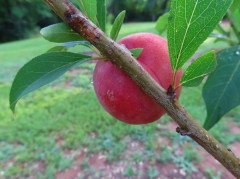
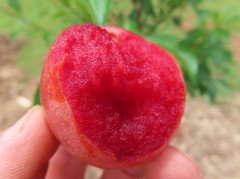
I have been watching a couple of plums on the Santa Rosa. The tree was doing very well and adding plenty of new growth so I left the two plums to ripen. I picked the first one today and am very pleased with the flavor and texture. It's just firm enough not to be mushy, quite juicy, clingstone but not difficult to eat most of the meat off the seed, and more sweet than tart. The peel has just a touch of a bitter finish but not enough to be distracting. Here is the plum and what it looks like on the inside.
- 3 months ago
Wow, if my plum tree set only 2 fruits the local squirrels would be fighting over them before they even got close to being ripe. My 2 plum trees died last year after lasting over 20 years (Shiro and Yellow Egg). Between the squirrels and the plum curculio pests I rarely ever got to pick any at all.
John 9a
Original Author3 months agoRight! I think my trees are small enough the squirrels don't climb into them yet. Not sure why the birds haven't bothered it. I feed with sunflower seeds so maybe everyone is too full to mess with the fruit.....so far.
- 3 months ago
Wow, those are pretty.
I let a supermarket peach grow in my mulch and it produced a single flower, this, its third year.John 9a thanked annpat John 9a
Original Authorlast monthlast modified: last monthJuly 2026 Update
After watching citrus taking 40-forevers to reset their roots and begin adding new wood, I'm really enjoying watching my stone fruit grow.
Here is an update photo and some notes that might help others in some way....but I'm mostly just enjoying sharing!
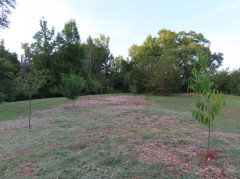
Short of taking a closeup of each tree, it's difficult to get an angle and lighting to show all in one photo.Powerline contractors dumped wood chips on our property after clearing rights-of-way. I spead the chips liberally in the low areas between the mounds on which I planted the trees. I brought the chips up to about two feet from each trunk. We had some heavy rains in June but it has been very hot and dry the last few weeks...and I have not needed to water for...maybe two months? I know I may be setting up an overly wet root zone during wetter times but I think it's encouraging the roots to move away from the tree now.
I did some minor pruning of two of the fastest-growing trees to remove co-dominant central leaders and a couple of oddball branches. I'm very new at pruning stone fruit trees but have watched several videos on the topic. I'm still unsure which trees should be pruned to encourage a strong central leader and which should be pruned to grow in more of a basket. Not sure if I'm supposed to just choose which shape I want and run with it, or if I'm supposed to prune tall-growing varieties with a central leader and shorter varieties in more of an open basket.
The Florida King peach (second on left row) is still blowing the rest away with canopy and trunk diameter growth. I was a little worried about the Methley plum (first tree in left row) but it has very recently put on a very nice batch of new leaves and branches...and two flowers. What's it thinking?? The Santa Rosa plum (third on left row) is still looking very nice, and the Sam Houston peach (4th on left row) is also putting out some nice new growth....it took a while to get set and begin growing. It made a flower recently but I think a deer nipped it off. That was the first sign of deer issues.
Along the right row, the first tree is a Georgia Belle peach and it hasn't put out much new growth but looks pretty healthy to me...maybe not as dark green as I would wish. The second tree along the right row is a Sentinel peach and difficult to see as it's quite small and has lost a lot of its foliage. Pretty sure it's on semi-dwarfing root stock....doesn't look well thus far. The third along the right row is a Loring peach and it only held its own until very recently and has now put on a very nice growth spurt, with new leaves and branches. The fourth tree along the right row is a persimmon...too far back to see well. It had a rough start with leaf edge browning and loss of some leaves but it's looking fine now and has added a few new leaves.




gardengal48 (PNW Z8/9)