Software
Houzz Logo Print
trashcanman

Why does my hood drip?

9 years ago

I recently had my kitchen remodeled last October, and had a chimney style hood(GE Profile, 350 cfm, with a glass baffle) put in that vents to the outside, the run is probably about 6ft. Before I just had a thin cheap recirculating hood installed under the cabinets. I really like the look and lighting on the hood, but it collects oil like crazy! It has a thin mesh panel filter with several layers, and after using it a few times I will see a drop of oil that will form on the bottom side of the filter, and may eventually drip down onto the stove surface.

We do cook alot and sear things with oil in a cast iron skillet, but no deep frying. If I take the filter off, I can actually look up inside the hood and see where oil has condensed on the bottom of the blower motor housing. Every other week I take a paper towel and wipe all the oil off up in there that I can. Is this sort of thing to be expected with a hood with a mesh filter? I have taken the filter and cleaned it with boiling hot water, dawn, and baking soda and that gets it really clean. I need to do that about once a month. But I still get the drips?

Comments (9)

  • 9 years ago

    I would check and make sure that it is installed level.

  • 9 years ago

    I think the answer is 'yes'.

    And you can put the filters in the dishwasher if they'll fit.

  • 9 years ago

    The first time or two I actually did put it in the dishwasher, and it really did not seem to do much, other than mess up the mesh screen ever so slightly.

  • 9 years ago

    Effective mesh filters have to be kept clean, but also have to be dense enough that grease is captured. That requires that one cannot see through the mesh -- the air flow has to impinge on the mesh before changing direction and getting past the mesh. This also requires a sufficiently powerful fan to deal with the resultant pressure loss and still move sufficient air. My guess is that GE aimed for getting their desired flow rate by minimizing the filter effectiveness.

    Proper baffle filters have lower, but still significant pressure loss for the same effectiveness. Baffle filters redirect the air flow so that grease vapor is centrifugally expelled onto the baffle surfaces, rather than impinging on them as in the case of mesh filters. Air flow through baffle filters makes two reversals of direction.

    What is the size of your duct, and what is the size of the entrance aperture of your hood?

  • 9 years ago

    The duct is 6", and the mesh filter is about 15x11.

  • 9 years ago
    last modified: 9 years ago

    I imagine you will be lucky to move more than 200 CFM with the actual restrictions present. 200 CFM and a 0.2 sq. ft. duct yields 1000 ft/min, a reasonable (but lower limit) value for limiting grease build up on the duct walls. Internal to the hood, however, the velocity will be lower due to the higher sectional area, and more grease vapor condensation is possible.

    200 CFM and a 1.15 sq. ft. mesh aperture yields 175 ft/min at the aperture. I would expect this to be loud. This is sufficiently higher than the suggested 90 ft/min for most residential cooking that it will help collect some effluent impinging on the glass outside the mesh area, which is good. This type of hood is not as suitable for the function of a hood as a canopy type hood can be. Expanding cooking plumes rise up and can miss or reflect from hood surfaces, so mesh or baffle filters need to cover as much of the area over the stove as feasible.

    I am now wondering whether even 200 CFM is possible through the mesh with such a small area. Is the air noise passing the mesh particularly loud (assuming it is possible to ignore the motor and fan blade tip noise that will be mixed in)? If not, the mesh pressure loss is moving the operating point of the fan left on its fan curve to where the flow is further reduced.

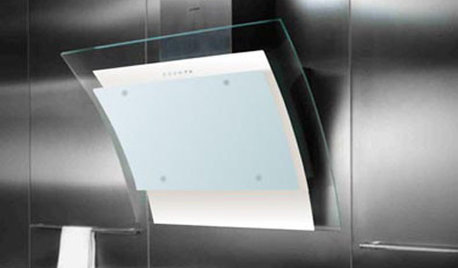
    What is the part number of this hood? Does it look like the image below? I was thinking curved glass canopy when I wrote above; this type will have less capture and containment from the glass portion due to that part of the plume impingement being separated from the mesh area by a barrier. In this case, the glass is mainly decorative, while providing a cleaning task (for your staff) on both sides.

    It may be worth restating that one can have only two (at best) of performance, aesthetics, and affordability. Here we have the latter two factors dominating. This is OK, so long as that is the intent.

  • 9 years ago

    Yep, that's the one. We do have cabinets right up against the glass on either side, so that helps with the containment somewhat, but I can tell that if there is alot of vapor going up, it does not all get sucked in. Do you know if this hood has a feature where it automatically turns on if it detects a sudden increase in heat? Sometimes when I open the oven door below I think I hear it come on, but I think it might be the fan in the convection oven too... I really like the aesthetics of this hood in my small kitchen, and the fact that it acts as a handy shelf for light items like salt and pepper shakers.

    Anyhow, I think I may know why I am getting drips before the mesh filter seems really dirty. On the bottom of the blower motor housing, there is a sticker that lists some of the motor specs. One of the edges of the label is about in the center of the mesh screen, and always seems to have oil on it when I remove the filter. In fact, this corner edge has been peeling back away from the housing, and the peeling is getting worse.

    What I bet is happening is that the corner of this label was not properly stuck down all the way when installed, and when the fan is running it the oil accumulates on this corner because of the change in airflow, just like the mesh works(this label is directly above the center of the mesh screen). And running the fan must be peeling this corner up slowly, and the oil accumulating there just exacerbates the problem. I'm going to try cleaning the housing really well and see if I can get some packing tape to secure the corner, otherwise I will probably just remove the whole label.

  • 9 years ago

    When the oven is broiling, even closed broiling, it would be a good idea to have this hood operating to capture at least a bit of the greasy smoke when the door is opened.

    I would doubt that a hood in this price class would include a heat sensor control, but I don't really know.