Software
Houzz Logo Print
mystearica

Cheap-ish Tomato Cage Ideas?

9 years ago

Heya,


So I plan on growing a decent amount of tomatoes and I have no idea how "big" they will be since I'm a new gardener. Point is - I'm looking for some cheap ideas for tomato cages. I thought I could use cattle panel - but most are 3 feet wide (obviously I can't use that for height).... and I don't think that's enough to act as a diameter - but please correct me if I'm wrong. Flimsy 33 inch go for $2 - I mean any wind - poof... and I'm pretty sure all my tomatoes last year were larger than 33 inches


Any advice/suggestions/links are appreciated!


Thanks!!!

Comments (14)

  • 9 years ago
    last modified: 9 years ago

    I use concrete reinforcing mesh. A 50' length costs about $60. A 4' length will make a cage with a ~16" diameter. Trim off a bottom row to make legs. If you do not have a pair of bolt cutters, I recommend those for cutting. 15-18" bolt cutters are probably $20.

  • 9 years ago


    Agree, CRW is the best bet, if you are a handy person.

    Tractor Supplies here sell 100ft length of 6ft tall for $100. But I would think that 16" diameter will be too small. A 20" - 24" ( lets say ~22" ) diameter should be better. In that case each cage should cost about $6. Not bad. I debated buying a roll but did not have a truck to bring it.

    The best 3-4 ring cages probably cost about the same but they are too short and flimsy. So you will also need to reinforce them by some kind of stakes.

    IDEA: If you plant in rows, you can only cage every other one and weave the one in between.

    Sey

  • 9 years ago

    I remember one enterprising poster on here who suggested selling half the cages from a 100' roll and recooping your investment. You could probably recoop enough to pay for the CRW and the bolt cutters. You will also need a serious pair of gloves. Look up YouTubes on how to handle the CRW. It is great but can bite like a barracuda. It is also springy. and has some tremendous recoil. Respect it.

    I just finished making up a 100 foot roll. I used 10 squares per cage, or 60 linear inches. Off the top my head, i believe the diameter is about 19.1 ". These are perfect for 4 foot row spacing, and 2.5 to 3 feet between plants. Still enough room to walk down the aisle in between rows.

    Working out the math you get 60/12 or 5 linear feet per cage, or 20 cages per roll. I got more than that. I bought a role 5 years ago. I used up all the new roll, but still have a remnant from the first roll. And I have 48 cages. I believe I made 24 out of each roll. Maybe somebody can find my math error. Some of my cages from the old roll are also bigger than 60 inches. My quality control was not all it could be.

    When I make a cage, I use 10 sections PLUS the full length of the 11th section to make the closure hooks. Those rolls are cut "long" by at least 26 feet.

    Cost is roughly $4.20 a cage. I would think you could get $10 to $12 each for them. Sell half, or 12 for $120. That is close to break even with tax.


  • 9 years ago

    This post needs a photo: here is my garden of 48 CRW cages.

    And another view from yesterday in the sun:

    They are zero maintenance and always have that rustic look, even on the day you bring them home. I suppose they will eventually wear out. After I mixed up the five year old cages with the new ones, I cannot tell them apart.

  • 9 years ago
    last modified: 9 years ago

    First of - thanks for all the advice... I have a few questions now

    Okay - let's start by saying - I suck at math. So... if I understand this correctly - ideally a cage should be 5 x 5 foot (aka 10 squares or whatever it works out to be).

    1- Would something like this work? If so - that's 10 cages for the price of $3.9 + tax.

    https://www.lowes.com/pd/Blue-Hawk-Rolled-Wire-Galvanized-Steel-Welded-Wire-Common-50-ft-x-5-ft-Actual-50-ft-x-5-ft/50017408

    2- So - how do you attach them to the ground? I'm confused since normally with regular cages you stake them into the ground but this has no stakes... would you use fabric stables like these:

    http://www.homedepot.com/p/Easy-Gardener-Fabric-and-Sod-Staples-10-Pack-814R/100000833?MERCH=REC--rv_gm_pip_rr--204331896--100000833--N

    (again trying to think as economically as possible).

    3- I guess I have no buy bolt cutters - what size would you use.. I bought a while ago these mini bolt cutters (see link) - will these work oO?

    https://www.amazon.com/gp/product/B000NQ4OYO/ref=oh_aui_detailpage_o01_s00?ie=UTF8&th=1

    4- Lastly - perhaps this is more of an education for me - when I planted my tomatoes - I had 3 tomato plants with per cage... but I also had 3 single tomato plants in their own cage - now I don't REMEMBER seeing a problem with either set-up but that could also have been the variety. Any thoughts on this?

    Thanks!


    EDITING: Your post didn't show up when I was typing - thanks for the pictures - these look amazing!!

  • 9 years ago
    last modified: 9 years ago

    #1) the mesh size is too small, concrete mesh is 5x5, if the mesh is smaller your hands and tomatoes will not fir.

    #2) you cut off the bottom horizontal row.

    #3 15-18"

    #4 1 plant per cage of indeterminate

    the larger diameter the cage, the farther you have to stick your arm in to pick tomatoes.

  • 9 years ago
    last modified: 9 years ago

    Nothing cheaper than T-posts and heavy crod/string for a Florida weave. But if you want cages and want something less expensive than CRW you can make them out of welded wire fencing like this

    https://www.menards.com/main/building-materials/fencing/utility-fencing/6-x-50-welded-wire/p-1449547090237-c-5768.htm?tid=-2854096058662813877

    The 5' height is even cheaper so you can get 100' of it and save $25. It is easier to wrestle with and cut. The drawback is you then have to cut some random spaced 4" openings to harvest (easy to do) with wire cutters so bolt cutters aren't needed. Plus it is galvanized so retains its appearance better.

    Keep in mind that any cages like this will require some space for winter storage.

    Dave

    Ah I see you found the welded wire (better prices elsewhere). And yes 1 plant per cage always.


    Container Plants - Summer 2015 · More Info

  • 9 years ago
    last modified: 9 years ago

    1 You would probably only get nine cages if the roll isn't' more than 50'. You need one extra square per cage to make hooks. However, I suppose you could buy hog nose clamps or something similar to hold the ends together.

    2 I use large wooden stakes to hold them down. I'll get a photo tomorrow. The stakes are another expense. You can reuse them, but they will corrode. My father used iron rods. He got away with that because he planted his tomatoes in a huddle in cages(one tomato per cage). I have seen it a few times. Supposedly the tomatoes are so close together, they shade collectively and temperatures are dropped, pollination goes up, and production is higher. Because the cages were all next to each other, he ran a single iron rod through 4 or 5 cages, just above the wire next to the ground. He secured both ends of the rod with other pieces of iron rod that were L shape. These were driven deep into the ground. When the wind blowed, nothing moved. We lived in tornado alley.

    3 the bolt cutters I have been using are bigger. But, the forces may be sufficient.

    4 could have been variety. I can see where I could get two Indigo Apples in one cage. But the Big Beefs need their own cages. A Sweet Million might need an extra large cage, or even two cages.

  • 9 years ago

    By Janice's method a 10 section length will be 50". Using one of the section as hook and making it into a cylinder it will make 14.5 " diameter. Ant the cost per cage will be about $4.25.

    Cutting 11 sections, you will have 16.5" in diameter and cost will be about $4.75, an extra cost of 50 cents per cage.

    Anyway you cut it, it is economical for quality cages.

    Cages offer a lot of convenience vs stake, weaving, stringing. I am doing mostly stringing and weaving this season and a few staking. A lot of work ahead.

    sey

  • 9 years ago

    Hi Mystearica,


    This applies to the CRW option:

    -- Concrete mesh usually has a 6" x 6" hole size.

    -- Your bolt cutters in the amazon link can do 3/16" (12/64")

    ==> Concrete reinforcement mesh is usually 10 gauge wire which is 9/64" which means your cutters can do the job though it might get tiring. You can put pipes on the handles to extend the leverage and make it more enjoyable a task

    --Concrete mesh rusts and looks, well rustic. I have come to love the look and I would not want shiny galvanized. I think this is a matter of personal taste. The rusty blends in with the earth and garden nicely while here the shiny can draw attention to the cages and be more an eyesore for busybodies.

    --If you buy a roll, don't expect to sell cages and get your money back. Hey anything is possible and this should be, but ... That is exactly what I tried to do and unless you have personal friends to share the burden, well, good luck, because the timing is going, going, gone ...

    --Wanna buy a 6 foot 150 foot roll? It is yours for $75, just come and get it :-). 6 foot is one of the commercial material height while five foot is the common height and only one available at HD and Lowes here. I have no use for the 5 foot height but that depends fif you are using containers and and short plants or determinate, though you could weave or stake most of those.

    --My preferred diameter is 22 1/2" (12 squares) or 24" (13 squares) depending on how bushy and vigorous the variety is. I would not go below 11 squares (20.5" dia) though others do it.

    --To secure your cage, do not cut off the bottom horizontal row to make spikes IMO. I would cut a few on one side of the bottom square and bend it parallel, stick the bent out ones in the ground to conserve the height. Or just take a few moments longer and get stakes around 2 or 2 1/2 foot long and use them to reinforce the vertical standing. One or two is usually enough. from a single scrap 2"x4" two feet long I can split easily 8 stakes, probably 10.

    --As mentioned, cutting holes in a smaller mesh is an option, but not something I'd want to do because then there would be sharp stubs and I'm good at scratching myself between too closely packed plants. On the other hand, the smaller mesh sure can help with the varmints.

    --I made 21 cages a couple of years ago and another 20 a couple of months ago. My plants are already reaching the top and starting to spill over.

    Good luck!

    PC


  • 9 years ago

    The mesh on the CRW I used is 6 in square. Diameter is 19" plus.

    I did vary the cage size some, which makes it harder to plant uniform rows. I put all the 19" cages in middle rows. Supersize cages go on outside rows, so they do not mess up my aisle. I did make one 9 section cage. I put a small determinant in it.

  • 9 years ago

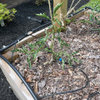
    Close up of CRW

  • 9 years ago

    I use jute twine I thought I paid under $3 but here it is at https://www.walmart.com/ip/TWINE-JUTE-HD-NAT-190FT/19870337

    Amazon, HD, and garden centers will also have it.

    I described it here but the link is below.

    <gumby_ct(CT it says Z5)

    I have been using the string method for quite a few yrs now, I wouldn't do it any other way now.

    I use jute twine - it ALWAYS lasted the entire season and can be
    composted. I used nylon and other synthetic products the 1st yr. - until
    I found out how time consuming it was to remove the string or wire
    twisted around a plant stem to save for next yr. Esp. if you till the
    garden soil.

    I can't imagine trying to have the roots grow into the string.

    What I do is wait until the plant has a couple branches then wrap the
    jute one complete wrap the main stem under a branch, doesn't matter
    where the stem/branch is located, really. The higher up the plant the
    less string you will need. The roots will hold it in the ground.

    So 1 complete wrap around the main stem then tie a loose knot - I
    can't esplain how to tie knots so pick whatever YOU know how to tie, it
    doesn't matter, really. It is the action of twisting the string around
    the plant as it grows that will hold it.

    So after you've tied the knot then twisted the string around the
    plant and between the next branch on the way up. I use a clockwise
    direction - do what you see fit just keep going in the same direction.

    So after you've got the knot and a couple twists around the plant -
    take the jute all the way up to the crossbeam, wrap then tie it with the
    knot of your choice.

    There that wasn't hard now was it? I was surprised to find that this
    string method held the tomato, cukes, watermelon, or whatever plant you
    want to trellis UP better than the cages and stakes I used esp. and
    during a hurricane while the plant is loaded with fruit. I was
    impressed.

    NOW, when you are out there watering, weeding, or just walking by and
    see a plant has grown, give it a twist or two around the string and the
    string will hold it up.

    Now there might be times esp. w/cukes or if you don't pinch off the
    suckers, you will need to run another string or two. I just pinch sucker
    with thumb & forefinger when I am out there.

    Cukes are esp. nice cuz once they get up off the ground they will
    grow nice n straight and are much easier to harvest. The hardest ones to
    find are the ones on the ground before the plant goes UP.

    IF you used just jute twine and no other plastic pieces or parts -
    you can just remove the plant and throw the whole thing into the compost
    or trash, if you want.

    HTH >


    http://forums.gardenweb.com/discussions/2192037/vertical-string-method


  • 9 years ago

    I hate dealing with round cages. I think the idea of square cages of cattle panel that are in 2 L shaped pieces 18- 24 inches on a side is the best storage method I have seen so far. Plus I can make them 8 feet long for a installed height of 6-7 feet for indeterminates. High priced though, roughly 10 bucks per cage.

Sponsored
Peabody Landscape Group
Average rating: 3.5 out of 5 stars8 Reviews
Columbus' Reliable Landscape Design & Contracting