

Growing tomatoes in containers on a deck - what am I doing wrong
So I've been trying this off and on without much luck, but last year I decided to read up on best practices and figured i'd follow what I thought were the best instructions I could find. Sadly I planted four plants and got two fruit for my trouble. Total.
I should say that I live in southern New Jersey, near Philadelphia. My deck is made of painted wooden boards with small gaps between them. It gets 8 hours of full direct sunlight plus 4 hours of partial sun. I used Rutgers tomatoes which seem to be a good variety for this area. Here's what I did:
I placed 5-gallon soft pots directly on the deck. I filled them with plain potting soil (not potting mix) to about 2 inches or so from the top and soaked with water. Then I planted the tomato seedlings and covered with a bit more soil so 2/3 of the stem was covered. I inserted two Jobe's tomato fertilizer sticks (not organic), each halfway between the seedling and the edge of the pot in opposite directions, added some more water and tomato cages. I also added Tomato Screens to protect from squirrels.
I planted on May 8 and watered when soil became dry pouring in a lot of water. This usually came out to every other day when it wasn't raining. I got flowers on all plants by May 30, when they also all reached the bottom rung of the tomato cages. On June 13 I noticed the growth of my first fruit. The number of flowers peaked around June 30 with approximately 10 on each plant. At this point, all the plants reached the second rung of their cage. Most flowers did not develop into fruit and eventually dropped, some quickly, but most after a long time. The second fruit (on a different plant) finally started growing around July 4. By this point all the plants reached the third rung of their cage.
On July 21 I harvested my first fruit. It was a lot smaller than normal for Rutgers tomatoes. By this point the number of flowers per plant was about half of what it was at its peak. By August the plants were growing sickly with yellowing of some leaves, but continued to produce flowers, peaking again on August 10, exceeding even the first peak, when I harvested the second tomato, only slightly larger than the first. There was no further fruit growth, and the health of the plants deteriorated slowly at first and then more rapidly, being all but dead by September.
Can someone tell me what I did wrong? I was planning to repeat my experiment this year, obviously correcting anything I did wrong.
Thanks in advance for your reply.
Comments (60)
 9 years ago
""Miracle Gro": They make lots of products. Which one are you referring to? The water soluble "tomato" plant food?"
Miracle Grow All Purpose Plant Food or Miracle Grow Tomato both work fine. They are basically the same thing with only minor differences.
""and and another 50 grams 4-6 weeks later mixed well and carefully below the surface without damaging the roots": This I'm really concerned about. By this point I have fairly large plants plus tomato cage in there. Damaging the roots would be very easy. Is there any way to do without this?"
Which is why I advocate using liquid, water soluble fertilizers. I have no objections to mixing additional Osmocote or any other granular fertilizer in to the soil prior to planting but once the plant is well established adding additional dry fertilizers can be quite difficult.
""Too little water": I have read many warnings about over-watering, so how much water do I really need and how do I know when/whether I need more?"
Most of the avoid over-watering warnings are directed at the young, just transplanted plant or at plants in the ground. It can be quite difficult to over-water an established plant in a container - especially if it is a small container. Not impossible to do but quite difficult. The point is your watering practices have to change as the plant changes and the climate changes. They aren't set in stone. And you determine the need by (1) sticking your finger deep into the soil and (2) watching the plant. Note how the leaves change, do they droop, are they yellowing, are they rolling up like a taco shell, etc. Learn to recognize the differences between a healthy looking plant and an unhealthy one.
"I'd like to re-use as much of my setup without buying everything new"
Then stick with only dwarf varieties or compact determinate varieties. Otherwise you need to invest in larger containers.
Dave
 9 years ago
You might also consider hand-pollinating your tomato flowers. It's pretty easy and doesn't take long.
Related Professionals
Aurora Landscape Architects & Landscape Designers · Rockford Landscape Architects & Landscape Designers · La Crosse Landscape Architects & Landscape Designers · Bronx Landscape Architects & Landscape Designers · Lynchburg Landscape Contractors · Portsmouth Landscape Contractors · Ithaca Landscape Contractors · Utica Landscape Contractors · Lima Landscape Contractors · Eureka Landscape Contractors · Vidalia General Contractors · Shreveport General Contractors · Salisbury General Contractors · Brainerd General Contractors · San Jose General ContractorsBoris Zakharin
Original Author9 years agoThanks to everybody for the help. I think I'll go with PupillaCharites for 3 of my tomatoes this year, but will try a 10 gallon container for one and hope for the best.
 9 years ago
RE: Osmocote "This is a goof proof low maintenance fertilizer for the NPK. You cannot over fertilize with it." Oh yes you can!! You can over fertilize with any type of fert (although organics are harder to do so with). This is why they supply dosage instructions on the label :-)
If you are using a prepackaged potting soil, then you do NOT need to add dolomitic lime. This used to neutralize an acidic pH, generally as a result of the peat or bark in the mix and is only needed when you are mixing up your own, custom batch of potting soil. It is not considered a fertilizer!! Since you will have to fertilize any container plant regularly, just pick a water soluble or liquid that contains either the Ca or Mg you need. Check out the Dyna Gro products for these - none of the MG ferts, even their tomato fert - contain Mg or Ca in any significant quantity.
Never allow containers to sit in water - even a saucer. Any sort of receptacle to collect water directly in contact with the bottom of the container will prevent proper drainage. It will also raise the perched water table. If you don't know what that is, do some research, as it is absolutely an essential bit of understanding necessary for successful container growing. If you do use a saucer to protect your deck, empty it immediately after watering the pot.
btw, if you are growing your plants out of doors, there is no need to hand pollinate. Tomatoes are wind pollinated and even a small breeze is enough to transfer pollen within each flower. Hand pollination is usually only necessary under greenhouse conditions (and not even then if a fan or good air circulation).
- 9 years ago
Boris - as you can probably tell, there is no one absolute right way to do any of this. There are at least 10 ways that would work and we'd all likely take issue with at least 1 or 2 of the parts in each of those 10. ;-)
All anyone can give you is their personal opinion of what works for them in their climate with their plants. So try to be as flexible in your approach as possible and may I also suggest some reading over on the Container Gardening forum here when you have a chance.
Good luck with your plants.
Dave
Boris Zakharin
Original Author9 years agolast modified: 9 years agoOh boy, 30 gallons. That's twice as much soil as all the other ones combined. Given my track record, I'm not sure I want to throw money away (not to mention carrying it all) for something that might not materialize
- 9 years ago
PC, we can disagree all you want but I still stand by all of my statements. I have gardened exclusively in containers for years, am a degreed horticulturist and actually teach this subject (among a bunch of other topics, including soils and fertilizers) and know whereof of I speak.
No fertilizer is "goof proof" and you can over-fertilize using anything. If you are not aware of that, then you simply have not gardened very long!! Do you really know what a fertilizer is? Were you aware that fertilizers are regulated and that the label is a legal document and for any product to be considered a 'fertilizer' it must publish a guaranteed analysis? That's why products like manures, compost or dolomitic lime are only considered to be soil amendments, NOT fertilizers!
And before you advocate the use of saucers for container plantings, study up on perched water tables and how they impact drainage and root development. Who knows - you just might learn something.
- 9 years ago
Boris - did you ever mention where you are located? I re-skimmed but don't see it above. Reason I ask is we are all comparing very different climates here. What works for one location and climate may not come close to working somewhere else.
Dave
 9 years ago
One thing no one has touched on here is temperature. Boris said the blossoms were falling off the plant. Here in sunny Phoenix Arizona, once the temps hit about 90 degrees, no more blossoms. Boris may simply have planted too late, but I don't know the temps in southern NJ in June. Just a thought.
- 9 years ago
Your problem is water. There is very little danger of over watering tomatoes in a pot. Actually, none. Tomatoes grow so fast that they need much more water than other plants. People make the serious mistake of assuming that tomatoes can be grown under the same conditions as lilies or daffodils.
I used to grow Big Boys (larger plants than Rutgers) very, very successfully in pots on the patio when I lived in an appt. Don't remember the size -- somewhere around 5 gallons or so. They needed so much water that I had to place the pots in large wash tubs and fill the tubs entirely up with water every morning and evening. Each plant took several gallons of water a day -- and they used it. Tubs would be empty when I came home from work.
I grow the largest tomato plant that I know: Sungold (mine are 15+ feet when in the ground) in 2 gallon baskets successfully. Every am, at least a quart of water until it is dripping out. Every PM, same.
More people kill houseplants by over-watering than any other problem, and more people kill tomatoes by worrying about over-watering and not giving enough. It is unbelievable how many people do that.
Watch out for the fertilizer formula. A ratio of 1-1-1 is acceptible for tomatoes, but certainly not ideal. Tomatoes need 1-2-1, or similar. What you used last year was great, if you had watered enough, and fertilized more. Also, Jobes makes a fantastic dry that is 2-7-4 with cal-mag, and is on sale at Lowe's for unbelievable price.
Miracle Grow has too much N ON PURPOSE because "the stupid consumer" will repurchase if the plant greens up right after use, whether or not it blooms a lot later on. Before Scotts bought MG, it was ideal for flowering plants:15-30-15. Now, the only MG best for tomatoes is Bloombuster, when you can find it at the pre-Scotts formula of 15-30-15. For some wierd reason, the identical box of BloomBuster will sometimes have a different formula. However, I use the basic MG (almost all N) or the pretended-for-tomatoes one on young seedlings that I do not want to bloom before they grow roots in their permanant place.
If you were to do what you did before and WATER, WATER, WATER, you would probably succeed somewhat. But you probably also need more fertilizer. I find that tomatoes in pots need more than in-ground, and in baskets, they seem to need even more. Manufacturers' instructions always suggest much less than ideal because they do not want "the stupid consumer" to accidentally use 8 times as much as suggested. (Honestly, 8 times is the formula used by Scott's, who owns MG, and "the stupid consumer" is their favorite in-house term. I used to develop new pdts for Scotts, so I know this as fact.)
Since both Sungold and Sun Sugar grow and produce well in my 2-gallon baskets (but only reach 3 feet, instead of 15+), you can continue to use your 5-gallon pots for Rutgers, without spending more money on equipment or buying anything special.
Each non-rain day, I give about a gallons of water to most smaller tomatoes in 5-gallon hard pots (recycled icing containers that I buy for $1 each). Maybe the soft pot wicks water away from the roots - like those awful peat pots do. So you could even need more than a gallon a pot. You could try placing each pot in a wash tub full of water or a deep saucer as suggested before.
WATER, WATER, WATER!
- 9 years ago
".... he was probably perfectly timed baring a heat wave or aberration!"
That doesn't happen these days at all! hahhah. Good info PC's, I love all the details. Try again Boris!
Boris Zakharin
Original Author9 years agoI believe the average last frost date for my area is May 1. What I have read is that planting tomatoes before low temperatures are consistently in the 50s, while not harming the plants, is pointless as they will not grow. Given all that I'm planning a similar planting time this year. I think today is the first time there are no 40s in the 5-day forecast.
Regarding emptying saucers, how exactly would I do that with 5 gallons of soil and a fragile plant? Or do I not need to do that after all?
- 9 years ago
Do you have to use saucers? Just raising the pots - either with or without the saucers will help. You just do not want to let the pot sit in a dish of water for any length of time.
Boris Zakharin
Original Author9 years agoNow I'm confused
"They dry out more quickly though, so saucer is now more necessary"
"You could try placing each pot in a wash tub full of water or a deep saucer"
"No saucers regardless of type of pot"
- 9 years ago
A difference of opinion due to differences in understanding of how best to grow plants in containers.
If you use a good fast draining potting mix and you water as necessary and let the water drain freely - no saucers - then you run very little risk of creating a perched water table.......the lower portion of container soil that never completely dries out. Depending on your climate, the type of soil and size and type of container, that may mean daily watering.
Placing the container in a large tub or big bucket of water is never necessary unless you let watering go too long between intervals and the soil mix becomes semi-hydrophobic. But if you water as often as necessary and very thoroughly when you do, this should never be necessary.
- 9 years ago
Wow! I can't blame you for being confused Boris. There is a great deal of conflicting info now in this thread - some of it like growing a Sungold in a 2 gallon basket is so far out in left field that it can easily be ignored It certainly IS possible to over-water a tomato plant just as it is possible to underwater it. But if one is going to err then underwatering would be preferable for many reasons.
Otherwise all you can do is pick and choose from all the advice given and go from there or perhaps experiment a bit and try 2 plants one way and 2 plants another way.
While I don't agree with PC on fertilizers, in general I agree with all that gardengal has said and I say that as a professional grower of more than 50+ years in the business. But that and $1.25 gets you a cup of coffee.
However I do use saucers under my fabric Smartpots primarily to protect the decking and I don't get overly concerned if a small amount of water sits in them briefly simply because it evaporates quickly in my climate and I use a great drainage mix. If i get a heavy rain that fills them to overflowing then I dump them out - I lift and my wife or one of the grandkids dumps. ;-)
The fabric pots are different than either plastic bags or plastic pots and they do dry out faster.
So don't try to incorporate ALL you have read here. That's doomed. If you want to try growing the Rutgers in your 5 gallon pots that you already have just concentrate on using a good growing soil-less mix, fill them to the brim with that mix (not 2 inches below the rim), and focus on regular watering and feeding using the fertilizer of your choice.
Dave
 9 years ago
to MaryMcP Zone 8b - Phx AZI have a similar problem with high temps and lack of flowers.
I added a 50% screen cloth to the mix and they flower as normal.
 9 years ago
Last year's temps in the Philly area (where Boris is falls in that area) were VERY hot and unusually dry. It could be an indicator of a new normal coming soon, but for now, we can assume that not every year is going to be like that.
It would have been a tough and particularly unforgiving year to be a novice growing tomatoes in containers.In a normal year, it is absolutely possible to overwater tomatoes to a problematic degree in containers during certain parts of the season here, particularly if growing in a non-ideal medium.
Last summer, though, once wee got past the first week of June, I would say it was definitely time to err on the side of more water.
Before that, though, in May, gardeners around here were pulling out their hair over the constant rain waterlogging everything and the ensuing slug apocalpyse.
There are no absolute statements in gardening. Anyone who tells you it's impossible to overwater or overfertilize or that you absolutely must always [xyz]... take that with some giant boulders of rock salt. It almost always depends on climate, soil, and other conditions. Gardening successfully is all about learning enough over time to be able to respond to changing conditions in the weather, the soil, etc. etc. and give plants what they need to survive and adapt and hopefully thrive through what comes your way.
Boris Zakharin
Original Author9 years agolast modified: 9 years agoIt seems like your posts have disappeared from this discussion. While I remember much of what you said, I was really hoping to use them as a guide for my attempts at tomato planting this year. Do you still have them or can you please summarize your points again?
Thanks
- 9 years agolast modified: 9 years ago
Boris, think less about whether you *can* get away with using 5 gallon containers (in a good year, if you're willing to obsessively water and feed plants and give them constant attention, sure, you can probably get some production out of indeterminates planted in 5 gallons) and more about what gives you a cushion to deal with error, unexpected life events that may keep you from giving enough attention to plants sometimes, and freakish weather. More soil mass is going to react to these sorts of conditions less drastically. It will make your tomatoes less likely to dry out suddenly if a heat wave hits, less likely to get too hot or too cold in the root zone in unusual weather, etc. Because your plant will be less rootbound, it will be more resilient in general. It's not that 5 gallons is an impossible size. It's just that you'll be far more likely to be successful in larger pots.
 9 years agolast modified: 9 years ago
Perched water table
I grow tomatoes in "Earthbox" self watering containers which hold three gallon sof water, and have to fill them twice a day in mid summer. All "dwarfs" in afternoon shade.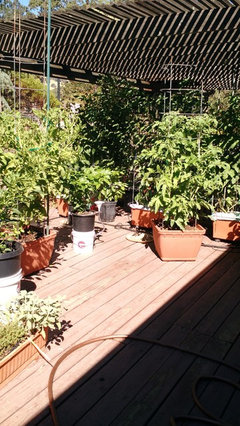
Boris Zakharin
Original Author9 years agoDoes anyone remember (or can suggest) how much lime was recommended here for 5-gal container? Also, should I fertilize a 20-gal container the same way as a 5-gal? If I need more fertilizer then how much more? Thanks.
- 9 years ago
The lime is added to the soil ingredients as you mix them up. It is intended to neutralize the acidity of the peat in the 5-1-1 mix. You don't need much - just a few tablespoons per batch. If you use a prepared bagged potting soil mix, it will already be adjusted for the pH. If you use a good fertilizer with necessary trace elements, then adding lime is unnecessary unless you are making up your own soil mix.
If you use a water soluble fertilizer - something like Miracle Gro or one of the Dyna Gro products - then you dilute it according to the label instructions to half strength and then use this liquid to water your containerized plants. No need to be concerned about adding less/more fertilizer by pot size - you just water the plant throughly until the water runs freely out the drain holes. Do this weekly. If you want to bump things up a bit, dilute the fert to 1/3 or 1/4 strength and use with every watering.
If you use a CRF or a granular, just follow the label directions for the size of the container.
Boris Zakharin
Original Author9 years agolast modified: 9 years agoUpdate: I planted four plants, one in a 20 gal bag, the others in 5 gal bags. I fertilized as recommended, 2 doses of osmocote, one at the beginning and another 6 weeks later, except one of the 5 gal bags in which I used my remainig Jobe's sticks from last year, 3 added monthly. I also began using MG water soluble tomato fertilizer at 1 tsp weekly at 6 weeks after planting. The plants are a lot taller than I expected, especially the one in the 20 gal bag which is a monster, literally over my head.
I had a lot of blossoms dropping early, presumably because of the aphids (see my other post). Still happening, but seemingly not as much. I do have fruits on all plants in various stages of growth (none ripe yet), anywhere between 11 and 18 so far with new ones every few days. I know that's not a lot, but much better than last year. Interestingly the most fruit are not on the plant in the 20 gal bag, but the one where I'm using Jobe's sticks.
Anyway, I think I have a watering problem, even on the one plant in the 20 gal bag, though less than the others. This started happening about 2 days before I saw my first fruit (june 26) On days I have to go out to work, I water before leaving (around 7 AM) and by the time I'm home (around 7 PM) the plants are wilting. I water them again and they're fine in an hour or so. In addition, once a week I have to leave them unwatered for 24 hours. This past week they wilted pretty badly after that. The problem is that water starts coming out of the bottom (or more precisely from the sides) very quickly when I water the 5-gal bags. I'm talking less than the 1/2 gallon it took when I first planted.
Is there an affordable way to get more water onto them? Irrigation system of some sort? I am also planning to be out of town for a week, in about 3 weeks, so hopefully it could be robust enough for that too (I can probably get someone to water the plants, but not twice a day).
- 9 years ago
Drip irrigation on a hose timer would be ideal but "affordable" means different things to different people. It might be a good investment and make your life easier in general in future, not just for when you go away. If you do the labor yourself, which you probably want to do, since it's not a permanent system but something you want to be able to put away at the end of the season, move around if you move your plants around, etc., it can be reasonable, AFAIK.
- 9 years agolast modified: 9 years ago
I got Orbit Single Outlet Programmable Hose Faucet Timer, for the timer, but got the tubing and emitters at the local Ace. I think something you can make specific for your needs is better than a kit.
- 9 years ago
Not sure about the tape, but for the hose timer, I'd go a little more upscale than that. Cheap timers can be leaky, hard to program, break easily, etc. I wouldn't buy something that cheap for which there are no reviews at all. I see that items that look like the same manufacturer but with different branding get lots of complaints about leakage, incompatibility, etc.
- 9 years ago
Boris, maybe you should start a thread on the irrigation forum? http://forums2.gardenweb.com/forums/water
I'm sure people there can give more concrete advice about setup, the minimum quality of the equipment you should buy, etc. - 9 years ago
For top watering, having too many holes is not that good, as you have noticed. Containers get pretty hot in the sun and a full plant loses massive amounts of water by evaporation. Try to prune unneeded stems or leaves to reduce water needs.
Self irrigating pots for next year (like earthboxes, or home made stuff), or a drip irrigation should improve things lots.
- 9 years ago
fungus: For top watering, having too many holes is not that good, as you have noticed. Containers get pretty hot in the sun and a full plant loses massive amounts of water by evaporation.
The number of holes, unless it's really extreme so that soil is falling out, is largely irrelevant. It's about the moisture holding capacity of the mix.
As for drainage holes, more problems are caused by inadequate drainage holes than extra ones, whatever the latter would actually look like. You don't want water pooling in the bottom of your pot and not draining freely. And if your mix is appropriately well-draining, 2 holes vs. 8 holes won't make a difference--the water will drain out just as well either way.
If evaporation is making it hard to keep plants watered adequately, the problem is usually that the containers are too small for the plants you want to grow, so the better solution for next year is to use larger containers and mulch the tops generously. The drainage holes will make little difference.
Although I do agree that drip irrigation will help because it makes watering easier and less time-consuming. Boris Zakharin
Original Author9 years agoI think it's been established that my containers are too small, so I'm working around that obstacle as much as I can. I asked my question on the irrigation board as recommended and have yet to receive an answer. Luckily we've been getting enough rain lately that my watering problems are temporarily solved.
- 9 years ago
Maybe start a new thread on here with just your question about the irrigation equipment you want to buy? I'm sure there are many on the tomato forum that will have experience with different levels of products.
Boris Zakharin
Original Author9 years ago@nanelle_gw, thanks. I'll hopefully be buying the kit locally Sunday.
I have a general question. As you know, I'm experimenting with different setups this year, including a 20 gallon grow bag (instead of 5 gal for the other three). I thought this one would be no brainer in terms of more fruit, but no. The plant itself is much bigger and bushier than the others, but has the fewest fruit. I gave it (and still do) the same amount of fertilizer as the others (both Osmocote at the start and water soluble weekly), and double to triple the water. The first few fruit are larger than on the other plants, but the rest are about the same.
Instead, the largest amount of fruit by far is on a single plant in a 5 gal bag, more than twice as much as the 20 gal one and more than 1.5 as much as the others. It has two to three fruit on almost every truss that has fruit, and I've just got a new one with five. The others are giving me mostly one per truss with some twos.
So what's the difference? My first guess is sunlight, as the 20 gal plant gets about 8 hours, the one with all the fruit gets 11, while the others are 9 or so. My second guess is fertilizer. I am giving the plant with all the fruit three Jobes fertilizer spikes each month from the leftovers from last year instead of the Osmocote for the others. My final guess is the pot. The big producer is SmartPot brand made of much softer fabric. I occasionally see some roots poking out of that one the sides slightly, and it somehow can take more watering before any comes out the side or bottom. The others are all "grow bags" made of a thicker material.
It can't be the aphids. The biggest producer was the second hardest hit by the infestation. The hardest hit actually converted most of its dwindling flower supply to fruit, albeit the smallest fruit of the lot. The 20-gal one was the least hit by the aphids. Anyway, they are mostly gone from all my plants.
There is a caveat. The 20 gallon plant is seeing a flowering explosion right now, to a much greater extent than the rest. Will that translate to more fruit in the long run? I hope so.
Any thoughts?
Thanks
Boris Zakharin
Original Author9 years agoAll Rutgers bought at the same time in the same seedling pod thing
- 9 years ago
I would guess that 2 things are at work. First, I think you're right about the sun. A few hours of extra sun can make a big difference.
Second, a plant with a bigger pot can spend more time developing a big root system. This can mean delayed fruit or fewer early fruit but more fruit overall over the course of a growing season. Smaller pots will cause more stress, and stressed plants try to fruit quickly in order to reproduce before death.
It will be interesting to compare the total yield and fruit quality at the end of the season. Ideally, for a good comparison, though, both the large pot and the smaller pot would have the same sun and fertilizer to really figure out the effect of pot size. Boris Zakharin
Original Author9 years agoThe big pot started flowering at the same time as the others and kept up with them for the first month of flowering on both the number of flowers and developing fruit. At the time the currently best producing pot overtook the big pot, both in the number of flowers and the number of fruit, they had 40+ flowers and ~5 developing fruit each. Is blossom drop normal when a plant is developing a root system?
If I want to compare with more similar sunlight (as I said, 8 vs 9 hrs) and fertilizer, then one of those overtook the big pot in number of fruit only a week ago, but pretty rapidly. It might be a random fluctuation. The other one had the most severe aphid issues, and was lagging well behind, and still is in terms of number of flowers, but is just now surpassing it in the number of fruit.
- 9 years agolast modified: 9 years ago
There's also individual variation between plants of the same variety. Genetics are not identical--just stable for the traits of the variety. The way 2 German shepherds will meet the breed standard but not be clones of one another at all.
For example, I have 2 Earl of Edgecombe plants in similar sized containers right next to one another, getting fed and watered the same. One is very branchy/bushy and has twice the fruit set of the other. But it had early BER, has smaller fruits, and is slower to produce ripe fruit. The other is more tree-like in habit with a clear main stem, has fewer fruit, but average fruit size is larger, and it's ripening earlier. Both have the same foliage, though, and fruit characteristics are very similar.
It's hard to draw solid conclusions from small sample sizes. You'd have to grow out a bunch of plants in identical conditions except for the variable you're testing. Or, if you wanted to do a very small sample size, you could probably take suckers of the same plant and root those and grow those to compare. But you'd have to account for the time difference/maturity difference of the suckers.
Boris Zakharin
Original Author9 years ago20 on the 20 gal one, 43 on the one I've been talking about, and 23 and 31 on the other two
- 9 years ago
It sounds like the one with 43 might just be a good specimen. I would bag some blossoms and save seed if this is one of the OP Rutgers strains.
Boris Zakharin
Original Author9 years agoI do't think the label said whether it was OP and I've never really saved seeds before or planned to, so didn't try to find out.
- 9 years ago
Labels almost always specify when something is a hybrid. They don't often specify when the seeds are open-pollinated.
Boris Zakharin
Original Author9 years agoI just counted 15 new fruit on the 20 gallon plant that weren't there 48 hours ago. This singlehandedly puts it in second place in the number of fruit. And those are just the ones I can see. It's really a jungle by now. So maybe the tide is turning.
Boris Zakharin
Original Author9 years agoThanks to everyone's help, I am actually getting a harvest this year. Here's the first week's worth (minus two that we ate)
The color in the picture is a bit off. They are all redder than they appear. The green looking one is actually yellow orange. The ones in the corners are bright orange. The rest are quite red.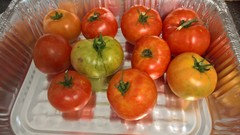




digdirt2