Software
Houzz Logo Print
bwernicki

Soil Savvy Results

I know this testing source is new but I already purchased the test kit.

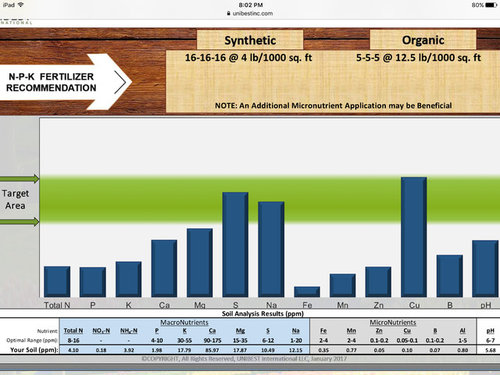
I'm assuming starter fert and some dolomitic lime should get me on track... results below.


Appreciate any feedback...

Comments (16)

  • 9 years ago

    You need iron as well

  • 9 years ago

    It indicates you are low on phosphorus and potassium and is recommending a balanced fertilizer (NPK numbers the same). Starter fertilizer will not give you much potassium. Their rate will deliver about 0.6 lb/K of each nutrient (nitrogen, phosphorus, potassium). The usual target is 1 lb/K for an application. Different grasses have different yearly nitrogen needs and the fertilization schedule is different for warm season and cool season grasses. The pH indicates lime is needed. There is no lime recommendation in the report? I would look for a fast-acting calcitic lime and follow the instructions on the bag. Often they will say if your pH is such and such, use such and such amount per 1000 square feet.

  • 9 years ago

    Any thoughts on ironite, looks to contain 8% Calcium too?

  • 9 years ago

    Ironite, I am reading, can acidify soil and you need to raise the pH, not lower it. Do some reading on Milorganite. Here's something from Milorganite about their iron. Milorganite would supply nitrogen and phosphorus if you use that as your fertilizer source but you would need potassium from another source. There is SOP, sulfate of potassium, 0-0-50, if you can find it at a feed store. Or you could use a balanced synthetic fertilizer alternatively with Milorganite, getting potassium when you use the balanced synthetic and iron when you use Milorganite. There are also foliar sprays that supply iron.

  • 9 years ago
    last modified: 9 years ago

    Becky,

    Click on their sample test image at bottom of this link and read about pH, specifically: *UNIBEST pH values are...

    https://unibestinc.com/industries/lawn-garden.html

  • 9 years ago

    So the pH value from this test is about 0.5 lower than it would be from a standard test. So, Red, your pH might be, probably is, around 6.2, which is a good pH to have. Which means no lime needed. All in all, a pretty untrustworthy soil test.

  • 9 years ago
    last modified: 9 years ago

    So... Knowing I already had the soil test purchased, thus the results above, and with "untrustworthy results". Any ideas which lab I should lean on? I'm local to Pennsylvania, any throughts/history with PSU's extension?

    http://extension.psu.edu/plants/gardening/fact-sheets/general-gardening/dont-guess-soil-test

    http://agsci.psu.edu/aasl/soil-testing/soil-fertility-testing/handbooks/turf/forms/sample-soil-test-report-for-home-lawn-maintain

    Or go somewhere else?

  • 9 years ago

    If they know their pH comes out low, why not just add 0.5 to the value on the report and give people a more accurate number?

  • 9 years ago

    I don't think you need another test now but I would use PSU or some other lab next year (and then stick with that lab). Your pH is somewhere between 5.7 and 6.2, probably close to 6.2. Even if it were 5.7, it's not a lime emergency. It would be advisable to add lime (and most labs would tell you how much to add) if it were 5.7. Adding lime at 6.2 is unnecessary. You don't want it to go too high (over 7.0). But if you were to add some lime at 6.2 and it went up some, that would be okay, just as long as it doesn't go too high. For this year, I would skip the lime. I have no idea how reliable the other numbers are but more than likely you need phosphorus and potassium so just keep that in mind when picking your fertilizer for this year. You can test next year and see how things stand. A bit of iron would be helpful too. Make sure the lab next year gives you a CEC number, does a buffer pH test, gives recommendations as part of the test. The CEC number will let you know how well your soil holds onto nutrients. If it is low you might want to do smaller amounts more frequently.

  • 9 years ago
    last modified: 9 years ago

    If they know their pH comes out low, why not just add 0.5 to the value on the report and give people a more accurate number?

    They know it's going to be low, they just don't know how much lower. Their technical quantifying-qualifying term is "about."

  • 9 years ago

    Ridge, why so upset? There isn't too much readily available material out there besides books (which ones to buy?), and not knowing where to start the LCN has been a good source of info on the web for beginners.

    Lets be honest, Logan Labs is pushed here by many and until 3 weeks ago you didn't mind it either (maybe didn't prefer it, but accepted it). I've offered to submit new tests from my cooperative extension and again, no feedback from anyone on the quality of testing there...but rather everyone bashes UniBest for having low pH values. I already bought the test kit and figured I'd get my $24 worth. If nothing else, I'd know the pH! (ha, that was a joke...)

    Without offering feedback, info, etc on which labs/testing are key and why, folks will never know where to go. I'm personally willing to do my research, already bought a few books, and pulling all the advice between yourself, Becky, and Morpheus from past posts to develop my own methods and calculations.

    Seems the LCN or myself has offended you, and if I have I apologize. I'll continue to do my research and watch/read all that I can to gain knowledge.

    Keep on chuggin' - Skip

  • 9 years ago

    You really are interested in the soil. Go on and get the test from Penn State. I looked and it's only $9.. The state universities probably are using extractants that work best with their state's soils. Why not use them? It will be interesting to see what Penn State recommends.

  • 9 years ago

    Yes, I was wondering why they recommend 0.6 lb/k for a nutrient per feeding. And also what a 5-5-5 organic feeding might be. Skip, you might be interested in reading about the various cycles in the soil: the phosphorus cycle, the nitrogen cycle, the carbon cycle, the sulfur cycle. And the cycle of soil life and all the bacteria, fungi, and soil critters. Fascinating stuff. If you're interested in soil, start there. Soil tests are just measurements but labs test and interpret their findings differently. Some labs use a certain extractant and others use another and the same sample of soil would give different results depending on which extractant was used.

  • 9 years ago
    last modified: 9 years ago

    @ridgerunner

    Would you mind posting, or sending me via PM your formulas for lime and other nutrient calculations, I'd like to put together a web page where people can just plug in their numbers off whatever soil test and get some recommendations. It probably wouldn't be quite as precise as a human being looking at it, but I think we could get it 90% of the way there. And like you said, it's more like horseshoes than darts.

    Edit: I'll make it open source of anyone wants to contribute :-)

  • 9 years ago

    Becky,

    Yes, I was wondering why they recommend 0.6 lb/k for a nutrient per feeding.

    I'm not so sure that the 0.6# of triple 16 is intended to be for multiple feedings. If you crunch the numbers (I did at one time when Soil Savvy was first brought up here), I think you'll find that the addition of that quantity of T16 will bring the ppm of NPK into their "target" area.

    j4c11,

    I don't use formulas for lime. I try to promote people getting a buffer pH test and use the corresponding Lime Recommendations Chart for the particular test used. IMO, it's just foolish to try to guesstimate with some type of calculated estimate, when you can use a recommendation based on actual tested acidity and charts that have been developed from years of research and adjustment. You already have (lime) and the other formulas if you copied yardtractor's post from a number of months ago, but if people use a reputable lab that provides recommendations (already computed on those simple formulas) for NPK, folks will already have what they need.

    Skip,

    For the record I'm not dismissing the usefulness of saturated paste testing or even the H#A (although I don't think H3A is ready yet and may never be useful for long term soil amending).

    Here are a couple of links that you can read to get a feel for the Haney H3A testing (if that is even what Savvy is doing):

    http://www.extension.umn.edu/agriculture/soils/soil-properties/haney-soil-test/

    http://landresources.montana.edu/soilfertility/documents/PDF/reports/NutDigSu2015.pdf

    http://www.agvise.com/wp-content/uploads/2017/01/Bob-Deutsch-Soil-Health-Haney-test.pdf

    Scroll down to pg 29 on the next one to see the recommended procedure and compare that to Savvy: "put it in the jar with the extractant and mail it, we'll analyze it when it gets here in a couple of days."

    https://www.nrcs.usda.gov/Internet/FSE_DOCUMENTS/nrcs144p2_043902.pdf

    Once again, sorry if you felt I was abusive.