Software
Houzz Logo Print
paytonbaldridge

possible foundation issues

9 years ago
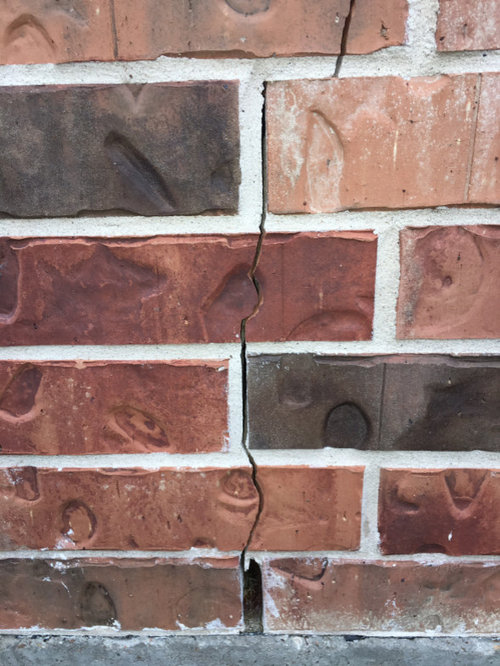
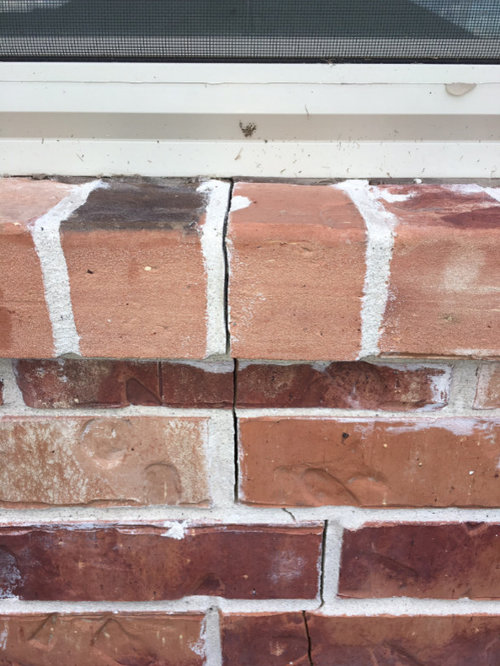
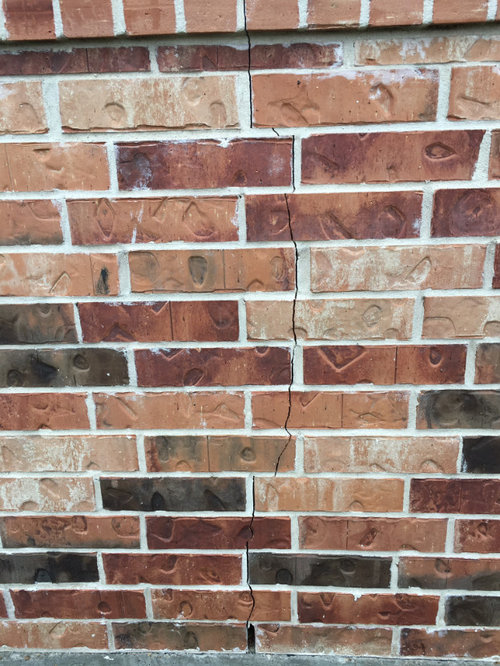
We recently had a new home built and are seeing rather large cracks in the brickwork. I realize small cracks are to be expected but these seem to be larger than what should be acceptable. I'd like to get some knowledgeable feedback before approaching the builders or scheduling a foundation inspection. The builder was less than helpful during the 1yr of warranty on the home and we are now entering the 3rd year. Pics of the crack are in this link:

https://drive.google.com/drive/folders/0B2cI1VgKAcB-ellPZ2hMSnZxakU?usp=sharing


Comments (14)

  • 9 years ago
    last modified: 9 years ago

    And include the foundation in the picture.

    Often, masons don't bother with vertical expansion joints in veneer brick walls despite the recommendations of the Brick Industry Association. Yet they are routine practice in every run of the mill commercial project. See: http://www.gobrick.com/Portals/25/docs/Technical%20Notes/TN18A.pdf

  • PRO
    9 years ago

    Is your wall a thin brick veneer over sheathing and stud walls; a full brick veneer on sheathing and stud walls; load-bearing concrete block with brick veneer; or something else?

    Look at your concrete foundation walls if you can see them, or reasonably excavate beneath the line of cracking...what do you see?

    The vertical crack in the brick appears to terminate at a weep hole on top of the concrete stem wall or slab. Do you live in an area with severe winter freeze, thaw and heave conditions, where moisture is getting behind the brick, freezing and expanding?

  • 9 years ago
    last modified: 9 years ago

    I'm not sure of the exact height of the entire wall, but it's a two story. The crack goes from where the very bottom of the brick in what I assume is a weep hole, and travels up to the base of the kitchen window frame. There is no crack above the window frame.

    Virgil, I'm not sure about the composition of the walls, that is mostly foreign language to me :) But I will look closer and let you know what I see. As for the weather, this is in South Texas and we rarely see anything below 40deg.

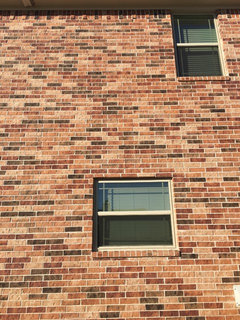
    Thanks for all the responses! I will take a bigger picture of the entire wall and post as soon as I get home this evening.

  • PRO
    9 years ago

    Which direction does the wall face; north, east, south, or west?

  • PRO
    9 years ago

    paytonbaldridge, I live in the Texas Hill Country and our area is full of clay soils which are highly expansive. When the rains come the clay absorbs the water and expands (heaves). When the extended dry spells come, the clay shrinks and contracts. Many folks believe it's important to keep the soil water saturation constant around the foundations and use drip irrigation hoses for the purpose. I don't have any direct experience with this approach, but it may give you something to inquire about in your area.

  • 9 years ago

    Mark, the wall faces South.


    Virgil, I've heard many cases of how bad the soil is here for foundations. That was the reason for my fear that this cracking was more than it should be and that the builder did not take proper precautions to account for the clay heavy soils here. Thanks for your input!

  • PRO
    9 years ago

    Paytonbaldrige, that's why I suggested you looking at your foundations to see if they show evidence of movement and/or cracking. Even if they are intact, it's still possible that they are moving, but not deteriorating, sufficient to crack what appears to be brick veneer.

    Have you considered contacting a structural engineer?

  • 9 years ago
    last modified: 9 years ago

    Usually bricks are stronger than their mortar joints therefore foundation settlement usually causes diagonal stepped cracks in the mortar. Vertical cracks are usually due to shrinkage, thermal movement or too much restraint of the bricks near a corner.

    I'm going to guess these aren't full-sized bricks in a cavity wall system but are attached to a substrate that does not allow the bricks to move or expand when heated by the sun. If that is the case, your foundation might be fine.

    Its odd that there are weeps but no thru-wall flashing.

  • PRO
    9 years ago

    Hmmm, I didn't think about thin brick.

    My guess is that it was the sun, in the kitchen, with the lack of expansion joints. What do you think Professor Plum?

  • PRO
    9 years ago

    Yes, it's a rather odd crack condition, being mostly vertical. It's difficult to tell if the wall is brick veneer or not. The brick sill coursing appears to be cut-down full brick, but there doesn't appear to be any flashing between the top of the sill course and the bottom of the window sill trim, possibly letting water penetrate behind the brick wall material...I dunno...mebbe Mr. Mustard did it!

  • 9 years ago

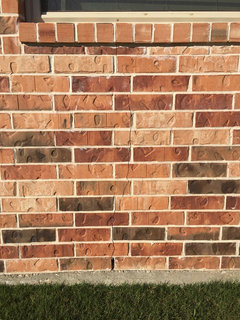
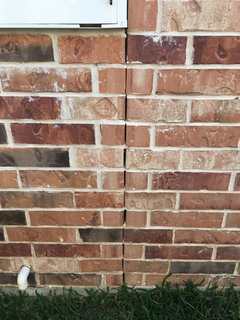
    Thanks for the responses, you guys are awesome. I'm including a few more requested pics that may help. There are two seams, one on either side of the house, not sure if those are expansion joints or not? The side that has the crack is facing a road with no house directly next to it and does receive a considerable amount of sunlight in the evening. Virgil, I am considering having a foundation inspection done which I assume is done by a structural engineer? Although I don't see any visible cracks in the foundation, the back patio door has to be jerked upwards hard to close. It's a total amateur guess, but I worried that may be due to settling issues.


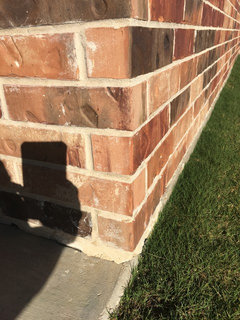
    Thought this corner shot may help determine the type of veneer.


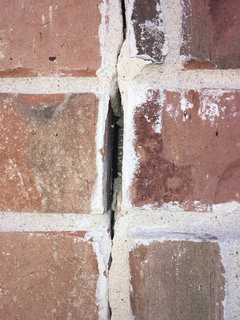
    This is one of the seams that are on either side of the house running from bottom to top.

    Thanks for all the great input!!

  • 9 years ago

    The last photo looks like a control joint that never got filled with sealant. A CJ allows a brick panel to move without cracking.

  • 9 years ago
    last modified: 9 years ago

    Your close-up photo appears to confirm a typical 1 3/4" thick brick veneer as suggested by JDS.