Software
Houzz Logo Print
hoganjr

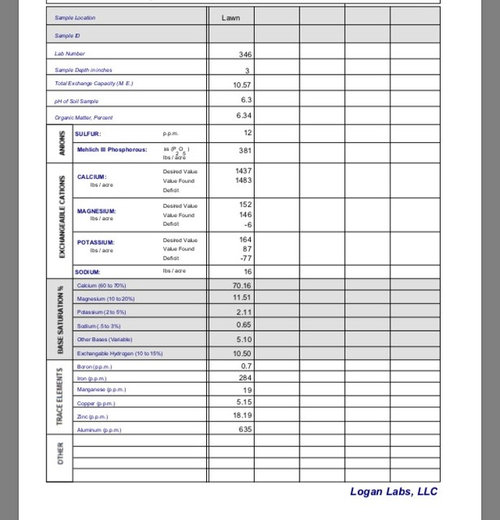
Soil test results Help Morph

9 years ago
Thanks in advance!!!

Comments (22)

  • 9 years ago

    Morph doesn't live here anymore.

  • 9 years ago

    No one has taken this on. The only thing besides nitrogen that you need is 1 lb/k of potassium. You can get that with a fertilizer that has N and K but no P (you should avoid P). Do you know how to calculate how much of a nutrient you're getting from a fertilizer? How much nitrogen to use and when depends on what kind of grass you're growing.

  • 9 years ago

    Thank you! How often do I apply potassium? Can I apply just the K without Nitrogen? I rather not apply N right now because I think I have a fungus issue right now.

    I have a mixed lawn mostly TTTF.

    The ph is ok?

    thank you

  • 9 years ago
    last modified: 9 years ago

    Don't disagree with becky's rec. Base saturation % is on the low end and should be bumped, just wondering if she noticed that the sample depth is 3".

  • 9 years ago
    last modified: 9 years ago

    You can find sulfate of potash and muriate of potash. Muriate is KCl 0-0-60; easier to find, cheaper but has a high salt index. Sulfate of potash is 0-0-50 and much better for your lawn but double the cost and harder to source. Both are easy to spread.

    I myself use KCl, at 2lb/1000 sqft just before it rains.

  • 9 years ago

    Ridgerunner, yes, I noticed the 3 inch depth which means that the lb/ac here are the same as ppm. I subtracted 87 from 110 to get a deficit of 23 ppm, which translated to lb/ac (6 inches worth) is 46 lb/ac, which is 1.06 lb/K. That was my process. I ignored BCSR. Thoughts?

  • 9 years ago

    Nope. :) Just wondered if the rec was based on SLAN, BCSR or a compromise.

    Just an FMI, Carry on. :)

    hoganjr,

    With a current fungal issue, use MOP only as a last resort, avoid the additional stress to the turf.

  • 9 years ago

    Hoganjr, if you have trouble finding those products, you could wait until early September to apply a fertilizer with N and K, which ought to be available most places. Suppose you got 24-0-11. Divide 24 (the highest number in the formulation) into 100. Answer is 4 (close enough). So your application rate would be 4 lb/K and that would get you one lb/K of N. That 4 lb of product will also give you 0.44 lb/K of K (11% of 4). So you'd need to do another application to get more K, which would get you fairly close to one lb. altogether. Early September and October applications would do it. Ideally you'd use a fertilizer that was equal in N and K with no P, but you use what you can find.

  • 9 years ago

    I agree with Ridgerunner. If you have fungus now, wait until later.

  • 9 years ago

    Wow that's great! And you explained everything so thoroughly.

    Two more questions......

    is 3" for a soil test too shallow?

    and does anyone use biofungicides? I use Serenade and just bought Companion. The label is very vague on directions for lawns. Trying to find out oz./1000 sqft.

    thanks again

  • 9 years ago

    Here are Ridgerunner's recommendations on soil testing. The reason Ridgerunner and I were discussing depth had to do with converting lb/ac to ppm (parts per million). Logan reports lb/ac for the reported depth. It would vary according to what depth was reported.

    Here is a label for Companion. It says 4 fluid oz (8 tablespoons) treats 1000 square feet. Good luck with the Serenade and Companion. I put cracked corn down in April to try to ward off brown patch. Have you identified your fungus?

    hoganjr thanked beckyinrichmond
  • 9 years ago

    I have updated and refined that a bit (took out extraneous commentary and needless asides):

    These are the labs and the sampling procedure I suggest people might want to use:

    IMO, for a person who knows what they are doing, probably the best
    lab is Brookside Analytics. they have one of the best battery and
    selection of tests available, but you MUST know what you need to ask for
    and able to do your own analysis.

    There are a number of alternatives by region. e.g. A&L Eastern located in Virginia or the
    Carolinas for the S. E. and N.E. Another choice for the N.E. is Agro-One
    which is associated with Cornell (http://dairyone.com/wp-content/uploads/2014/01/Form-T.pdf).
    Spectrum
    is used by a large number of farmers in the Eastern U.S and Mid West
    (but their default is a buffer pH calculation for lime, not a buffer pH
    TEST, so make sure you request an additional buffer pH TEST when sending
    the sample to them), but any lab that does Mehlich III is good for
    Midwest soil testing.
    West of the Mississippi, I'd say probably A&L Western located in
    Cal. or Oregon. Last I checked they all offer recommendations, but verify that a buffer pH TEST (Not a calculation) and results are included (or at least is available at a reasonable cost) in the report before you order.

    Proper and consistent soil sampling is a must in order to reduce inconsistencies and get the most accurate results possible.

    Proper: When digging the samples, use only high quality steel
    tools. Use only plastic buckets for holding and mixing the samples.
    Avoid brass, galvanized or other zinc coated utensils. Otherwise, the
    sample can be contaminated. If you do not have a soil sampling tool
    (auger or
    probe), insure that your soil sample is an even thickness vertical slice
    and not a wedge shaped slice. Take 8 samples, evenly
    dispersed, from each 60 x 60' area. Try not to sample any sooner than 30
    -60 days after an amendment application.

    Consistent: Take all samples to the same depth (4" for turf)
    and do so each year of testing. Use the same "range" of soil for each
    sample and from year to year. e.g. soil from the 0" depth down to the 4"
    depth (preferred, but remove the soil surface and any fertilizer
    prills it may contain). or from 1"-4", or the 2" to 4" depth, etc. if so suggested. Stay
    consistent. Take the samples in the same
    month each year.

    Use the same lab each year. Use an established professional or
    university lab that offers a broad menu of testing processes, reports
    results in ppm or lbs/acre and at a minimum, reports CEC/TEC, Ca, Mg, P,
    S, K, Na, OM, Mn, Zn and Cu. Verify that they offer ammonium acetate
    cation and buffer pH testing and that their fees are reasonable. Verify
    if they use Mehlich III (unless otherwise recommended) as their default extractant and extra points if
    they offer Bray and Olsen too.

    Do the vinegar test on a small sample. If it fizzes, request that an
    ammonium acetate test be performed. If it doesn't fizz, either ask for
    or be prepared to request that (if the test comes back with a soil pH
    less than 6) a buffer pH test be done.

  • 9 years ago

    Thank you both! @Becky.... I also did an app of cracked corn about 3-4 weeks ago.

    Everything was great til about a week ago we got too much rain. A few days later I noticed patches of brown blades.

    I battle brown patch every year. The Serenade really helped last year. This year I guess I was a little late.

    This time I want to add Companion to the mix. I may have to use a chemical if it gets worse.

    @RR.... thanks for all that info. I have a soil probe. I took samples before I did any amendments.


  • 9 years ago

    I have a correction. I calculated the shortage of K but didn't calculate the shortage of K2O which is what the K in NPK actually is (Ridgerunner, you should have reminded me!). 1.06 x 1.2= 1.27. So you are aiming to get 1.27 lb K when you go fertilizer shopping. From the example of the 24-0-11, it would take three applications of that fertilizer instead of two. It might be good for you to look around and see what potassium sources are available to you. If you used SOP (0-0-50) or KMag/Sul-Po-Mag, you could then do the nitrogen feeding in the fall however you like. Or maybe you'd find a NPK fertilizer with a higher K number where you could just do two applications. Try to avoid P. You already have a high number.

  • 9 years ago

    Thank you Becky..... so if I found 0-0-50 I can apply now? And that would be 1.25 lbs/1000? And I would apply just once now?

    My lawn is only 2k sqft so I could buy the 0-0-50 in smaller quantities and maybe easier to find online

  • 9 years ago

    To supply 1.25 lb of K (actually K20) you would use 2.5 lb of 0-0-50 (the 50 there means 50% of what is in the bag is K). I would split it into two applications. In general you don't want to apply more than one pound of a particular nutrient in any application. So you could do 1.25 lb/k now and 1.25 lb/k later. It may be difficult to spread a such small amount of product evenly. In general people spreading SOP are trying to get 1 lb of K and they use 2 lb/k of SOP. You could do two applications at 2 lb/k and it would end up giving you 2 lb/k of K instead of 1.25. It won't hurt anything. In fact, if I had used BCSR instead of SLAN, the recommendation would have worked out for more than 3 lb/k (77 lb/ac, what Logan shows as a deficit, is a bit under 2 lb/k and multiplying by 2 to treat 6 inches instead of 3 inches would put it somewhere between 3 and 4 lb--don't have a calculator handy and too lazy to get out pen and paper). I did that with another soil test and I fear it was just confusing, so with yours I went with just the more conservative method. For a 2k lawn you don't need a 50 lb bag. But be careful ordering online as there are powders in a 0-0-50 formulation and you're looking for a granular product that you can put in a spreader. As for when you apply, you can do it now if you like. It's not the danger for brown patch that nitrogen would be, but it is a salt (though not high in the salt index) and if your grass is stressed, might be better to wait. Your call. Do it in two applications.

    hoganjr thanked beckyinrichmond
  • 9 years ago
    last modified: 9 years ago

    Ridgerunner, you should have reminded me!

    Lol. You were still well within the blast zone. It's all hand grenades anyway donchyano.

    the 50 there means 50% of what is in the bag is K

    Actually, the 50 in 0-0-50 is K2O. :)

    http://lghttp.17653.nexcesscdn.net/808B16/cdn_images/media/catalog/product/cache/1/thumbnail/9df78eab33525d08d6e5fb8d27136e95/f/2/f2260.jpg

  • 9 years ago

    I ended up finding 0-0-22 Kmag. I came up with about 4.5 Lbs/1k. I was going to do 1/2 now( 2.25 Lbs/1k) and 1/2 next month.

    Going to be really hot here next few days. High 90s so I may wait til heat breaks . I assume it needs to be watered in good.

    thanks

  • 9 years ago

    4.5 lb/k will give you 1 lb of K2O (22% of 4.5= 1). To get 1.25 lb, you need 5.6 lb of KMag. Divided into two applications, that's 2.8 lb/k for each application. You might as well do 3 lb/k for each application. Water it in.

  • 9 years ago

    Ok thanks......last question, after I apply the entire 5.6 Lbs. that's it? Just do another soil test next year?

  • 9 years ago

    Yes.

Sponsored
Peabody Landscape Group
Average rating: 3.5 out of 5 stars8 Reviews
Columbus' Reliable Landscape Design & Contracting