Software
Houzz Logo Print
chavaleh7a

RRV, roundup, other?!

9 years ago
last modified: 9 years ago
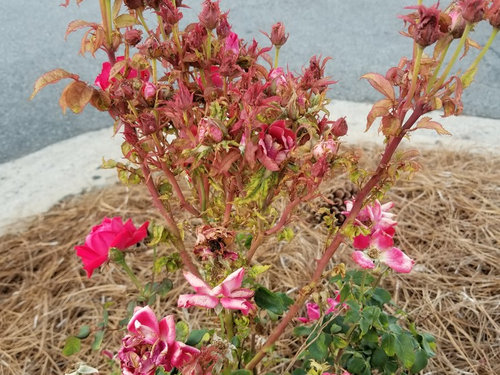
There's a bed of very weird growth on knockout roses down a major road close to me. I can't get out of the car and take a picture due to where they are but I've emailed the county extension office and the local business group about them. Haven't heard back yet but will get on the phone Monday. This morning I found these plants at the local Costco right off the same road. Do I need to go in and talk to a manager?

I'm in the Atlanta Georgia metro area.


Comments (23)

  • 9 years ago
    last modified: 9 years ago
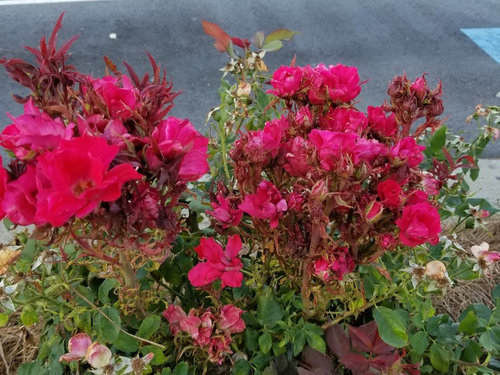
    100% RRD, been there for a while, well infected with RRV, at this point the entire bushes are done for and need to be pulled out and thrown away into trash as the virus has reached all roots of the plant. Yeah would be great if you inform them and would be awesome if they actually follow your advice. The only way we can reduce RRD is by getting rid of all infected plants.

  • 9 years ago

    I hope that I never encounter such a sight in my neighborhood or anywhere within 5 miles radius of my home. That is so awful!

  • 9 years ago

    We went back over to Costco and talked to them. I'm not sure how seriously they took me. I'll also contact a local rose garden since I'm sure they have a vested interest in making sure this gets dealt with as well as some regional gardening groups.

  • 9 years ago

    Definitely RRD and, as Braverichard says, has been there for a while (probably since early last year).

    Please don't be discouraged with the lack of interest - it's all but universal. Do warn local rose gardens (Atlanta Botanic had it over a decade ago.) Maybe somebody with the state cares by now, but ....

    Karen in Pennsylvania. Almost every county in southern Pennsylvania has already had it, keep an eye open.

  • 9 years ago

    Oh my lord, that is hideous. Thank you from all who garden for taking the time to deal with this. They do have rose groups in your area, They should be helpful in getting them removed.

  • 9 years ago

    I posted on a local FB group, wrote the Smith Gilbert Gardens who are not far away, still looking for other people to contact. I'm happy to become the Crazy Lady who doesn't shut up about it though.

  • 9 years ago

    I would not rule out roundup when a large number of plants plus a large number of canes per plant exhibit symptoms (plus being near a road).

  • 9 years ago

    I would like to hope it is roundup damage but these plants that the pictures are of were single or double plantings scattered throughout the parking lot and the roadway that I mentioned earlier is a good ways down a large hill (not immediately beside it). The roses that were impacted on the road are planted in between the lanes on the dividers, there are beds running for miles down the road and the one bed that seemed almost completely overtaken was pretty far down the road from the Costco (maybe a mile?) and there are plants in the various other beds I think may be messed up as well. I can't really get a good look at them because the road is very very busy. It would make sense if it were just the one bed but with it also showing up at the Costco it seems less likely to have been roundup to me. Also different landscaping crews. I really hope I'm wrong.

  • 9 years ago
    last modified: 9 years ago
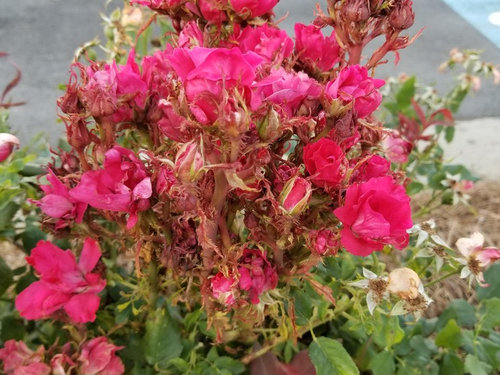
    Henry may have a very valid point. In that these plants may well have been sprayed by road crews. I have to admit that much of the damage appears to be identical. RRV is not uniform in its damage and it seems to be lacking a certain amount of rapid growth. None of the growth shows hyper thorniness or thicker canes coming from thinner ones.

    This would be really interesting to test for the disease.

  • 9 years ago

    However there is still a lot that resembles rrv. Without testing to know positively or without knowing how long they have been sick. All I can say is Henry is correct in that a large planting just does not all get sick at the same time. There are many new herbicides hitting the markets. I'm just throwing out possibilities. Does anyone else wonder how many of these plants got sick at the same time

  • 9 years ago

    I've been keeping my eyes on the ones at Costco (and others around the area) since I heard about RRV and this is the first time I've seen it there. I have no idea about the plantings in the road because they're a lot harder for me to see. They would have had to have been sprayed by two different landscaping groups since the Costco ones are maintained by a third party and the ones on the road I assume are dealt with by the county? I really really hope it's not RRV. I'm not sure who I could convince to test them since I am not getting any responses back from anyone yet.

  • 9 years ago
    last modified: 9 years ago

    I wish I had an answer. You bring up good points. It looks so much like rrv but when Henry weighed in he made since. RRV just does not hit a large spread out planting of roses all at the same time.

  • 9 years ago

    Yeah, I really couldn't say how quickly the bed/s on the road were taken over. All of the plants at the Costco aren't affected, just three or four that I noticed but I didn't carefully look them all over. I really don't know but it worries me greatly.

  • 9 years ago

    Its has to be rrv it is so horrible looking. So hope you continue your efforts.

  • 9 years ago

    I could pretend to be a stable person. ;) That sounds like a good idea. I already posted in our local communities Facebook group which is fairly active and included links for further info and got some response so hopefully that will help.

  • 9 years ago

    Unlike Ohio, Georgia had a mild winter and nothing much got killed. Even in my area, a zone colder, sickly rose canes survived and looked that bad this spring and now, even worse.

    Not all of the canes are sick, BTW, but ones that are sick are much beyond first year problems.

    Henry is really lucky to have seen so little RRV in his area.

    The test for the disease (The PCR test) costs $35 per plant, plant has to be frozen, shipped frozen, and arrive in Oklahoma City frozen, and stay frozen until it gets tested. And then the test will only indicate a positive; if the test doesn't test positive, negative means, negative as tested, and you can't prove a negative, only that the test wasn't positive.


  • 9 years ago

    One thing, Dublinbay, don't use the "Rose Mosaic Virus" wording. That will confuse as there are a number of viruses that cause mosaic patterns.

    Just call it Rose Rosette virus and mention that its was recently identified as an Emaravirus and that the syptoms are complex and that the plants will only get sicker with time and there is no cure.

    chavaleh 7a thanked stillanntn6b
  • 9 years ago

    Good point, stillann. Rose Rosette Virus!

    I was a little more careful on the first draft--why my computer went blip and everything disappeared, I don't know. Second time through, I was typing very fast and didn't stop to proofread. Thank you for doing it for me. : )

    Kate

  • 9 years ago

    I am with Henry Kuska on this one, R/up damage by my eye. things to be concidered are that they appear to be in a public place(car park) I hope I am wrong in saying it is due to council or car park employeees using R/up over years to get rid of weeds and the roses get a dose everytime from drift or direct spray. I would try to contact the authority concerned.

    Regards David.

  • 9 years ago

    David,

    I hope you never see this in Australia. You cannot imagine how heartbreaking it is to have a rose that is resistant to Black Spot....which is a major problem and the reason many in the eastern US had given up on roses....well, a great rose came along at the same time as a lethal, easily spread virus. And the spread isn't to one plant but, given lack of action, more than capable of destroying entire rose beds.
    And for a while all the state agriculture publications said, chorus like, "It doesn't /seldom affects cultivated roses." They didn't know that, they just regurgitated the results of tests on four test plots of roses in a single field in southern Iowa (and at the end of three years only one plot remained, floods and deer haveing destroyed the other three.) And the disease continued to spread throughout the eastern USA.

    If you can access the American Rose Society quarterly , read the article which has Mark Windham as the head author. You will see pictures there of Knockouts with RRv and those have been tested with PCR protocols. They look all most identical to the photos above.

    In your part of the world you might want to read about the Pigeonpea sterility virus, which is in the same virus 'genus' as RRv. Also wheat streak and about emaraviruses in general.

  • 9 years ago

    It's RRD I live around Atlanta and I see this quite often. Entire groups of KOs with horrible RRD symptoms. They still bloom, so the landscapers don't take them out. I have reported roses like this but usually they don't do anything. It's NOT RU damage.

  • 9 years ago

    This makes me so angry, that people do not act when notified their roses have RRD. It hurts all of us with roses. Honestly, if I saw this I would quietly dump some round up at the base of each one to kill them. It would be a public service.