Software
Houzz Logo Print
westes

Good Soil pH Meter?

9 years ago
last modified: 9 years ago

Can someone recommend a good soil pH meter that is accurate to at least 15%? My main requirement is I want something that does not require maintenance or calibration.

I purchased a cheap meter on Amazon, and it is measuring the pH of redwood bark soil at 6.5, when I know the soil is closer to 5 to 5.5. So apparently that meter is junk. My main application for this meter is going to be testing for acidic soils to grow plants like rhododendrons.

Comments (24)

  • 9 years ago

    There simply is no such thing as a "good soil pH meter" that is accurate and does not require maintenance or calibration. Rely on a good soil testing lab for that information.

  • 9 years ago

    Indicator strips/solutions with distilled water will fit the bill. You don't need *that* much accuracy

  • 9 years ago

    Look up "pH paper". You should certainly be able to get decent and economical indications of soil acidity without paying a lab to do it for you.

    Electronic meters won't work properly if you just shove them into the soil.

    15%? pH is logarithmic. You mean like within a pH of 1? That's easy with the pH paper.

  • 9 years ago

    I have not had any fish tanks for some years and I have forgotten but check the range on pH strips in aquarium supplies. toxcrusadr's shake it up and let it settle should be close enough for hobbyists soils.

  • 9 years ago

    Distilled water poured over the soil in a flask, then measured with pH paper, appears to work great! Thanks for that suggestion.

  • 9 years ago

    An easier method that might also work: add water to an already-wet soil container, and have the pH paper ready to catch the first water coming out the bottom of the container. Theoretically, that water was already in the container before you started watering and was pushed out by the new water. That technique gave me similar results to the distilled water method, but I have pH paper on order that will give more precise results in the narrow range of pH where I expect the soil to test.

    If fresh water from a hose is going to do any distortion, it will be in the direction of alkaline, so if I am getting a pH paper reading of 4.5 and I need an acidic soil then - as a worst case - the soil would be even more acidic than the test number suggests. I can live with that. What I am really trying to do is make sure I don't accidentally put an acid-loving plant into an alkaline soil.

  • 9 years ago

    I'm not sure I accept your theory. I suspect the water you pour in the container will mix with the water in the container before much is pushed out. But the water you pour in may, in fact, run down the sides and get pushed out without mixing with anything! I think the correct approach is distilled water poured onto soil (one cup of water per cup of soil), and tested while the soil is immersed in it. Shake to mix. Be sure to take your cup of soil from a range of depths and locations.

    BTW, test your distilled water before you pour it in. You're hoping the pH will be 7 (neutral). Also, use freshly opened distilled water. Distilled water that sits around exposed to air will gradually get acidic by absorption of CO2. If you have a still handy, make it yourself! In principle, you can deacidify distilled water by adding tiny amounts of sodium bicarbonate.

  • 9 years ago
    last modified: 9 years ago

    The litmus papers, pH papers, and the pH meter may give you an indication of what the soil pH is but it will not answer the question of what do I need to do to make any needed corrections. How much lime do I need to add to bring the pH up to where it should be? How much sulfur should I add to lower that pH if necessary? Since it can take 6 months, or more, for any correction to show some results those are not good options.

  • 9 years ago

    Distilled water will indeed absorb a little CO2 from the air and although that will move the pH a bit, it has virtually no buffering power. In other words it is a negligible amount of a weak acid. Once you dump that in with soil, it would be very hard to detect any difference in the final pH vs. using distilled water that has not been in contact with air. Actually we don't really know that a jug of store bought distilled water hasn't been in contact with air enough to absorb CO2. In the labs I worked in, we never worried too much about the distilled water. I think for gardening purposes the error is negligible.

  • 9 years ago

    Fair point about buffering capacity of distilled water. The pH of distilled water would be relevant only if you were using a meter, and trying to get a very accurate result. Of course, if your soil doesn't have a lot of buffering capacity, like sand, it could make a difference.

  • 9 years ago
    last modified: 9 years ago

    >>westes, daninthedirt - Neither the water from the hose or the distilled water will have any measurable buffer capacity so the pH of the water used for a shake , wait and test, will be pretty much irrelevant.

    I don't know about that, if it's hard water with high bicarbonate and sulfate, and the soil being measured is on the acidic side, I wouldn't trust it. I know my tap water is pH 8 and is hard. I don't have a lab right now so I can't test this theory and you might be right, but a jug of distilled costs like a buck or two, and you need it for the steam iron for your shirts anyway, so why not be on the safe side.

  • 9 years ago

    Yes, hard water will certainly bias the soil pH result. I mean, irrigation with hard water will significantly deacidity soil. It's pretty much impossible for me to acidify my soil, because of my water that I irrigate it with. I can keep heaving sulfur onto my soil but as long as I water it with tap water, it ain't going to acidify. In my climate, I do a lot of watering. That's actually a good reason to test your irrigation water as well as your soil. The soil pH very much depends on the pH of the water you irrigate with.

  • 9 years ago

    Just by coincidence, a few days ago I thought about buying a pH testing device identical to that which my locally-owned nursery uses for the free soil pH tests they offer to customers. At the store yesterday, I looked at the device and made a note about it. They use Oakton pH 5 Acorn series, pH and temperature meter. Online prices seemed to run $211 and up. The employees mix the soil and distilled water, insert a glass probe, and wait until the display stabilizes. (A little sign nearby reminds employees to be careful when handling the glass probe.)

  • 9 years ago

    I wonder if they calibrate that thing with some pH buffers now and then. In the lab we'd do it daily or even more often.

  • 9 years ago

    tox, if you are asking about the Oakton device, I was kinda thinking that maybe when I took soil in a couple of weeks ago that she started by measuring the pH of distilled water. If the distilled water tested at a pH of 7, would that be adequate "proof" of proper calibration? At least you would know an acid result is an acid result, and an alkaline result is an alkaline result; you just wouldn't know whether your exact level of acidity or alkalinity was pinpointed accurately?

  • 9 years ago
    last modified: 9 years ago

    One point is not a calibration curve, it actually requires two. Usually one at the lower end of the range and one at the upper end (4 and 9 for example). Otherwise you only know for sure that it's accurate at that one point.

    The other thing is they should be using a pH buffer, which is a mixture of salts that resists changes in pH due to atmospheric CO2, dilution, etc. Water will change a bit as we've discussed.

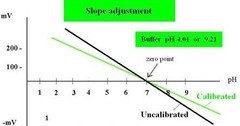
    Long version: Think of a graph of 'actual pH' on the X axis and 'instrument reading' on the Y axis. You want the instrument calibrated so there is a straight line with a 1 to 1 relationship. Now any line has a slope, and the whole line can also be moved up and down vertically. So in order to calibrate, you need 2 adjustments, first to anchor the line on one end and then to determine the slope. You use a buffer at one pH (4) and set the meter to that value with one control. So now you have one end of the line. The other knob is the 'slope', and you use a second buffer (7, 9, whatever) to adjust that. Then it should be accurate within that range.

    But for gardening purposes, anything within a few tenths or even half a pH unit is close enough unless you're doing something very fussy like hydroponics.

  • 9 years ago

    ok just stop. youtube is full of this meter business, so watch a few vids and spare me. The meters are nothing without the liquid standards purchased separately with which to not only calibrate, but also store the hyper sensitive devices. And most of the vids I have seen so far are machines costing 100 bucks and up, a d the packaging kinda gives me the impression they are sort of the serious scientific student version of the technology.

  • 9 years ago

    I think the most economical and trustworthy electronic pH devices are paper pH strips with lots of wires and batteries attached.

  • 9 years ago

    Dr frankenplanter I presume?

  • 9 years ago

    >>ok just stop. youtube is full of this meter business, so watch a few vids and spare me.

    Spare you? You weren't even in this thread. I was answering ella's question about whether one-point calibration with distilled water would give accurate results. Admittedly, I probably overdid the answer.

  • 9 years ago

    Not possible, but I had to interject the youtube as a overlooked source given what I have seen on this important tool.

  • 9 years ago
    last modified: 9 years ago

    Perhaps this would help.


    I'm sorry trickyputt(7b AL) but I cannot find anything you have done on YouTube.

  • 9 years ago

    lol what I was looking at was the instructions on how to maintain and use the machines put up on youtube by the manufacturer.