

More Earthbox Questions - and a sun question
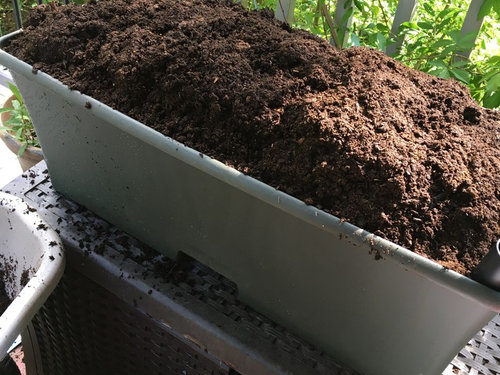
I finally planted half of my Earthboxes last week. Since I've never grown in them before, I have more questions.
- When I fill the box with moist potting mix, do I need to pack it down tight or leave it kind of fluffy?
- What is the purpose of mounding the mix 4-6 inches over the top of the box? Is it imperative to do that? In my other EB thread, Dave mentioned he doesn't mound and doesn't use the plastic cover. If I use the cover, does that mean I must mound?
- I used the ProMix BX, and I still added the lime per the EB instructions. Will that be okay? Or did I mess it up?
- Should I get the casters? They seem pricey at $9 per box. But this whole EB adventure has been pricey. It's turning into the $64,000 tomato project...
- Do I still need to water when it rains? It's been raining for a few days, and when I touch the dirt around the plants, the top is still wet. (I have the covers on right now.) Does that mean I don't need to fill the reservoir? Can I overwater?
Comments (38)
jenswrens
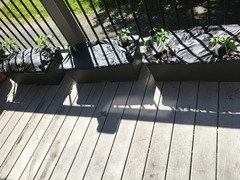
Original Author9 years agolast modified: 9 years agoAnd lastly, a question about location.
I'm planning to keep the
EBs on my deck. The deck faces south. Is it better for them to get
morning sun or afternoon sun? If I keep the boxes along the railing,
they get dappled sun (from the railing) until about 11am. Then they get
full sun until 5 pm. See photos below. If I move them so they are along
the house wall, they will get full sun in the morning, but by 4 pm, the
house shades that area. It is still light, but shaded. Will they even
get enough sun at all on the deck? I can't have them out in the middle,
because we use the deck for other things. Need to have a pathway at
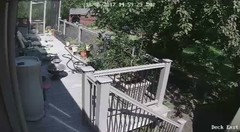
least!This was taken at 10am:
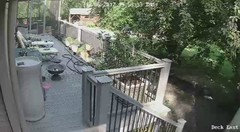
This is the deck at 4 pm:
And finally at 5 pm:
 9 years agolast modified: 9 years ago
Morning light is better, and in your case the railing would be my choice
provided you are reasonably sure they wouldn't be cooked, especially
with the black plastic in the pm. That's is what I'd pay attention to.
If there is a lot of air circulation along the wall I might be
convinced if it were mine for the lower wall temps, but from the pictures that is why I want to be safe at the
railing - air circulation. As for the mound, I am not an EB junky, but I assume the mound is so water will drain, and not puddle the plastic - same as the reason to pitch a roof and maybe to be sure the fertilizer granules are buried well.It is hard to over water in that sort of set up and if the plant is fine there is no reason to insist on topping off continuously the res below --- just be sure it's not going dry. If the soil is wet on top you should be fine as gravity tends to pull water down as well as working roots when they suck the middle dry pull from the surface by the same action too.
They probably have an overflow on it to prevent over-watering.
I would not get the casters as they will make it more unstable. It is probably personal situation - only if you need to move them. By the time they are big and laying on the rails I doubt you will want to move them.
Cheers
PC
jenswrens thanked PupillaCharitesRelated Professionals
Washington Landscape Architects & Landscape Designers · Hartford Landscape Architects & Landscape Designers · Detroit Landscape Architects & Landscape Designers · Oneonta Landscape Architects & Landscape Designers · Denver Landscape Architects & Landscape Designers · Tuscaloosa Landscape Contractors · Palm Bay Landscape Contractors · Lexington Landscape Contractors · Coeur d'Alene Landscape Contractors · Hilo Landscape Contractors · Toronto Landscape Contractors · Carbondale General Contractors · Buffalo General Contractors · Chula Vista General Contractors · Riverside General Contractors 9 years agolast modified: 9 years ago
- When I fill the box with moist potting mix, do I need to pack it down tight or leave it kind of fluffy?
I don't pack it down, but I think I saw a You tube video once, where someone did, and might have mentioned getting capillary flow started.
- What is the purpose of mounding the mix 4-6 inches over the top of the box? Is it imperative to do that? In my other EB thread, Dave mentioned he doesn't mound and doesn't use the plastic cover. If I use the cover, does that mean I must mound?
I think the mound keeps water from pooling on top. It might alos give some more room for roots.
- I used the ProMix BX, and I still added the lime per the EB instructions. Will that be okay? Or did I mess it up?
I use pro-mix with the added lime, and have for many years.
- Should I get the casters? They seem pricey at $9 per box. But this whole EB adventure has been pricey. It's turning into the $64,000 tomato project...
I use the casters, and yes, these tomatoes are an expensive project. They don't roll easily, and not at all when six feet tall, but I do move them from time to time.
- Do I still need to water when it rains? It's been raining for a few days, and when I touch the dirt around the plants, the top is still wet. (I have the covers on right now.) Does that mean I don't need to fill the reservoir? Can I overwater?
You need to water, especially with the covers on, and presumably you can't overwater. I have mine on a drip, and by mid summer i have to fill twice a day, but it seems to depend on your weather, and how big your plants are. You might want to see how much water you have at then end of each day, then decide how closely you need to monitor as the season progresses.
I try to give them dappled shade in the late afternoon, as 95 plus temps, even 100 plus, aren't unusual here in the summer. In this dry heat, shade makes a difference in the ambient temperature around the plants. I don't believe it makes as much difference when there is humidity.
jenswrens thanked nanelle_gw (usda 9/Sunset 14) 9 years ago
Good info from PC and I definitely agree with the rail position.
I have to tell you that much of growing in EB is trial and error. So you will have to learn much as you go. I started out years ago religiously following their instructions but bu year 2 was making several changes. So keep good notes for yourself for next year. As I have mentioned in the other thread there are many things they recommend that I have found don't work for me - the mounding of the soil being one of the big ones - but that doesn't mean they won't work for you.
I also do not use the black plastic covers and find that both they and the soil mounding defeat some of the benefits. Not only does the black plastic overheat the soil vs. conventional mulch, not only is it tacky in appearance and quite flimsy, but the whole point of the fertilizer band is supposedly to feed the plants slowly as it dissolves. It can't do that effectively if there is no rain or other water allowed from above.
And while the plants are young their roots are far too shallow to reach down into the water well as they will later on and the wicking action alone isn't sufficient for just-planted-young-plants. The plastic prevents you from providing them with supplemental water and nutrients.
I notice you also followed their plant placement instructions and I have found that too will cause you problems down the line.
So consider this a BIG learning year and remind yourself as you go along that their guidelines are just that - guidelines - and not cast in stone. Changes/adaptations can be made to their guidelines that can make your experience even more productive in the future.
1. when you fill the box you are supposed to water it well as you go along - soil-water-soil-water-etc. That is true when planting anything in a container. That watering will level and will pack it sufficiently. If you did not do that then you will have dry soil pockets and problems and need to fix that now. You never fill a container with dry mix.
2. mounding is not necessary (and detrimental IMO) but you can still use the cover if you wish by just leveling the soil at the top. It can even be recessed 1/2" or so if you wish.
3. read your labels. ProMIx BX already contains lime - I thought I mentioned that before - so by adding more your pH has been skewed and it is possible that some of the nutrients will now be unavailable to the plants. You will need to watch for nutrient deficiency symptoms and correct as needed.
4. casters are your choice. Their only benefit is easier moving of the box. They do allow for the decking to dry out under the boxes better but you can accomplish the same thing with 4 small blocks of wood.
5. Rain cannot get into the soil if the plastic covers are on. It just runs off. So yes you would still need to water so see my point above about why wicking isn't enough at the beginning. Can you over-water just by keeping the bottom full? No. Once the plants are full grown you may find you are filling more than once a day.
Hope this is of some help.
Dave
jenswrens thanked digdirt2- 9 years agolast modified: 9 years ago
Dave, what do you think about the white side of the shower caps, and what have you learned about the placement instructions, specifically with regard to tomatoes? Is it the fertilizer placement? I was thinking if I am planting high n a mound it would be awhile before the roots get near the fertilizer. I do water from the top at first; leaving some soil exposed by the plastic cap. Not the entire box but around the root ball. Also, can you say more about organic ferts ( I use Garden-Tone) in containers. Something about not hiving the right stuff in pro mix to get it going?
- 9 years ago
The failure-to-deliver problem with organic ferts in containers is pretty thoroughly discussed here and on many forums so lots of info on it is available. But briefly - there is no soil food web, no bacterial micro herd in a container so there is no way for the organic fertilizers to be predigested so that the nutrients are available to the plants. This applies to the dry/granular ferts only. Liquid organics are already pre-digested and readily available to the plants. For example, feather meal, a common ingredients in them, has no benefit for a plant whatsoever. They can't absorb it in any way. Not until something eats and digests it thereby converting it to nitrogen, Ca, and phos.
My objections listed above apply to the plastic covers period. Sure the white may reflect more heat than the black but all the other issues remain.
Center placement of plants works best for single indeterminates and left and right of center for 2 determinates. Their placement recommendation creates caging/staking/support problem for the plants.
Dave
 9 years ago
EB instructions call for packing down the growing medium heavily at the 2 corners which contain the wicking towers. Since and EB is designed to hold 2 cubic feet I find I must pat and smooth it down to fit it all in. Using this much results in a mound. I think the idea is for the shower cap cover to actually make contact with the growing medium. When I have used less growing medium before I have place some rocks on top to keep the cover in contact with the potting mix.
jenswrens thanked suncitylindajenswrens
Original Author9 years agoThanks everyone. Railing it is for now. I think I will go ahead and get the casters. It's only another $100. And I'm going to try a few different methods - some with the mound and plastic, and a few with level mix topped with the bark fines like Dave.
I used espoma tomato-tone as the fertilizer strip. I guess this means I will need to do additional fertilizing along the way since it may not be available to the plants.
So, stupid question #16.5: when using Miracle Gro or the like, do you water the leaves with it, or water the dirt with it, or water the fill tube with it?
- 9 years ago
The answer to your question is to think about (1) where does a plant absorb most of its nutrients? The roots. There is minimal nutrient absorbtion through any leaves. (2) where are the roots in the box right now? Up in the soil, not down in the water trough. (3) where will the roots be mid-season and on? Down in the water trough.
Dave
jenswrens thanked digdirt2 - 9 years ago
I don't grow with dry organics in my EBs except as supplemental but some that do just mix it into the growing medium as opposed to creating a strip.
jenswrens thanked suncitylinda - 9 years ago
"I don't grow with dry organics in my EBs except as supplemental but some that do just mix it into the growing medium as opposed to creating a strip."
Agree but as I said above and in the other thread those just starting out with them seem to prefer to follow the company directions regardless. They too will learn as they go along what works and doesn't work. I just wish it was possible to get the company to take a more botanical knowledge role in their recommendations but that isn't their focus.
Dave
- 9 years agolast modified: 9 years ago
@digdirt2 I am searching far and wide for a really good thread about dry organic fertilizer in containers, with only limited success. I will keep looking, and perhaps start or resume an older thread. I am feeling a bit forlorn since I have already set up about 10 Earthboxs with Pro-Mix HP and Garden-Tone
I know I will get by as I have done for 10 years, but I am looking for something that will help me make the most of it.
ETA found it! Fertilizing Container Plants 4
I did like this one from UC Davis
- 9 years ago
" I am searching far and wide for a really good thread about dry organic fertilizer in containers, with only limited success."
I'm not clear on just exactly what it is you are looking for. I mean the publications on the soil food web and how it works are beyond numerous. The role that soil bacteria, which do not exist in sterile potting mixes (and the small amount GardenTone adds to its mix can't survive for long in a container), plays in pre-digesting organic materials for plant use is also well known and documented. It has been since people started composting, learning about the decomposition process, and using compost in gardens.
Even the article you linked - though it discusses only nitrogen - points out that
"The nitrogen stored in organic fertilizers becomes available when chemical or microorganism activity converts it to soluble forms through a process called mineralization. The first breakdown product is ammonium. Microorganisms can also convert ammonium to nitrate, which is the normal end product of mineralization. The conversion process is affected by several factors, including the population of microorganisms; soil temperature, moisture content and aeration; and the type and amount of organic matter." (Note the many references to microorganisims.)
There is no population of microorganisms in your containers.
Think of it this way. It is the exact same way compost works. Feather meal, soy meal, etc. (read the label contents) are all non-digested, non-decomposed ingredients. They have to decompose to free the nutrients they contain. What causes decomposition? Soil bacteria and the micro-herd of soil residents. Note that even the GardenTone label use instructions are directed at in ground use, not in containers and soil-less mixes.
"Apply 3.5 lbs. per 50 square feet and work into the top 4 to 5 inches of soil."
No one objects for any reason to you using dry GardenTone in your planters. It is your choice. All that matters is that you understand the limitations of their effectiveness and that those limitations are easily overcome simply by using liquid organic supplements instead or in addition too it (if the added cost is no problem).
Liquid organic supplements are pre-digested, emulsified and the nutrients are readily available to the plants. No further micro organism effort is required.
Dave
- 9 years agolast modified: 9 years ago
Thanks Dave, and I found what I was looking for and linked it in my last post. For the record, I am not doubting what you and others are saying.
And I did not notice the Garden tone did not include container instructions! Thanks again!
I understood UC Davis agreed, but what was hopeful about the UC Davis link was that it seemed to suggest it might work for six weeks. Did I get that wrong?
I was hoping that some of the factors I'd read, like no microorganisms, might be somewhat mitigated if Pro mix included "mycorrhiza" or Garden-Tone included "Bio-tone®, our proprietary blend of beneficial microbes", or what would happen if I added some "aerated compost tea", in addition to "Neptune's Harvest Organic Hydrolized Fish & Seaweed Fertilizer" or a soluble synthetic fertilizer.
I mean all that Garden-Tone is in there,and the stuff is not cheap, and I'm not digging it out.
Anyway, I don't want to take this thread off course. Thanks all, for your patience.
- 9 years ago
Heavens no don't try to dig it out! It isn't going to hurt anything. It just won't help much. 3-4 weeks is about the max life span of mycro in a container. Beyond that they die off. So yeah for those first few weeks, IF there is enough of them ok. But keep in mind that is when the new plant is putting on its biggest growth spurt and nutrient demands are highest until after first fruit set. So a quick fix of Neptune;s could be quite beneficial. Their fish seaweed fertilizer is great but does lack some of the micros (Ca and Mn and Mg) so think about some Cal-Mag Plus or similar.
Dave
jenswrens thanked digdirt2 jenswrens
Original Author9 years agoDave said "(1) where does a plant absorb most of its nutrients? The roots. There is minimal nutrient absorbtion through any leaves."
That's what I thought, but I had to ask because they always call it "foliar feeding solution." Good to know.
nanelle said "I mean all that Garden-Tone is in there,and the stuff is not cheap, and I'm not digging it out."
I hear you! I've only planted 5 of my boxes so far, so I'll skip the Tomato-tone strip on the rest of the boxes. But I don't really want to dig the stuff out. So I too would like to know - why can't we inoculate the boxes with the appropriate bacteria for fertilizer digestion? I was reading elsewhere where someone advised adding worms to the EB! That seems a little silly to me unless you filled the boxes with actual dirt from the garden, but hey...
Can't wait for this rain to end so that I can plant the rest of the boxes and start setting up my cages! My little plants are getting huge and need out of their 4x4s.
- 9 years agolast modified: 9 years ago
I always seem to have worms in my Earthbox by the time I switch them for the season, and I have no idea how!
- 9 years ago
" why can't we inoculate the boxes with the appropriate bacteria for fertilizer digestion?" You can and some people do. For me, trying to grow organically in Earthboxes just became too labor and cost intensive. The MicoHeards needed to digest are, as Dave so well explained subject to constant die off, especially from heat which is far more pronounced in containers than in ground. I try not to spray poisons on my plants but I feed them whatever works best. In my experience synthetics work best in Earthboxes for heavy feeders like tomatoes at least for me in my hot climate.
jenswrens thanked suncitylinda - 9 years agolast modified: 9 years ago
Uh oh! I may have iron deficiency due to over liming! Going to check pH.
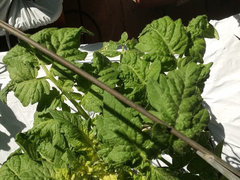
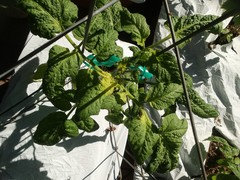
Before I read the whole list I dug the plants up and replanted with unammended ProMix. Apparently it can also be from soil that is too wet. The pH did test high in spots, although the meter would go back to 7.0 after a second or so. The bottom soil seemed a little wet, and some the roots were a!ready reaching the reservoir!
- 9 years ago
Mites can do an excellent imitation of iron deficiency. I have always limed my new boxes per EB instruction and I lime every season thereafter. I have however wondered why you would need to add lime to a supposedly balanced mix. I wonder if it got started because so many start with peat and not potting mix.
- 9 years ago
Several tomato growers on other forums grow organically in containers some in Florida like you PC. I understand heat may not kill all the microbes but they are tricky buggers and as I said, I do not have unlimited time and money to devote. Others, like my brother who is a professional organic grower/ writer in Pacific North West pull it off successfully. A different crop but the principal remains the same as he grows in 4 gallon containers.
jenswrens
Original Author9 years agolast modified: 9 years agoI wanted to order the casters and some of the clippy things to hold the cages in place, but the EB site has been down for a few days. Does anyone know anything? I haven't tried to call yet, but I hope they haven't shut down shop or anything - just when I'm getting started. Worrisome since their forums seemed to have disappeared a while back also.
eta: Ah... it's back online for the moment. Seems all I had to do was post about it for it to magically appear.
- 9 years ago
They've been telling us for over a month they are "working on" fixing the forum. New owners and they seem to be clueless about self watering containers. They released a new root box (a jerry rigged planter they had in stock) without prior testing. Holes were drilled in the wrong place and the flimsy screens collapsed under the weight of wet potting soil. They are trying to maintain a facebook page but often posts are inappropriate for SWC growing. Our best hope at this point is they give up soon and resell to someone who has some knowledge of the product.
jenswrens
Original Author9 years agoOh no - I had no idea it was under new ownership! That sounds awful.
I called them yesterday to ask why they only have grey rim clamps instead of the green ones I got with my boxes, wondering if the green were out of stock, when would they be in, etc. They said they don't make colored rim clamps anymore - just the grey ones now "because once the plants grow, you won't see them anyway." Ugh. I beg to differ. The lady was very nice, but that's not the answer I wanted. I should have ordered extra back then.
jenswrens
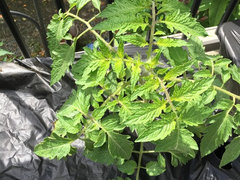
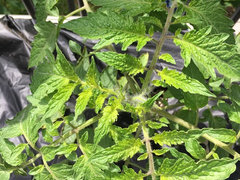
Original Author9 years ago@nanelle_gw - I am suddenly also having that bit of yellowing at the very tops of the EB tomatoes. I have fertilized them with a liquid MG. Do you really think it was from the lime or is there possibly some other issue? I have found a few aphids on the plants and last night I sprayed them all with Neem oil (but it didn't seem to kill any bugs - hmm). @suncitylinda - what kind of mites and can they be found with the naked eye?
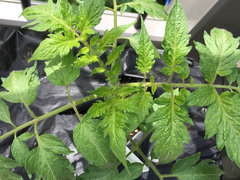
- 9 years ago
IF there have been no use of Round Up herbicide in the area then most likely that specific type of yellowing is caused by iron deficiency. Most commonly when we see that type of yellowing it has been caused by herbicide drift.
Dave
jenswrens thanked digdirt2 - 9 years agolast modified: 9 years ago
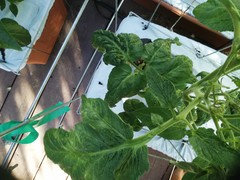
My issue could have been pH. I believe it was. I do not believe that was bugs, although they are an issue.
They are improved. It did not seem yellow, it seemed white, and while the plants are greatly improved, the growth that followed DID remind me of that following glycophosphate.
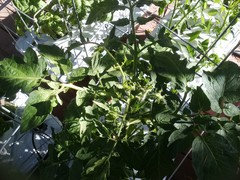
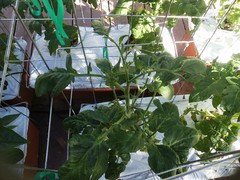
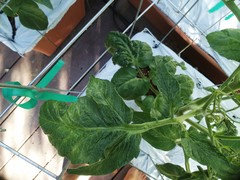
Perhaps there is a connection.
Excuse me.....Go Warriors!
jenswrens thanked nanelle_gw (usda 9/Sunset 14) jenswrens
Original Author9 years agoThanks. I went out this afternoon and all the ones I planted in the raised bed have the same weird yellowing. And they are in dirt (not potting soil). It IS new dirt - a mix of mushroom compost and topsoil that we had delivered. And the compost doesn't seem all that decomposed maybe. But that doesn't explain the EB plants.
If it is iron, how do I supplement that? Or do I just try to acidify the soil? I'm not digging the plants out of the EBs and replacing dirt at this point.
My DH does spray weeds around the property pretty heavily. (We have a horrible invasion of poison ivy and other noxious things.) He swears it's not drift. I suppose it could be, but it seems unlikely. Idk.
I just hope I don't have some dread disease.
- 9 years ago
Jen,
If it is a minor amount of yellowing like in the first picture and looks gradual into the new growth vs. blotchy or unnatural, this can sometimes happen to my plants when they are experiencing a spurt of growth and my approach is to do nothing and it goes away after a while. You are right to suspect the pH is too high, but sometimes we are over-corrective of out babies and they can suffer from that. Keep an eye on it and see if it is just on the inner parts of the leaflets of the growing tips and you'll most likely be fine.
This doesn't mean you should not work on dropping the pH very gradually of the soil by a cumulative method, if you can. But to do that you must test your soil first. Guesses and hunches are not the way to make these corrections. Patience and test results are.
Regarding iron supplementation, this can be done for example, with a liquid supplement you buy at Lowes or Ace as a foliar spray (link), etc., but if the problem is minor don't waist your time micromanaging the plants and just let them be for the time being. That is only a band-aid anyway if it really is the soil. Also don't get too hung up with the lime you added, more likely than not everything will be ok and outgrown. Just keep being observant in case things look more significant in need of help. There are no severe symptoms of iron deficiency in that picture. I bet it works itself out, not perfectly, but the plants tolerance is pretty robust.
Cheers
PC
jenswrens thanked PupillaCharites jenswrens
Original Author9 years agoThanks PC. That's relieving. One more thing, the mix in these boxes stays wet 100% of the time. Is that how it is supposed to be? Why isn't that too much moisture? Everything I read here says to let the soil dry out between waterings but the EBs never get dry. Why isn't that a problem ?
- 9 years ago
If EBs are working / wicking correctly they should remain moist but not real wet, at least mine don't. The EB system, which was created by a pro tomato grower in Florida is designed to allow air from the bottom grid. EB company and thus the forum sold, maybe almost two years ago. I just noticed they now have introduced an entire line of products to aid organic growing. Good bet that just like their root box, none of these have been tested in use either.
jenswrens thanked suncitylinda - 9 years agolast modified: 9 years ago
Drying out between waterings in my interpretation would be when soil is not optimal and roots risk suffocating. That refers to roots always being deprived of oxygen deep in the soil weighing over them after exhausting the oxygen which roots consume.
EB mix is supposed to be light which means it has lots of interspace in the texture of the mix for the oxygen to penetrate and the roots to be suspended in a nice air/water mix. Furthermore, there is a layer of air below the grating inside from which air enters the soil - something that doesn't happen in nature usually. This keeps roots from suffocating and is touted as the major advantage of EB over dumping a pile of soil in a pot.
Drying out roots is bad. Perhaps it refers to the soil top being dried out under some gardeners heavier soil, with the assumption that the rootzone is moist deeper down, a rule of thumb so that zone is not maintained over saturated. All of us here who are successful use or develop a lighter mix to get this effect, as there are many ways to have well-aerated soil which EB has no monopoly, and is just a participant in a wide selection. What it is is a cookie-cutter container design that is reproducible when used as directed.
EB pulls the irrigation from below by capillary action (wicking), so the mix is never saturated being light always maintains the appropriate aeration and moisture and drains excess into the reservoir any excess if you violated instructions and watered from the top rather than the tube. But yeah, IMO don't OCD like continuously top off your Earthbox especially if you have the cover on. Let the wicking work and drop the saturation level of the wicking a bit ... as a higher air to lower moisture is better. All depends on your soil mix, how spongy and waterlogged it gets so that's a bit of art and feel of it. Remember the best is to have soil squeeze in your fist but not drip anything, yet clump from moisture.
Cheers
PC
jenswrens thanked PupillaCharites jenswrens
Original Author9 years agoThank you PC for the excellent explanation! I can't believe how addicting this is. I'm going to worry myself to death over these silly plants. ;-)
- 9 years ago
My DH does spray weeds around the property pretty heavily. (We have a horrible invasion of poison ivy and other noxious things.) He swears it's not drift. I suppose it could be, but it seems unlikely. Idk.
There is no way to control drift. Herbicides can drift for up to 1/2 mile. Just browse through all the discussions here about herbicide damage to tomato plants. There are hundreds of them.
I'm not saying that is your problem but that it could be given the appearance. Tomato plants are highly susceptible to it, very easily damaged by it. So if herbicides must be used the plants need to be covered first to avoid damage.
Dave
PS: "wet" is a very subjective term. I agree that the soil should be consistently moist but not "wet". You can wring water out of a handful of wet soil. Moist soil feels cool and only slightly tacky.
jenswrens thanked digdirt2 - 9 years agolast modified: 9 years ago
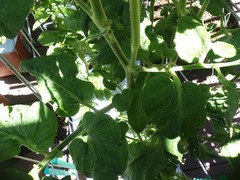
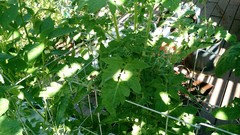
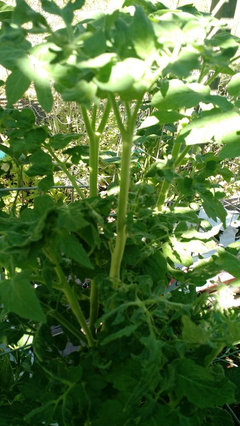
On June 9th I posted "They are improved. It did not seem yellow, it seemed white, and while the plants are greatly improved, the growth that followed DID remind me of that following glycophosphate."
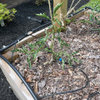
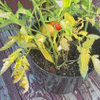
The funny ( narrow, twisted) leaves continued for a bit, but now seem to be growing more like I am used to. Here are some leaves side by side.








PupillaCharites