Software
Houzz Logo Print
rosie1949_gw

Hummers came for breakfast!

9 years ago
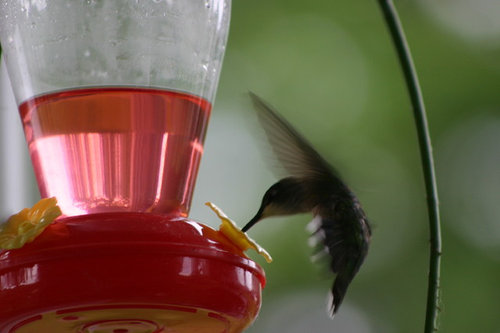
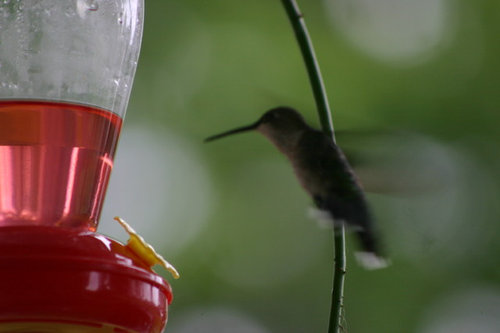
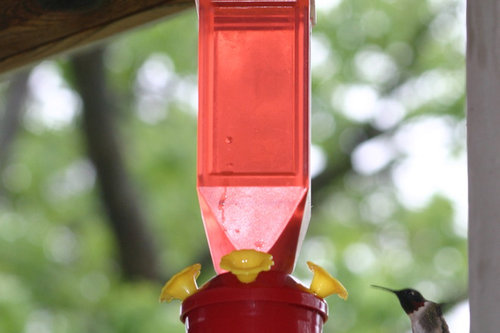
Here are a couple pix I took this a.m. as the hummers came for breakfast. I have two feeders hanging about 4 feet apart and they go from one to the other as though they can't make up their mind which is better! Rosie

Comments (5)

  • 9 years ago

    Thats great, great job!

    You might want to consider making your own solution of 3.5 cups water to 1 cup plain white table sugar, and skip the red dye. Red Dye #40 is banned as a food additive in most european countries, and is considered a carcinogen.

  • 9 years ago
    last modified: 9 years ago

    I make my own and I use food coloring same as I use for cooking for humans. 4 cups water/1 cup sugar/one half drop red food coloring. Rosie

  • 9 years ago

    I would still omit the Red food coloring. It is totally unnecessary, and even though you don't use that much, it's still a carcinogen. Hummers will eat 1/2 their body weight in nectar per day. That is akin to a human drinking about 12 gallons per day. 12 gallons is 16 cups per gallon and one drop per cup would be equal to 192 drops of red food coloring, nearly 2 teaspoons per day for a human.

    Again, red food coloring is totally unnecessary and dangerous to hummingbirds!

    If you want additional red color presence, go to the craft store and buy some red material or do-hickeys.

    http://fieldguidetohummingbirds.com/hummingbirds/feeding-hummingbirds-dangers-red-dye/

  • 9 years ago

    I just got some red Krylon and painted my reservoirs. Birds coming every day, in spite of the one redthroat who thinks he owns every feeder in the neighborhood. I got feeders and bags of sugar for every house on my block when a friend told me they will kill wasps. I became very allergic to the wasp stings 2 summers ago.

  • 9 years ago

    I googled do hummingbirds kill wasps and this is what I got. Here is the source: www.hummingbirdsociety.org/index-inside.php?Hummingbirds-101-Predators-14

    PS KRAN Lopez you may want to rethink supplying the neighbors with bags of sugar!!!! Read down toward the end.

    Hummingbird Predators

    All wildlife faces hazards to survival, including weather, humans, pesticides, and so on. For tiny hummingbirds, however, predators are a significant source of risk.

    Cats, both domestic and feral, are probably the most common predators of non-nested hummingbirds. Reports to the Society come in regularly, for example, of people whose cats carry a hummingbird in their mouth--sometimes dead, sometimes not. Reports of tailless hummingbirds are less likely to indicate a hummingbird in molt than one that narrowly escaped being caught by a cat. In the case of one species, the Critically Endangered Juan Fernandez Firecrown (Chile), cats are actually an important reason for the bird's being close to extinction.

    To reduce the risks from cats, feeders should be hung high: at least five feet (1.2 m.) above ground, and preferably positioned so that a stalking cat will be quite visible. If you have a cat and love hummingbirds--or any other birds--keep the cat inside!

    Other birds, such as hawks, have been documented catching hummingbirds. Considering the differences in size, one wonders just how much nourishment a tiny hummingbird (typically only 3-4 grams, or 0.1 ounce) can provide to a large bird, but it happens nonetheless. In contrast to this, many people have observed hummingbirds pursuing or confronting a hawk, most probably in defense of a nest. This fearless behavior against overwhelming odds is but one of the reasons that hummingbirds evoke our admiration.

    In the nest, eggs and chicks represent an easy target for a variety of predators: other birds, such as blue jays and crows in the U.S., and snakes, particularly in the tropics.

    UNUSUAL PREDATORS

    Hummingbirds share some of the same predators as birds of greater size. Their very small size, however, causes them to have more--and very unusual--predators.

    Most people are surprised to learn that praying mantids will successfully capture, kill, and eat a hummingbird (click here to see graphic image). Typically the insect will position itself on a plant or a hummingbird feeder to which it observes a hummingbird coming repeatedly. Its lightning-fast strike often assures it of success. Because of the relative size difference, it make take over a day for the bird to be consumed. While praying mantids are very beneficial insects in a garden, they should not be allowed on hummingbird feeders.

    Spiders: Hummingbirds use spider webs as a source of spider's silk in nest construction, being necessary to bind the nest to the tree branch or other substrate and to hold the nest together. Even so, the hummingbird must be careful when removing the pieces of webbing, for it may become entangled and be trapped there. Spider's silk has a tensile strength comparable to steel on a weight basis. In one report, a Ruby-throated Hummingbird was caught in an active web, and quickly wrapped and encased by the spider, much as an insect might be.

    Other insects, particularly bees and wasps, can sometimes out-maneuver and attack a hummingbird. A single sting may be fatal to a hummingbird, because there is so little body mass to absorb the venom.

    Hummingbirds are not much bigger than some insects, which accounts for some reports of unexpected predators. Frogs can capture a hummingbird, although the result is probably death to both. One image in the files of the Hummingbird Society shows a frog with a half-swallowed Anna's Hummingbird, which almost certainly had tragic results. There is at least one report in the literature of a fish (bass) capturing a hummingbird.

    Rosie

Sponsored