

KBG and Rust
I noticed a few yellow patches of grass in the lawn today so took some pics. It looks like rust, although I didn't notice much of anything flaking off the blades. Does this look like rust to you?
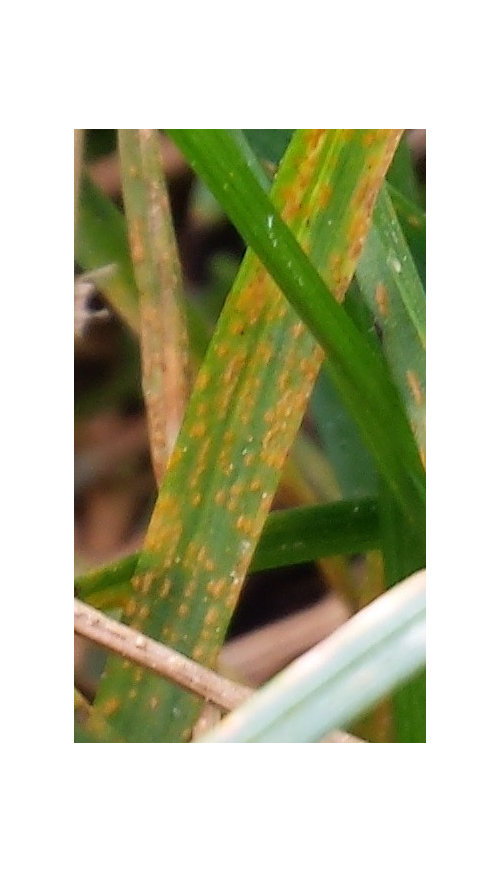
If so, I'm inclined to do nothing based on what I'm reading for remedies, other than possibly adding nitrogen. My lawn's been growing quickly (mowing twice a week) but the color is not as good as it was a month ago. Maybe I'll up my frequency of nitrogen apps and see what happens. I came across the following post from a departed forum member from 2010. Has this been discussed/debated here recently? It has been 7 years since this was posted and I wonder if opinions have changed. I know too much nitrogen at the wrong time can encourage fungus...
"The Philes Phertilizer Lecture follows:
These new KBG lawns are hungry for fertilizer. Very much like, (and
if you renovated, exactly like) a sod farm, those guys that start with
bare ground, throw some seed around, and by late July of every year,
they are selling product: a deeply rooted, dense intertwined dark green
carpet of lush (no bare spots) Kentucky Bluegrass. Now how do they do
that every year? (And, of course, the implied question "How come you and
I can't do it also?")
They do it with frequent, rather than heavy, applications of
fertilizer. Literally, every two weeks, a light application of
fertilizer. At seeding time, they start with an 8-8-8 or a 10-10-10.
Upon the grass reaching the 'first mow' stage, they add Milorganite, and
then it's Milorganite every two weeks, as the weather gets warmer.
Every two weeks would seem to you (and in the old days, to me) as
'excessive'. It's not. Not only is it not excessive, it may well be
Required.
There's only one difference between the sod farm, with that lush
green grass for sale every year, and the typical homeowner here (I'm
leaving out the general public: the public is a 2 or a 3, as you know,
and you guys and gals are a 6 or a 7. Twice as good. But I'm trying to
get y'alls up to a 9, which is where the sod farm is), and that
difference is Frequent Applications of Fertilizer.
Especially with KBG, more fertilizer than you are used to putting
down is good. A typical homeowner would fertilize once in the fall. Not
the first year, but every following year, on these newly renovated (or
overseeded) KBG lawns, two full applications are required in the fall.
Spring? A lot of people don't like to fertilize in the spring. A KBG
lawn requires an application of big-first-number fertilizer, in May. A
newly renovated KBG lawn requires yet another application in mid June.
That lawn needs the nitrogen, for all the growing, both above, below,
and across the ground, that it's wanting to do, and will do, if you feed
it. Density? It requires nitrogen. Color? Requires more nitrogen.
Aggressiveness? You already know what it requires.
Even an old KBG lawn, the Merion sods of this world, needed more
nitrogen than they received. As proof, drive through the subdivisions of
ten or twenty years ago, and look at the lawns: those lawns were not
exactly treated like a sod farm, were they? If you want your new lawn to
turn out just like that, here's all you have to do: fertilize once in
the fall, and once in the spring. That's it. The results are guaranteed.
By now, somebody is saying (and should be), "Is it possible to OVER
fertilize a lawn?" Yes, it's possible. But not what you'd think. The
'typical' overfertilize stripes that we all seem to fear came from the
old drop spreaders, when the rows were overlapped. That overlap caused a
doubling of the fertilizer along that narrow, overlapped row, and it
was all delivered in one day. What most people forget, while imagining
the scorn of neighbors and children, is that those bands of over
fertilization did not last until fall, they went away in less than a
month. Repeat: the so called over fertilization went away, in less than a
month. The homeowner had not created another Love Canal toxic zone, the
homeowner had instead managed to put down more than the grass could
handle all at once, but in fact the lawn handled it, and probably even
needed it. The lawn just didn't need it all at once. Nor in summer's
heat. Disaster? No. Bad delivery technique? Yes. It wasn't too much
fertilizer, it was too much fertilizer all at once, and there's a
difference, isn't there?
These days, with the rotary far-flinging spreaders, a more evenly
spread application of fertilizer is the norm. Now that we want to
emulate the sod farms (and their turf success), we know that there's no
sin in putting down a half application, in one direction, and putting
down the other half application, in the other direction a week later.
Now that we want to emulate the sod farms, we will want to feed the lawn
during summer, rather than letting it starve while it battles the hot
summer sun. So Milorganite, or other organic fertilizer is required,
rather than a big-first number fertilizer. At least once in summer, but
if you've renovated, or over seeded, that new KBG needs two
applications. It needs the food.
So there's my recommendation for the renovators and overseeders: two
applications in the fall (not the first year, on the seedlings, they
can't use the food yet, as they haven't grown enough yet) at least one
application in the spring (two if you renovated or overseeded. That
application we skipped last fall goes down the following spring), and
you must feed the lawn in the summer: that new KBG needs the food.
So here we are, end of August. You know you are going to fertilize in
the fall, probably twice, and perhaps didn't do enough during spring or
summer. You can do a half application right now, of big first number
fertilizer, or a full application of Milorganite. And still do the
regular fertilizing when fall gets here. But your lawn likely needs the
meal, and if you provide that light meal right now, before fall gets
here, I think you'll love the visible results.
Good luck with it."
Comments (6)
 9 years ago
It does look like rust. From what I've read on rust it sounds like some nitrogen would be helpful. Is this a new lawn from last fall or are you just curious about what we think of Philes Lecture? It makes sense to me and he sounds like he knows what he's talking about. KBG needs a fair amount of nitrogen, more than tttf does. In the first fall the seedlings wouldn't be able to use a lot. I think a slow release would be good to release nutrients lightly and continuously on new lawns.
- 9 years agolast modified: 9 years ago
I agree that it looks like rust based on your photo.
Just wondering, what if your lawn is mixture of fescue and kentucky blue grass, like j4c11's? He stated in his spring renovation:
"Use a mix of Traverse 2 fescue and Turf Blue HGT Kentucky Bluegrass. The bluegrass will hopefully make up for any summer losses in the fall."
What does that mean in terms of summer maintenance? Do you go heavy on nitrogen to feed the hungry KBG? Or.... do you avoid nitrogen in the summer on fescue, so as not to encourage fungus?
Related Professionals
Sebring Landscape Architects & Landscape Designers · Charlotte Landscape Architects & Landscape Designers · Leominster Landscape Architects & Landscape Designers · Durango Landscape Architects & Landscape Designers · Alexandria Landscape Contractors · Hagerstown Landscape Contractors · Memphis Landscape Contractors · Norfolk Landscape Contractors · Burlington Landscape Contractors · Lincoln Landscape Contractors · Ontario Landscape Contractors · Peoria Home Builders · Newburyport Home Builders · Jamestown Home Builders · Westerly Home Buildersdanielj_2009
Original Author9 years agoThanks for the replies. I had an outbreak of what I assume was summer patch last year, and this rust was on a clump of grass that was growing back into the bare spot from last season, which is why I got worried.
Becky: I read his article from the angle that even old KBG lawns need more nitrogen than they get. I've gone under the idea that it needs 4 to 5 lb per season, which is about what i give it. Although, if you go by bag rate on some fertilizers I notice that they seem to target for more like 0.75 lb. Oceangro went down to 45 lb bags last year, so at the recommended sf of "up to" 3000 sf per bag, I'm only putting 0.75 lb. I figured that was good enough for spring, but maybe not. I have 9000 sf, so 3 bags is convenient, but maybe not enough.
Early in the spring, coming off synthetic winterizer, my lawn was a nice dark green. Then the sunnier areas turned a lighter green, while the east side of the house was still pretty dark. It occurred to me that it was the synthetics that made it dark. I thought, damn, maybe that j4 guy is on to something. lol.
I'm going to throw another bag of Oceangro down and see what happens.
- 9 years agolast modified: 9 years ago
Hey daniel_2009,
Rust is pretty benign as turf diseases go, although the one year that I ignored it, I did have some thinning in the affected area. In almost all cases, Rust will run its coarse with little to no long term damage.
You can confirm that it is Rust by running your hand or a paper towel through it. Rust will deposit a heavy red powder on your hand ot the paper towel.
Nitrogen application is the common recommendation to counter Rust. Although Nitrogen is neither a preventative nor cure, it will promote blade (top) growth allowing the turf to outgrow the infection by creating new blade growth (continued sufficient photosynthesis) until the Rust finishes running in coarse. Fungicide for Rust is over kill.
danielj_2009 thanked User


beckyinrichmond