

Trouble with tile
The tile setter started to tile the shower walls. I couldn't be home all day, but I saw the very beginning of the job before I had to leave. He was using some spacers in one small area, but not using any spacers in the majority of the shower. I asked him about it, and he said something about some of the tiles being shorter than others and so this is how he would handle it. I called the GC to inquire and was assured that the tile person was the best of the best and not to worry.
When I got home I found dozens of very obvious lippages, uneven spaces where the grout would go (some tiny like the width of a fingernail, other's more than a quarter inch and others that look like about 3/8"), tiles that were crooked, and tiles that were cut too short so they didn't reach the end of a space where one wall meets the other.
I find it hard to take good pictures, but I did take some so that I could document what happened.
The next day the GC and tile setter decided to take the tile out. I have been asking the GC whether the issue was the installation or the actual tile being defective. I haven't gotten a clear answer on that. The tile setter quit and said he would not work here anymore saying I was too hard to please.
Can somone please tell me if this is what tile is supposed to look like when it is being installed? The GC and tile setter are implying, not so subtly, that this is my fault, that the job was a good installation and that it's too hard to make me happy. If it was a good installation, then they shouldn't have taken the tiles down I guess, instead show me and talk to me about it and assure me how it would look when done. Since they took it down, that tells me they knew it was bad, but I haven't gotten an answer on whether it was bad install or bad tile.
I hope you can tell what I'm talking about in these pictures. I find it very hard to see the lippages in the pictures because they are hard to photograph. But let me put it this way - if this were a floor, people would trip on the protruding parts of the tile. The wall was not at all smooth as you would run your hand along the wall.
Where 2 walls meet, the tile was cut short and doesn't reach the wall, leaving a large space where I guess they were going to fill with grout?
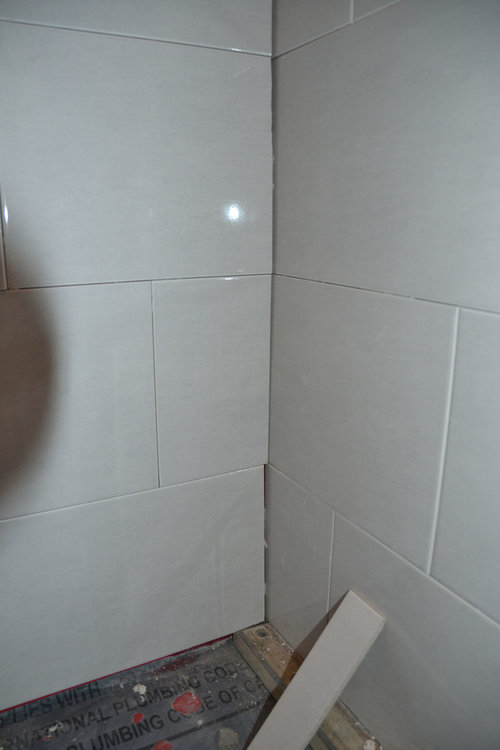
Close up of that area:
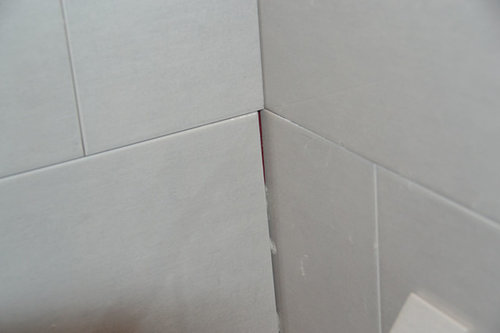
Crooked tile:
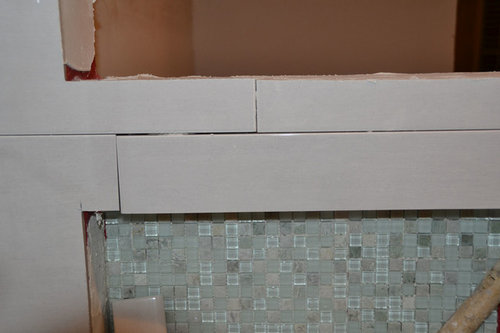
Whole tile that has a rough edge as if cut or dropped, or maybe was a bad tile right out of the box:
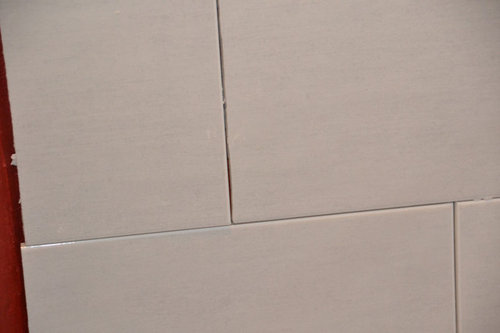
Different sized spaces where the grout would go:
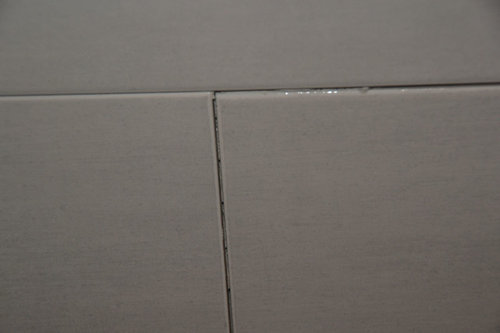
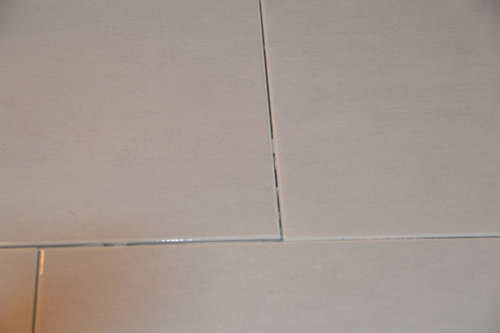
Lippages (these are hard to see, but there were dozens of areas where the edges of the tiles were poking out).
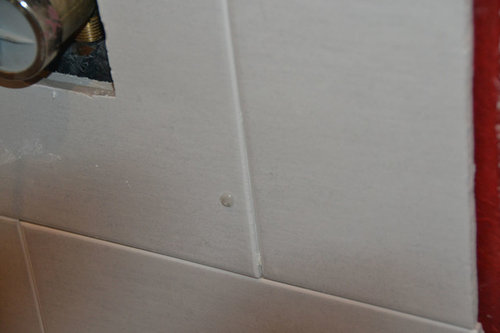
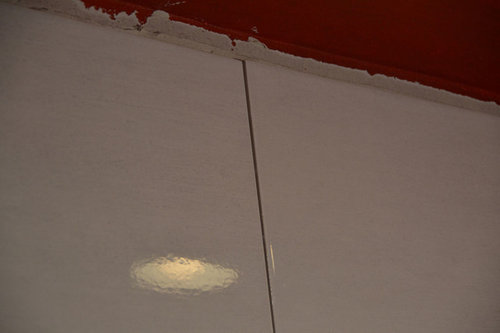
Lippage, also teeny tiny spaces for the grout to go (can't even put my fingernail into some of the spaces).
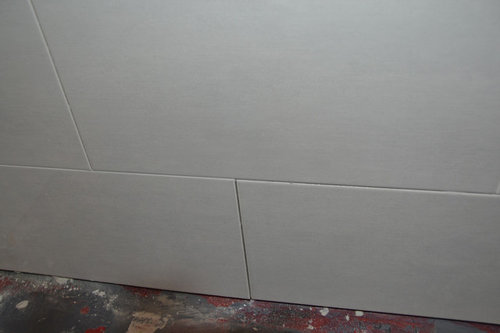
And finally, after they took the tile out, the wall looks like this:
That's one of my tiles sitting there.
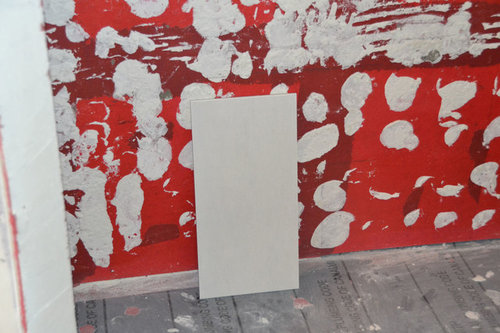
I don't understand why the thin set is in little globs like that. Does that mean that the tile setter didn't cover the whole back of the tile with thinset? Just using small little globs? I'm not sure what I'm looking at here.
I need to be prepare to talk to the GC tomorrow about how to move forward.
Comments (45)
 9 years ago
I think you are lucky he quit. That is not a good job. Larger format tile is more difficult but if that's all the better he can do, he should leave it to someone else.
User thanked palimpsestRelated Professionals
Greenville Kitchen & Bathroom Designers · Miami Kitchen & Bathroom Designers · Lafayette Kitchen & Bathroom Designers · Williamsport Kitchen & Bathroom Designers · Zanesville Bathroom Remodelers · Stamford Bathroom Remodelers · Augusta Bathroom Remodelers · Toledo Bathroom Remodelers · Clearlake Bathroom Remodelers · Mobile Tile and Stone Contractors · Salina Tile and Stone Contractors · Annapolis Tile and Stone Contractors · Davenport Tile and Stone Contractors · Hobbs Tile and Stone Contractors · Yakima Tile and Stone Contractors- 9 years agolast modified: 9 years ago
Where did you buy the tile? HD and Lowes tile is often not rectified, meaning that the sizes might differ and also that the tile might bow, meaning, not be uniformly flat.
Tiles begin their life evenly sized, but the clay might differ in moisture content and so will shrink at different rates. Additionally, during baking, the temperature in the oven can differ for each tile, depending on location inside the oven. The result is uneven tile. A quality tile manufacturer therefore cuts/grinds off each tile to the exact size and weeds out bowed specimens. This step adds to the expense of course, so typically cheap big box tile does not undergo this quality control.
Buying rectified tile is especially important when using large tiles as the variation in size is can be much more pronounced and bowed tile is useless.
That said, a good tile setter knows how to compensate for small size differences. The tile install will take longer though, more tile will be needed and the result won't be as exacting. Also, the tile guy will probably curse the tile (and the home owner who foolishly thought they were a good deal).
If the tile is rectified, it will say so on the packaging.
User
Original Author9 years agoThe tile is from a specialty tile store that has a dozen or so locations in major cities across the South and Southwest USA, not a big box store. I had a meeting with the GC and one of the contractors to determine which tile I should choose. I asked if there were going to be any installation issues with any of the choices, etc, etc. I had 3 options that I liked: 2 rectified porcelain tiles and a glazed ceramic tile. I specifically asked if I should eliminate the ceramic tile option because I had heard porcelain was better. They said no, that all 3 were fine; it was just a matter of taste. I chose the 10" x 20" glazed ceramic tile.
I still have not gotten an answer from the GC as to whether the problem is with the actual tile or the installation.
 PRO9 years ago
You never followed up on the other thread? flood test?
[spot setting can be best understood here.[(https://www.houzz.com/discussions/tile-failures-understanding-why-spot-setting-should-be-banned-dsvw-vd~832015)
User thanked Mint tile MinneapolisUser
Original Author9 years agoOh, yes. They did the flood test. I was here during that, and it turned out fine, no leaks. Thanks for following up.
User
Original Author9 years agoI should have followed up on my flood test question, sorry. The last few weeks have involved college kids moving back for the summer, one kid having surgery and many follow up Dr. appointments, so I sort of lost control of my schedule.
User
Original Author9 years agoA different person built the shower and did the waterproofing. He put a membrane, then cement board, then redguard. He did a mud bed for the floor sloping to the drain. As far as I can tell, he waterproofed according to the advice I've read here. I took pictures and they look like they match the "good" pictures I've seen here. The tile-setter was a new person brought to the job just for installing the tile.
Based on how the wall looks, I guess this tile person did the spot setting method. Thanks for the link to understand that.
I need to prepare for the meeting with the GC tomorrow. I would really appreciate some more feedback to help me prepare for that meeting.- 9 years ago
Even if grouted it would have shown most, if not all of the mistakes. Since they have removed it did they compromise your waterproofing? Ask the GC if he would proudly post those photos in the web as a professional, error free install. You have done the correct thing and you should get a good install.
User
Original Author9 years agoAs far as I can tell I the waterproofing looks okay. There aren't any holes, scratches or gouges in the walls. Probably the tiles came off easily because of the spot setting. Tomorrow I'll inspect the walls more closely.
About the actual tile...if the problem was the install, can this tile be
reused? There are globs of thin set on the backs of the tiles.- 9 years agolast modified: 9 years ago
Question about your waterproofing. Did you say they put a membrane of some kind behind the cement board and then a topical waterproofing? If so that is a big no no. That creates a moisture sandwich. Also did he do a pre-slope on the floor? Just things I have learned here and know are often not done correctly.
Hope a professional comes along and corrects me if I am wrong.
User
Original Author9 years agoI will have to pull up my progress pictures to answer the question about the waterproofing. The floor was pre-sloped.User
Original Author9 years agoWhen I hired this GC I didn't specify the waterproofing method. The sub explained what he uses. I wasn't super educated about it. But I had heard of a moisture sandwich and asked the sub to make sure he did not create that. Unfortunately he might have done just that. I'm really not sure. On 5/13 this is what was up:
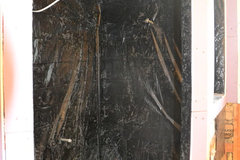
Then on 5/16, this is what was up:
Then on 5/19 they did this: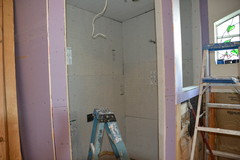

 9 years ago
"I still have not gotten an answer from the GC as to whether the problem is with the actual tile or the installation."
Only one answer to that question is acceptable and you aleady know it!
"Based on how the wall looks, I guess this tile person did the spot setting method."
More like a game of Pin the tail on the Donkey........................- 9 years ago
Is this a steam shower, I see a fixture placed low. I am not certain but vapor proofing is different than water proofing if it is.
Glad your "tiler" is out of the picture! Get new tiles they should not be at your expense!
I hope the rest of your project goes well.
User
Original Author9 years agoThat lower fixture is going to be a hand-held about 3' off the floor next to where I will place a teak bench (no built in bench). We're going to mount it there and not put it on a sliding bar.
It's not a steam shower with a generator, but we are going to "capture" steam by enclosing it. Ceiling is sloped and will be tiled. There will be a transom. The vent is already installed just outside where the door will go.
The sub explained that he would vapor and waterproof. But now I'm worried maybe he created the dreaded moisture sandwich.
I'm losing confidence in the GC who should know a lot more about this than me.
If this has to be ripped out and rebuilt, that would be a bummer, but I'd rather learn that now, not down the road.
Can someone weigh in on the waterproofing and whether this is right or wrong?- PRO9 years agolast modified: 9 years ago
Yep worry or tear it out
Your supposed GC is failing you first and his handyman is failing him, but he didnt know that or he thought it would pass by you in which case hes failing you. You hopefully have permits contracts and an actual GC.
User
Original Author9 years agoMy community doesn't require permits except for outside stuff. We do have a contract. It says that the shower will be vapor and waterproofed. But it doesn't list the brand names of materials. I had heard of the moisture sandwich problem and verbally discussed this with GC before starting saying something like, "I want it vapor and waterproof, but be sure he doesn't create a moisture sandwich." GC said something like "he knows what he's doing; he's built hundreds of showers, etc."
Can I fire this GC? I have already paid 10k for demo, framing, plumbing rough ins, electrical, ventilation and building and "waterproofing" the shower.User
Original Author9 years agoTundra, thank you. Just to be clear you are confirming that this is a moisture sandwich and needs to be torn out?
What about the floor? He pre-sloped it with mud bed and there's some kind of board on top of that and the drain is installed. It passed the flood test. Does the floor need to be torn out also, or can the walls be fixed and leave the pre-sloped floor?User
Original Author9 years agoI appreciate your comments. I'm trying to prepare for my meeting and if I asked for clarification it doesn't mean I'm not listening. It means I wasn't clear on something.
I don't want to embark on a gardenweb argument. Clearly I needed help understanding my situation which is why I posted.
Thank you for responding.- PRO9 years agolast modified: 9 years ago
You are welcome. I will politely tell you :):) the whole story seems a bit shady in regards to inspections permits and especially the supposed flood test. it is your home your $ and your resale at stake.
User thanked Mint tile Minneapolis - 9 years ago
I would wait to see how the GC offers to fix this and read your contract with a fine tooth comb before terminating him.
I believe tundra is saying the industry supports only one form of waterproofing not a combo of two. You and your GC need to decide if you want to use poly behind cement board to protect framing but no red guard on top or take out the poly and use a surface waterproofing coat or membrane.
After determining how to redo the shower ask for a flood test that is conducted with a third party witness.
It will not be too hard of redo but it will cost. Hopefully the GC swallows that cost.
good luck and as one who had a shower redo I found it was not as time consuming as I feared and my GC was wonderful and took care of details and bills. I am glad I gave my contractors the chance to make things right.
User thanked roarah User
Original Author9 years agoThank you. We have set our meeting for tomorrow so DH can be here.
I re-read the contract and it actually says:
Install vapor barrier
Install hardie backer and apply red guard.
I see now that I should have asked them to specify the exact products in the contract. Then I could have posted a question here asking if that was a good plan.User
Original Author9 years agoI know is seems like it wouldn't be true, but I called my city and county about permits and inspections because I had a hard time believing the GCs that were telling me they aren't required.
The city said they only require for external things like pools, driveways, porches, or if it's a home addition.
The county said they only require for commercial projects.
I asked them: what if I want inspections? They said they don't do that. I should have hired an inspector. I'll do that when the project starts again.- 9 years agolast modified: 9 years ago
A few points that have been discussed, but I'll reinforce a bit. And beat a few to death.
Waterproofing; you want either poly behind the cement board with no RedGard on the face, or RedGard on the face with no poly behind.
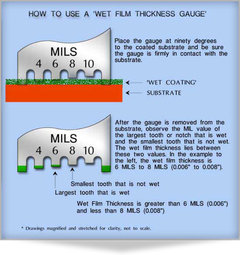
Given a choice of the two, I'll choose RedGard. HOWEVER, the RedGard needs to be applied in a certain way on order for it to perform properly as a barrier. Generally referred to as "wet mil thickness". A mil is a thousandth of an inch. There are mil thickness gauges that are used to ensure it's being applied properly. they cost a few dollars at most any good paint store.
When applied at the proper thickness, the dried coating of RedGard is generally more opaque than transparent.
I'd recommend downloading the RedGard installation instructions, reading them, then passing them along to your GC.
Here's a little ditty on how to use a mil thickness gauge:
The tile setting itself? Yeah, it's not the greatest setting job. Especially the wonkiness around the niche. Some tiles have lugs on their edges, the lugs act as a built-in spacer. With non-lugged tiles, you'll typically see spacers or tile wedges/spikes used.
Regarding not having full thinset coverage behind the tile? That's an installation mistake in a wet area, as the standard is a minimum of 95% coverage.
Other issues? It looks like the tiler is working directly on the exposed pan membrane. Again, at a minimum, a layer or two of cardboard should be put on the membrane to protect it while the walls are being tiled.
I can't tell if the bottom edge of the bottom course of wall tile was held above the membrane so when the next layer of floor mud is packed in place, the mud won't bury the bottom edge of the tile.
Any one thing done wrong could be nothing more than a slightly bad day. All these things being wrong? It indicates that the tiler who did this work is nothing more than a slap and go type of installer. There appears to be little-to-no professional education, common sense, or care behind the methods of his work.
My opinion.
One last thing, you wrote:
"What about the floor? He pre-sloped it with mud bed and there's some kind of board on top of that and the drain is installed."
A shower floor with a membrane like yours will typically be done by applying a sloped layer of deck mud over the subfloor. Then the shower pan membrane gets placed over the sloped mud. Then another layer of mud gets placed over the sloped membrane, and the tile goes on top of the second layer of mud. With deck mud floors, unless it's some new sort of system, no "board" is typically used on a traditional mud and membrane floor. I could have misunderstood what you wrote.
- 9 years ago
Vapor and water barriers:
Since we have to redo the walls, please advise me on the right products I should be asking the contractor about for vapor and water barrier. Is there one product that provides both types of barriers? I don't think it's redguard. If there's not one product, then what is the correct combination of products to provide both; something behind the cement board (but not what I have now) plus a surface applied membrane?
Floor:
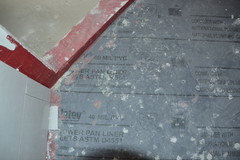
I know he applied the sloped layer of deck mud over the subfloor, sloping to the drain. Then the shower pan membrane was put in (a thick plasticy-rubbery sheet?), and that went up the walls many inches. Then this grey liner was put in. The second layer of mud is not there. Then the tiler came in and started his work. The tile has been taken out.
Does the vapor/water barrier decision will impact the floor as well, and how? The second mud layer is not there yet. There's no board, that was my mistake in typing.
Here is a picture of the floor today:
- PRO9 years agolast modified: 9 years ago
Yes it all comes out. EVERYTHING redone with a new prefessional TCNA/ANSI approved installation at zero cost to you and by someone new that you hire seperately.
why? No REAL Professional tile guy or gal will come into this mess and take on the liability to salvage a small part of the handymans work that is clearly done wrong. If someone does then you know youve again found the wrong novice.
I hope you are not letting these hacks take another stab at this mess just Look at that liner and curb its all gotta come out. to the drain flange and wall studs and subfloor.
 9 years agolast modified: 9 years ago
Check out Wedi shower systems. My contractor used this for my shower. It seemed pricey to me but after a few years of installation I haven't had any issues. (Of course, cheaper options properly installed shouldn't have issues either). Good luck...
- 9 years ago
Okay, thank you.
I didn't see a way to search for an approved installer directly on the TCNA or ANSI websites. I emailed TCNA, but haven't heard back. I called ASNI and they told me they don't have a search service like that. But there were links on TCNA to several other associations: on CTEF there were 2 contractors about 25 miles away; and on NTCA there were several in my area.
_____________
"Look at the liner and curb"
I'm just a homeowner, what am I looking at with the liner and curb?
_____________
As far as my contract with this GC is concerned, the cabinet maker is finished with the vanity and is ready to install. How should I proceed as far as our contract? Should I have this GC proceed with getting the vanity installed, and negotiate to change our contract and part ways as far as the shower re-construction? Or should I keep the contract intact, and insist that I choose the new shower contractor from the lists I have gotten from CTEF and NTCA?
Thank you for continuing to respond, I really appreciate it. - 9 years agolast modified: 9 years ago
"Since we have to redo the walls, please advise me on the right products I
should be asking the contractor about for vapor and water barrier. Is
there one product that provides both types of barriers? I don't think
it's redguard. If there's not one product, then what is the correct
combination of products to provide both; something behind the cement
board (but not what I have now) plus a surface applied membrane?"Cement board is fine as a tile backer board.
On the face of the cement board there are myriad membranes that can be used, but when you use one of those membranes you don't want or need the poly sheeting behind the cement board.
Some membranes are waterproof. Some are water and vapor proof. For a non-steam shower, you only need waterproof, but you could go with a vapor proof membrane as well.
There are sheet membranes like Kerdi, Laticrete sheet, nobel sheet, etc. There are liquid membranes like RedGard (which is fine), Hydroban liquid, etc.
You can forgo the cement board and instead use a foam core board that has a waterproof membrane factory applied to the surface of the board, something along the lines of USG's Durock Shower system board, Kerdi Board, Wedi, etc.
With the liquid surface applied membranes like those previously mentioned, the installer has to follow the installation instructions and properly apply the membrane to get proper thickness. Only by applying the proper thickness do you get proper waterproofing performance.
Your shower is not a steam shower, so you need waterproofing. If it was a steam shower, you'd be looking for vapor-proofing as well.
With sheet membranes like Kerdi or Laticrete's sheet membrane, or with membraned foam boards like Durock's foamboard, Kerdi board, wedi board, etc, the membrane thickness is already there. The product just need to be properly hung and detailed to achieve proper performance.
Your shower "as is", is a hybrid of sorts: A surface applied membrane (RedGard) on the walls, and a 40-mil Oatey liner on the floor.
With hybrid systems, things can get questionable where the two systems meet, or at curbs, or at the drain, etc.
While not required, I'd recommend sticking with one "shower system" for both the walls and the floors. Using just USG's Durock Shower System for the walls, floor, drain, etc, or just Laticrete's Hydroban system, or just Wedi's System.
When installed in accordance with the manufacturer's instructions, you'll have a shower fully warrantied by the manufacturer.
Good luck with the next phase, I hope all turns out well for you.
- 9 years ago
I will say that my tiler also built my shower and was tcna approved, but even than somethings still went wrong. I think your GC should not have been in charge of waterproofing. A good GC hires trade specific pros for your job rather than act like jack of all trades.
with the exception of this are you happy with your GC's work? Will you face a steep financial consequence for breech of contact if you terminate his involvement? Is he malleable and reasonable to changes? Will he make his make his mistakes right? What is his field of expertise? These answers would persuade the way you should proceed. Good luck!
- 9 years ago
Thank you very much
for your replies.Steam:
This is not a steam
shower with a steam generator, but we do want to close it up to capture steam.
I read on this forum that if you want to capture steam you need to have
both vapor and water barrier, tiled ceiling, transom, ventilation, etc., so
that's what we asked the GC to provide.GC Meeting:
Conclusion of meeting was
that we are going to hire someone to inspect the shower construction and GC is
going to formulate a plan for getting the rest of the work done. GC strongly defended quality of tile work, then suggesting that we find a new
tiler, we call the fabricator with our questions, we do this and that. DH expressed that the GC is supposed to do
those things. GC said they don’t have
another tiler, that this person is the best and they don’t use anyone
else. GC said they don’t
want to be involved in the shower anymore.
So we got the strong sense that the GC wants to walk away from the job
entirely. If that is the plan GC comes
back with, we will get the inspection and then DH will negotiate parting ways
with them. We've paid some money, and GC
has provided some value with the demo, electrical, ventilation, plumbing
rough-ins, tub framing, etc, so DH is
evaluating all that now to propose a “settlement.” We will obtain a release of lien if we part
ways.Finding a contractor:
I went on TCNA, ASNI,
NTCA, and CTEF and used their "find a contractor" search. From
all of those associations there were about a dozen within 50 miles, but only 1
of those does residential work. The boss was off site Friday, so I will
have to talk to him on Monday about coming to do an inspection. The person I talked to on the phone said they
absolutely do inspections and they build showers and are approved by NTCA. She said that if they are going to follow on
the heels of another contractor, they would be doing a thorough inspection
anyway, so this is nothing new to them.I was surprised that
there weren’t more results when I was searching for a contractor. On Monday I’ll call these associations to see
if I was doing something wrong or they have any further advice for me.Clearly we made a mistake
hiring this GC. We've remodeled the entire rest of the house, and this is
the last big project. We did a total
kitchen gut and re-build, 3 light remodels of upstairs bathrooms, wood floor
installation, doors, windows, pool/patio install, driveway pavers, staircase remodel,
dock replacement, etc.. Issues come up with any project, that's normal,
but they've always gotten resolved. The
GC I hired for the kitchen retired and moved away last year, so I had to find a
new GC for the bathroom.Thanks for your
replies and especially for educating me about the vapor/water barrier systems. - 9 years ago
I am glad you may be able to let this contractor go without too much loss of money. I am sorry you have had a difficult time. You should be cheered for stopping things when you did and researching further. Many don't and end up with a mess in a year or two.
I have seen some people post the location they live in and ask for recommendations here. I think Houzz still allows this. I unfortunately I don't have anyone to suggest
- 9 years ago
"Look at the liner and curb"
"I'm just a homeowner, what am I looking at with the liner and curb?"
An answer to this, or a link to a resource, might help me communicate with inspector, GC, and future contractor.
Thank you.
- 9 years ago
"While
not required, I'd recommend sticking with one "shower system" for
both the walls and the floors. Using just USG's Durock Shower System for the
walls, floor, drain, etc, or just Laticrete's Hydroban system, or just Wedi's
System."Which systems provide both vapor and water barrier?
 9 years ago
Wow, that seems to have been a huge hassle! Glad you managed to cut it off before it was too late and spent too much money. It could've gone far worse...
- 9 years agolast modified: 9 years ago
"Which systems provide both vapor and water barrier?"
Hydroban Sheet (but not Hydroban liquid)
Kerdi Board (Only the "Kerdi Board". The sheet membrane alone does not qualify anymore as a vapor barrier for a steam shower)
There are others as well. But that's a start. The devil is in the installation details.
 PRO9 years ago
Mongo, I was of the understanding that Kerdi was acceptable for a residential, steam shower for occasional use...but NOT for a commercial steam shower. Did Schluter change this?
- 9 years agolast modified: 9 years ago
Kerdi sheet goods are too permeable for steam. Waterproof, but not vapor proof.
 PRO9 years ago
Late 2014 TCNA changed perm rating requirement from less than 1 perm for residential and less than .5 for continuous use commercial to all steam showers less than .5 This is the reason why Schluter came out with the DS membrane which is extremely thick.
- 9 years ago
Pretty much what Creative wrote.
Schluter versus TCNA.
DS has been hard to come by, I can't get it regionally, only online.
- 9 years ago
Tundra - what do you mean - redo bad tile job using a new professional at no additional cost to customer?!? We had to rip out badly installed shower - walls and floor, contractor charged additional fee for demo and new tile guy got paid too. Tile person that was recommended by the contractor refused to do the job blaming us for picking wrong bathroom floor tile (rectified 6x30, according to him it bowed so couldn't be laid herringbone as we wanted on cement board subfloors), contractor didn't send a replacement tile guy saying that was the best tile guy he ever worked with, citing that tile work was not in his quote given absence of tile design at the time when house addition project had started. Good reference from tile shop owner for someone with 17 years of experience turned into a disaster with complete shower demolition, which then was rebuild by a premium priced tile professional - luckily he finally did a great job. All that was at our expense - lost deposits, additional materials and labor. Do you imply that a homeowner can recover such expenses through the contractor? How often do people settle this in court based on "he said/she said" situation? I certainly would like to get at least some of expenses back.... Advice would be appreciated.
 9 years ago
Did you take pictures of the poor job as they were doing the shower and now the good job? If you have pics of both jobs you can use that as evidence, along with the best practices manual in a court of law to prove your point
- 9 years ago
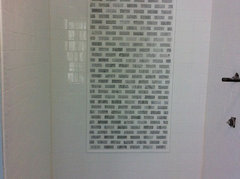
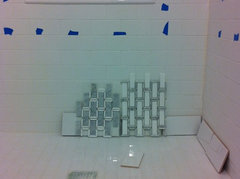
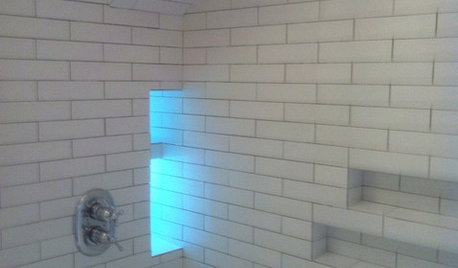
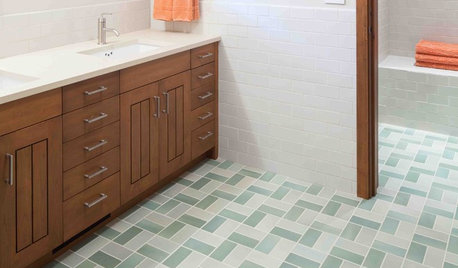
If you look closer you'll notice uneven tiles, especially on the side walls, some tiles wouldn't meet in the corners properly (off by 1-2 mm). Mosaic accent wasn't planned well, some sheets were set too close to each other while some were stretched (spacers, anyone?!?). To top it off, there was a thin sliver of tile from the mosaic accent to the next row of field tiles. Mosaic floor wasn't centered, floor line wasn't straight, drain set too low (green paper is covering the actual top of the drain - there would be nothing else to go on top of it). Also heard back that it was a normal tile job given low quality of tile (regular subway from HD) and I should have been happy with end result...









vpierce