

Till soil before soding
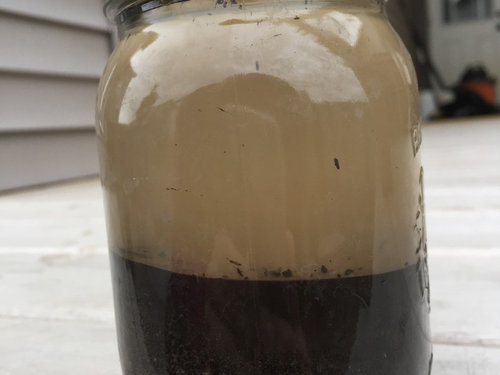
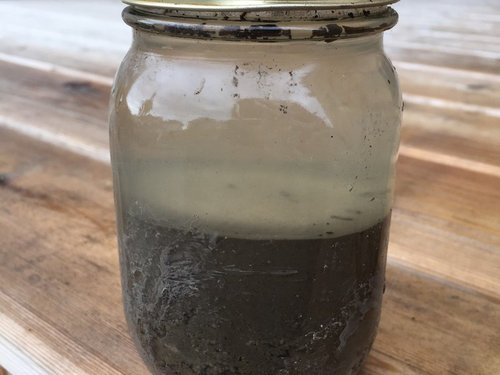
Clay subsoil sample.
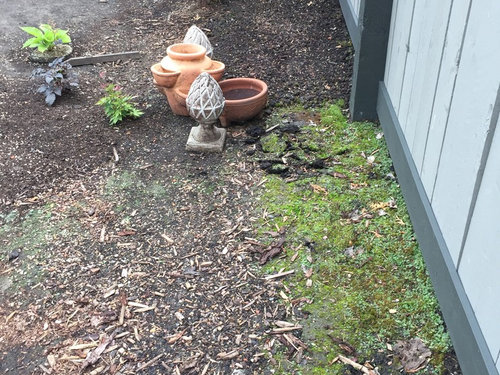
We are landscaping our new construction backyard. The soil is very compacted from building as well as from work that has gone on in our backyard (fence, deck and patio building). The soil has sat uncovered for two years so has compacted from rain as well.
i have done jar soil tests for my topsoil layer and my subsoil yellow clay layer. I seem to have one type of soil in each layer and very little organic matter if any. I maybe have 3 inches of topsoil on top of my clay subsoil. When digging in my soil I find very few worms and no other bugs.
I tried digging amendments about 10 inches into my soil but it results in fairly clumpy soil.
How do I fix this compaction and add the needed organic matter without tilling my soil in order to have flower beds and eventually a lawn?
I can maybe add a couple of inches of topsoil on top of the existing soil but that will not fix the hard pan underneath or add in organic matter. I can't add several inches of soil in top due to grading restrictions.
I will have a very small lawn area in my tiny backyard and I plan on using sod.
Comments (59)
Carebear3117
Original Author9 years agoNow if I end up rototilling in my amendments and regrade the soil for drainage in my swale areas of my yard, will the water drain away out of the swale if the soil gets saturated enough? I amended my front yard last summer and graded the soil to drain away from the house. When they is a downpour I see very little run off onto the sidewalk on the street. I just want to make sure I don't create drainage problems for myself I my backyard. 9 years ago
The article is on a Washington State U website but it is a PDF file, so I don't know it that has anything to do with you not being able to pull it up. It's by Dr. Linda Chalker-Scott, titled "Mycorrhizae: So, What the Heck are They?" and it was published in Master Gardener, Winter 2009, pages 3-6. You can google Linda Chalker-Scott and go right to her page where the article is included in a list of articles she has written. That's the only place I found it. Just a nice introductory article on the subject, but it sounds like you already are familiar with them. The grasses and trees have different kinds of mycorrhizae. You would want the kind for grass.
Are you saying there is a valley in your backyard where water would collect and there's no way to redirect the water? A French drain might help. But having the water run out of the yard would be better. Is this just the water from the roof? You can connect the gutter drainpipes to pipes under the ground and redirect it to where you want it to drain.
Daniel, if Andy is adjusting Ca without regard to the pH, why is it that everyone with low Ca and low pH gets the same recommendation to use maximum bag rate of a fast acting lime? If he were balancing for calcium, he would be calling for lots more lime when Logan shows a big deficit. He likes the fast acting lime and it does bring up pH quickly. To adjust for calcium you would need to use ordinary lime where you could use larger amounts per application. Here is some information on the North American Proficiency Testing program, which may be of interest. Just because Andy likes one particular lab does not mean that other labs are no good. I think people should use a lab that gives recommendations, in addition to data, without extra charge. After they get them they can seek out additional information if they like. They should not have to depend on an online forum to find out how many lb/k of phosphate or whatever they need.
Related Professionals
Sarasota Landscape Architects & Landscape Designers · Grand Rapids Landscape Architects & Landscape Designers · Hempstead Landscape Architects & Landscape Designers · Mesquite Landscape Architects & Landscape Designers · Medford Landscape Architects & Landscape Designers · Evansville Landscape Contractors · Covington Landscape Contractors · Greensboro Landscape Contractors · New Braunfels Landscape Contractors · Clarksburg Landscape Contractors · San Angelo Landscape Contractors · Logan Landscape Contractors · Tuscaloosa Home Builders · Gary Home Builders · Yuba City Home Builders- 9 years ago
Carebear, if you can read this other article by Chalker-Scott, please do so. She discusses problems of incorporating compost into a periennial landscape (which a lawn would be). Basically it's that the compost will degrade over the years and you're left with a sunken landscape. So maybe you need some compost, but a large volume could be detrimental. And let's try this as a link to the mycorrhizae article. I generated the other link through Google and this one is more direct.
Carebear3117
Original Author9 years agoBeckyinrichmond, my backyard drainage is set up to be surface drainage. We live in Alberta where the ground freezes solid in winter so unfortunately a French drain wouldn't work. My yard is sloped so 3/4 of it drains to the low area of my yard and then it's supposed to go down this sloped ditch to the storm pond. The other 1/4 of my yard goes to the side property line, past my ho- 9 years ago
Daniel, I looked up your last soil test. You had a deficit of calcium, according to Logan, of 132 lb/ac at a 4 inch depth. Adjusting to.a 6 inch depth for applying amendments and assuming that inches 4-6 are the same as 0-4 (they're not) that is a deficit of 198 lb/ac. Calcitic lime can be 30-40% calcium. That's assume yours is 40%. That would require 495 lb/ac of lime, which is about 11.4 lb/k. Did Morph recommend that? He recommended 3 lb/k and even said it was optional. Why? Maybe because your pH was 6.0, an acceptable pH. And because there is no need to get to that "perfect balance" which Logan sets as the target. My last soil test with Logan showed a 786 lb/ac deficit of calcium which would work out to needing 67 lb/k of lime. Andy prescribed 9 lb/k in two applications, total of 18 lb/k. How much lime did I really need? It might not have been 67 lb/k. The only way to know is with the buffer pH test.
- 9 years ago
Carebear, I can't tell if your yard is draining properly. Does it work like it's supposed to or is there something not working? If the 3/4 part does go to the pond and the other 1/4 goes off the property, it sounds like it's okay.
Carebear3117
Original Author9 years agoMy message cut off. Anyway, the side drainage goes to the front street. If I amend my soil in my backyard but can't amend everywhere in my yard will it still drain? Here are some photos. The long strip of rocks along the back of my fence is my rear swale. This easement is owned by the city for drainage.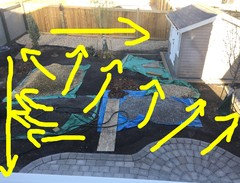
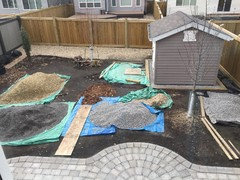
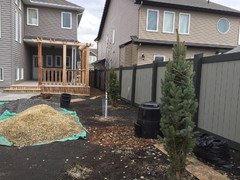
Carebear3117
Original Author9 years agoYes it drains fine right now. We had to get rough grade approval for our new home and then final grade. I'm just afraid if I mess with things too much I'm going to mess up the drainage but my yard is compacted so I'm stuck. 9 years ago
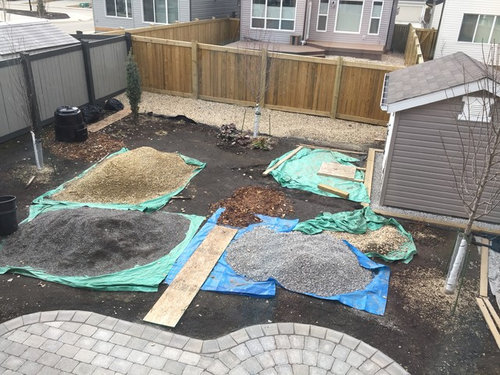
Daniel, can I open my eyes yet? carebear, what are those piles of stuff in your yard?
The soil jar test is a timed test. Take a picture of the jar with a ruler next to it. Then shake the jar and take a picture with a ruler at 2 minutes, 2 hours, and 2 days. Compare the height of the settled material at the various times to determine sand, loam, and clay content.
If you pay Logan Labs they will interpret your soil test for you. I
have seen a couple of those, and they were a simple NPK and lime
recommendation. They were nothing like the total chemistry tune up that
morpheuspa and andy give.Logan Labs was selected because it provided the most consistent, complete, accurate, and reliable testing using methods which have become standard. I suppose you could make a case that the buffer pH and other tests would make a more comprehensive test. Logan Labs does provide the cation exchange capacity which gives more information than most of the other labs provide as to the ability of the pH to change with applications of lime or other pH altering materials.
For answers as to why morph and andy do the things they do, you can ask them personally. Private messaging is perfect for that.
- 9 years ago
Carebear, I see your problem. You are mixing all those piles of stuff to put into the yard. Yes, I would be concerned about how things will drain after you put all that on. Maybe there is a landscaper in your area that can assist and make sure it's done correctly. What are those piles? Are you working off someone's recommendation to apply it? Maybe they can help.
Carebear3117
Original Author9 years agolast modified: 9 years agoThe piles of stuff are left over building materials from last year. One pile is road crush and one pile crushed limestone. Both piles are left over from our paving stone walkway/side yard limestone crush path built last year. I am waiting for my paving contractor to come and build me a flagstone walkway from by paving stone walkway to the shed. That should be done in the next month hopefully and those two piles will be used up in that construction. The other couple of piles are leftover rock from our shed base and for under our deck. I ordered extra for my side yard which hasn't been put down yet (I think I ordered a bit too much). I would be amending my soil with compost, peat moss and very gritty sand. I used that in my last yard which started out gumbo clay and after a couple of years ended up pretty nice soil with lots of worms. My garden in my last yard grew like crazy so I think I did well there and planned to do the same in this yard. It's the compacted soil with very little life that is holding me back in this new yard. And I also don't want to mess up the grading because this new yard has more complicated grading.
Carebear3117
Original Author9 years agolast modified: 9 years agodchall, I will take photos for the jar soil test and post them here. Thanks. I am from Canada so we don't have access to Logan labs. I would have to send the sample to the US which could be more expensive than trying to get the test done here. :)
- 9 years ago
@becky: I'm not sure which soil test you are looking at but my last one did not have a 6.0 pH I can assure you. I'll have to look it up tonight when I get home.
Carebear3117
Original Author9 years agoSo back to my dilemma. Once my flagstone walkway is built and all the piles are gone and I mark off where the grass will be and the flower beds will be. I will be left with compacted soil clay subsoil with only a few inches of topsoil on top. Where do I go from there? This will be the second summer we have been in construction and I am ready to be done with it. Thanks again for all of your wonderful advice. I really appreciate it.
Carebear3117
Original Author9 years agoIf I call a landscape contractor in to deal with the soil I can tell you right now they will touch up my grading with a bit of top soil and call it a day. It is very hard to find a contractor around here that cares about soil and plant health. They are just out to make a fast profit and move on to the next customer unfortunately.
- 9 years ago
If your soil was in good condition it can recover by itself. You're probably not in that situation. I'd do an infiltration test. If I recall, the procedure is to cut a hole 1 ft by 1 ft by 1 ft deep. Make it a nice flat bottom but don't pat it down overly. Fill the hole with water from a garden hose and note the time. Measure the drop in water level every one or two hours and record how many inches it drops. I think 2 inches per hour is good. I think the details are on around the yard as to what is good and bad. The procedure above is correct, though.
- 9 years ago
Daniel, your soil test. There was also a potassium deficit which Morph attributed to sampling error. He didn't trust the results of the test.
Carebear, thank goodness that was all stuff you were not planning to till in. How about if you got the stuff yourself that you want to use and just use the contractor for the labor?
Carebear3117
Original Author9 years agolast modified: 9 years agoDaniel, when I dug for my large caliper trees I had to dig a huge hole that was 4 feet across and 2 feet deep. I used a pitchfork for the majority of it making sure not to glaze the soil. I then filled the hole with water and waited for it to drain. Most of the water drained away after 8-12 hours except for about 4 inches at the bottom that remained after 24 hours. I think the drainage in my yard is not too bad. I don't have standing water after a rain except in a low spot in my swale which needs to be topped up with extra soil. It is more the soil health I am worrying about as it is lifeless except in a couple spots in my yard and it stays wet for quite a while and cracks when dry. While digging for my trees/plants I did not see one bug or earthworm last summer. This year I have seen a few worms and a few bugs so it has improved some.
- 9 years ago
If it drains well, then it's not compacted. Add as much organic matter as you can to improve soil structure. Use miloranite, soybean meal, alfalfa, grass clippings, clean sawdust pellets (like equine pine) etc. whatever you can get cheap. Especially important is to mulch in as many leaves as you can get in the fall. All of these things will work their way in and will attract worms and othe micro critters. I'd get the soil test and work any amendments into the top few inches. Till it if you want, I don't think it will get overly lumpy when you sod if my experience is any indication.
- 9 years ago
Daniel, if your potassium percentage was not correct, it means the other base cation percentages were not correct also. They all have to add up to 100%. If the potassium% was higher, then probably calcium% would have been lower and their calculated deficit would have been higher. Morph didn't know and you don't know how much lime you needed. It wouldn't have been a whole lot, so he recommended a small amount (6 lb/k by the way when you add in the spring 2017 app) and your pH was ok anyway, just not perfect. It was just a guess. One ought to have a calculated lime recommendation when getting a soil test back. It's a very basic thing. Also, if a value seems odd, like the potassium deficit, you can ask the lab to rerun the sample.
Dchall, CEC is a quite common thing on soil test reports. It's not unique to Logan. I will work on Logan tests that come in here, but you should stop promoting Logan by promising that people they will get an analysis here. I will be calculating ppm and comparing it to SLAN values. The more involved part is picking appropriate products and the timing of apps and other considerations like P getting tied up in alkaline soils. I have no way of making a good lime recommendation. Andy gets around the problem by using fast acting llime, which gets pH up for the current year. If my approach isn't what you want, direct them to Andy instead of saying "post it here." But check it out with him first.
Carebear3117
Original Author9 years agoBeckyinrichmond. I found a place that does soil testing near me. What are the most important things to test for? Nitrogen, potassium, phosphorus etc? Do I need to test for anything else? Thanks
Carebear3117
Original Author9 years agoFor a complete soil test it is $79 CAD for micronutrients/macronutrients, pH, etc. I think I will go for that test because it gives me the most info. Now since I have a clay subsoil layer and a "topsoil" layer, can I mix a bag of the two soils together and bring in one sample or do I have to do two separate samples with the different soils?
- 9 years ago
That seems very expensive. Here in the states the land grant colleges offer soil testing and it runs about $10 (at least here in Virginia). Go up to that link I left Daniel about North American Proficiency Testing. It has links to labs. You could check them out. Most would have websites. I am going to copy in Ridgerunner's directions on taking samples. Maybe he will weigh in with advice on picking a lab. Hopefully he will have advice too on your subsoil/topsoil issue. The grass is going to be growing in both but the part you generally test is 0-4 inches. You however plan to till and mix things up. And the other stuff you're adding in won't be tested. Nitrogen is not tested because it varies so much. Fertilizer recommendations for nitrogen are based on what kind of grass it is. Here are soil sampling directions:
Proper and consistent soil sampling is a must in order to reduce inconsistencies and get the most accurate results possible.
Proper: When digging the samples, use only high quality steel tools. Use only plastic buckets for holding and mixing the samples. Avoid brass, galvanized or other zinc coated utensils. Otherwise, the sample can be contaminated. If you do not have a soil sampling tool (auger or probe), insure that your soil sample is an even thickness vertical slice and not a wedge shaped slice. Take 8 samples, evenly dispersed, from each 60 x 60' area. Try not to sample any sooner than 30 -60 days after an amendment application.
Consistent: Take all samples to the same depth (4" for turf) and do so each year of testing. Use the same "range" of soil for each sample and from year to year. e.g. soil from the 0" depth down to the 4" depth (preferred, but remove the soil surface and any fertilizer prills it may contain). or from 1"-4", or the 2" to 4" depth, etc. if so suggested. Stay consistent. Take the samples in the same month each year.
Use the same lab each year. Use an established professional or university lab that offers a broad menu of testing processes, reports results in ppm or lbs/acre and at a minimum, reports CEC/TEC, Ca, Mg, P, S, K, Na, OM, Mn, Zn and Cu. Verify that they offer ammonium acetate cation and buffer pH testing and that their fees are reasonable. Verify if they use Mehlich III (unless otherwise recommended) as their default extractant and extra points if they offer Bray and Olsen too.
Do the vinegar test on a small sample. If it fizzes, request that an ammonium acetate test be performed. If it doesn't fizz, either ask for or be prepared to request that (if the test comes back with a soil pH less than 6) a buffer pH test be done.
Carebear3117
Original Author9 years agoThank you! I live in Canada so I don't think I can send the sample off to the US without it being expensive for shipping/testing. In my province of Alberta when searching online there are very few companies that test soil unless it is for a commercial farm. We are a prairie province so they are lots of farmers here.
- 9 years ago
This has been one of the longest reads ever. And confusing. There were so many things I wanted to say as I read through this, but I've forgotten what they were.
Carebear,
While I'm thinking of it, FYI, here is a lab that a fellow Canadian has decided to use:
http://forums2.gardenweb.com/discussions/4683209/which-fert-to-apply-please?n=30
$79 is awfully high, The OP in that thread says it's $25 from that lab.
You could cal A&L Canadian and tell them what all you want your soil tested for and see what they would charge. I'd guess that A&L could test for everything you want on both the topsoil and the subsoil for the same price as one test from the lab you found. 2 for the price of 1.
I guess I'd have to say that it would be best to get the soil tested before tilling and that you should get the 2 different soils tested separately. I hate to see you spend double, but I hate to see you tilling too and it's best to know exactly what your getting into. Maybe once the tests come back you'll re-evaluate.
- 9 years ago
@becky: My bad. You are correct about my 6.0 pH from the most recent test. I don't really want to argue about morpheus' recommendations with you. If you had issue with how he did things you should have said so at the time, and not after he has left the forum and is unavailable for comment. Clearly he didn't care what the pH settled out at as long as the minerals were in the right range.
I'll be resampling this year to see whether I had spurious figures or sampling.
- 9 years ago
Daniel, I was just trying to illustrate that the Logan test has shortcomings and that the interpreters using it aren't always the"balancing the soil." Andy even had a warning about it: "don't chase the ratios." He would often make recommendations just for plant nutrition instead of trying to get a certain balance of minerals. One more point about this supposed virtue of balancing: A soil with low Ca and low pH could be amended with gypsum (lots of Ca) and the pH will not rise. It's the carbonate action of lime, not the addition of calcium, that makes the pH change. You could have a perfectly balanced soil with the pH out of whack. I have no issue with Morph's lime recommendation. It wasn't required and what he suggested is fine. But he was not calculating it and he wasn't trying to get your soil perfectly balanced. I was the one that could have used a more accurate number for lime, as I had a greater shortage. A buffer pH test is the way to let people know just what they need altogether.
- 9 years ago
@becky: I can't say whether you or morpheus is more qualified to analyze my soil. I haven't seen you do any complete analyses so I assume you don't have the confidence to do so, which is good because nobody should make recommendations when they are not qualified. As far as my soil goes, you are seeing the third of three years of amendments, so I believe what you might recommend based on one test might be different from the same results seen with the benefit of two prior years included.
You said: "A soil with low Ca and low pH could be amended with gypsum (lots of Ca)
and the pH will not rise. It's the carbonate action of lime, not the
addition of calcium, that makes the pH change." I'm pretty aware of that since I was the one who explained it to you while discussing acid/base chemistry about a year ago. Maybe you can find that, too. :o) The lawn industry seems to like using shortcuts like saying things like add calcium to raise your pH, or to call minerals like calcium and magnesium "basic" elements. That is misleading and they are not basic in terms of chemistry. It even confused me when I first started learning lawn care until I realized that the industry is a little loose with its terminology.Maybe guys like Andy and morph have been doing it all wrong and you absolutely need a buffer pH test. From what I'm reading that kind of test might be more important for crops where you target the pH to the crop, and then till everything in, rather than lawn care. Having said that, I'm sure a buffer pH is helpful in any case.
@ridgerunner: I didn't just recommend Logan. I recommended Logan plus someone on "around the yard" to read it. I do that because you are the only one doing readings here and you don't seem too keen on carrying on with it. The other forum continues to read reports and they prefer Logan. Not complicated.
My impression is that there is a wide range in quality of testing across the country. Logan came out on top according to Andy, but if you can vouch for an accreditation method that really works, then great! I think it is a disservice to just tell people to get a test done by their local ag extension or whatever if such a place has not have a proven track record.
As far as motivation I believe people who come here are better served having someone in the forum read it and give recommendations. If they have gone this far then maybe they have the interest to really do it right. On the other hand I guess some people don't care so much and the lab recommendations for how much lime to till in for your soybean crop will be fine.
Also, if you have to worry about whether an annual test costs $25 or $45, but is a reliable test, then you might need a second job.
I don't have any hidden agendas and I think both of you people are very knowledgeable. I'll stop recommending any lab as I really don't know much beyond what worked for me.
- 9 years agolast modified: 9 years ago
@ Daniel,
I'm sorry I put you into the crossfire. You didn't deserve that. You DON"T recommend LL AND say that it will only cost them $25. You DON"T say that someone here will read it for them and you DO say that they MIGHT need to have it read by someone elsewhere on another site.
As per recommending a lab. The whole advantage of directing people to an NAPT-PAP accredited lab is that NAPT is "vouching" for their quality and accuracy of testing, not some unknown like me or any other internet poster.
A buffer pH test isn't absolutely critical for adjusting pH. It's not absolutely critical to know the value of any nutrient. If a test only reported nutrients as very low, low, medium and high without values and they report your potassium as very low, you would/could add small amounts of K every year and retest the next year to see what changes have occurred. Not very efficient, but it would work in most cases. So, you can do the same thing with lime/pH. But it makes sense (as you seem to agree) to know exact values of deficiencies, if for no other reason, just to know. Especially when many laboratories will provide that information as part of their standard test, at a cost equal to or lower than LL. Many of those labs also include EC and NO3 and NH4 values. Not particularly important in most cases, but if it doesn't cost you anything extra, what the heck.
Once again, my apologies for painting you with the same brush and I'm coming to the conclusion that dchall is going to do what he will do.
BTW, I hope this isn't our last conversation here as we have both directed people to other sites :(
Carebear3117
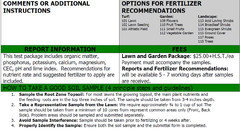
Original Author9 years agoWow! this has been quite the thread! The majority of what is being said about soil testing is way above my head! lol @Ridgerunner thank you for the suggestion about soil testing in Canada. I called A & L Laboratories and they say they only do a "Lawn and garden soil testing package" for residential use. It is $25 per sample which is reasonable. I was hoping you could look at this and see if you think that these nutrients would be good enough for what I would need. She said the analysis would give recommendations on what nutrients to add to my soil based on any deficiencies. They also list the soil sampling instructions below. Thank you!
- 9 years ago
Daniel, I do remember our discussion on pH. I was reading about pH then and trying to understand it and you were very helpful. The understanding we came to is that the statement "get the cations balanced and the pH will take care of itself" is incorrect. One of main benefits of a soil test is to know whether or not to add lime and how much to add. For some people that it is their only concern, the only reason they have bothered to get a test. That very basic information is missing from the standard Logan test and even with Andy's or Morph's analysis, you still don't know. They are just guessing. If someone has a large calcium deficit, they will recommend the maximum amount of fast acting lime. If someone, like you, has a small deficit, they recommend a smaller amount. The package would lead you to believe that if you need x amount of lime, you can get the same results with their product but you only need about 1/4 the amount of ordinary lime. You do raise the pH quickly that way, but it doesn't last. If the lime recommendation is for x amount, you really do need that amount (whether it's fast or slow lime) to get the pH to the target and keep it there for a few years. The manufacturers of the fast acting lime apparently intend you to use the maximum amount to get the pH up and then for every year thereafter you would use the maintenance amount. Indefinitely. I think both kinds of lime have their uses. My quibble with Andy's and Morph's way is that we are never told how much lime we need altogether.
We can better provide a better service by helping people understand the recommendations they have gotten from a lab. The labs don't do much explanation. Someone can come on here and say "The test says I need 2 lb/k of P and 3 of K. How do I do that?" Lots of people here can help with that. Instead of saying "Post a Logan test and we'll tell you what to apply (since they don't)," we should say "We'll help you with any questions you have about the test and its recommendations."
As for Andy's selection of Logan after sending samples to various labs, think of this: he used a bag of purchased soil. He has no idea how many locations the soil pile came from, what depths of soil are included, how or even if it was mixed. Think of the instructions for soil sampling: about being careful to dig to a certain depth, mixing it up, not using certain metals to dig with, doing the test at the same time each year. I am not surprised he got differing results from labs.
- 9 years ago
@becky: of course I am assuming that andy controlled the variables when he submitted samples to the various labs. I think he submitted the same sample multiple times to each lab, something like that.
I'm not sure why you keep coming back to having to know how much total lime to add in order to bring your pH to a specific number. That's not what morph did. If you are targeting a particular ppm or lb/A calcium figure, that has nothing to do with pH calculations. If I am short 500 ppm over 1 milliion lbs of soil just do the math and you know how much calcium you need. morph said my pH settled out at 6.0 and his settled out at 6.1, both of which he was completely fine with. I can't argue the details of his method because it is his method. Had my pH been 5.5 or 9.2 then that would have been reflected in the mineral content of the soil and he would adjust accordingly. I would think in this case that a buffer pH would be good information, rather than just pH, CEC and calcium content, but maybe not necessary if it costs extra $. I'm not morpheus so I can't say.
You do bring up good points and I hope to get answers in andy's forum. Unfortunately it doesn't look like there is any capability to use pm's on that forum.
@Carebear: What's the idea with butting into our conversation, huh? :o) j/k. If the others agree I'm happy to let this conversation get back to your issue. Did you redo the jar test?
Carebear3117
Original Author9 years ago@daniel, haha! Sorry to butt in on your conversation. Just reading your messages I can see I have a lot to learn! I haven't had a chance to work on the jar soil test but maybe tonight after my appointment. More to come! :)
- 9 years ago
@carebear,
Well, I'm not overly impressed with that at that price. That will provide values for the most important nutrients and the ones that most people are willing to adjust. It is nice to have the micronutrients Cu, Zn B and Mn and Fe values FYI and if you are a gardener who has experience applying them, you want them. The other red flag is they use the term "Buffer index". Some labs have gone to a calculated lime application recommendation based on a formula because it's cheaper than testing. I'd call them and verify that they provide a Buffer pH value derived from testing. (Sikora, Adams-Evans, Mehlich and SMP are common buffer testing methods)--ask which they use.
Use the vinegar test--maybe it won't mater.
It might be worth jumping through a few hoops to use a lab in the U.S., if you are a serious gardener who amends the micros. I believe all of the labs that I gave as examples have the capability to accept soil samples from other countries. You could call them to see if they can tell you what you would need to do.
BTW, I did some editing to that above referred to post to clarify some things.
- 9 years ago
"If I am short 500 ppm over 1 million lbs of soil just do the math and you know how much calcium you need."
Daniel, do the math and it's about 23 lb/k of Ca. Then figure out the lime that delivers that: about 57 lb/k. Did Morph or Andy EVER tell anyone that it would take 57 (or more) lb/k of lime to bring their soil into balance? I haven't seen it. How many people know what a ppm is, much less how to estimate the lime? It's even more complicated with Logan because they report in lb/ac but it varies according to the depth reported. So people rely on Andy and Morph and HLG. Their recommendation is the same, whether the shortage is 500 ppm or 1000. If someone is adding lime, whether it's to make up a calcium deficit or to bring the pH, it just happens that both things happen. And you're right, it's fine to have a pH of 6.0 or 6.1. But if you do go for the target of 6.5, it gives you some wiggle room when pH starts dropping. I think many people have the impression that if they use Andy's or Morph's recommendation, it will take care of their deficit. It's not clear that it will only get the pH up for the present year. And it's only a partial solution for whatever Ca:Mg imbalance they may have requiring calcium.
Andy could not send the exact same sample to each lab. He could only send another sample from the same bag.
Carebear, I am sorry to have taken over your thread this way. Ridgerunner has been pointing out Logan's shortcomings for months, even announcing he won't interpret the tests anymore. I wrote to Dchall and didn't get a response. He has continued to plug Logan, despite what Ridgerunner and I, the only people interpreting them here, say. At least Daniel understood that tests posted here might not get interpreted. I hope we have now explained our objections.
- 9 years agolast modified: 9 years ago
@daniel,
If you are targeting a particular ppm or lb/A calcium figure, that has
nothing to do with pH calculations. If I am short 500 ppm over 1
milliion lbs of soil just do the math and you know how much calcium you
need.Edited as I too realized that I was rambling.
Boiled down, I guess I'm trying to say that adding a cation wont change pH (you are correct); however, if the Hydrogen is not neutralized, it is still there and will re-balance by pushing much of any cation amendment gain and/or other cations off TEC sites. This push back is not particularly significant for soils with pH >6, but in low pH soils it can create significant issues when attempting to balance nutrient cations.
http://lawr.ucdavis.edu/classes/ssc102/Section6.pdf
http://agriinfo.in/?page=topic&superid=4&topicid=293
http://www.terragis.bees.unsw.edu.au/terraGIS_soil/sp_exchangeable_cations.html
Sorry for continuing to muck up your thread Carebear.
- 9 years ago
ridge: some interesting information I'll have to look through when I have more time. I'm not 100% sure of what conclusion you are drawing, or if you are making a specific point with this information. I can see from your discussion how hydrogen might get pushed down into the lower levels for awhile, but ultimately by adding calcium carbonate you are changing the equilibrium of the system, and it has to result in a higher pH once things settle down. I don't think the hydrogen hiding down at lower levels escapes neutralization in the end. Of course this makes sense because why else would we add lime? I guess I'm just rambling...
- 9 years ago
I did a lousy job of trying to explain my tenuous understanding of the science involved danielj. Erase it from your memory as I have removed and edited it.
- 9 years ago
Daniel, the Logan deficit figures are the lb/ac of that element that it would take to bring that element into the "ideal" balance in the reported depth of soil. If you want to amend 6" and only sampled 4", you would multiply the deficit by 1.5. Then you have to see what percentage of the product will deliver that amount (and convert lb/ac to lb/k). This idea of an ideal balance is the basis of BCSR. Wikipedia has a good article on it. Here is the conclusion:
Much of the research in favour of BCSR can be adequately explained by changes in pH. Liming soil is well known to improve microbial activity, soil structure, nitrogen fixation, and palatability of forages. It is also used to correct Ca and Mg deficiencies, change nutrient availability and reduce manganese and aluminium toxicity that can retard crop growth.[42] While fertiliser recommendations based on BCSR continue to be in widespread use by private soil testing laboratories, the evidence on balance suggests there is no benefit to crop yield or quality. Any perceived change is likely to be due to correction of deficiencies (which would have been picked up by the SLAN method) or the result of other beneficial soil practices used in conjunction, when transitioning to sustainable agriculture.
In his 2001 study on the Albrecht method, Schonbeck stated "A review of over 100 published studies and conversations with several soils consultants revealed evidence that proper cation balancing is inherently site specific. Most soils apparently do not need to conform to the Albrecht formula to be healthy and productive."
Here is the link to the article, which is worth reading. The other approach to making recommendations is SLAN (Sufficiency Levels of Available Nutrients). It looks at the level of a nutrient in the soil and compares it to the level that has been found sufficient. This is most widely accepted method. By fulfilling deficits, some excesses are reduced and we get to levels that are neither deficient nor excessive. While the Logan test caters to BCSR, with deficits based on ideal percentages of base cations, it often makes more sense just to make sure a nutrient is sufficient. That's my approach. It is useful to look at Ca:Mg ratios and see if there's anything whacky but I generally ignore the Logan deficit figures. In the case of your soil test, if the K deficit is an erroneous number, it also means the other deficit numbers were erroneous. The "value found" numbers would be accurate (except in this case Morph thinks the reported K number is wrong).
Using a buffer test to get a lime requirement is a straightforward way to find out what's needed. Getting a lime requirement by calculating a calcium deficit according to an ideal balance means you need to take into consideration the other deficits and excesses and aim to get everything just so. It's more imprecise and impractical. Both will bring the pH up and fulfill a calcium deficit because that's what lime does. It's a matter of getting the best lime estimate. Much easier to do with a buffer test. I want to point out again that when the maximum amount of fast acting lime is the only recommendation for people with a large deficit, they are neither fulfilling their calcium deficit (just reducing it a little at a time) nor correcting their pH except on a short term basis. It is better for people to know up front what their lime requirement is. Perhaps they may want to do the first application with a fast acting lime to get the pH quickly and then use an ordinary lime (calcitic or dolomitic depending on their Mg situation) for the next. They can do up to 50/k per application of ordinary lime. It is much slower to act but the flip side is that it sticks around longer and continues to reduce acidity.
- 9 years ago
Becky: Yes I'm aware that there are differences of opinion between the two methods. I don't think it matters one way or the other for a typical lawn. I could see it being important (ie, $$$) when you have 100 acres of corn to do things with the least cost. I'm not well versed enough to know whether BCSR was based on faulty science or not. I do know that just because a group of people say one method is good and the other is baseless, that does not make it true. Of course if they have actual data and the other side does not, then I would go with that side.
I agree that if pH is a problem and needs significant adjustment then the buffer information would be good to have.
- 9 years ago
Daniel, as an example of BCSR and SLAN differences, take a look at this soil test which I just worked on. Using SLAN, I found a shortage of 4 lb/k of potash. Using BCSR, the shortage is 6 lb/k. Four lb/k is all he needs to have sufficient nutrition. Using 6 lb/k would get him closer to the ideal balance, but it doesn't make any difference. He is never going to get to the ideal balance anyway because he has alkaline soil and he can't add hydrogen by any practical way (sulfur can lower pH but it's impractical to use sulfur over a yard to lower pH). I can't think of any advantage to recommending 6 lb/k of potash. It just seems excessive. And by the way, everything I told him you, or many other people, could have told him if you knew what his shortages were. Whatever value I have given him is in brainstorming how to best get him the 2 lb/k of P and 4 lb/k of K. If people come here with that kind of information from a soil test with recommendations, many more people could assist others with their soil test questions.
Carebear3117
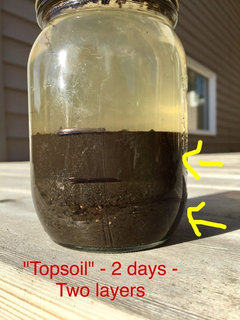
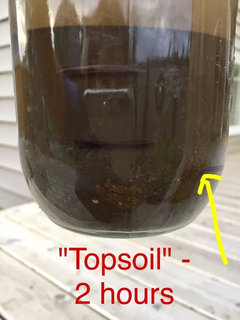
Original Author9 years agoI re-did the jar soil test for my "topsoil' sample. I have two distinct llayers with some sand grains at the bottom of the jar. I haven't been able to redo the subsoil jar test yet because we had a big storm last night but I will post the results in a couple of days.
What do you think about my "topsoil" sample?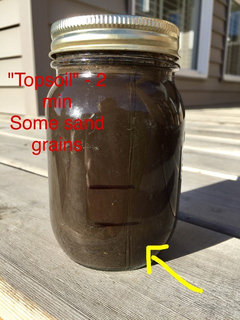
- 9 years ago
In the last jar it looks like there is very little cloudiness after 2 hours. Looks to me like you have around 50% or 60% sand the the remainder silt for a "sandy loam" which is good. I'm curious to see if there is any clay in the sub layer you talk about. I'm thinking not if that large hole full of water drained so quickly.
I'd still do the 1 ft cubic water test in a central area of the lawn without a slope. It's easy to do and might be more accurate than what happened in a large hole 2 feet deep.
Carebear3117
Original Author9 years agoThank you so much for your interpretation @daniel. My entire backyard has a slope so it will be hard to find an area that is flat. I will dig the hole anyway and see what I get. I'm pretty sure my subsoil is clay as it sticks together, cracks like clay, I have a hard time breaking it apart, it rolls easily into a ribbon and doesn't want to break, drains poorly and gets waterlogged easily and it dries hard as a rock. Also, around here subsoils are supposed to be clay so they prevent water in the basement and flooding around the foundation. We will see if that is what I actually have when I do the jar test on the "clay" soil. :)
From our lot grading instruction brochure:
As settlement occurs, it becomes necessary
to redo proper foundation grading by adding
additional soil to re-establish the required 10%
slope away from the building. Decorative mulches
should be removed and clay should be added to
re-create the slope. In extreme cases, topsoil and
grass may have to be removed prior to adding
additional clay.
Carebear3117
Original Author9 years agolast modified: 9 years agoI found a document with the soil map for our area. Since soil can vary from yard to yard it may not be completely accurate but my subdivision was built on what used to be prairie farmland. Of course our top[soil was scraped off and trucked away during the building process and then some subsoil was brought back in to fill, compacted to create the rough grade. Then we purchased topsoil to meet the final grade requirements. This is what the document says about existing soils in our area:
Malmo Silty Clay LoamThe Ellerslie association consists primarily of Chernozemic soils. These soiIs are characterized by a dark colored, granular and friable Ah horizon (topsoi I) of high fertility. The B horizon is fairly friable while the C horizon is calcareous but only weakly saline. Soils of this association are developed on lacustrine silty clay and clay material.
The soiIs of the EllersIie association have the highest potential for landscaping and for supporting plant growth. As a topsoil source it is superior to the other soils in terms of thickness, organic matter content, and total nitrogen content. At the same time the analyses show that the water soluble salt content, as expressed by electrical conductivity and per cent sulfate, is negligible and should not affect plant growth.
- 9 years ago
That was intriguing, so I looked up Chernozemic and it's a very fertiile soil, so good that it is sold illegally in the Ukraine. Here is a soil survey for Ellerslie association. Ridgerunner wanted you to do a vinegar test (put some vinegar on some soil to see if it bubbles). If it bubbles, that would indicate a calcareous soil. That 1972 survey indicated that pH in the top layer was 6.2-6.8 and the C horizon was calcareous, so it is unlikely that the soil is acidic. So the possible benefit of tilling to till in lime if needed is unlikely.
I have been thinking about the compost, peat moss, and sand you plan to till in. The compost and peat moss will decompose in the coming years. In 2013 I created some raised beds for flowers and vegetables and used a topsoil/compost mixture (50/50). The height has dramatically dropped in 4 years. If you do this, your soil will need to be higher than your hardscapes to compensate for the compost and peat moss decomposing later. It might make sense to do those amendments just for raised beds and not do it for the lawn.
Carebear3117
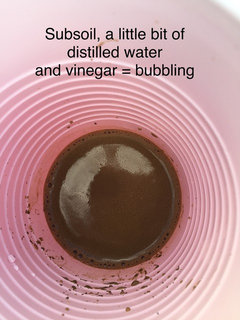
Original Author9 years ago@beckyinrichmond, thank you. I added vinegar to my subsoil and I had definite bubbling throughout the sample but not excessive amounts. I also did a sample of my topsoil with no bubbling that I could see. I'm also doing a perc test. I filled the hole and it has gone down about 4 inches in 2.5 hours but it has another 5-6 to go and it seems to have slowed down.Carebear3117
Original Author9 years agoContinued...
We will see if there is water still in the hole in the morning. Once it drains I'm going to refill and do proper measurements.
If I don't amend the soil at all where I'm putting my lawn, it will be more prone to compaction, correct? Maybe I can add too dressings of compost and sand twice a year on top and then aerate it every year.- 9 years ago
I don't think it will be more prone to compaction than any other lawn. If you're not planning to have kids jumping up and down or to run vehicles over it, I don't think compaction should be a worry. There will be some from rain but everyone gets rain. I think maybe you should leave things alone (no tilling) as the runoff drainage is good right now. Prep the ground (maybe a little raking to loosen it up or aerate if you like), add fertilizer (maybe some organic fertilizer to invite the soil life to lunch), put your sod on (maybe with some endo mycorrhizae applied near the roots when you do), add organic matter (mulched leaves, etc.) on top when you can. The microbes and earthworms (maybe they'll sniff out your goodies and crawl over to your yard) will take the added matter down below. Once you have roots in the ground, those roots will grow and die back and grow in a cycle of root growth and those roots will be a significant source of organic matter. I don't think it would be good to add sand twice a year. Use it just to fill up low spots. Sand doesn't decompose and you would be raising the level of your soil if you keep adding it over the whole lawn.







danielj_2009