Software
Houzz Logo Print
skip1909

How to reclaim property border?

9 years ago
last modified: 9 years ago

My wife and I bought an old house 2 years ago, and the yard had been poorly maintained for a decade or two before we moved in, according to the neighbor.

I had some weedy and badly located trees removed, and am slowly working to get the yard looking less like an abandoned woodlot. The property lines between my rear neighbors and one side neighbor are over run with weeds and basically unmaintained. Everything is in there: multiflora rose, Japanese honeysuckle, mile a minute vine, garlic mustard, ground ivy, goutweed, burdock, dock, pokeweed, poison ivy, asters, goldenrods, sedges, crab grass, brambles, Virginia creeper, wild strawberry, etc... some desirable plants, mixed at least 50/50 with noxious invasives. The border is heavily shaded by trees. The neighbor has white pines and an oak that are being devoured by vines on my side (still on his property), but from his vantage I imagine all he sees are his lawn and pine trees with some understory growth. The property line is a shallow ditch-like low spot, it fills up with water if there is sustained heavy rain but drains within a day.

I cut back the honeysuckle and multiflora a lot this spring and i think i can keep it from spreading, but the garlic mustard was too intermingled with poison ivy for me to get at this year. It rained and snowed too much for me to get the GM in really early spring. I removed a lot of the poison ivy.

How should I handle this area, smothering? I'm thinking of raking all my leaves back there in the fall then covering that with 6-8" of wood chips. Anything that sprouts through that should be easier to isolate and remove. I would try rototilling in late autumn before smothering, but I think there are too many tree roots that would be damaged. I will probably have to hit the area in the fall with a brush cutter to chop down anything woody before smothering. I covered a smaller area back there with sycamore leaves last year and it worked pretty well to reduce vegetation in that spot. Does this sound like a plan?

Comments (13)

  • 9 years ago

    I've got a very similar challenge, and having only myself to manage 9 acres and a 300+ year old farmhouse, have opted for the slow and steady route.

    Step One: Tackle the things that fight dirty.

    If you or someone in your household is allergic to Poison Ivy ("PI") - not everyone is! - identify and mark it. Same for whatever other poisonous things may grow in your area. Be sure it is actually PI - there are several lookalikes. Here in MA, the two primary offenders are Virginia Creeper and black raspberries. VC has very similar growth habit and the young plants have the same glossy shine young PI has. But, PI never has more than three leaves - VC has five. As for the raspberries, that's easy - just remember that PI is already 'defended' by the poison, and thus doesn't need the thorns and bristles like the berries have! Grab a stick and see if there's any 'hair' on the leaves or stalk; the underside of the leaves and the stem of the berries is usually also a pale, chalky color. There's a ton of resources to ID PI online, but if you're unsure, find someone who knows what it looks like or post photos here for a second opinion. With practice you'll be able to spot it on the side of the highway at 65mph.

    I'm ridiculously allergic to PI (the hospital loves using me to gross out new residents) so this step is where I spend the most time. Long sleeves, top and bottom, and a bandana for the head (hair covered too if its long) - PI climbs trees and will sneak attack from above! Disposable medical exam gloves, a roll of surveyor's tape, and some rocks, bricks, or other heavy items if the PI has invaded an open area without trees nearby.

    Check the perimeter, mark what you find by tying some flagging tape to the nearest branch, or tossing down a brick with a bow of tape wrapped around it. Now look inwards from those points, to the lawn - best done after letting it grow up a bit - and see if any PI is growing there. Toss down a brick when you find it - which you should. PI spreads underground and can't resist a nice sunny lawn.

    Now, if you can, look outward, into the depths, and trace the breadcrumb trail of poison ivy as far as you can, or until it becomes a horrifying blanket. In my case, the wild rose and honey suckle prevent me from taking a direct route, so when I find a clear area I try to work my way from the outside inwards, to see if there is PI amongst the brambles and how far in it goes.

    The end goal being to mark a perimeter of where is safe, and where isn't. New plants can pop up anywhere along the "path" you determined by connecting the dots of each plant you found.

    I prefer spot treatment of the whole "chain" of PI at once with glyphosate, marketed as 'brush and vine' killer. Only spray once - it is working, even if it doesn't look like it. If you're not into the chemicals, you can grub around in a hazmat suit on your hands and knees. Either way, you should try to hit entire 'chains' as far as you can at one time. This will NOT be the end of it. You are intentionally pissing off the hydra, and it WILL come back with many more heads - most, conveniently along that nice path you marked earlier. Wait until the new growth leaves are no longer glossy and have good size, and hit it again with the chemicals/digging. Rinse and repeat. I usually can get three or four cycles in per growing season, and push the 'line of scrimmage' back 4-10ft each time.

    If you're faced with a literal wall of PI that has no boundary, and you're allergic, your options are to get comfy in that hazmat suit, spray it all, call in a professional, or get some goats.

    The oils that cause the allergic reaction are extremely stable and won't break down for 10+ years. So any clothing or gear that's been in contact, dirt or dead branches, that's now become a contaminant. Clean up is easy though - dish soap breaks down oils, as does alcohol. There are plenty of awesome commercial products out there too. As long as I wash up within a few hours of exposure, I won't have a reaction. I use alcohol-based hand sanitizer when working before touching my face, just as an extra precaution, because PI on mucus membranes is not pretty!

    Goodness that was long winded,my apologies, I hope something of it is helpful. I will continue with "step two" in a fresh post.


  • 9 years ago

    Step Two: Know Thine Enemy.

    Take photos of leaves, flowers, bark, fruit, buds, cross section of a branch, etc and hit the books to confirm exactly what you're up against. A great resource is GoBotany (https://gobotany.newenglandwild.org/simple/) which focuses on plants in the North East and has a great tool to help ID plants. If you get stumped, the folks on here in the Name That Plant forum are geniuses, and if they aren't certain, make an account on the PlantShare section of GoBotany and submit to Ask A Botanist (https://gobotany.newenglandwild.org/plantshare/questions/)

    Several items I had thought were "keepers" and had been careful not to damage turned out to be mature invasives, the parents of the millions of devil spawn I couldn't seem to vanquish. Eliminate the seed maker, no more seedlings!

    and vice versa, several things I had been wantonly destroying turned out to be native species - and one, which thankfully hadn't met a cruel death by my hand yet - turned out to be endangered!

    Once you know exactly what you're up against, and whether or not its a keeper, punch the name in to your favorite search engine with the word "invasive". The best articles are .edu .org and .gov - NPS, USDA, and nearly every state university extension office have published quality science-backed documents regarding growth and eradication. Keep a sharp eye for info on the best time of year to do things, this I've found makes the biggest difference.

    Make a list of the baddies, their identifying features, and the recommended removal process, what works, what doesn't, and include time of year. Note how long the seed is viable, when it matures, and whether plant is anual or perennial; and ways it propagates, especially if it can regrow from cuttings or root fragments.

    Review your list and identify a method AND time of year that's common across most, if not all, of your pesky plants.

  • 9 years ago
    last modified: 9 years ago

    MEANWHILE, prevent things from getting worse:

    Eliminate seeds before they mature, but be aware many can continue developing after being cut, so toss them in a black trash bag in the sun for several weeks. (Honestly though, I've cheated and cut/pulled garlic mustard then just piled it to decompose, and just doing that made a huge difference the next year). This is best done juuuust after blooming, to reduce the amount of time the plant has to try to bloom a second time. Garlic mustard is a priority because it's seeds can remain viable for TEN FRIGGEN YEARS.

    Get the evil velcro hell ball seed pods off the burdock too. Nothing more obnoxious than trying to get those unstuck.

    Keep mowing, and mow/weedwhack the edges aggressively - avoiding the PI you marked earlier. Aerosolized PI via cutting or burning or otherwise is a bad, bad life choice.

    Rake the perimeter INwards, towards the lawn, to expand the mow-able area as much as possible.

    Stop piling/raking/blowing leaves IN to the jungle. They just make it harder to get things out later. Separate out the sticks, spread the leaves out on the lawn, and mulch them with the lawn mower. Use this to thickly cover any areas you've cleared that can't be mowed.

    Cut a one-foot section out of any vines climbing up trees. Bonus points for immediately painting the raw wound with glyphosate. Note: Hairy vines are Poison Ivy!

  • 9 years ago
    last modified: 9 years ago

    Onto the actual destruction....

    Since you mentioned smothering, we'll start there. It can be effective for many species, given you monitor for escapees, lift and reapply yearly, and use appropriate materials. For example, Japanese knotweed will go through a tarp like it wasn't even there, and I've read rumors of it going through concrete.

    For your GM/PI mix, though, my uneducated opinion is that smothering with carpet would work well. Ask around, post on Craigslist - someone is tearing out their wall-to-wall carpeting, has an area rug that's been ruined by fido / mold / wine, has leftovers from renovation, etc.

    Overlap the edges, watch for escapees, and flip/shake off yearly - else things will start growing on TOP of the carpet. Cover with mulch if aesthetics matter. Some folks leave the carpet there forever and just reseed on top, though personally I'd only consider it if it was a 100% natural fiber rug. I have several old braided rugs rescued from the trash, and move them to new places once or twice a year.

    Tarps, cardboard, newspaper also work, but will need to be weighted down and closely monitored for breakouts. Less vigorous plants can even be buried in dirt, shredded leaves, yard cuttings, etc.

    Best thing I ever used was the rubber sheeting used on large commercial buildings with flat rooves, closely followed by an old billboard. Trickier to get your hands on, but the large size, heavy weight, and UV durability make for near maintenance free smothering.

    Just remember, the PI oils will still be viable. Get a bottle of dish soap and keep it by the garden hose ;)

  • 9 years ago

    DO NOT BURN poison ivy.

  • 9 years ago

    That's so important, I'm going to say the same thing: do not burn poison ivy. Those who are susceptible should NOT breathe the smoke/smoke-borne ash. Inhaled poison ivy can be deadly.

  • 9 years ago
    last modified: 9 years ago

    Thanks for the suggestions! There is quite a bit of blackberry and virginia creeper, and I've gotten pretty good at identifying the poison ivy. Ive used the "Name that Plant" forum here a few time, and also reddit's "whatsthisplant" sub when I felt like I was overusing this site :).

    There were PI vines climbing up trees that were 2-3" in diameter, with overhead branches that looked like they were part of the tree. I cut sections out of those with a limb saw and applyied glyphosate to them with a foam brush. I also painted glyphosate on any ground running sprouts I could see. The PI isn't dominant, but there are little bits of it sticking up just about everywhere.

    The most present invasive plants Im seeing currently are mile a minute vine Persicaria perfoliata, ground ivy Glechoma hederacea, dock rumex obtusifolius, Japanese stiltgrass, and orchard grass.

    The pokeweed seems to be having it's best year ever with thickets of the stuff in places, and there are a ton of brambles, Virginia creeper, a scraggly looking thin leaved aster, and pilewort Erechtites hieracifolia.

    When I mention smothering with wood chips, I mean really smothering it. I was planning to ask the tree service I used last year to dump 3-4 loads of wood chips so I can spread it 8-12" thick. Thankfully I don't have any Japanese knot weed but if I see any of that i will go straight to the nuclear option and spray it/cut+paint it with whatever combo of herbicides I can find.

  • 9 years ago

    I have used the smother-with-chips method and would recommend it over the labor intensive process described above. True, you may lose some desirables buried in the mess but it's a shortcut worth taking. The only weed killer you will need after that is on the severed vines making their way up your trees.

  • 9 years ago

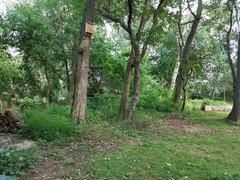
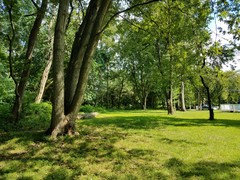
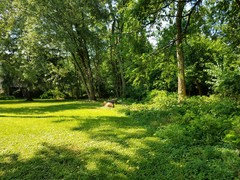
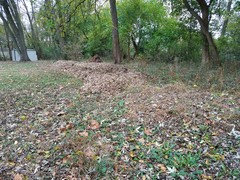
    I ripped out a ton of the mile-a-minute vine on Sunday, balled it up, and then ran it over with the lawn mower until it was mush. I got a couple pictures of the area while working today, just to show the size. My neighbor said it was all gardened and landscaped beautifully a couple decades ago, now it belongs to the weeds and the trees.

    My goal is to kill off the invasives, and eventually plant understory shrubs and perennials from a land trust nearby. Bladder nut, winterberry, common witch hazel, spice bush, Euonymus americanus, and maple leaf viburnum are available and I think should grow back there in the shade and moisture.

  • 9 years ago

    To identify the plants you have to deal with there is a Name That Plant Forum right here on GW. You'll likely get an answer within the hour ... or sooner.

  • 8 years ago
    last modified: 8 years ago

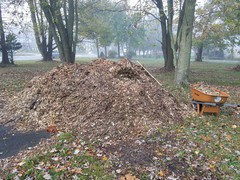
    I got my first load of arborist chips today! My neighbor was having a silver maple over his house taken down, and the tree service was owned by his buddy from way out of town. He was happy to dump the chips at my house and not have to haul them anywhere.

    I started moving the pile this morning, clearing out a thicket of black locust sprouts and mowing down all the vines and weeds that are still clinging to life back there. I'm filling the wheel barrow and dumping each load right next to the last to end up with a layer that is one wheel barrow load thick.

  • 8 years ago
    last modified: 8 years ago

    I spread the chips here where I had the most undesirable annual and woody vegetation. I hope the chips help suppress their seed germination and rot the crowns of the perennials under them.

    I've been reading Garden Revolution: How Our Landscapes Can Be a Source of Environmental Change by Larry Weaner and Thomas Christopher. I've only gotten through ~20% of it, but its already providing valuable information on planting vs. seeding, working with existing vegetation, and creating a landscape that composes itself through site characteristics, succession, and guided disturbance by the gardener.

    I haven't decided exactly what to plant and where, but the book should help shed some light on those decisions. I may end up moving the wood chips in the summer to create paths, so that I can plant and seed the area more effectively, and allow desirable vegetation to suppress the weeds growing there.

Sponsored