Software
Houzz Logo Print
katiejbaugh

Squash Bugs and Borers

9 years ago

OK I think I'm going to be a row cover girl next year. I planted Tromboncinos and a breed of butternut that is supposed to be not to their liking...found bugs laying on both two days ago and think i'm seeing holes and frass too! ARGH! We've been clipping the bugs in half and removing leaves with eggs but the BORERS make me so mad! I read that injecting bt can help...gonna try that. HMPH!

Comments (8)

  • 9 years ago

    Some years can be that way. I'm sorry the little beasts are attacking your plants. They usually don't mess with C. moschatas, though I won't say that they never do. Be sure you continue cleaning up and killing all of them. If you cannot burn the plants to destroy the grubs within (out here in the country we can do such things, but I know folks inside city limits generally cannot burn stuff in that way), then bag them up and send them off in the household garbage. One of the most important ways to control next year's outbreak is to do everything you can do this year to ensure none of them survive to overwinter and attack your garden next year. I think a lot of people perpetuate the problem by not promptly cleaning up garden debris harboring squash bugs and squash vine borers, which sets the stage for overwintering.

    Remember that row covers are only effective before the plants begin flowering. After they start to flower, unless you are growing a parthenocarpic variety, you have to uncover the plants long enough to hand-pollinate each morning, or you have to uncover them and leave them uncovered to allow insect pollination.

    I use row covers a lot, but they are not a perfect solution either. Sometimes I'm guilty of forgetting to remove them when flowering starts---because I'm so busy I don't notice the plants have begun flowering. Eventually I notice the flowers and remove the row covers. I took all the row covers off my succession plantings of squash sometime last week and now they all are on their own and will have to sink or swim. No SVBs here yet, but squash bugs have showed up.

    If you don't have too many SVB grubs in your plants already, you can cut vertical slits in one slide of the stems, remove the grubs (some people sort of fish them out with wire like a bent paper clip, for example), and then do whatever you can to heal the stem. Some people wrap the cut stems in duct tape. Some place them on the ground and heap up several inches of soil over the cut areas. Sometimes this allows the plants to keep on growing and producing, at least until the next round of SVB grubs show up.

    Good luck.

  • 9 years ago
    last modified: 9 years ago

    Dawn -do you put your row covers over frames or just drape over the beds?

  • 9 years ago

    Recently someone posted a link to this site that you may find interesting, even informative. So far it looks like good information to me.


    Search - BugGuide.Net - images

  • 9 years ago

    I've read a few articles about cutting slits and removing bugs then covering with soil. Other suggestions are to stick a needle or pin around the frass opening and try to stab it to death haha! A friend who is an avid gardener said that you can inject bt into the frass holes or order live nematodes (kind of expensive tho) and inject them and they will eat the borers. Oh my goodness! I have never seen pictures of the moth and they say it's commonly mistaken for a wasp sometimes so I wonder how many of those have sent me running when I could have swatted them dead?

  • 9 years ago

    Katie, you should see an old fat woman chasing a SVB moth around with a can of hairspray. (Closest thing I had to pesticide.). They used to casually land on the beans and thumb their noses at me. They attacked my moschatas at the leaf stem/base of the leaf. Of course squash bugs don't care that you're growing c. moschata. It's just that c. moschatas usually grow so rampantly that they outgrow any disease or damage. Some people say that cedar flake mulch helps. The kind they sell for horse stalls.

  • 9 years ago

    Amy - hahaha! I'm the same with the butterfly nets we bought for our grandkids and cabbage moths! My hubby always says he is going to film me someday and send to America's Funniest Videos!

  • 9 years ago

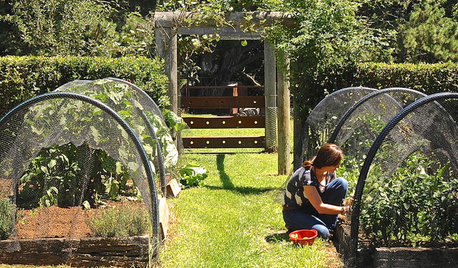
    Katie, I put them over hoops. This is more important than it sounds. If you use free-floating row covers (like Agribon summerweight, for example), you cannot use the netting types (tulle, Micromesh, Proteknet, mosquito netting, etc. ) because some of them have holes large enough that the moth can sit on top of the netting and, assuming the netting is touching any part of the plant, can lay their egg though the netting, depositing it on the plant portion making contact with the netting. With a solid lightweight row cover like Agribon, there are no holes through which eggs can be deposited.

    I see the moths a lot, but not necessarily sitting on a squash leaf, which would be too obvious. Instead they'll sit on a bean or corn plant or whatever and wait for a gardener to leave the garden before they go to the squash plants and leave their eggs. They are sneaky that way. One day I had one sitting on the front door. Maybe it wanted to keep track of me coming and going. I don't know. Maybe it wanted to come inside into the air conditioning. I imagine the moths don't appreciate 90-100+ degree temperatures any more than we do. We have the moths here from roughly June through November.

    One of our members (I see him posting more on FB than here any more) who lives a county east of me has had at least 5 rounds of them in one year before---probably not 5 different generations based on how long each generation takes, but 5 separate and distinct rounds of them within one summer. He has them much worse than anyone else I've ever known here in OK, where they are a constant and perpetual pest.

    I want to laugh (but I don't!!!) when someone moves here from somewhere else where there's only 1 generation of SVBs per year and tells us they will just wait and plant late after the SVBs are done. It doesn't help in our area. Our problem is that the SVBs aren't done here until frost kills them. I know I have had three generations of them before, but not every year. In any year that I've had them, there's always at least two generations--one in late June/earliest July and another in August. Sometimes there is one last round of them around October.

    Two years out of 10, I don't see them at all. The last two times that happened? In 2011 and 2016 so I cannot expect another good year for a few more years yet.

    Amy, I've seen that about the cedar flakes and wondered if it has worked in multiple back to back years for, let's say, 10 years out of 10, or if maybe it has worked for 2 years out of 10 and maybe the cedar is getting the credit when it was their year or two to be SVB-free? I used cedar once. Still had SVBs and squash bugs, and I wasn't even trying it specifically for them. I was trying it to see if it repelled stink bugs and leaf-footed bugs from tomatoes. It didn't.

    Today when I was harvesting tomatoes and squash, I found one squash bug (sadly it got away) and then found squash bug eggs on a lot of leaves. I guess the war is about to begin.

    I don't bother with butterfly nets. We have too many snakes in the garden. I'd probably step on one while trying to catch an SVB moth in a net. Try telling that story at the ER about how you stepping on a venomous snake while trying to catch a moth with a butterfly net.

    Dawn

  • 9 years ago

    Ha I can just imagine this crazy group all running around with butterfly nets raging against miscellaneous flying pests! My DH has definitely witnessed this behavior while in my "natural habitat" aka the garden.. I almost twisted my ankle diving to clap a cabbage Looper to death while dancing around the container garden "obstacle course" on the deck this spring.. Man, that was a sight I'm sure. I got the little bastard though.. so WORTH IT..

Sponsored
Innovative & Creative Custom Closet Designer Servicing Franklin County