Software
Houzz Logo Print
hzdeleted_2655804

Used coffee grounds tea

9 years ago

Have a 25,000 lawn area that we planted after construction and have some trouble areas in lawn pertaining to weak growth and periodic yellowing. I have started going more natural using sbm, milorganite, mechanical removal of weeds, compost tea and used coffee grounds. Had soil test done last fall and ph was 7.23 with higher calcium and magnesium. Used our ph pool water test strip last night and our well water (have irrigation system) is very alkaline as this effects our pool and have to lower pool water ph regularly. So after I water lawn those problem areas seem to yellow more. My guess is the alkaline irrigation well water is inhibiting iron uptake, not sure. So recently have been getting 5 gallon buckets of coffee grounds and putting them in drop spreader filling up spreader with water and applying this 'weak coffee tea' to lawn (sometimes I add in my compost tea too) which seems to be greening up lawn. I have not found any information about what the ph is of used coffee grounds dissolved back into coffee and the effects of applying that to a lawn. Wondering if I should apply elemental sulfur eventually? Thanks for any kind feedback and/or educational information I'm not 100% organic and neither is my lawn, I'm definitely working towards a healthier and more balanced yard and appreciate your tips. Soon will be getting some alfalfa for next application


Comments (20)

  • 9 years ago

    so once brewed grounds are acidic but used grounds that water is added and dissolved into weaker coffee is neutral? I'm thinking I'm getting something that must be lower than my 7.23 to help (milorganite in those areas did not really green up) idk maybe I'll try using a pool ph test strip on my lawn coffee solution I'm putting down, one thing for sure it's quick and easy liquefying the grounds and applying vs even just throwing them

  • 9 years ago

    Coffee grounds have a pH of about 6.2, or slightly acidic.

    Where in the world are you?

    What is the soil type?

    How much organic matter is in the soil?

    Unless the coffee grounds soaked for at least 24 hours, probably longer, there will be no benefit to applying that mix to the lawn.

    User thanked kimmq
  • 9 years ago

    We are zone 5, Wisconsin, built house 4 years ago, we planted lawn and hired grader-so its a newer lawn. I mulch mow the leaves 'out back' that fall from the wood line other than adding soybean meal and compost tea not much other om land used to be a pasture. Most of lawn is beautiful, it's these mottled yellow areas that are interesting to me, haven't aerated because was afraid would hit irrigation system but did dethatch this spring. I have a huge compost pile and started getting compost this year used most for veggie garden and other plantings-guess I will need a lot more for the lawn- what are some other ways to get om to lawn other than spreading compost (front lawn not the sides is 6,000 alone. Thanks

  • 9 years ago

    There should not have been any reason to dethatch after only 4 years,, even after some 40 years here (across Lake Michigan from Milwaukee) I do not have thatch in my lawn.

    Have you had the University of Wisconsin do a good soil test? Where did the soil pH and Calcium and Magnesium numbers come from?

    How well does this soil drain? How well does this soil retain moisture?

    How much organic matter is in the soil?

  • 9 years ago

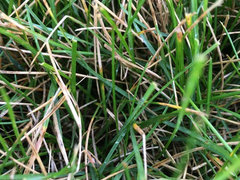
    (Pic from fall)

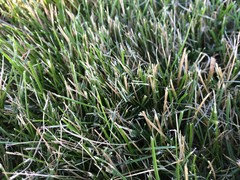
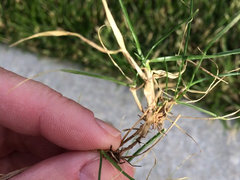
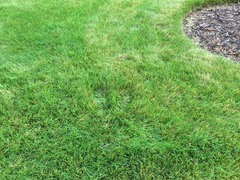
    I had a test by soil savvy, I dethatched the areas of concern as a troubleshooting way to cross something off the list that I thought was a possibility, in the fall I mowed at 3 towards the end of the season and there were areas in lawn that looked like straw upon closer look it was a straw colored sheath on the grass (see pic) soil drains great due to good grade however we have a mound system due to slow soil perc (not water table) and after installing over 400 hundred plants so far I would say it's clay soil. In the beginning of lawn establishment we did use approximately 60% synthetic fert and sprayed weeds now about 90% natural" adding compost tea, soybeanmeal, milorganite, hand remove weeds. In the spring the lawn is dark greeen no mottling (everything is reset over winter) then around this time the mottling starts (have redthread) but this affected area is the same, the grass is just weak there, the rest of the yard is awesome. I don't run sprinklers unless we don't get rain and water deep, going to rule out if certain heads within one zone are pumping more water. I would say this year the area of concern is smaller and in the NW corner of property vs last year was most of front yard, one small strip out back and a 10x10 area I call our side yard. We did have a 3 inch rainstorm and a lot of storms this year a lot of rain all togeher. I also have 3 sets of mower blades so not due to dull blades and mow at highest setting, until latest part of fall then slowly dropped to 3"

  • 9 years ago

    You need to dig in and take a good look at the soil you have and have a good soil test done by your University of Wisconsin Cooperative Extension Service. Find your local office here. http://www.uwex.edu/

    The these simple soil tests may be of some help.

    1) Soil test for organic
    material. From that soil sample put enough of the rest to make a 4 inch level in
    a clear 1 quart jar, with a tight fitting lid. Fill that jar with water and
    replace the lid, tightly. Shake the jar vigorously and then let it stand for 24
    hours. Your soil will settle out according to soil particle size and weight.
    For example, a good loam will have about 1-3/4 inch (about 45%) of sand on the
    bottom. about 1 inch (about 25%) of silt next, about 1 inch (25%) of clay above
    that, and about 1/4 inch (about 5%) of organic matter on the top.

    2) Drainage. Dig a hole
    1 foot square and 1 foot deep and fill that with water. After that water drains
    away refill the hole with more water and time how long it takes that to drain
    away. Anything less than 2 hours and your soil drains’ too quickly and needs
    more organic matter to slow that drainage down. Anything over 6 hours and the
    soil drains too slowly and needs lots of organic matter to speed it up.

    3) Tilth. Take a handful
    of your slightly damp soil and squeeze it tightly. When the pressure is
    released the soil should hold together in that clump, but when poked with a
    finger that clump should fall apart.

    4) Smell. What does your
    soil smell like? A pleasant, rich earthy odor? Putrid, offensive, repugnant
    odor? The more organic matter in your soil the more active the soil bacteria
    will be and the nicer your soil will smell, to a point. Too much organic matter
    can be bad as well.

    5) Life. How many
    earthworms per shovel full were there? 5 or more indicates a pretty healthy soil. Fewer than 5,
    according to the Natural Resources Conservation Service, indicates a soil that
    is not healthy.

    User thanked kimmq
  • 9 years ago

    By the looks of your grass, you might want to sharpen your mower blade. The tops of the grass blades look shredded rather than cleanly cut. That will help the health of your grass a little.

  • 9 years ago

    Thanks those pics are from last fall, this year we have 3 sets of blades and definetly switch them out. Funny though there is that strawish looking grass this year, I think it's a reoccurring fungal issue

  • 9 years ago

    I meant to add that if you do need to apply sulfur, you should check out a farm supply. They will likely have 50lb bags of 90% sulfur 10% bentonite for about $25. A lot cheaper than some acid mixes that are around $10 for a six lb bag of 13% sulfur. The bentonite is a clay that is supposed to expand when damp which helps the sulfur pastilles dissipate. Your extension should be able to tell you the rate of application based on your current pH and soil structure.

  • 9 years ago

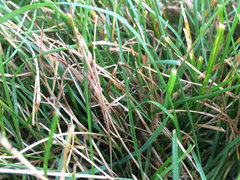
    Thanks I did call earlier this year the feedstore nearby and that was around the price they had for sulfur. I haven't sent in another soil test this year yet. It has been so rainy and cooler this summer here in Wisconsin, lawn is looking great have been applying lawn restore, milorganite and coffee grounds, lawn is thick and lush ( except when I drop to 3.75 instead of 4) for mowing then you can see the residual of either fungus or whatever causes lawn to get strawlike in some areas. Trying to go natural and busy pulling weeds on 25,000+ sqft lawn and other gardening tasks so sometimes I just have to overlook some of the "imperfections" but still curious what causes it, so will send in a sample soon.

  • 9 years ago

    Yep, I hear that. I think that's the appeal of traditional products.. Ease of use, lower costs, and reduced labor needed. It sure can be tempting at times. I'm in the same boat. I like going more natural, but with two little kids, I can't spend all of my time in the yard getting every last weed... So I end up with a pretty good looking yard, but not perfect.

    I'm no fungus expert. Maybe you can post a few more pictures and someone might be able to help out. I only know about rust fungus. You know you have it bad when you mow and there are so many spores on your mower that it looks like you mowed over a ten-pound bag of Cheetos. :) Not really harmful, just looks bad. Nitrogen is all that's needed for that... helps the grass outgrow the fungus cycle. Anyway, post some more pictures... Someone will know.

  • 9 years ago
    last modified: 9 years ago

    Drainage refers to the percolation of water thru the soil while grading controls water runoff.

    Why would sulfur be needed? A soil pH of 7.2 is not all that far out of the optimal (6.0 to 7.0) range for cool season grasses.

    The "dust" on the mower may be pollen and not a fungus.

  • 9 years ago

    kimmq,

    I was not suggesting sulfur 'should' be applied. I was suggesting sulfur pending a soil test and suggested to follow the guidance from an extension, which isn't likely going to suggest it unless it's high. I also recommended where to buy if that route is needed.

    As for the spores, not sure why your questioning that. I was not saying that's the issue here, I was stating that I had a rust fungus issue in case of a random chance that the symptoms are the same. In my case it was growing on the blades, definitely not pollen.

  • 9 years ago

    We do have some rust (evident when I blow off mower and walking around tips of shoes get orange) but this isn't my concern. I'm still curious what is (my guess is red thread or ph or nutrient def or our well water) what is causing this straw like grass mixed in with the healthy grass, I'll take pics today and post. It's just frustrating because we hired grader, bought all materials, planted seed, care for lawn so there are not that many unknowns (had soil savvy test) and this is just one thing that keeps happening each year. Thanks everyone, I appreciate anyone who throws out possibility since it's a mystery like much of gardening

  • 9 years ago

    Here is last falls test, again this year on our list to send out a sample to our uw extension. After putting down a decent amount of milorganite, coffee grounds and lawn restore the 'light green struggling mottled" areas caught up with rest of lawn and you can no longer see those from afar it's just now all over straw issue (2 different issues)
    mowed a 3.75 ring around tree and that's when you can see straw grass vs mowing at 4" like I do.

  • 9 years ago
    last modified: 9 years ago

    That makes me think of one of two things. Maybe someone can correct me if there is another possibility. The first could be that the grass mix that was used had several varieties of which one happens to have that characteristic. It is common for a mix to be a blend and can include annual grasses that can be straw-like, however they usually go away after the first year.

    Another possibility is that it could have to do with how often you mow. If you mow more than 1/3 of the grass, it could be allowing the grass to grow tall and developing a longer culm (stem) that when cut appears as straw. If it's cut more frequently, you would have more blades filling in and less of a chance for the culm to develop. This site has a few good graphics. http://msue.anr.msu.edu/resources/mowing-lawn-turf


  • 9 years ago

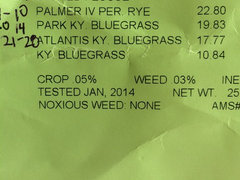
    Here's the seed we used, planted about 4 years ago. I usually mow every 4-5 days depending, only area that gets more than a 1/3 off is septic mound area and the grass is great there, figures

  • 9 years ago

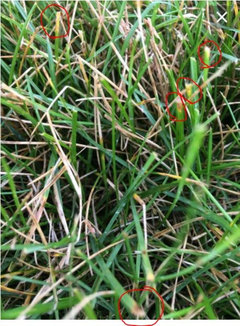
    I didn't see your pictures when I posted above, so I'm adding a little here... With that soil sample, it does seem like you could use some nitrogen which will green up your grass. Also, make sure not to water at night as that could help with any fungal issues. It does appear that some blades are being infected where they are cut. I have reattached your picture with highlights. Also, be sure to mow in the evening, so the freshly cut grass isn't stressed from the hot sun. That may help.

  • 9 years ago

    Thanks unununium, I have never heard of the mowing at dusk, will try that, I have been quilty of mowing wet grass, don't water past morning and this year really have been applying a lot more nitrogen via natural ones. Will check out the link you sent/ thanks again

Sponsored