Software
Houzz Logo Print
frederikshriver

Should I prune the lower stems?

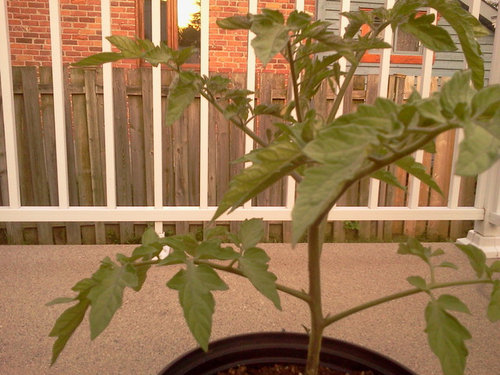
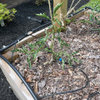
This is my zone 5b tomato plant, started one month earlier from seed with 4 similar ones in size. Unbloomed flowers just started to appear on top for all five plants. No fertilizer, just compost.

Should I prune the two lower stems so the plant would supposedly put more energy in producing fruits? Or too late, it would "hurt" the plant at that size?

Thanks.


Comments (20)

  • 9 years ago

    I wouldn't. If they were touching the ground, it would be a good idea so that it wouldn't transmit disease up the plant (from rain splashing on the soil). If the lower leaves were diseased or yellow, you would prune them then, but they don't have many leaves at the moment and they need them!


    Some fertilizer would help at this stage. I usually put some Tomato Tone in the planting hole or add it to the pot when I plant my seedling into it.


    Linda

    Aleksey Denzil 5b thanked Labradors
  • 9 years ago

    The leaves are making the energy so that the plant can make fruit. Trimming bottom leaves that touch the ground is a preventative because blights and other diseases can be splashed from the soil onto the leaves and spread upwards.

    Aleksey Denzil 5b thanked donna_in_sask
  • 9 years ago

    Agree with the previous posts. "prune the two lower stems so the plant would supposedly put more energy in producing fruits " is an old wives tale.

    Believe it or not many successful tomato plants are grown every year without pruning them at all except for branches that would drag on the ground.

    But if you want fruit then please do keep in mind that compost is a soil amendment, not a fertilizer. There is no micro herd, no soil bacteria in a container to pre-digest compost so the plants can use it. There are any number of organic tomato fertilizers available.

    Dave

    Aleksey Denzil 5b thanked digdirt2
  • 9 years ago

    I'm... I'm too poor to buy some fert.


  • 9 years ago

    I don't really see any additional stems in that picture. But considering the size of the pot and lack of fertilizer, I think it's better to keep it to one stem.

    Aleksey Denzil 5b thanked fungus
  • 9 years ago

    "I'm... I'm too poor to buy some fert."

    Then plant it outside in the ground rather than a pot. That way it can at least get some nutrients from the soil. Then do some research into natural sources of plant nutrients - things like diluted urine, animal manures, liquid tea made from compost, etc - and how to use them on plants.

    Dave

    Aleksey Denzil 5b thanked digdirt2
  • 9 years ago

    What is your location?

    Aleksey Denzil 5b thanked gorbelly
  • 9 years ago
    last modified: 9 years ago

    Uh, as in compost tea? Not much. Even worse if it isn't composted. You mean like soaking a bunch of green leaves in water? Pfffft. Compost has virtually no fertilizer, and water percolated through it won't have much either. That compost is any kind of immediate "fertilizer" is a myth. That compost tea has fertilizer value is similarly incorrect. And WAA LAA!, you got a myth. Plants don't thrive on myths.

    Nitrogen fertilizer is pretty cheap. You can get 40# of lawn fertilizer for $15. If you want to take the risk of bad bacteria, you can dig in some fresh manure. That'll get you nitrogen as well. You can get a few pounds of Miracle Gro for a few bucks, and that will go a long way.

    Aleksey Denzil 5b thanked daninthedirt (USDA 9a, HZ9, CentTX, Sunset z30, Cfa)
  • 9 years ago

    A bucket of organic material in water sitting in the hot sun will decompose at a rapid rate. Once decomposed it will have all the little critters to take advantage of the broken down material.

    Of course you can go with store bought grass fertilizer, but the OP said "too poor to buy". I too use store bought fertilizers, but I can afford it.

    Make do with what you have. It will work. It will help.

  • 9 years ago

    Ain't so. I can put a bucket of green leaves in water the hot sun and it'll be a bucket of stringy green paste in a few days. I have hot sun. I know. Actual decomposition will be minimal. To the extent bacterial and fungal decomposition is accomplished, it uses up most of the easily available nitrogen anyway. It's well known that the NPK of organic compost is minimal. Seriously, if you're too poor to spend a few bucks on cheap synthetic fertilizer, you shouldn't be gardening. You can, on the other hand, go whole hog on fancy fertilizers, and spend a bundle.

  • 9 years ago

    Dave mentioned diluted urine. Can't get much more free than that. And it works. Dilute 10:1 at least.

  • 9 years ago

    And I don't know about any old organic material in a bucket, but something like comfrey will turn into foul-smelling gunk that makes a decent weak fertilizer. It takes a few weeks, though, and smells really nasty.

  • 9 years ago

    The reason I ask about location is that something like the small box of Miracle Gro is usually very cheap, unless the OP is in a place where it's not readily available. If too poor for that, then ask relatives, neighbors, friends if they have old fertilizer that they don't use or were thinking of throwing out.

  • 9 years ago
    last modified: 9 years ago

    Yes, diluted urine will provide nitrogen pretty efficiently (and economically). It really should be *fresh*, though. If it sits around for a while the nitrogen gets outgassed as ammonia. In fact, that's where the nitrogen comes from in fresh manure. But unlike manure, urine is pretty aseptic, so I would use it without hesitation. I believe the NPK ratios are something like 10:1:4. A family of four can produce the equivalent of a 50# bag of 10:1:4 every year. Of course, if you want to fertilize a garden today, that will be a little harder. Drink up!

    Miracle Gro was the cheap synthetic I was suggesting. About 2 bucks a pound, and pretty complete.

  • 9 years ago
    last modified: 9 years ago

    The OP said he has 5 plants. One person can easily supply enough nitrogen for 5 plants. And no need for it to sit around; there's a constant fresh supply in the making at all times!

    I use Texas Tomato Food, which has enough N in it, but I do like to give my cucurbits and peppers extra N because they like more N than tomatoes. I usually use fish fertilizer, as I have a supply of it from a sale a while back, but maybe I'll try urine on some plants and see how it compares. LOL, I just talked myself into trying pee as fertilizer.

  • 9 years ago
    last modified: 9 years ago

    But lay off the Fritos, french fries, and pretzels. If your diet is high in salt your pee will be as well, and many plants don't like salinity. Yield for large tomatoes in particular will be lower. Cherries are more salt-tolerant, I believe. Now be aware that a nitrogen-rich fertilizer will develop foliage, and will not necessarily help with fruiting.

    I use the stuff regularly on my compost piles. But again, the most important thing is to use it fresh. I've heard of people who collect pee in a bucket, and then slosh it all on a month later. At least with regard to nitrogen, that won't work.

  • 9 years ago
    last modified: 9 years ago

    They've done studies with urine that definitely wasn't super fresh (collected from homes where it was collected/stored in special toilets), and it still worked well. So I expect the freshness factor is overrated. But for a small number of plants, storing urine is an unpleasant thing that just isn't necessary. And you're right that it's probably superior when the urine is fresher. But storage obviously doesn't render the urine useless as fertilizer.

    https://www.scientificamerican.com/article/human-urine-is-an-effective-fertilizer/

  • 9 years ago
    last modified: 9 years ago

    Sorry, but it's well understood, and I might dig up the research papers I once found about it, that the time scale for nitrogen loss of urea in solution is a few days in an open-air environment. I confirmed this with a biochemist ag expert at A&M. Sure, after a month it will still have a little left, but not much. Now, if the urine is protected from urease, which is the naturally occurring enzyme that breaks it down, perhaps by keeping it in a well sealed, clean container, it might have a much longer lifetime. But storage in an open bucket won't do the trick. Urease is blowin' in the wind.

  • 9 years ago
    last modified: 9 years ago

    But who stores urine in an open bucket for long periods of time?

    This trial used year-old urine collected from eco-toilets, which aren't exactly hermetically sealed environments. This one used 3 month-old urine collected from a septic tank shared by a village. One of these case studies used urine that was 1 month old collected from a men's hostel. This field trial used 1- to 6-month old urine from a waste collection company that collected it from public urinals that have collection tanks. Probably some sort of pee-only port-a-potty. This study used 6 month old urine collected from family members of the researchers. Of all of these, maybe the last one involved urine that was sealed tight in sterile conditions for all of the time it had left the body (although obviously not the case with the livestock urine), but I'm skeptical that was the case, even in the case of the family of researchers.

    So I suspect it doesn't have to be used posthaste immediately after excretion, and just a normal closed jug of some kind would be fine for storage for at least a few months.

    daninthedirt: I confirmed this with a biochemist ag expert at A&M. Sure, after a month it will still have a little left, but not much.

    Did the people at A&M do field trials and determine this? Lots of things that seem obvious theoretically work out to be very different in real-world practice.