Software
Houzz Logo Print
rorycn

Low spot with clay...will this work?

9 years ago
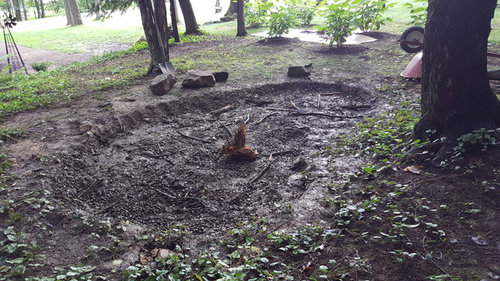
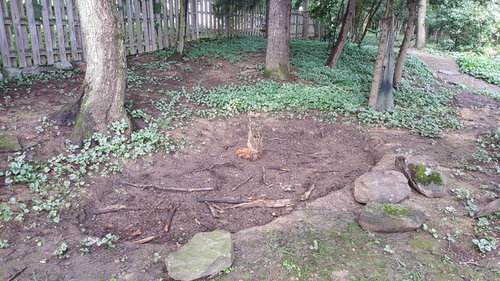
We have this low spot in our side yard that fills with water when it rains and remains wet for several days.


We dug a lot of clay out already but underneath the sticks and topsoil is still many more feet of clay.

Would a sort of hugelkulture work here to amend the clay? I would fill it with rotted leaves and wood and top it with soil and manure or mulch. DH is going to build a rock wall around it so I can plant some shade plants that like moisture.

I am I going about this in the correct way?

Thx!

Comments (16)

  • 9 years ago

    The video I linked is soil transformation using just wood chips.


  • 9 years ago

    I think you are doing it correctly. I did bury wood in clay in my garden and it does take a long time as John says, so make sure you put 50/50 logs and leaves/kitchen scraps or other fast disappearing material. That is anyway what Holzer (the inventor) used to do, the first drainage channels will be done by earthworms. Also, if you hire something big to dig it, use vertical hugelkultur (logs planted vertically instead of horizontally), it gives better fertility and surely gives better drainage.

    Rory (Zone 6b) thanked glib
  • 9 years ago

    I have tons of decomposing leaves and rotting logs to put in. I will also add wood chips because I have those also. My property backs to 10 acres that my neighbor owns and there are many years worth of leaves and fallen trees in various states of decomposition.

  • 9 years ago

    sounds good in theory but...you're doing this under trees. I'm willing to bet that the trees are not going to know you are not doing this for their benefit.

  • 9 years ago

    Where in the world are you?

    Is the soil all over the property clay?

    Why did you dig out some of the soil?

    That clay does not drain well most likely because it lacks organic matter. Hugelkulture would change that, eventually, but other forms of organic material, shredded leaves, compost, etc., will work faster and with less work.

  • 9 years ago

    I didn't dig out soil - i dug out clay to add organic in so I wouldn't have a pond every time it rains. The dirt on top we added from a bed on the other side of the house. There is a lot of red clay and rocks on the property but also some really nice soil in the wood in the back of the house.

  • 9 years ago

    You don't want to dig down - you want to build up. Right now, what you have is a clay lined pond. Adding organic matter isn't going to change the fact that the pond still exists with its clay lining. You are simply making it bigger. What you should do is fill the pond in with similar clay soil. Then, instead of ponding in that area, the water will flow downhill to somewhere else.

    What you are trying to do is only going to work if you can dig down far enough to punch through the clay. Since clay layers can be hundreds of feet thick, unless you know the local geology, it isn't a practical idea.

  • 9 years ago

    I totally disagree. Dig it. Organic matter underneath is always more valuable than organic matter on top. Ideally it should be decaying deep roots of some vigorous cover crop, but hugelkultur is an acceptable substitute.

  • 9 years ago

    glib, I have a large patch of Comfrey but I am afraid to transplant any of it for fear it will take over the neighborhood. Do you think I should cut the leaves off and put them in the hole with the other organic matter before I top it with soil and mulch.?

  • 9 years ago

    I have no experience with comfrey. But if you put earthworm food in the hole, along with the chunks of wood, it will improve drainage fairly soon.

  • 9 years ago

    That clay you dug out is soil. The only problem with clay soils is the particles fit together so well they prevent moisture, nutrients, and plant roots from moving around much unless that soil is well amended with organic matter which separates the soil particles so moisture, nutrients, and plant roots (as well as the Soil Food Web) can move around easier.

    Comfrey leaves are organic matter and they make a good earthworm food and could aid in opening up that clay soil along with other organic materials.

  • 9 years ago

    Rory, you said the word clay, and that has clouded everything.

    You have a low spot. You happen to have clay. You made the low spot lower, now you want to raise it.

    My initial response? sure. go for it. Just don't think you are going to be able to plant moisture loving things, because those trees are going to think you are doing this for them, or that you have solved your wet spot problem...the wet spot will still be there, just in a different place.

    and then you are going to learn about planting things under trees.

    My best answer? Do it. I can't say as your plan sounds bad...I just have reservations about the outcome of plants. The plan you have isn't necessarily all that bad...so do it. You're going to learn something, you're going to solve one problem, and you're going to have another. Eventually, you'll get the problems solved.

  • 9 years ago

    I think it would be rather nice to make a mini garden bed in that spot using logs and soil. Water won't pond there after rain, as it does now. As someone above said, you would be better off raising the sunken area, not digging clay out of it.


  • 9 years ago
    last modified: 9 years ago

    Because of all those trees around, a garden bed will not work. Trees immediately will fill that nice amended place with their roots. No other plants will survive there.

  • 9 years ago

    I think the trees would be welcome to partake of the new little garden bed. Why not? And if the plantings are done shortly after the bed is made, then left to grow and mingle with others (tree roots) what's the problem?

    The problem, as I see it, is that water ponds in that pond-shaped indented area, so one simply fills up the indentation. Logs will break down slowly but so what? Why does quicker equal better? Nature isn't quick, generally; things fall over and rot, decay, get nibbled and recycled. Slow release, is what I call it, if it needs a name.

    I think we try to control everything. What's wrong with a little lack of control?