Software
Houzz Logo Print
deannatoby

Help IDing plants

The garden area I inherited that needed lots of work to rejuvenate when I just didn't have time is now getting some attention. Because tree removal has significantly added sunlight I'm finding that some plants need to now be moved. I don't know exactly what's in the bed, but I either need ID or confirmation. Thanks in advance for your help!

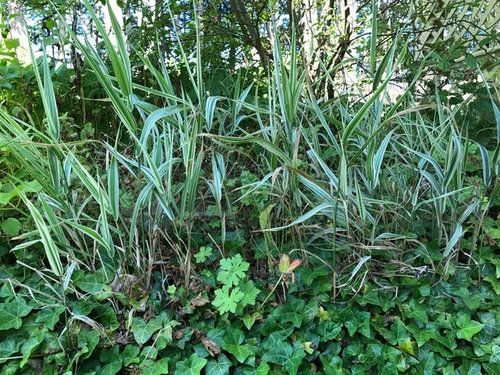
Are the following two photos of Japanese Forest Grass? I see the branching at the stem line, but online I see only pictures of the whole plant, not a single stem. If they are JFG, then they are gasping and losing their graceful form. Hope they can be saved.

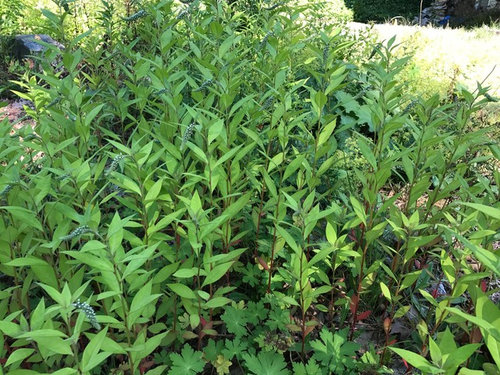
Next is what I believe is a white speedwell, but online searches give me only erect versions. This graceful arching version with the foliage leaning towards lime I can't find anywhere. I saw a bunch of it on the garden tour in a garden, planted en masse, so it's got to be something. The buds are just beginning to form, if you can barely see in the picture.

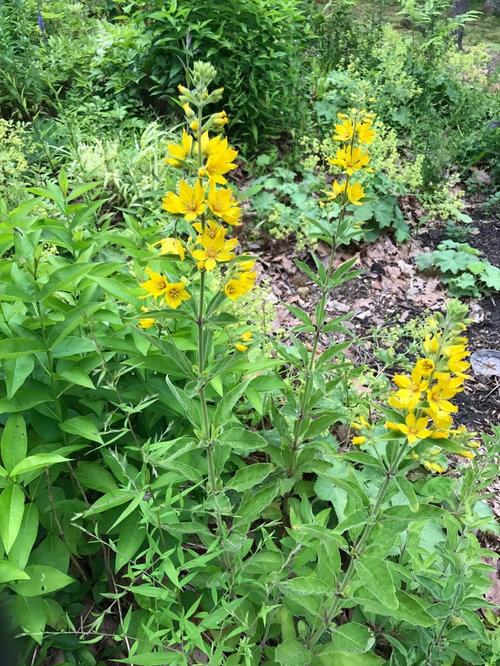
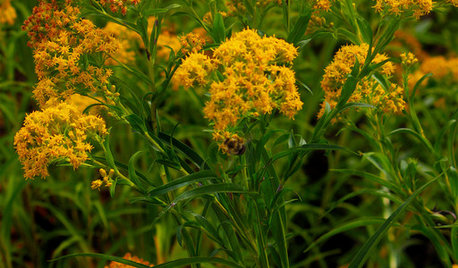
Next is a common yellow plant, and I can't remember the name for the life of me.

Comments (6)

  • 9 years ago

    The first photos could be Hakonechloa but both are being smothered by other plants, Clean out the ivy and any other weeds that are encroaching and they should slowly develop more of their classic clumping, softly arching form.

    The second plant is gooseneck loosestrife, Lysimachia clethroides, and the third is Lysimachia punctata. Both can be aggressive spreaders.

  • 9 years ago
    last modified: 9 years ago

    I think your first grass is variegated ribbon grass/Phalaris arundinacea, another aggressive spreader. The second one could be Hakonechloa/Japanese forest grass; I am not sure.

    I agree with GG48 on the last two. I got a chuckle out of your "planted en masse" for the gooseneck loosestrife since even if one tiny sprig is planted, within a few short years it will be en masse. As mentioned, both can be spreaders, but I found that the gooseneck loosestrife is difficult enough that I removed it. It needs an area surrounded by edging and mown grass or concrete to keep it contained. Yours seems to be taking over a perennial geranium. The yellow L. puntata I found to be less aggressive in my garden, though last week in the Rangeley, ME area I saw huge swaths of it in several places.

  • 9 years ago

    Ribbon grass is right for the top, and the middle is forest grass. The ribbon grass has leaves that wrap around the stem, which was really the only way I could surely tell. The forest grass also has less substaintial stems. Thanks, gardengal and NHBabs!

    As for the gooseneck loosestrife, I'm on the fence. It is pretty, and right now it is in the pollinator bed. Some online sources say it is a wonderful plant as long as it is surrounded by equally as vigorous plants. I could leave it there ONLY if I was willing to plant some things like monarda around it. But, I don't have any monarda right now, and I don't want to have to deal with several species of invaders. Is monarda an invador, or merely a plant that stops loosestrife in it's march? But, as far as pollinators go, loosestrife doesn't seem to be a favorite. One site said wasps like it, but the other pollinators prefer other species. So, one less vote for leaving it in the pollinator bed.

    I have one isolated area bout 6-8' round that currently has overgrown grass and a lady's mantle, clearly used to be a garden bed becuase it has a rock perimeter. I could put it there. The herb bed is about 8' away. Can loosestrife runners travel 8' underground? I know seeds can blow, but what about the runners? I don't need it popping up 8' away.

    The yellow loosestrife is coming out, too. Not so enthusiastic about it, and again there are better pollinators out there.

  • 9 years ago

    I happen to be a big fan of the gooseneck loosestrife - love that herd of nodding white stems when in bloom - and while it does spread and quite vigorously, I have never found it straying large distances away from the mother plant. And I have also found it quite easy to remove if it expands too robustly. Monarda in my area spreads to the same degree and vigor as does the gooseneck. In fact, I have them growing in opposite corners of the same bed and am quite happy to let them meet in the middle :-)

    I did have thoughts about the first grass being the Phalaris, as the green and white variegated hakone grass is not very common. But I accepted your assumption ;-))

  • 9 years ago

    I grow ribbon grass in a pot and a chimney tile where they are easy and provide some foliage interest all season. I imagine that you can surround the gooseneck loose strife with a 6" deep edging strip and that will keep it contained. Monarda I find easy to remove where I don't want it since it's a runner that's shallowly rooted, but the loosestrife has roots that are a bit more difficult to remove, so I might well opt for trying to contain it where it is.

  • 9 years ago

    GG48, sorry I led you wrong. I still consider myself new to gardening since I really didn't start till I moved to New England 10 years ago and took a few years off between the move from NH to Maine, so I still have a lot to learn and many new plants to discover. I wouldn't recommend following my lead! I look forward to the day I can recognize things as well as you all.

    I've been pondering the gooseneck crazy-strife, and I think I have two places that are appropriate. One is the bed mentioned above. The other is a bed that was planted with some great things by the previous owner, but subsequently was not maintained. After breaking my back in NH to "fix" neglected beds, I didn't have the heart or the time to start that again. As for placement, the bed has almost no value to us based on how we live in the house and what we look at. I'm not spending any time in that bed other than occasionally removing a plant that I'd like to place somewhere else. Right now it is under the dictatorship of ivy, lady's mantle seedlings (which are prolific here), montauk daisies, which seem to claim more and more ground every year, and weeds. I'd welcome the gooseneck in that area to give the others a run for their money and keep the bed populated and less weedy. Once we build a porch in that area the whole bed will come out anyway, but that is far in the future after other more important projects.

    So, I'll move some gooseneck out of the pollinator bed and in those two places. Might have to resort to Round Up if the gooseneck continues to send up shoots in the pollinator bed, but I'll try to get it all the first time.