Software
Houzz Logo Print
cindilu60

What's wrong with my Roses?

9 years ago
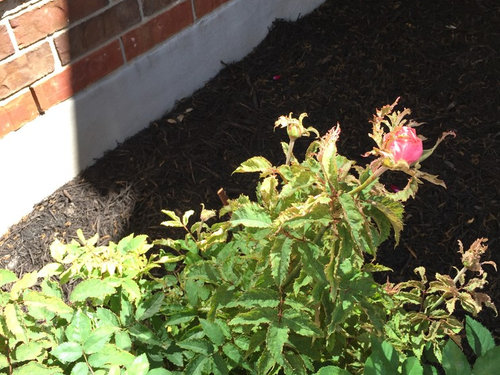


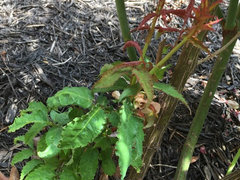
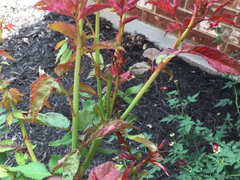
I have a belinda's dream rose and also some knock out roses with the same symptoms. In parts of the rosebush the leaves change to pointed edges, curl up, rose buds don't open, bunches up. Can anyone tell me whats wrong? Thanks for your help

Comments (15)

  • 9 years ago

    Uh oh...that doesn't look good. Have you sprayed them with Round Up? Otherwise it may be rose rosette disease in which case you need to do drastic measures. Someone else will respond who knows about this more than I do. Hang tight til then.

    Carol

  • 9 years ago
    last modified: 9 years ago

    Looks more like weed killer damage than rose rosette disease to me. Time will tell.

    If it is weed killer damage good general care is called for with ample watering. Depending on how extensive and severe the damage is, if light, the rose should recover. If the damage is worse, the rose may die. After all, that's what weed killer is supposed to do, kill. To weed killer, anything is a weed, even roses.

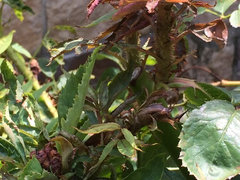
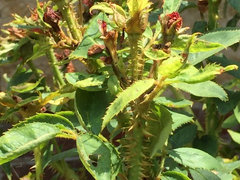
    Rose rosette disease will manifest itself with: condensed growth, excessive thorns, distorted leaves colored reddish and pale green, and malformed flowers. If it is rose rosette disease it must be removed. Tools used must be disinfected afterwards. The diseased rose must be securely enclosed in a plastic bag and put in the household trash.

    Moses

  • 9 years ago

    No Roundup or weed killer has been used around them at all. They are in a little courtyard and very protected from even anything drifting on them. They get half day sun and half day shade. If there are any weeds nearby I have pulled by hand. We live in Central Texas and its very hot and humid. I haven't even fertilized them since April because of the heat. The roses have had it for about 2 or 3 years. It hasn't killed the roses. I have cut those parts out before but new growth sometimes comes out like that but not always. Will rose rosette disease kill the roses or just make them look ugly?


  • 9 years ago
    last modified: 9 years ago

    Cindy,

    We, therefore, can eliminate any weedkiller damage.

    Rose rosette disease is a fatal virus carried by infected mites, spreading from rose bush to rose bush. It infects a rose through the virus infected mite saliva entering the rose's vascular system as the mite feeds. Mites are carried in the wind and land on fresh roses, thius infecting them as they feed.

    RRV infected mites were ntroduced years ago into the environment in an attempt to kill Rosa multifloral, an invasive, noxious weedy rose that has adverse effects on agricultural land.

    Can you provide a closeup photo of the damaged sections so that forum members well familiar with RRV can evaluate your roses?

    Moses

  • 9 years ago

    Make sure you or your neighbors did not use a weed and feed product on your/their lawns and that you are not near (apparently even miles away) farmers that sprayed a dicamba based product on their fields.

    "In hot weather, dicamba turns into a gas that apparently can drift for miles."

    http://www.npr.org/sections/thesalt/2017/07/06/535669282/damage-from-wayward-weedkiller-keeps-growing


  • 9 years ago

    Sure looks like rrd to me. Would you mind taking more photos to post here. Do you know when the first rose began to look sick. If it is rrd the sooner that you can remove the roses the better in order to save your other roses. I'm not up to speed on how far into Texas rrd has spread. I only know that it is indeed there. It is possible to successfully grow roses in spite of rrd but we need first to find out what you have. I'm sure that I've read that Texas has places where you can report possible cases. I assume the extra diligence is due to the rose growing fields that are there. One place to start is to google rose rosette disease in Texas. Some sites have excellent information. Some unfortunately are just terrible. It is possible to learn as much as possible so that you can spot it early when you have a chance to save the plant.

    Does anyone know how to reference Ann Pecks site? I'm sorry to say that I actually don't know. It is for me a bit technical but extremely accurate. Thru the years I have reread the writings and while at times hard for me to understand. I was also able to understand enough for it tone helpful.

    Speaking of dicamba it makes me sick when they arial spray herbicides in 40 mile an hour winds at the edge of town right next to the grade schools and nurseries that carry plants that I purchase. That children pets gardens you name it are still being spray with toxic chemicals in this age of knowledge is beyond my understanding.

  • 9 years ago

    Here is a new picture of the Belinda's dream taken today. I had cut that bad part out and this is the new growth in the same spot. It looks just like the bad stuff before. Most parts of the rosebush looks fine. This has been going on for 2 or 3 years.

  • 9 years ago

    Here are the Knock Out Rose pictures. Clumps and lots of thorns!


  • 9 years ago

    I appreciate your help so much!!! Thank you!!

  • 9 years ago

    I'm sorry Cindy but that is rose rosette disease. It is to late to try to save them. More than likely you have neighbors with sick roses or perhaps business's near by that have rose that are sick. Gosh I wish I could remember the place that was asking for people to let them know if they had sick roses. Another place to access information is on top of this page you can do a search in garden web. Just type in rrd and page upon page will show up.

    If you have any roses that are not yet sick you will need to remove the sick ones. Or the others will get sick as well. It is a wingless mite that carries the virus. It can be blown by the wind and be carried from spot to spot by other insects and such. How the disease became established in America and what people are doing about it is a very long story. But you can find the answers by searching. I'm so sorry about your roses. I'll never forget how I felt when my first cases arrived.

  • 9 years ago

    So sorry it's RRD. You should get rid of them and maybe alert your ag extension office.

  • 9 years ago
    last modified: 9 years ago

    Cindy,

    I agree with Patty's diagnosis 100%. Your second photos are classic cases of RRV.

    Now your diseased roses must be carefully dug up, and place them in a large, heavy plastic bag, tied securely, put out with your household trash for your next municipal trash pickup.

    Make a solution of 1/2 cup chlorine bleach in 1/2 gallon of water. Soak down all the tools you used in removing the diseased roses.

    Take heart, now. Strangely, rose mosaic virus is contagious, but not to the degree that every rose in your garden has it, or will get it. It usually hits here and there. The sooner an infected rose is discovered and removed, the less chance of the disease spreading to nearby healthy roses. There are numerous cases where one rose bush in a bed came down with RRV, was quickly identified and swiftly removed, and no spreading occurred.

    Please did not give up on roses.

    There is a strong possibility your roses came diseased when you purchased them. Early symptoms of RRV are not easy to spot, especially if you are not looking for them, nor have had prior experience with the disease.

    You came to the right place, The Roses Forum, for help. We have so many knowledgeable persons here. Patty is chief among many chiefs on rose care. Ann, always called upon for her expertise on RRV, frequently posts here with valuable advice. Look up Ann's RRV info. in the Roses Forum Archives.

    Keep your hopes up. There is a solution to this dilemma.

    Moses

  • 9 years ago

    Thanks Henry, correction noted and made.

    Moses

  • 9 years ago

    Thanks everyone for the information :(