Software
Houzz Logo Print
amanda_eggers415

Soil Test Results - needing guidance

9 years ago
last modified: 9 years ago
Hello,

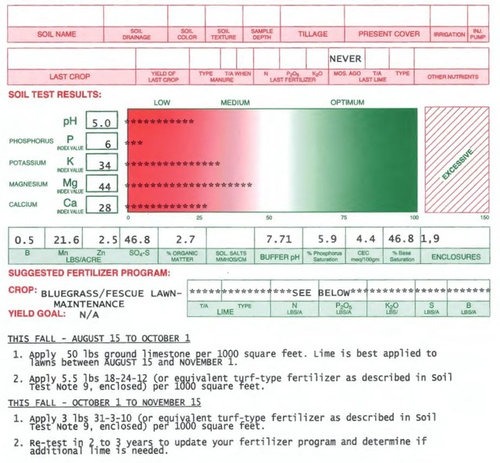
I have my soil test results back from a local university and want to put together a game plan. I sent the sample in before I knew about Logan, so pardon that.

Located in Maryland. New construction home built 2 years ago, builder did a horrible job on the lawn but we do have good grading. We just had inground sprinkler system installed so things are a mess out there right now.

I'm planning to aerate (soil is very compacted), seed, fertilize and do whatever amendments I need to do. Bring in top soil or organic matter if needed. I'm just not sure what order I should do these in and what products to use.

Test results:
Organic Matter 2.7%
ph 5.0
Phosphorous 6
Potassium 34
Magnesium 44
Calcium 28
And a whole row under that in which I have no idea what any of it means :)


Thank you for any help!!

Comments (16)

  • 9 years ago

    The soil test is saying you need lime and phosphorus. Your pH is very low, low enough for aluminum toxicity to be a problem, so be sure to do the lime. Since you plan to aerate, spread the lime then while the holes are open so it will go deeper into the ground. Best to do this as soon as possible so the lime will have some time to react before you seed. If you want to add some compost then too, that's great. But the lime is more important. It's a fair amount of work to spread compost. Easy to do the lime. You will get phosphorus from the starter fertilizer they recommend. Add that when you seed. The bad news from the soil test is your cation exchange capacity is low, meaning your soil does not hold onto nutrients well. In general you should do more frequent fertilizer applications at lower rates.

  • 9 years ago

    Thanks Becky,

    Does the CEC get better as I start adding the soil amendments? Or will that number be forever the same?

  • 9 years ago

    University of Delaware?

  • 9 years ago
    last modified: 9 years ago

    @ridgerunner, yup it is University of Delaware. I live right on the Delaware/Maryland line

  • 9 years ago
    last modified: 9 years ago

    UDel uses M3 extraction.

    The FIV (fertility index values) and bar graph indicate where your nutrient values fall on a scale of 0 to 100 with 51 to 100 considered optimum and 25 to 50 being considered minimal to sufficient. Below 25, use it for a car park.

    The "whole row under that" are levels of some of the micronutrients used by plants. They usually are not a problem for turf unless they are wholly missing or extremely excessive.

    Conversion of your FIV values to ppm:

    P = 6 ppm (Min/Sufficient = 25-50, recommended/optimum = 50 to <100)

    K = 62 ppm (Sufficient = >110, max/optimum = 183)

    Mg = 58 ppm (Min > 50 but less than 600. Ratio to Ca is more important once greater than minimum levels are present)

    Ca = 280 ppm (Min > 350, sufficient > 750)

    pH Buffer is via Adam/Evans, To change pH to a depth of 8": 46 lbs/k of lime is required to reach a value of pH 6, 55 lbs/k of lime to result in pH 6.2, and 69 lbs/k of lime to achieve pH 6.5. Multiply those amounts by 0.75 for changing soil pH to a depth of 6" or multiply by 0.5 to change pH to a depth of 4".

    Those values may help Becky "dial" you in.

  • 9 years ago

    Two other points.

    I would recommend Waypoint Analytics, Brookside Labs or A&L Western Labs rather than Logan.

    Aeration followed by spreading Spagnum peat moss, filling the holes as best you can, will improve water retention, maintain/improve soil aeration-reducing compaction and slightly increase CEC-Spagnum peat moss CEC is 100-250.

    Keep in mind that it takes ungodly amounts of OM to increase CEC, but any increase helps.

    Good Luck.

  • 9 years ago

    Thanks for the help Ridgerunner.

    So for an order of operations.. I should aerate now, apply lime and maybe the peat moss?

    Then seed and fertilize in a couple weeks?

  • 9 years ago

    Dial her in? U of Delaware made the recommendations, which seem reasonable. Yes, aerate and apply lime as soon as possible and maybe peat moss, then seed and fertilizer a few weeks later (early part of September). I hope Ridgerunner comes back and talks some more about the peat moss. He has applied it to aeration holes. I haven't. How much is needed? Does peat moss on the surface interfere with seed/soil contact? Usually when people are applying peat moss at seeding, it goes on over top of the seeds. It's then a topdressing helping to keep the seed moist (and when the peat moss dries it changes color so you know more water is needed pronto).

    A few more comments on the lime: 50 lb/k is the most to apply at a time when it's not being tilled in. I would recommend slow acting aglime. If it's mainly calcitic, that would be great. But if it has some magnesium too, it's okay. You need more calcium than magnesium and most aglimes will have more calcium than magnesium. Your pH may tend to bounce around, so a slow acting lime is better for you. You do need a substantial rise in pH but the lime should do it. Have it ready to go into the holes as soon as aeration is done.

    Organic fertilizers will be good for you because the nutrients are held by soil organisms rather than just the soil and they are slowly released. Slow release synthetic fertilizer is also good. The fertilizer you'll be using at seeding is starter fertilizer and will put the needed phosphorus right by the new seeds' roots.

  • 9 years ago

    Thanks Becky! As for organic fertilizers, is there a particular brand you would recommed?

    Also, if I aerate now will the holes be closed up by the time I seed? I was honestly thinking about doing a light layer of top soil when seeding and think it would be helpful for it to get in the holes to mix with the existing soil.

  • 9 years ago

    No particular brand. You can use animal feeds, like soybean meal, alfalfa pellets, cornmeal, etc. for an organic feeding. 20 lb/k is a general rate. Milorganite is popular. When using organic fertilizer, the soil needs to be warm for the microbes to be active.

    It's good for the holes to close up before seeding so the seed doesn't fall down too deep.

  • 9 years ago
    last modified: 9 years ago

    Dial her in? U of Delaware made the recommendations, which seem reasonable.

    Reasonable, yes, but commonly a bit simplistic and not very detailed. By "dial" I was referring mostly to the lime and Mg (do you think the OP might consider a split of lime between calcitic and dolomitic limes to bump Mg or maybe a bit less than 50 lbs as I believe you have been looking at lower soil pH (6.2ish? in the Mid-Atlantic States to reduce summer disease?), but also the total amounts of of the major cations (use of a TNPK?) needed for a long term plan (I do agree that with that CEC, "ideals" are unlikely attainable and "small and often" apps are preferred. Still, it's good to know where the target is) to achieve SLAN levels.

    Under these circumstances, ideally preparation would have begun a couple of months ago with aeration, lime and peat moss. There would have been plenty of time for things to settle out before the Fall seeding. The aeration and peat moss was a technique for improving turf conditions in general. In this case, I'd follow your recs and aerate and lime now. Seed in early Sept. (depending on the seed type and conditions, I might recomend slit seeding/vertical slicing) and lightly topdress the seed with peat moss.

    Late next Fall would be a better time to aerate again and fill with peat moss.

    EDIT: A 3 cubic foot bag of peat moss will topdress 3-400 square feet at around 1/8 to 1/4" depth if sprinkled on. I use a wheel barrow to hold it and a dustpan to sprinkle. Warning: Very labor intensive, but worth it IMO. Using peat moss to fill aeration holes varies in quantity. It depends on the number of holes. I always shot for 20/sq ft. On bare soil a bag will cover up to 500 sq ft (I'm filling holes, not leaving it on the surface). On established turf, much of it remains on the surface despite efforts to work it in. I am fortunate enough to have the tools. I aerate then throw the peat moss out in a pattern based on how much peat moss I could afford (I try to shoot for 300 sq feet per bag or $120 for my 3000sq ft front lawn. $120 is my limit, so it varied a bit based on that.) then use my rider and a drag to even it out and work it in. My experience was that it did make a significant impact. I did that every Fall for two years but not for the last five. Discounting my rock-heave issues, I can see that the peat moss effect is beginning to dissipate and if not for the rocks, it'd be time for another aerate/peat moss app. Four years isn't a bad return on my two year investment.

  • 9 years ago

    Ridgerunner, I am not at home and don't have soil notes. Would you mind doing the NPK totals for the year (with suggestions for 2018)? It looks like Delaware just made recommendations for the balance of 2017. Amanda, what kind of grass do you have (or will have)? That will make a difference for nitrogen recommendations. Maryland, I think, has some fertilizer law restrictions. Amanda, could you look them up and let Ridgerunner know. Your locality might have restrictions too.

    As for the lime, with a pH of 5.0 and such a high buffer and low CEC, you need lime ASAP and a slow release is best. And with seeding time rapidly approaching, you need to find whatever you can find and get it down. Ridgerunner, if you want to get into calcium/ magnesium ratios and CCE and fineness grades, please go ahead. I just think we're running out of time to shop. More important to get it done than to get the ideal lime.

    The peat moss in the holes would have been nice. But could considering the amount of work, maybe that could be a project for next spring or fall. If you use peat moss or topsoil or compost as a top dressing for the seed, be sure it is a very, very light covering.


  • 9 years ago

    To meet sufficiency levels and achieve entry to optimal levels would require 5# of P2O5/k and 2.7# of K2O. Applying one application of a Starter fertilizer and four applications of a TNPK (10-10-10, 12-12-12, 19-19-19 at the rate of 1# of N/k) would supply the desired amount of P2O5 and a bit more K2O than calculated to achieve sufficiency levels (however, the additional amount of K2O would still be well below what would be considered "luxury", solidly within optimal levels and certainly would not be harmful).

    Timing and rates will depend on type of turf and climate. I defer to Becky's expertise on timing and quantities per app,, as I believe Md is more similar to Va and the Carolinas than to my Ohio climate. Becky and j4c11 have had extensive discussions regarding fertilization and disease, so their perspectives are likely to be very useful to you. j4c11 is known as the "Renoman" so he may have some tips for seeding cool season grasses in the warmer climates.

  • 9 years ago

    I looked up Maryland law. No more than 0.9 lb/k nitrogen per application (or 0.7 lb/k soluble nitrogen), no phosphorus unless soil test indicates need or new lawn establishment, no fertilizer between Nov 15 and March 1. I suggest doing starter fertilizer at seeding early in September. If you use 18-24-12, you can use 5 lb/k to get 0.9 lb/k nitrogen (divide the N number into 90). Maryland is prohibiting sale of lawn fertilizer with phosphorus but hopefully you can find starter fertilizer somewhere (maybe Delaware if you can't find it locally). Try to find the Scott's kind that includes mesotrione, as that will prevent weeds for a little while. Then at the end of September, start applying 0.5 lb/k of nitrogen, phosphorus, and potasssium every two weeks until Nov 15. This is with the garden fertilizer where the NPK numbers are all the same. If you find 10-10-10, the rate is 5 lb/k (divide the N number into 50). If you find 16-16-16, the rate is 3 lb/k. Then in the spring, start applying the same fertilizer at the beginning of March every two weeks until mid May. However, in the spring cut the amounts in half, so that you're applying 0.25 lb/k of each nutrient each time (divide the N number into 25 to get the rate). Water in all the fertilizer applications. This plan will get you 4.7 lb/k of phosphorus (close to the 5 lb/k Ridgerunner calculated) with the bulk of it this fall and a trickle in the spring, stopping the nitrogen before brown patch season. Spoon feeding this way also means your grass has a better chance of getting nutrients before they leach away.

  • 9 years ago

    First of all, please remind me to never live in Maryland. I can understand throwing away the bath water, but please leave some of the baby so it can grow up. If they wanted to ban fertilizer periodically, it should have been from Jan 1 through May 15. Wonder what Scott's would say about that? As it is, how will they make their boat payments all winter? Maybe they will respond by getting into the snow blowing biz.

    Secondly, if you bring in more topsoil, two things will happen. First is your drainage will change and that usually gets worse than better. Second thing is your old soil test will become obsolete. It is almost always better to work with the soil you have.

    Would you characterize your soil as sandy? If so, then aerating it will not have much effect. It will be important to help get the lime into the soil, however. Just don't expect much improvement in the "compaction" you mentioned.

    How is your lawn doing? Can you post a picture - preferably taken on a cloudy or overcast day?