Software
Houzz Logo Print
dmoore66_gw

Basil breaks

Do first year hybrid teas ever get basil breaks.

I almost never get basil breaks on any of my roses.

What is the best way to encourage basil breaks? I fed a lot with a variety of fertilizers, organic and chemical, including alfalfa pellets, epsom salts, fish emulsion, miracle grow for roses etc.

Comments (27)

  • 9 years ago
    last modified: 9 years ago

    See this advice from Chris at New Flora for Kordes roses to get more bushy habit. Not sure if it would work for HTs in general. More details from Chris in a post on poseidon.the method has worked for me on First Crush and Mme Anisette.

    http://forums2.gardenweb.com/discussions/4398632/kordes-plum-perfect-growth-habit?n=36

  • 9 years ago

    Interesting - Houzz suggested this article https://www.houzz.com/magazine/herb-garden-essentials-how-to-grow-basil-stsetivw-vs~12714965 based on the title of this discussion. The southern portion of our state is usually considered to be the most disadvantaged. Siri?

  • 9 years ago

    Years ago Harry and David ( where I work ) owned Jackson and Perkins. The test Garden was here in Medford. So, I got my first exposure to roses and began a love/obsession with Jackson and Perkins roses. I thought they were the only comany that grew roses lol

    Keith Zary pruned and he pruned hard. Roses in the test Garden went down to 18 inches to 24 inches

    So I did likewise. I never had those awful bare legs on the ht. We have fairly mild winters so it isn't because of cold weather.

    That is just the way I learned to prune the ht and they put out lots of new Basil's.

  • 9 years ago

    The more sun the bigger the plant. In many yards this requires cutting down trees. There used to be big maples trees on either side of my front yard. The trees are gone and now I can grow big roses in the front yard.

  • 9 years ago
    last modified: 9 years ago

    Here's what I have found helps bushes develop basal breaks. This system is geared primarily to hybrid teas. Please know that some roses are by nature reluctant basal break producers. Some will give 2 or more basals a year. Others give one basal every other year at best. If a rose produces its regenerative growth a little higher up on a bush, so what. It's doing its own thing. Some climbers rarely produce basals, yet bloom excellently.

    1. Prune back to no more than 6 strong, newest canes on a mature bush in the spring, fewer on an immature bush.

    2. Any canes narrower than a pencil on a mature bush get cut to the crown.

    3. The thickest, youngest canes are your best canes.

    4. Prune back these canes to no taller than 12-14", even shorter is better. Winter kill often dictates maximum cane length!

    5. Select canes to save that are as far apart from each other as possible.

    6. Practice fertilizing as normal.

    7. In spring, for a mature bush sprinkle 1/4 cup Epsom salts on the soil, away from the crown; proportionately less for immature bushes.

    8. Light hitting the rose's crown stimulates basal cane production. Keep the crown as open as possible.

    Roses with dense, compact crowns have a hard time producing basal canes. Roses with open crowns produce basal canes regularly. Own root roses have an easier time making basals; grafted roses...not as easy.

    Moses

  • 9 years ago

    That would be basal breaks, not basil :-)

    There is little to no evidence that applying epsom salts has any benefit to roses other than offsetting a magnesium deficiency.......which is uncommon in most soils. However, the application of alfalfa with its naturally occurring growth hormone triacontanol DOES encourage basal breaking. But it may not appear readily on first year plants.

    btw, both of these contentions are supported by the ARS.

  • 9 years ago
    last modified: 9 years ago

    There is also the concept of available nitrogen--it has to be in a form that can be used by the rose bush. The important point you need to make sure that the limited supply of available nitrogen isn't grabbed by weeds and tree roots before you roses get it. Nor can you provide more of it by simply piling fertilizer around your rose bushes. But, merely pulling the weeds helps my roses get big and bushy.

  • 9 years ago

    I have no weeds or tree roots. They are in raised beds and are well mulched.

  • 9 years ago

    I tired Chris's (Newflora) suggestion on several of my Kordes roses. Kosmos Fairytale, which was a one cane wonder, developed several nice canes. They're still small since I just tried this mid July but she's a lot fuller now. This also worked on Madame Anisette, which was extremely gangly, and others. I mixed about 1/4 cup of Rosetone fertilizer with mulch and piled it up to around the base around 4 inches up the cane. Kept it moist until I saw new growth then removed the mulch and spread it around the plant. It might be a little late to do this now though depending on when your first hard frost is.Chris recommended doing this as soon as spring weather permitted. But it seemed to work really well. I'm planning on trying this next year on some of my other roses.

    Sharon

  • 9 years ago

    Moses, that is exactly what I do to get new Basal breaks.

    Sorry my phone is a bad speller gardengirl

  • 9 years ago

    Dmoore,

    I wonder if your rose beds are in full sun? I have lots of basal breaks on pretty much all my 1st year roses, and my cultural practices are quite similar to yours...raised beds, combination organic/inorganic fertilizer, alfalfa, fish, seaweed.

    David Moore zone 6a nw new jersey thanked BenT (NorCal 9B Sunset 14)
  • 9 years ago

    All my roses this year produced basal breaks and at least one per bush and a ton on my mature bushes. I bought soil that was for large outdoor containers and threw it on top of the soil like a mulch. I put the soil right up to the bushes crowns and canes. The bushes in the ground and in containers all produced basal breaks for me this year. I do prune in spring normally and fertilize regularly.

    David Moore zone 6a nw new jersey thanked Va Joh(zone8b)
  • 9 years ago

    Thanks everyone. Learned a lot today and will mound soil up on my roses when I prune in spring

  • 9 years ago

    Va Joh- What kind of soil mix did you use?

  • 9 years ago

    I bought many many bags of Scotts Garden Soil.

  • 9 years ago
    last modified: 9 years ago

    First year? No. Even grafted plants need to become established and build a root system to grow additional canes. Best I've seen, on roses grafted on R. multiflora rootstock, has been the second year after planting. I also use fertilizers that contain alfalfa.

    dmoore66(6 NorthWest NJ), you don't need all of those fertilizers. Pick simple regimen. They don't need special "rose" fertilizer. I think my plants didn't thrive in my early years because I was over fertilizing.

    David Moore zone 6a nw new jersey thanked diane_nj 6b/7a
  • 9 years ago
    last modified: 9 years ago

    http://forums2.gardenweb.com/discussions/3932050/my-rose-garden-this-year?n=62

    This thread shows the progression in my garden. The hybrid tea roses in the front row were planted as bareroots in March of 2016. They are now full size plants 1-1/2 years later. In June of 2017 one of the Marilyn Monroe (I bought two) bushes I planted took best of show at the New England Rose Show--a spray of three blooms.

  • 9 years ago

    what is your fertilizer program, Diane. I think I am over doing the feeding!

  • 9 years ago

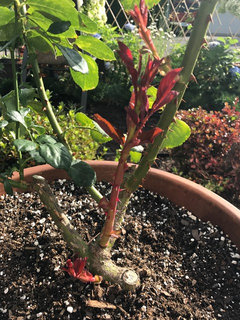
    Enchanted I used some Kellogs garden soil in a red bag originally and mixed it with Master Nursery Gardener's Choice. Recently when I got a couple band roses I used Foxfarm and got basal breaks from those tiny things too. I noticed the roses REALLY like the foxfarm stuff but it's expensive. I also forgot to mention I water quite often because a lot of my roses are new this year. This is my Blue Girl hybrid tea with two basals and a third cane up a little higher on the plant, but all my roses are doing this. They seem to like that woody soil.

  • 9 years ago

    Thanks Va Joh. Did you put soil up onto the canes a couple of inches? I don't have any of the products that you mentioned available here although Fox Fram is available from Amazon prime.

    Sharon

  • 9 years ago

    Great input everyone for hybrid teas and similarly growing roses. Just remember that some rose types don't respond well to the drastic pruning, teas being a good example. According to folks that grow a lot of teas, you need to leave the wimpy canes to grow as they will and the rose will eventually get more substantial as it gets older. Pruning to the ground (as I have to for my teas) or even the 18-24 inches for a tea rose (like my Maman Cochet) results in knee high sulking bushes that never really get very big. Still, in my zone with no surviving canes, that's what I have to do for my teas. Obviously that's one reason teas aren't recommended for any zone lower than 7.

    Cynthia

  • 9 years ago

    Good reminder Cynthia. Not all roses respond to the same pruning methods

  • 9 years ago
    last modified: 9 years ago

    dmoore66(6 NorthWest NJ), I apply Espoma Holly-tone or Rose-tone (the usual), or Mills Magic Mix (if I happen to win some at the district raffles) every 5 - 6 weeks from right after pruning (early April) until mid-August. One cup for smaller plants, two for the larger ones. I use a liquid seaweed (Neptune's Harvest) mixed in with my fungicide spray, and apply it to the soil for those plants that I don't spray. If I have it (I usually win it at the Penn-Jersey district meetings), I'll apply Mills Easy Feed a couple of time a year. I don't apply Epsom salts anymore, I did early on, I never saw a difference.

    David Moore zone 6a nw new jersey thanked diane_nj 6b/7a
  • 9 years ago

    Cynthia, heads off to you for keeping teas alive in your zone

  • 9 years ago

    Dmore66,

    One other thing I want to tell you about, that some old timers are said to have done to stimulate basal cane growth.

    It is taking a wire brush, the kind that is used to remove loose paint and rust, and scrubbing the woody, knobby crown, to rough up the surface in order to remove the barky pieces and scar the living layer beneath the bark a bit. This was reported to help invigorate a bush, and cause basal growth production.

    Please do not think for one minute I advocate this practice. I have never done it myself. Personally, I would try it experimentally, if a rose bush seemed to be a good subject, but would never recommend anyone do the same.

    I am just sharing this with you, informationally. I remember this procedure being discussed some years ago. Don't go outside and wire scrub your roses!

    I would imagine that this wire brush treatment was/is reserved for very old, gnarly crowned rose bushes. Perhaps this treatment was/is limited more to grafted roses whose crowns are congesting because of the confining effects the shank of the rootstock has on it.

    I do know that in bonsai culture, wire brushing the trunks of some species of trees (I believe mostly evergreens), stimulates increased trunk development.

    Moses

    David Moore zone 6a nw new jersey thanked Moses, Pitt PA, cold W & warm/humid S z6
  • 9 years ago

    Is the bud union the same as the crown because I bury the bud union 2-4" below the ground when I plant them. Maybe that's why I don't have basil breaks!

Sponsored
Custom Home Works
Average rating: 4.6 out of 5 stars10 Reviews
Franklin County's Award-Winning Design, Build and Remodeling Expert