Software
Houzz Logo Print
dennor2

highbush cranberry

9 years ago

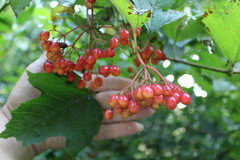
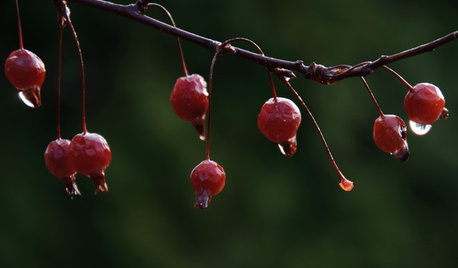
We've got some going, maybe 3 years old. Some fruit on them this year. Not more than pea size, though. Aren't they supposed to be bigger? And though they are turning red, strictly bitter tasting.
Also wondering if I need to net them for birds.
Upstate NY; 2000 feet.
Anybody have experience with these?
Thanks,
Dennis

Comments (15)

  • 9 years ago

    Viburnum opulus var. americanum (V. trilobum)? Fruits not large, should be tart yet palatable when mature. One manual says birds are not interested.

  • 9 years ago

    Thanks for a fast reply.
    It is well before the frost I read is good to have before picking, so I guess we wait and see what happens. Looks like I'd better start trimming for height. And I thought I read berry size up to 15 mm?? These are nothing like that. Wondering if we want to fertilize, or something. There has certainly been enough rain this year!


  • 9 years ago

    unless a soil test indicates something is lacking in the soil ... fertilizer is usually not really a fix for anything ...


    a little of this or that usually wont hurt .. but there is no proof it will accomplish much of anything ...


    besides.. you already have a height problem ... so why would you juice them for more height ...


    check timing of pruning .. you dont want to be cutting off next years buds or some such ... or .. in the alternative .. its not a haircut thing.. usually .. just topics for discussion.. as i dont know the answers offhand ...


    when i used to plant fruit trees.. i really had no expectations for at least 3 years ...


    ken


  • 9 years ago

    I'm curious that these are being planted for fruit at all. The species, V opulus, grows wild here and I've never heard of anyone bothering to pick the berries. They are fairly unpleasant tasting and smelling and really need cooking to become palatable. They are ornamental with a curiosity fruit factor but I wouldn't set great store by them.

  • 9 years ago

    OK...to thank you all and answer en masse...
    We are definitely growing these for fruit. My wife is taking to heart the descriptions here and there that say they will substitute for cranberries, have "similar taste," and so forth.
    We love home-cooked cranberries (or Ocean Spray) and lack a bog (though I'm looking at our back yard this rainy year), and are on a general kick to be as self-sufficient as possible.
    It does appear that we have the edible cultivar---edulus, definitely NOT opulus (upset-stomach poisonous). Nonetheless, the couple I've tasted are bitter, not sour. Awaiting proper ripeness, I guess. But it says they ripen in August. And that they taste best if picked after a frost and not quite ripe. We won't get a frost, usually, till October, so this is a conundrum. There is a range of colors yellow to full red on the bushes at the moment.

    (We are around Albany, NY, at 2000 feet.)

    About height, one source says 8' and another 15'. So looking to contain them to picking height. Was wondering if a soil adjustment of some sort might affect the flavor.
    We've gone through bug attacks, fixed by spraying oil. The bushes are remarkably resilient; have come back from thorough denuding when we did not learn the fix quickly enough.

  • 9 years ago

    You don't need a bog to grow real cranberry, Vaccinium macrocarpon, although they grow in bogs commercially and in the wild. I grow it as a groundcover in my perennial and shrub beds. If I paid more attention to them, I could harvest fruit from them, but I mostly use them as an ornamental plant and to feed the local wildlife, though I do pop an occasional cranberry in my mouth as I am working. They need sun and a never-dry, acid, organic soil, but don't need a bog to grow well and produce cranberries. They taste best after frost.

  • 9 years ago

    Hmm...

  • 9 years ago
    last modified: 9 years ago

    Perhaps you could confirm exactly which species or subspecies you have and then use the botanical name when seeking info about it. Did the vendor have it accurately labelled do you think? Do you actually have V edule? The common name is quite confusing since it appears to be applied to several different plants.

  • 9 years ago

    I'm unfamiliar with Highbush cranberry being grown for fresh eating. Nearly everything i've heard about it as an edible is always processed...jams, jellies, something along those lines. Of course, I also know people who insist chokecherry is great fresh...and yes, I'm referring to prunus virginiana, not aronia melanocarpa.


    If you have the named varieties, Wentworth or similar...size is still small. Larger than species, which is sorta pea sized, so size reference starts small. More than that...patience. It's not uncommon for things to be shy about fruiting until they get established, which happens on their time, not yours.

  • 9 years ago


    I just took this pic of my American Cranberrybush. Notice the lovely fruits. I tasted one, it was both sour and bitter. So much so I had to rinse my mouth out. I'm guessing that they will fully ripen next month and quickly disappear.

    This is 'Wentworth' and started out as a solitary plant that was given to me. It has now spread to a dozen or more arching canes easily 8' tall and bare at the base, have never done anything to it. For me it is a wildlife shrub.

  • 9 years ago
    last modified: 9 years ago

    Yes, apparently you have the wild species Viburnum edule if you thought these were supposed to be a horticultural selection called "edulus" - a thing which I, at least have never heard of. Or you were supplied with material that was supposed to be V. edule - I have seen V. opulus on the market here presented as the other species more than once. And photos of V. opulus used for V. edule - even in serious publications - and so on*. Yet when you pay attention the two of them aren't really that similar, starting with V. edule flowering only on side branches, never at the ends of main branches etc. etc. through various pertinent details of the plant structure.

    *Including on the page linked to below, where the first image is correct and the second one down is not - compare the leaf outlines and the placement of the fruit clusters on the branches

    http://www.pfaf.org/user/Plant.aspx?LatinName=Viburnum+edule

  • 9 years ago

    Edulus, edule, edible, pardon my Latin.
    I used the pix, mainly, and descriptions on the web page I provided somewhat above, to determine that I seem to have the edible type.
    Kate Shugak was known to have gobbled some gratefully right off the branch. But then, she is woodsy, Native American, and at the time was being hunted by an evil industrialist and his insane girlfriend through the Alaskan bush, was without other food or resources, and was highly stressed emotionally. She's also a fictional character.
    I can see I have stepped into a binder-full of erudite, well-versed horticulturists.
    Thank you for the wealth of information and opinion.
    Looks like I shall let 'em grow onwards, keep an eye on the birds, prune to a convenient height before winter, taste weekly, await frost, probably throw a feeding at them on principle, and hope my wife (who started alla this) figures out what to do with them.

    I expect I'll be back for more advice on my flora.
    So we could grow real cranberries in a year like this....or by leaving a hose on trickle forever. Hmm.

    Thank you.

  • 9 years ago

    "So we could grow real cranberries in a year like this....or by leaving a hose on trickle forever. "

    I honestly never water my cranberries after settling in. They are unhappy if the voles tunnel under them since then they get dry, but ordinary mulched garden soil in the northeast is fine most years since we get regular rain. Mine grow in a bed with hydrangeas, rhododendrons, etc., also plants that aren't happy with really dry soil. However, cranberries do need acid soil, and parts of NY have acid soil while others have alkaline soil. Cooperative extension in most states will do soil tests for a fee, and this would be worthwhile to know what will be happy in your garden.