Software
Houzz Logo Print
fretfullyanxious

over-watered, stressed out split leaf

8 years ago
last modified: 8 years ago
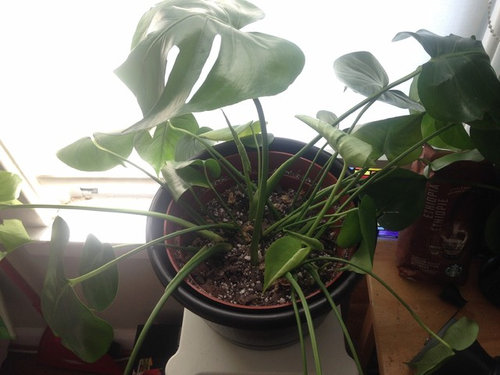
Hello all, I greatly appreciate any help you can give. I believe this poor plant is dealing with effects from overwatering/sitting in wet mix, and I'm starting to worry I won't be able to fix it. I'll hopefully cover all important info, but please ask any questions you need to.

Patient history: a young split leaf philodendron, three months under my care. Bought at a walmart garden centre (fully aware that's not the greatest plant pedigree, but I love a good deal). Unfortunately no photos from that time, but he was very healthy looking, had lots of fresh new growth, three older leaves with a few splits each and more newer growth with the full splits coming in. Everything seemed strong and happy.

Here he is now:

(It gives me no pleasure to present him to you this way.)

Patient stats:

- at a south-east facing window, more east than south (photos taken around 9:30am today; I live in Toronto, Ontario); early morning direct sun is usually blocked by the shade, and by the time the shade is opened it's not as direct.

- temperature and humidity wise: it's not notably humid at the window, in that room (the kitchen); there is a window air conditioning unit on in the apartment, in a room not directly attached to the kitchen, so he is not in a direct draft or breeze; it's been the typical Southern Ontario summer weather the past few months.

- 10" pot with drainage holes, inside a larger pot; repotted into this pot about two weeks after bringing him home; I made more drainage holes in the inner pot because the standard ones were fairly lacking; no bottom layer of drainage rock or anything (I've read the forum's writing on this topic!); every so often I manually aerate with a wooden chopstick (wiped down between aerations).

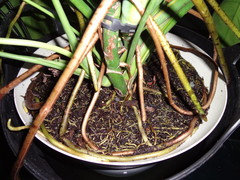
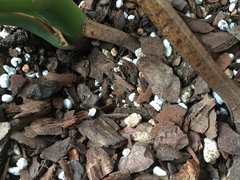
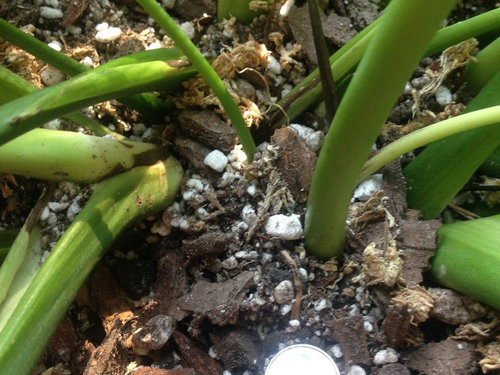
- a week and a half ago, repotted into an attempted 5-1-1 mix: orchard bark (chopped up a bit smaller to make it more in line with pine bark fines), some Miracle Gro cactus and succulent mix, and perlite. Yes, that is not the correct 5-1-1 recipe ingredients list- I now have some pine bark fines on order from Home Hardware; it was relatively hard to find a manageable size of those so I subbed with the orchard bark but ultimately don't think it's working for me. I am also absolutely ok with buying spagnum peat if I should do that instead of my soil substitute. I think my substitute-heavy failed 5-1-1 mix was a big aspect in the decline of this plant.

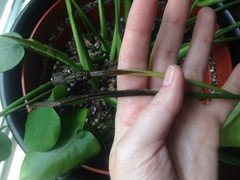
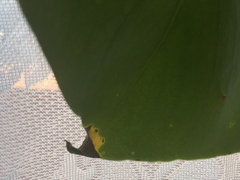
(Dime as size reference; browning stalks?)

- I gave it a heavy water when I repotted (week and a half ago), and was very pleased to see water running freely out of the drainage holes. I had him sitting out on my shaded porch in just the drainage pot to let the water drain for the Sunday afternoon, and then brought him in and sat him in the bathtub for a bit longer before going back into the bigger pot. Previously, I'd watered once every week and a half to two weeks since bringing him home three months ago. I have not watered since the repotting 1 1/2 weeks ago.

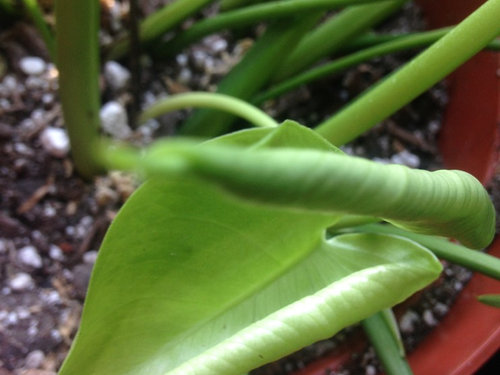
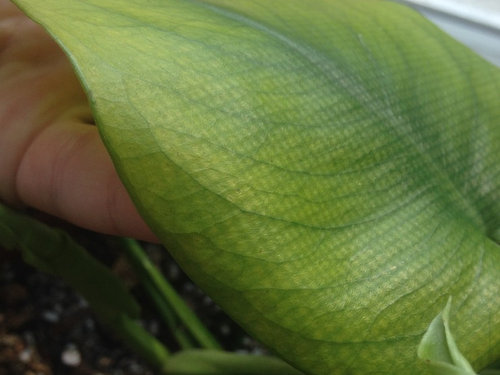
I feel sure that I overwatered it, or was massively overconfident about how freely draining the potting mix really was- I've had many leaves wilt, yellow, and blacken at the base (noted when I remove the leaves); the new growth has slowed down and is not the fresh bright green it had been; leaves continue to wilt terribly. A few nights ago I removed a large amount of still-damp potting mix from the pot (without fully removing the plant itself), and replaced with similar proportioned, fresh dry mix, but this likely was just more added stress to the plant, and not helpful.

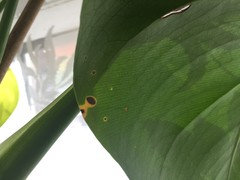
(stalled, yellowing new growth)

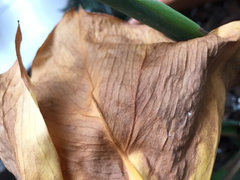
(yellowing leaf)

I suppose my questions are mainly: is this plant suffering from overwatering, as I assume? Could it be a rot? Is this something I can remedy, and how?

I am second-guessing anything I thought I knew about plants, even though I've had a relatively good history with your standard "thrives on neglect" apartment-friendly plants in the past; I am actually usually very skilled at underwatering!

Comments (12)

  • 8 years ago

    I am now suspecting/assuming this is a rot, beyond my ability to save.

  • 8 years ago
    last modified: 8 years ago
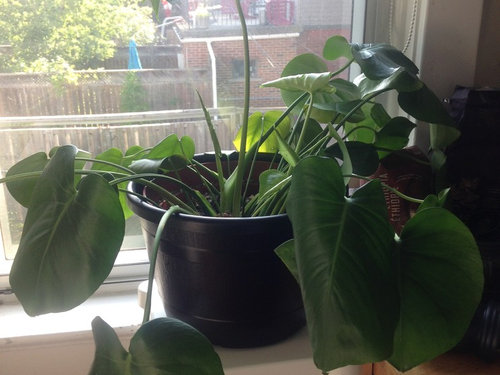
    It looks like it was planted too low in the soil. The petioles of the lowest leaves look like they're emerging from the soil, when they should've been above the soil line. On top of that, it also looks like it's not getting watered enough; being in such a coarse, fast-draining mix. These plants love water. They just don't like soggy soils (which you don't have to worry about). The soil mix looks fine, and isn't much different than the mix I use for mine. It just needs to be watered more frequently. The leaf issues aren't from being "overwatered." It's from the petioles being under the soil line. Only the actual stems of the plants should be emerging from the soil.

    These plants have earned their monster reputations because they are tough plants. They couldn't care less about having their roots disturbed from being repotted. When I repotted mine, its roots were so tangled up that there was no hope of trying to separate them. So I hacked away roughly three-fourths of its roots, and it didn't phase my monstera one bit. It just grew newer ones to replace them.

    Mine stays outside for most of the year, where it grows like a weed. I brought it into my garage to place its pot in a bucket and let the whole root ball soak in some diluted fertilizer. I did this just yesterday, and my monstera has been soaking for a whole day. I meant to only let it soak overnight, but didn't get around to draining it just yet. Though I will first thing tomorrow. Not only will I drain away the water, but I'll immediately flush the whole pot out again with plenty of fresh water. After all of that, I'll let the excess water drain away. Does this mean that my plant was overwatered? No. Seeing as how it's potted in a coarse, fast-draining mix (just like yours), I never have to worry about "overwatering" my plants.

    Overwatering plants isn't about how much water you give them, but rather how much water remains in the soil after you've watered your plants. In their natural habitat, these plants grow close to water sources, and get rained on all of the time. So they're no strangers to water. But they're epiphytes, which means that they grow up the sides of trees. Which is why they don't like soggy, water retentive soils. I almost never let my monstera go dry. In the wintertime, I'll cut back on how often I water it, but when I do water it, I always flush out the whole entire pot with more than enough water. If you want proof, then just take a look at my plant. I repotted it back in the springtime, and since then, it has already filled in the whole entire pot with roots. Not to mention the aerial roots that are growing out in every direction. Even on its plant stand, its aerial roots are already laying on the ground, with no signs of stopping whatsoever.

    ^ As you can see, I have it soaking in water with diluted fertilizer added to it right up to the soil line. After I drain the soil, I'll flush it out with plenty of fresh water. If I were to leave this plant soaking any longer than this, then it would most definitely begin to suffer from "overwatering." Once it's sufficiently drained, plenty of fresh air will rush into the soil to let its roots breathe in the oxygen they need to function properly.

    Another thing you'll notice is that only the actual stems are emerging from the soil. All of the petioles to each of its leaves are well above the soil line. The stems are where the aerial roots are emerging from. The petioles are what hold up and support the leaves. Those are what you are holding in your hand in your last photo. They suffered from being potted under the soil, not from being overwatered. If there are any other petioles still under the soil line, then I would repot the whole plant to raise them up above the surface of the soil. Don't worry about disturbing their roots. These monsters couldn't care less about that.

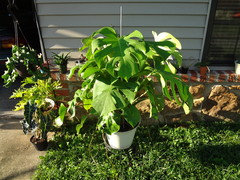
    ^ Here is where I keep it in my front yard, which faces north. The morning sunlight is shining on it in this photo, but my roof shades it from direct sunlight throughout the rest of the day.

    Monstera deliciosas are very thirsty plants. They soak up and require lots of fresh water. I have mine in a self-watering pot, which has a small reservoir at the bottom to hold water. I will soak my monstera in the evening and fill up that reservoir before nightfall. Then the very next day, that reservoir will be empty. But my monstera is outside, and it's summer, so it goes through a lot more water than a monstera that is being grown indoors.

    Danielle thanked Photo Synthesis
  • 8 years ago

    @bossyvossy & @Photo Synthesis, I appreciate both your comments, thank you for taking the time! Apologies for my delayed reply- spent a night at the hospital shortly after posting and medical issues then took up all my time and attention, which actually worked well for giving my plants some alone time away from me fretting over them! Not entirely a technique I recommend to everyone, but I'll take it :)

    @bossyvossy, your reassurances were very helpful- good to be reminded that it had a life before I bought it and took it home, and that it could still be dealing with effects from that. Thank you!

    @Photo Synthesis, I don't think I would have ever made the petioles realization on my own, but gosh, I think you hit the nail on the head. I've readjusted the plant-soil height balance accordingly.

    I've seen photos of your monstera deliciosa previously, and it is a lovely, healthy looking plant. Thank you for sharing your obvious knowledge!

  • 8 years ago
    last modified: 8 years ago
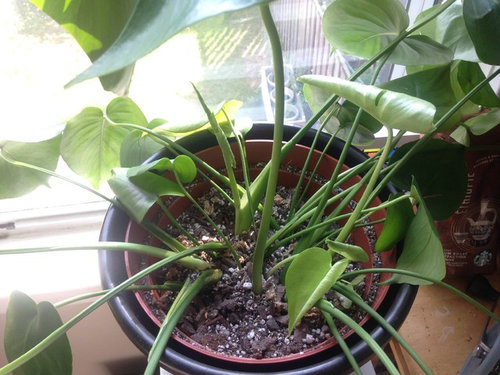
    Hi Photo Synthesis, and Danielle! I hope I'm not taking over, but this might be similar to the problem that I've been having, I really don't know.

    [https://www.houzz.com/discussions/need-help-determining-cause-of-two-sickly-monstera-deliciosa-dsvw-vd~4827928[(https://www.houzz.com/discussions/need-help-determining-cause-of-two-sickly-monstera-deliciosa-dsvw-vd~4827928)

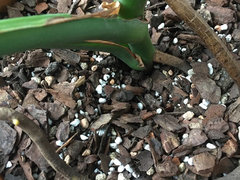
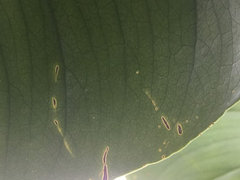
    Here (below) are some more up-to-date pics of the soil and leaves that are turning yellow. The tips on on the other leaves are turning brown/black, it's a shame as they're turning so quickly.

    I guess my question(s) are:

    1) does this look like a simple case of not enough sunlight, if so would supplementing with a growing light be sufficient;

    2) too much water aka soil isn't aerated enough, if so what would good aerated soil comprised of?

    3) leaf disease of some type? I have an elephant's ear that is also suffering, which makes me wonder if I've unknowingly transferred it. If so, what should I do?


    Thanks in advance, and again sorry to interrupt, I'm trying to learn but I'm getting stuck along the way!


  • 8 years ago

    Your plant's soil mix is staying way too dry. These plants love water. Lots of water. But they still need a fast draining mix that doesn't stay soggy, which yours already has. Although yours is in an unglazed ceramic pot, which can be okay, but it will dry out much faster than it would in a plastic pot.

    I showed photos of mine soaking in a bucket of water. That pot is a self-watering one, and has a small reservoir at the bottom. Late in the evening, I water all of my plants, and thoroughly flush out the soil in my Monstera's pot. Then I drain away the excess and fill up that reservoir with plenty of fresh water. I went outside a little while ago and noticed that the whole reservoir was completely empty, which happens all the time. I bring this up only to point out how much water these plants can drink up. As long as you're using a fast-draining mix (which you are), then you won't have to worry about "overwatering" your Monstera. I completely soak mine all of the time, and it still soaks up the water from the reservoir by the next day. Just look at how many roots there are. My Monstera has filled in every nook and cranny inside its pot with roots, and it's sending out all kinds of aerial roots, too.

    Your plant is thirsty, so give it the water it craves.

  • 8 years ago

    Oh Photo Synthesis I hope you're right! I prodded my finger into the soil and it's still damp around the top of the root ball from last watering which was a couple of days ago. When I repotted it, it did smell a bit. I think the roots were still healthy but I thought that might mean there's not enough aeration? Gosh. I'll give her another huge gulp, but it's very dark, and overcast here in the UK. I think I'm going to have to buy some growing lights to get these guys through the winter. :)

    Thanks so much for your help.


  • 8 years ago
    last modified: 8 years ago
    I took a look at your other post and thought I'd comment some more. You see how well my monstera is doing? Well, this is with me rarely ever fertilizing it. Even when I do give it fertilizer, it is always diluted down to at least half strength. Fertilizer isn't a substitute for sunlight. If you want to "feed" your plants, then feed them sunlight. In this case, very bright indirect sunlight. Because plants produce their own food, and they can only do that through photosynthesis. If your plants leaves are dying off, its most likely because it's not getting enough sunlight to feed itself properly. When they can't produce enough food to sustain "x" number of leaves, then your plant will begin shedding older leaves to conserve what little energy that it is receiving, and focus its efforts on the newer, younger growth instead.

    So to sum this all up, your plant is hungry and thirsty. Don't worry about fertilizing it right now. That comes secondary to the bright indirect sunlight and water it's craving. Inadequate fertilizing isn't the issue.

    I never let mine completely dry out. Although, there have been a couple times where it has. These are rainforest plants, and they absolutely love the "rain" that they get. If you're growing yours indoors, then keep the leaves dry. Mine is growing outdoors, where it's warm and humidity, and bright and sunny, so I spray the whole plant down with water, lots of it. I soaked it down last night, and I'll be watering it again later in the evening before nightfall. When I bring it back indoors for the winter, I refrain from getting the foliage wet. I don't mist it or anything. However, I still give it plenty of water.

  • 8 years ago
    last modified: 8 years ago
    If it smelled when you repotted it, then that old soil wasn't well aerated. This newer mix that you've used should fix that. When you water your plant, the water shouldn't take very long to filter down through the potting mix. If the mix is still damp, then it should be okay for now and not require any immediate watering. But as I stated before, I never let mine go completely dry, and it does just fine. As long as the roots can breathe in fresh oxygen, then it doesn't matter how much water you give them.

    If you want to give them supplemental lighting, then you can always use regular cfl or led light bulbs, just as long as they are specifically labeled as "daylight" light bulbs. I use these for my plants and they love them.

  • 8 years ago

    Hi Photo Synthesis, thanks for your advice and clear instructions. I'm sorry I haven't replied in a while, life got in the way!

    Sadly the smell is now present at the top of the pot and the leaves are now getting black spots and cuts. I don't think my Monsteras will live through the winter here. I've had to remove several leaves now. I don't know what to do, I've watered them throughly and have given them more light by moving them from one side of my place to the other. I also picked up a daylight bulb and have that on a timer.

    I'm really starting to think this is leaf disease of some type.

    Does anyone have any helpful advice? Should I report and cut away most of the roots? I recently repotted when I noticed the problem starting and didn't see anything that looked like rot. Now the smell is getting worse and that may mean there's not enough aeration, I'm not sure what to do.

    The soil mix is approximately:

    1/3 perlite
    1/3 orchid mix

    1/3 bonsia mix (mixture of Loam, Pumice, Bark & Baked Clay)

    Any and all advice welcome, I don't want to lose these lovely plants. Thanks.

  • 8 years ago
    last modified: 8 years ago
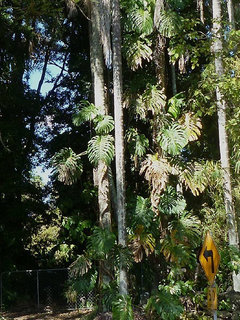
    You need to keep in mind (it was mentioned before) that these plants grow epiphytically. They grow up tree trunks and the roots are on the tree surface. Those roots that run on the soil are usually on the surface as well, only under leaf litter. You can grow them in just bark which would avoid the roots being in cold wet soil. Bright light and warmth are needed as well. This is some growing outside getting a lot of sun, it does them a lot of good when they're aclimatised to it.

  • 8 years ago
    last modified: 8 years ago

    these plants grow in FL in dappled sunlight going up the trees to get MORE sunlight.

    do not be afraid to give them direct sunlight indoors, especially if you are up north or you have a lot of overcast skies.

    during hot summer months do not let them cook next to the window though!

    then the best solution is vertical or venetian blinds mostly OPEN! but with the sun light changing the angle throughout the day you will still get some shading effect, but THE DIRECT SUNLIGHT will be hitting the leaves! and in weaker winter sun at low angle you can give them direct sun - just do not place them next to the window (hot in summer /cold in winter). when they say 'these are low light plants' - you have to understand that shade in tropics is much brighter then your south window indoors!

    the soil mix for both posters is ok - but watering is not enough - that's why the plants are wilting. like photoS said - they LOVE water. also if you have a lot of large bark in the mix and you let it dry up completely - it will not absorb ANY water when u water: it'll just pour thru. the plant will not have enough time to absorb enough.

    when the leaves wilt completely in this type of rough mix - it means the plant needs MORE water, not less. give it a good soak for 30 min at least in a bucket of water.

    however, the rotting smell is def not good - it's quite possible you have a bacterial rot - which is impossible to get rid off, except by physical means : cutting off effected tissues, be it stem, roots or leaves - they all have to go and you need to monitor ev day for more infection. if it's in roots - u'll need to change the mix most likely. there are some vicious bacterial infections common to tropical plants (like erwinia) that are fatal :(.

Sponsored
Peabody Landscape Group
Average rating: 3.5 out of 5 stars8 Reviews
Franklin County's Reliable Landscape Design & Contracting