Software
Houzz Logo Print
rjfletcher1962

Tomato Problem

9 years ago
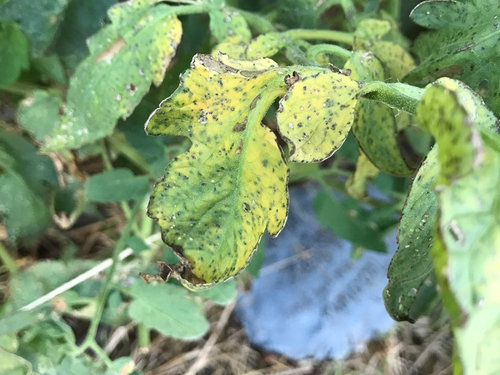
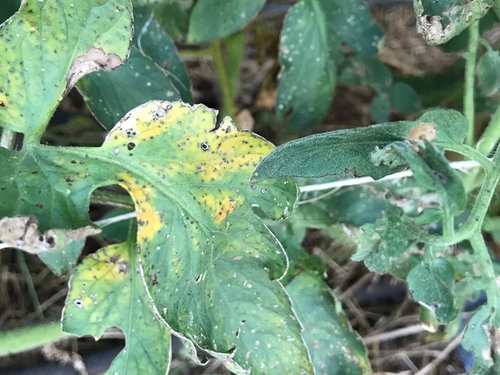
I need the expert advice of the forum on what is causing this on tomatoes. Plants were planted in June and are producing well. This starts from the bottom and works it's way up the plant and is affecting all varieties. Thanks for your help.

Comments (5)

  • 9 years ago
    last modified: 9 years ago

    It looks like bacterial spot or bacterial speck to me, but I'm not an expert. It could also be Septoria Leaf Spot and/or some Early Blight. Do any of the fruit have spots on them, or is it just on the leaves?

    I tried to insert a link to the Cornell University website, but it isn't working for me. I typed it in below, and it has lots of photographs, explanations, and various treatments of the different diseases/viruses, etc., that plague our gardens.

    It is hard here in Oklahoma to escape the season without a disease (or two or three) on our tomatoes.

    At any rate, when Dawn looks at the photo (she is our resident expert here), she will be able to tell you what it is.

    http://vegetablemdonline.ppath.cornell.edu/cropindex.htm

  • 9 years ago

    I see several issues together, and think Mary hit the nail right on the head. It looks like a combination of fungal and bacterial diseases, many of which are hard to distinguish easily from one another.

    Regardless of exactly which bacterial or fungal diseases your plants have, the treatment is the same. Remove all the damaged foliage. This is very important because if you leave the foliage, the diseases will continue to move upward from limb to limb until the entire plant is affected. Bag up and throw away the foliage and do not compost it unless your compost pile is a hot pile that will destroy the microorganisms. Even so, if composting, immediately put something else on top of the tomato foliage you've removed, or dig into the center of the pile and bury it there, so that diseases doesn't keep propagating from the foliage you removed.

    The next step is to spray the plants thoroughly, hitting the top and bottom of every leaf, all the branches and stems and all the fruit, with the fungicide of your choice. If you are purely organic you could use Serenade or Copper, or use both, alternating their use every 7-10 days as the product labels advise. If you don't mind using a synthetic, use Chlorothalonil (aka Daconil). While I am mostly organic, I'd probably use Daconil first if this were my garden and then the next time I sprayed, I'd use copper. Understand that the fungicides available to home gardeners are not systemic and do not kill the disease microorganisms. What they do is coat the plant so that new disease microorganisms cannot spread any further on the plant. If you miss a leaf while spraying, that leaf is likely to become diseased, so take your time and coat all the foliage with the fungicide. All you'll be doing from this point forward is spraying to keep the diseases from spreading. It is possible, though, to keep the plant relatively healthy, alive and producing for the rest of the season.

    If the ground beneath and around the plants is not mulched, it should be. These diseases are present in the in the soil and easily go airborne and spread, so every time it rains, soil splash can carry the diseases up onto your plant and from there, the diseases climb progressively upward. A good, thick layer of mulch helps slow down how much soil splash spreads these sorts of infections. And, in case you're thinking the long-term solution is to replace your soil, that's not a good option as these diseases affect all soils worldwide so you'd be wasting your time and money. Simply work to add more organic matter to the soil annually to improve soil health.

    Tomato plants are susceptible to many, many different kinds of bacterial, fungal and viral diseases and learning to deal with these diseases is just a part of being a gardener. You can do this. You can keep your plants well enough to produce throughout the rest of the season. It is frustrating but is just part of the gardening life.

    Good luck,

    Dawn

  • 9 years ago

    Thanks for the help. I have used wheat straw for mulch, but will add more. This is a new bed at a new house so I had no idea what to expect. Hopefully with time I can improve the soil. There does not appear to be spots on the fruit so hopefully I can get a harvest,

  • 9 years ago

    From the epa.gov.nz (New Zealand) about Daconil...

    "It is the first time the EPA has issued a Red Alert notice. CEO Allan Freeth says: “We have issued this Red Alert to raise public awareness of the dangers of using products containing chlorothalonil, a broad-spectrum pesticide used to control fungal leaf diseases in vegetables, ornamental crops and turf.

    “Chlorothalonil is acutely toxic, especially if inhaled, and is classified as a suspected carcinogen. The European Union has banned its use in consumer products. The US and Canadian authorities are also concerned about the dangers it represents to domestic users.”

    Dr Freeth initiated a reassessment of chlorothalonil based on his concerns over new evidence which came to light when the EPA considered a recent application for a fungicide containing the substance. It found there were unacceptable human health risks that could not be mitigated by imposing controls on its use in a domestic setting.

    “Given the serious effects chlorothalonil can have on human health and the environment, initiating a Red Alert is another way for us to help protect New Zealand and New Zealanders from chemicals that we have concerns about,” says Dr Freeth.

    The decision to revoke the approvals means that the following products cannot be manufactured or imported into New Zealand after 11 May 2017. They will be banned from sale to anybody in New Zealand from 11 November 2017. "

Sponsored
Landscape Management Group
Average rating: 4.9 out of 5 stars33 Reviews
High Quality Landscaping Services in Columbus