

Schefflera Dropping Leaves left and right
Hi everyone,
First time posting here, but probably should have started a few weeks ago. I got a Schefflera for a house warming gift back in January, and started having some green leaves drop within a few weeks. I wrote that off as just normal shock from changes in the environment.
After a few months


of continued leaf drop at varied rates I researched and thought it was simply overwatering. Focused on limiting watering to only after the soil had completely dried out for a few days. This seemed to work for a few weeks.
Then I began to lose leaves again, including many which turn brown in spots, then the entire leaf, then drop. In addition to the brown leaves I also continued seeing additional green leaf drop as well.
Once I got to this forum, I read alot of Al's posts on soil drainage etc. Decided bare rooting, pruning the roots back and repotting in the gritty mix would be the best course of action. When i did repot it, roots looked generally pretty good (no clear rot) but i did take the opportunity to prune several roots that had started forming a J and coming back up towards the top of the soil.
I was wrong..... Now I am getting even more leaf drop (both brown leaves and green) as well as a few stems. I am watering about every 5 days with water and diluted nutrients every other feeding (blend of General Hydroponics Flora series I had laying around). When the leaf drop started again, I immediately ended any nutrients and ensured I was getting proper drainage from the gritty mix.
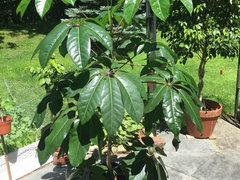
I'm not sure where things are going wrong here, but I am open to any advice you all can provide. It is in an east facing window which gets good indirect light throughout the morning and early afternoon. Temp has dipped here (Cleveland Ohio area) for a couple weeks, so I guess there could have been some cold shock (house got down to 65ish one night, with the scheff near a patio door that could have been open at times).
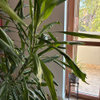
I have attached a couple of photos, one of the schefflera, the other of the leaf drop just from this afternoon!!
Thanks in advance!
Comments (27)
 9 years ago
Schefflera, ficus benjamina, and some other woody plants that able to form aerial roots have unique characteristics. They are happier (grow muscular trunk with nice aerial roots) when live in very dense soil that make their base root (where root and trunk connected) attach tightly. They even survive more when sprout on rock and sending root down to soil surface to grab some nutrients. Some grower here usually give some clay base soil around root base before planting them in regular potting soil. That clay ball planted above perched water zone so even some roots tips stay wet for long period because rain or overwatered, they will survive. If you shake the trunk of yours and it easily lost contact with soil around, that plant not in ideal living condition, and will be hard to make it happy.
 9 years ago
First, don't fertilize after repotting until you see new growth (I forget exactly why, but it's in several of Al's posts about repotting because fertilizer makes it harder for new roots to take up water, or something like that...).
Second, how long since the repot? It's typical for a plant to sulk for a while after repotting. Also, water the gritty mix freely and frequently at first until the plant is established, and then water as needed, which should be every few days. Considering that you repotted this late in the season and the plant was weak to stay with, it may take some time before you see some imprudent.
Water very slowly, covering the entire surface of the mix, so you don't leave dry areas. Gritty mix doesn't wick water around the way a peat-based soil does, so it's up to you to make sure the moisture gets to every part of the pot.
If you don't see improvement, tell us more about how you did during the repot and maybe give us a good pic of the mix.
Matt O thanked litterbuggy (z7b, Utah)Related Professionals
Hot Springs Landscape Architects & Landscape Designers · Belleville Landscape Architects & Landscape Designers · Newburyport Landscape Architects & Landscape Designers · Rochester Landscape Architects & Landscape Designers · Los Angeles Landscape Architects & Landscape Designers · Paducah Landscape Contractors · Baltimore Landscape Contractors · Enid Landscape Contractors · Memphis Landscape Contractors · Leominster Landscape Contractors · South Sioux City Landscape Contractors · Eugene Landscape Contractors · Rochester Interior Designers & Decorators · Lubbock Interior Designers & Decorators · Calgary Interior Designers & DecoratorsMatt O
Original Author9 years agoYea I know I was a bit over-anxious to repot (even though it was late in the season) since I'd seen considerable leaf drop.
Anyway, I flushed the pot yesterday to get rid of any potential leftovers from the nutrients and will go about watering slow and thoroughly for the next few days/weeks.
Since we are getting to the end of the growing season up here, and daylight is beginning to dwindle, would it make sense to try and keep the plant under a supplemental artificial light?
Also, the repot went pretty well. I trimmed back the roots but not too aggressively (they were in pretty good shape honestly, just some J-hook and woody roots without any fine roots sprouting from them).
Thanks for all the help. I'll report back if I don't see any improvement or if things get considerably worse.
Matt O
Original Author9 years agoOh btw, is that 'rippling' (i guess you'd call it) on the edge of the leaves normal? My local garden center thought it was a bit odd for a Schefflera. I guess you could call it a wavy edge of the leaves? Just curious.
- 9 years ago
I underdtand where Gudang is coming from being in the tropics.
Unfortunately, indoors in North America is much different. A heavy dense soil will only lead to issues.
you can't treat the tropics and an indoor environment the same.
Scheffs love a lot of water but they don't like to stay wet. Hense why a heavy dense soil won't work indoors.
Anyway, OP, when did you repot? Did you keep the roots wet during the whole process?
- 9 years agolast modified: 9 years ago
The heavy dense soil isn't on all soil, just around max 2 inches surround the root base, where root and trunk conected. The rest is just whatever soil you prefer to so it's not effect the drainage or perched water amount in pot. It's just prevent the plant from losing contact 100% with the soil while moving, shaking, or even replanting. Even in tropic, soil preference almost the same. For indoor usage, during rainy season, mostly for non woody plants, active grower prefer less water retentive soil to prevent root rot. Rice husk is commonly used to reduce soil density. It work maybe almost similiar with 511.
- 9 years ago
Matt, Al recommends indirect sunlight after a repot, but artificial light should be fine and will encourage new growth once the roots grow back. I'm going to cheat and link to a thread where I just posted a little info and links to some stuff at HD:
http://forums2.gardenweb.com/discussions/4856475/fiddle-fig-leaves
Matt O
Original Author9 years agoRepotted about three weeks ago, late august and yes I kept the roots wet and out of direct sunlight as much as possible.
 9 years ago
If the first pic represents the light level its growing in, I would say it is going through acclimation, a rather sped up one because of the change in the level of lighting.
- 9 years agolast modified: 9 years ago
I can't agree as the leaves would yellow and fall.
The brown suggests over or under watering.
I've always had great results with scheffs in the 5:1:1. I have not used the gritty for any.
Heres one I grew for a couple years and recently sold. Never ever shed a single leaf even after major root work.
It's very strange yours is acting the way it is. These are normally very easy to care for.
Is there anything else you can think of? Any changes?
Matt O
Original Author9 years agoNo real changes since it was brought into the home 6-7 months ago. Same lighting, temps (other than seasonal variations) and watering schedule. Only change was the repot after leaf drop started picking up again. I guess it never seemed to get fully over the initial shock of moving from nursery to here.
Outside of just the brown leaves, fully green leaves and green stems drop as well.
- 9 years ago
Matt, it just occurred to me that you never talked about checking moisture levels before watering. At the bottom on this post is a summary about how's and whys derived from Al's 'teachings' that I'm lazily pasting in.
But first, I've found that 5:1:1 performs differently depending on the properties of the bark you use. My first batch retains very, very little water, and needs to be watered every few days even in the winter, and the other has to be tipped to drain away a relatively small amount of perched water that otherwise might endanger the roots even in summer. If your bark stays wet for a long time, which could easily happen if it had a lot of dust and very fine particles that your didn't sift out, it could be retaining a significant amount of water.
The only way to know is to test the moisture at the bottom of the pot and water only when it's dry:
Watering when the plant needs it (and not before) is one of the biggest things you can do to keep any plant healthy. Like most plants, aerated soil is as critical to a ficus's health as sunshine. That's why we check soil moisture.
A sharpened dowel is a simple, fast, and accurate tool for this (5/8" or 1/4" seems best), but any thin piece of unfinished wood, like a wooden skewer or even a cheap chopstick, works fine too.
Stick the dowel through the soil to the very bottom of the pot, leave it for two seconds, and withhold water until the whole dowel comes out completely dry (don't worry, at that point there's still water within the soil particles that the roots can access but we can't feel). Then water slowly but thoroughly, wetting the entire surface of the soil, until water drains freely from the pot, making sure the pot doesn't sit in the drained water.**
To get excess water out of the pot so the soil at the bottom doesn't stay completely saturated, prop it up so it's tilted at 45 degrees for 10-15 minutes. If there are drain holes around the edges of the bottom you're done (that's why I love my cheap plastic pots); if the holes or holes aren't at the edges you'll leave the pot upright for 5-10 minutes to let the excess water drain out.
This practice ensures the roots get substantial periods in moist, not wet, soil, when they can get oxygen from the air between soil particles and grow into a healthy system that takes up water and nutrients stores water for dry periods. Watering until water drains freely from the pot prevents the buildup of mineral and fertilizer deposits that can damage the plant and retard growth.
Plants use more water when they're growing and in low humidity, and use less in the winter, so check the moisture every day until you know how your plants behave . If you don't have a pencil sharpener, just scrape off the dirt stains from the last time you checked with a utility or pocket knife or even a razor blade.
I hope that helps!Matt O thanked litterbuggy (z7b, Utah) Matt O
Original Author9 years agoThanks, I was not checking via the dowel method, but will try that going forward. I did commonly tip the pot to get out any additional perched water and did basic finger test down about 4-5'' in random spots.
Also, does the not watering until dowel is dry advice hold for the Gritty mix as well (which I am using, not the 5-1-1).
- 9 years ago
Ah, sorry, I don't know why I assumed it was 5:1:1.
Regardless, it seems soon for a weakened plant to recover from an autumn repotting. Members often report long recovery of weeks or even over a month for a plant that's sick or repotted at a difficult time of the year (or both), but it will come back if the media is well made and you follow good watering practices. It will probably sulk for a while, like my old schefflera after repotting last fall, but it will make it through the winter and start to flourish in the spring and summer. It helps that your scheff was healthy before it started acting up, and scheffs are tough little buggers to start with, so hang in there and try to be patient.
People do use the dowel to check moisture in gritty mix, if only to get a feel for how often they need water, but it's really not necessary because it really can't retain water if it's made well, which is why Al says we can water it freely. If you're worried about it, use the dowel to check the day after watering. If the dowel comes out wet instead of moist you may have an issue, but I doubt there's a problem. Also check when the seasons change, because the pot may need water more often, if not daily, when it's actively growing or if the weather is hot and dry.
Lenore
Matt O thanked litterbuggy (z7b, Utah) Matt O
Original Author9 years agoThanks Lenore. I tried out the dowel and surprisingly enough, it did come out wet (only on the bottom 1 inch or so, which the roots aren't close to fortunately). Perhaps the mix wasn't as well made as I hoped. I'll keep an eye on it and be careful throughout the winter with the watering. We've had a warm spell here recently (highs in low 80's, lows in high 60's) so I've moved it outside to take advantage of the last few good days of sun before fall and winter really set in.
As for the Gritty mix, I will say the granite was probably on the smaller side of the requirements. Not sure if that combined with reptibark that is on the bigger side causing that small bit of perched water. Any thoughts?
Matt O
Original Author9 years agoOk, so I wanted to give an update and get any feedback you all might provide....
Since my last post, the Schef has continued dropping leaves but in a slightly different manner. I'll preface this by saying that the plant is back inside as the warm patch we had has since gone. The below picture is a few days after being outside. I started to get a light brown coloring in the middle of leaves before they would drop.

After moving it back inside, I continued to get the old type of drop off (where the tip of the leaf turns dark brown/black and gets 'crispy', then drops). This happens to all the leaves on a branch and then after a few days, the branch gets the black on its tip, moving towards the trunk, then drops as well.
I have now lost almost all of the lower branches with just the top two or three remaining on each plant. I continue to check the water using the dowel trick, and the bottom 1-2 inches continuously comes out darkened/damp (not much, but enough to be apparent). Also, this 1-2 inches of water doesnt change even if i tip the container at a 45 degree angle. I do have some screen material in the bottom of the pot to prevent any of the gritty mix from escaping, I wonder if that being clogged with fines could be part of the moisture issue (although the roots are probably 3-5 inches from this perched water level).
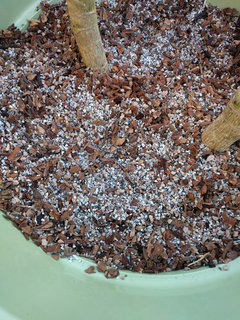
I'm guessing my gritty mix is the issue, with the bark being too large compared to the granite and turface. See a picture below.
So as I see it, my potential next steps are either:
1. repot immediately in a new medium - seems like a poor idea given the limited vitality of the plant currently
2. wait out fall and winter until conditions are ideal for a repot in a new medium
3. ????
Any sage advice would be greatly appreciated!
- 9 years agolast modified: 9 years ago
I hate to harp on this, but you need to wait until the tip of the dowel feels dry before watering. I know it seems like an inch or two of perched water wouldn't be a problem, but I think it's clear at this point that your mix is retaining a lot of perched water, and it's very likely that perched water in a water retentive mix is the reason the plant is failing. After all, it's well known that a water retentive mix can wick up enough water to keep the root zone too wet for too long.
Spend the next week or two letting the pot dry out before watering well and see what happens. Be sure to withhold fertilizer until the plant is stable and putting our new growth. Remember Occam's Razor: the simplest solution is usually the right one. If I'm right, your plant should stop dropping leaves and within a week of fixing your watering practices. If not we can think about other now risky options. What do you have to lose?
You may think the plant will die if the pot goes dry, but you just have to trust the method, which is based on the fact that moisture hides inside the mix's particles where you can't feel it but the plant can still access it. After all, the dowel method even works in the hydrophobic 5:1:1 I made when I first started, which has made that substantial schefflera and two rooted ficus cuttings thrive through the hot dry summer months despite the fact that the whole pot feels bone dry by the time the bottom half inch is dry.
As for your mix, there's way too much fine grained material that is far too small to provide aeration and fast drainage, regardless of the size of the bark. You can see how the tiny pieces of granite and Turface completely fill in the spaces between the pieces of bark. Measure with a ruler and I'll bet the majority of the Turface and granite is under 1/10 inch, which is the point where a mix will retain water and wick it around the pot, no matter what it's made of.
I know Al says he includes turface as small as 1/16-1/8", but if you read that post carefully you'll see that his bark, granite, and half of his turface--5/6 of his mix--are all bigger than 1/8", keeping the fines from blocking water and air flow.
So for now I'd act as though it were a sick plant in Miracle Gro: withhold fertilizer until it stabilizes and starts growing again, let the bottom dry between watering, water well, and tilt after watering. Then, once it's stable you can consider adding ballast, which will dry much faster, protect the roots from the perched water, and let you water more normally, or water in sips, preferably with RO water to avoid mineral or fertilizer buildup.
I'll be very interested in hearing about what happens!
- 9 years agolast modified: 9 years ago
Matt, I know this contradicts the dowel method for watering and checking moisture, but I make a mess every time I stick a dowel into my plants and pull it out and I don't want that all over my floor so I just pick the whole pot up. If it's heavy for more than 4 or 5 days it has too much moisture due to the wrong soil, over watering, or bad drainage. That has to be dealt with, but to simp,y find out quickly whether or not a plant needs water right now, if it's very lightweight when you pick it up, it's dry. Water it. Sometimes water runs through and if it's really thirsty it will drink it all up. Get rid of any excess water in the saucer after an hour or so. Take into account the type of pot you are using. I'm a big fan to terra-cotta pots and of course they're heavy, but you learn with practice. Good luck to you!!!
 9 years ago
I'm definitely no expert, but perhaps Lenore, Matt should also try and use a wick to help with the excess water the pot is retaining? I know I've read that before in one of Al's posts.... I don't think it can hurt anyway.
Matt O thanked Cassandra H- 9 years agolast modified: 9 years ago
Matt, I just remembered the screen over your pot's drain hole, and you're right, I recommend pulling it out or cutting a substantial hole in it. That will also let you insert a wick in the hole to help drain some of that excess water out (excellent catch, Marcy!!). The mop that my wicks came from must not retain enough water because they didn't work for me at all, but most people find that wicks can drain most of the perched water out of the pot.
I hear you on the mess, Marcy, but right now it's critical for Matt to solve his plant's wet-feet problem before it gives up the ghost, and the only sure way I know to do that is to actually feel what's going on at the bottom of the soil column. Most moisture meters aren't even reliable because they measure conductivity, not moisture. Besides, Matt's gritty mix won't stick to wood nearly as easily as a peaty putting mix would, and a pot of gritty mix is so heavy that he won't be able to tell the difference between wet, kind of wet, and dry
Always discard drained water. Letting your plant soak it up is just begging for toxic mineral deposits to build up in the soil. Don't ask how I know this; let's just say I still feel guilty.
When my plants were extremely thirsty during the summer I would just wait an hour after the initial watering and then go back and water again. If dealing with the drained water is a problem, lay two pieces of wood across the top of a bucket and set the plant on top so the bucket catches the water. I even keep a 4x4 piece of plastic nearby to protect my area rugs from whatever mess I might make.
Matt O thanked litterbuggy (z7b, Utah) Matt O
Original Author9 years agoOk, so I haven't been able to get to the screen without completely emptying the pots.... the screen goes across the entire bottom of the pot, so I can't really get to it from the drainage holes. I suppose I can quickly empty and repot (figure it should take 5-10 minutes tops. let me know what you all think.
To add to the intrigue, both plants have slowed their decline (way fewer lost leaves/stems, still some browning tips, but they haven't progressed to consume the entire leaf as they had been previously). More curious, they are both putting out new growth at the bottom of both stems (see picture). I am absolutely baffled.
The only thought I had was that when I initially repotted and root pruned, that I potentially trimmed too much of the root ball which no longer allowed the plant to sustain all of the large green leaves that it had at the time. Now that it has shed a large number of the larger older leaves I think it may have stabilized in terms of roots/canopy ratio. Just a thought, would love to hear what you all think.
Thanks as always!

- 9 years ago
Use some tin snips, utility shears, or a sturdy knife to cut an X in the screen, then either cut off as much of the triangular flaps as you can or use something thin to tuck the flaps between the pot and the screen.
If you've been letting the soil dry enough to admit some air it's not surprising at all that the plant is recovering. The fact that your plant is backbudding at all shows it hasn't exhausted all of its energy reserves, which the plant is now spending on new roots and even backbudding. That's one of the great things about plants: they usually respond quickly once their needs are met, which makes the effort more worthwhile.
Did you cut or pull off any leaves that didn't drop on their own? If so, you interrupted the flow of auxin. Auxin is a hormone that flows down from the top of the plant and suppresses growth from dormant nodes, and interrupting the flow allows backbudding, which is what happens when previously dormant nodes produce new branches.
This happened to both of my leggy scheffleras this summer. All I did was cut a few sunburned leaves off of each of them, and they responded with clusters of new branches right at the base of their main stems, as well as some backbudding closer to the growing tips.
The healthier the plant and the more excess energy it has, the more dense and vigorous the new growth will be. That's why you get better results when you prune a plant in early August than you would in April. For example,after I removed the sunburned leaves my plants produced three or four times the number of new branches and many more young leaves as yours, but that was after I had been taking proper care of them for almost a year, with good watering, fertilizer, and supplemental light from bright white (5000k) LED and CFL bulbs over the winter, and the intense direct sunlight they got on my porch gave them lots of energy for new growth.
Matt O thanked litterbuggy (z7b, Utah) - 9 years ago
Matt, here's an extreme example of the kind of backbudding you can get from a very happy plant. Dave grew this from a dwarf schefflera cutting in 5:1:1 under lots of supplemental light. The backbudding on my plant was somewhere between this and your plant, and I think dwarf scheffs tend to have more dense growth, but the photo will give you a general idea of the kind of thing that can happen once you get your plant sorted.
 Matt O thanked litterbuggy (z7b, Utah)
 9 years ago
I cut off 6 leaves from my dwarf schef, hoping to back bud. It's a healthy happy plant that could use better form. It's probably the wrong time of year to expect much, but I will try it again in spring. Is spring the best time to encourage back budding this way. Love this info. I will post if there is any excitement. Thank you.
- 5 years ago
Hi stop watering it they don’t like a lot of water let it completely dry out before watering again they also don’t like to be moved around so try and find it’s home with light- use artificial lights if not enough light - if you re pot needs to be done in spring good luck













litterbuggy (z7b, Utah)