I've been thinking about these two concepts a lot lately. I'll discuss ambiance first. I notice that even those with small yards tend to have garden areas with a very different "feel" to each. For instance a cottage garden in back and a more structured formal garden behind their house.
A walk around my own property is like visiting different universes without really leaving home, and we love this. Dog trainers will tell you that dogs do not only require physical exercise, but they need mental stimulation as well, and a walk in unfamiliar surroundings is, at once, more tiring and enriching than chasing a frisbie in the back yard. In addition to occasional excursions to the national forest roads and trails, we walk our dogs daily around our property, doing what we call the "garden tour" that takes us around to all of the gardens in the open land and up the hill through our trails in the woods. For the dogs it is a wonderland of new smells and the excitement of seeing a rabbit jump out of the underbrush, while, for us, it is a self-guided tour of the natural paradise we have helped to create. And, of course, it is good for the health and well-being of all of us.
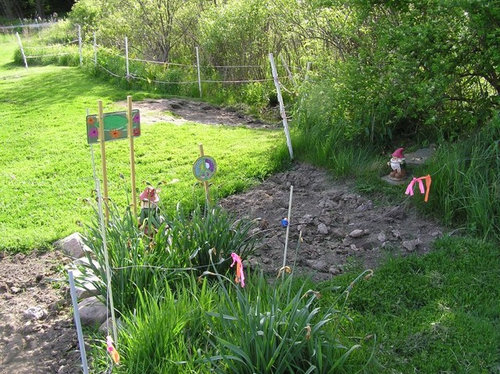
Our "gnome garden," for instance, is a whimsical place. It has an organic, old-fashioned, hippie sort of feel to it. It, and the other gardens along our "esplanade," aka the strip of land bordering our brook, have a peaceful aura about them. The sounds there are a mix of running water and chittering of birds in the willows.
I guess none of my gardens will ever have a traditional look to them (I love the eclectic!), but my perennial beds and veggie patch come closest.
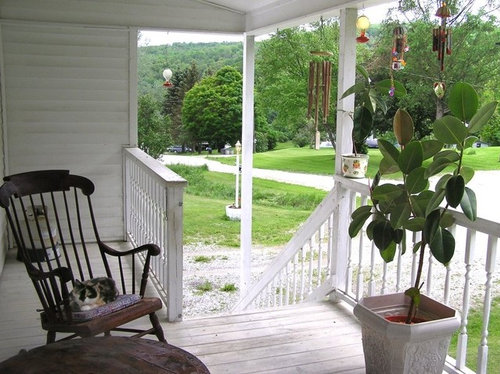
The front porch with its wind chimes and potted plants has always had a "new age" air.
We have a collection of green and orange solar lights out across our land in summer. They are difficult to photograph, but they have a serene look to them, and, on a summer night, the effect is beautiful and calming. Most of the lights are basic cheapy solars from home depot, some with colored duct tape around the outside of their plastic domes and others filled with colored plastic beads to convert them from their original ghostly white/blue/cold color to warm orange and green.
However, behind the house, the "water garden" where my goldfish live in their plastic kiddie pool is lit with color changing lights on poles and other multi-colored solar lights. It is sort of the Los Vegas strip area! Variety is the spice of life they say. More about diversity in the "evolution" part of this post.
-----------------------------------------------------------------
As to evolution: the focus for our property originally was as a habitat for our horses, and it remained that way for the duration of their 3 decades long lives. It was 2+ acres of open pasture land with a hill in back, and a wetland area bordered by a little brook. Only after the death of the last old pony at age 36, did we begin to look at our patch of earth with new eyes. Converting a dinner table for our equine charges into park land and gardens was the biggest transition. Trees had previously been the enemy; anything growing that was not edible fare was slated for removal, either by the horses or by brush shears. (The only tree that survived in that era was a single quaking aspen in our yard.) But now suddenly, a miniature forest of white pines sprang up on our hill (seeded from pines in the older woods on the other side of our property line), and with it, a whole new eco-system. Similarly, a thicket of pussywillow bushes colonized the wet area by the brook. In the open meadow area (now mowed lawn) we created a number of gardens.
As time passed, one of the first things I learned was to let nature guide me, rather than to attempt to control the landscape myself. Originally I envisioned a pine forest on our hill, and stupidly culled all the hardwood seedlings that appeared amongst the pines. Fortunately I realized the error of my ways early on, thanks to advice on the Trees forum, and discovered the advantages to diversity in time to allow seedlings to become saplings before the blister rust arrived, dooming all my pine trees to extinction in the not too distant future. Now our woods are transitioning from a softwood colony to a hardwood forest.
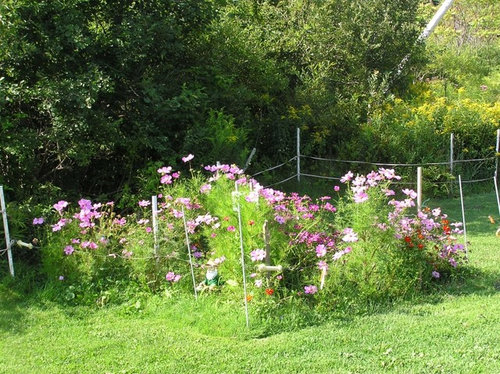
Other smaller evolutions have taken place. The gnome garden is a good example. Below are a couple photos from when it was a sunny spot and home to my annual flowers, as well as a few perennials. The first picture shows the two areas I cultivated for annual flowers with a strip of daylilies dividing those areas, and the second shows it later in the summer in full bloom.
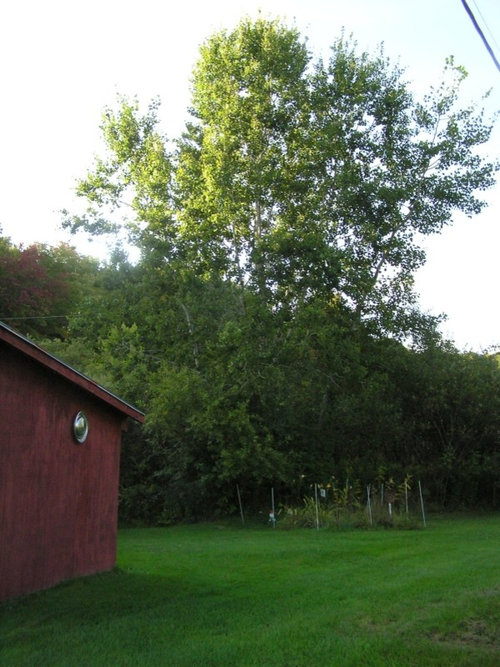
This is a picture of the tree, a tree which is the reason why I am now converting the gnome garden from sun loving annuals to shade loving perennials. Shrubbery (willows and an invasive honeysuckle) has also contributed to encroaching shade, but the tree is the primary reason for the evolution of this garden. I love this quaking aspen and do not wish to harm it, so digging the back section of this garden has become impossible without disturbing its root system which has expanded as the tree has grown.
This is a photo showing the former glory that I hope to restore to this garden.
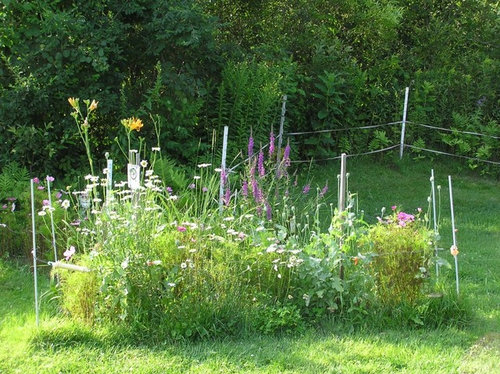
This (below) is the best I have been able to achieve so far, but one problem is that the salvia, aka meadow sage, does not bloom at the same time as the strip of orange daylilies. The sage blooms twice each year, but neither bloom coincides with these daylilies, just my luck. The sage in the back is older and was doing very well until the shade invaded its territory. The sage in the foreground (new plants this year) gets more sun and I have hopes that they will grow and expand. I've also planted veronicas and false indigo this fall in the hopes that these plants will be on the same blooming schedule as the daylilies, and that the partial shade will be to their liking. The second image shows that I have abandoned the area in back to grass to spare the tree roots.
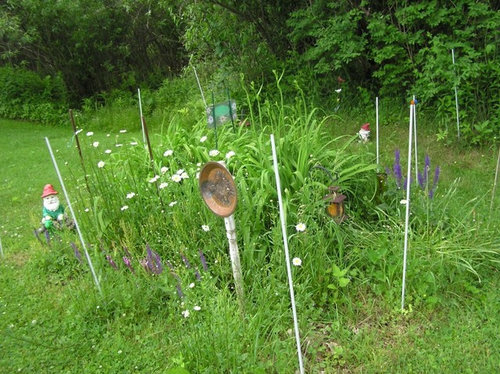
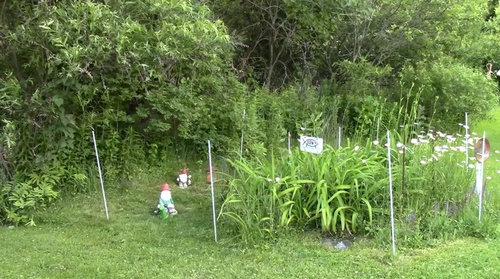
All these spikey purple plants are intended to take over for my poor loosestrife that the natural resources dept in their infinite wisdom have pretty much killed by introducing an evil beetle to "control" them. But that's another subject. I originally introduced both purple loosestrife AND cattails to our swamp. Both co-existed over the decades, so the claim that loosestrife inhibits the growth of native plants like cattails certainly was false, at least on my own land. Despite my resentment and disgreement with these "experts", I am forced to find replacement facsimilies for my beloved purple loosestrife. Also the fact is, that even if the beetles had not been introduced, the loosestrife would not have been happy with the encroaching shade in this spot. Time will tell if I can achieve the same look with these new plants.
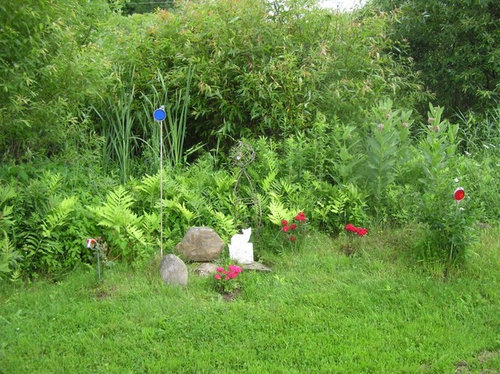
Another garden that has shifted from a sunny garden to a shade garden is the pet memorial garden, also a brookside garden. It once was a home to miniature roses shown in the photos. I have a variety of shade plants, some planted and some on order, to create a new look, but it is a work in progress.
This area (below) inside the stakes will eventually be home to a grove of pussy willow bushes, and while they are small to an expansion of the goldenrod and Joe Pyeweed border on the right. I also planted some lobelia. This is a wet area, often standing water that cannot be mowed in early spring, so not having to mow it will be a blessing. The catalyst for this was the town's effort to control washouts of the road by digging ditches and dumping loads of rock. I have no idea if their efforts will work or not, but it woke me up to the fact that the town right of way extends quite a ways into our yard, and now might be the time to expand the buffer of willows back our direction. That way if they decide to do something really diabolical, perhaps involving more digging, rocks, or even concrete structures, we won't have to look at it!
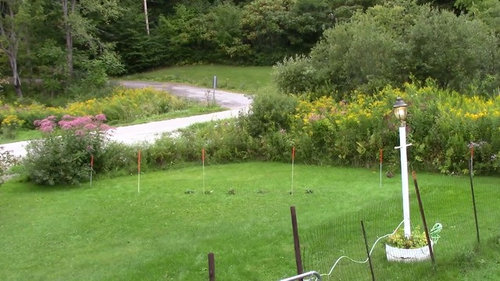
Most transition in my gardens stems from the evolution of nature, but some from the actions of man, and I always try to steer the changes in the direction of making things more sustainable and easier to care for.
To summarize, much of my inspiration and knowledge for transitioning our gardens and creating diverse gardens has come from the garden web, and I'm so grateful for this. Other inspirations that guided us are the so-called Emerald Necklace of parks in my hometown of Boston, nature trails at state parks and campgrounds that we've visited in the past, as well as local gardens and gardens at historic sites like Hildene and the Calvin Coolidge homestead. For us, each year that we remain the caretakers of this plot of earth, the evolution and ambiance of the land will continue to unfold in ways that we can't fully imagine now.






deanna in ME Barely zone 6a, more like 5b
spedigrees z4VTOriginal Author
Related Professionals
Waterloo Landscape Architects & Landscape Designers · Lincoln Landscape Architects & Landscape Designers · Sebring Landscape Contractors · Cumberland Landscape Contractors · Beatrice Landscape Contractors · Brattleboro Landscape Contractors · Modesto Landscape Contractors · Santa Maria Landscape Contractors · Shreveport Tile and Stone Contractors · Johnson City Tile and Stone Contractors · Georgetown Tile and Stone Contractors · Beatrice Tile and Stone Contractors · New York City Tile and Stone Contractors · Napa Tile and Stone Contractors · Rapid City Tile and Stone Contractorsdeanna in ME Barely zone 6a, more like 5b
claireplymouth z6b coastal MA
spedigrees z4VTOriginal Author