Software
Houzz Logo Print
upperbaygardener

Chilean Abutilons in the PNW - how common?

9 years ago
last modified: 9 years ago

Am wondering about these plants which are pretty popular in the UK. I seldom see them on the lists of PNW mail-order nurseries. Cistus, for example, has stocked a bunch of other, showier, Abutilons over the years, but I've never seen the dour, mauve colored A. vitifolium. I asked at another forum years ago and someone in WA state answered that he had one...but that was a collector. I am wondering if they are seen around in typical yards...maybe too old fashioned to be found in nurseries, and/or more of a passalong plant. But those can come back into style, like Hippeastrum X johnsonii in the deep south.

The monumental New York Botanical Garden Illustrated Encyclopedia of Horticulture, from the 1970s, noted that they had been able to grow for some years, out of doors, at that garden. Probably written before the horrid winters of the late 70s.

The classic one is Abutilon vitifolium, but showier hybrids seem more common in the trade in the UK now. Cotswold Garden Flowers actually says the popular 'Jermyns' is hardier than the species. I've kept my eye open for it on US nursery lists, but I have never seen it.

Comments (8)

  • 9 years ago

    Ok thanks. I too sometimes worry that UK material is sold here as a clone when it's really a seedling of a clone.


  • 9 years ago

    The only abutilon that has overwintered successfully for me here for any length of time is Abutilon megapotamicum, which I grew for many years in my Shoreline garden. Not an overly large plant, it has more the arching/weeping habit of a hardy fuchsia, IMO. And I much prefer the more intense coloring than that of vitifolium, which I have seen growing in various locations but have no idea for how long.

  • 9 years ago
    last modified: 9 years ago

    Gardengal, agreed that the Brazilians ones or their hybrids are more showy. I guess I was more curious as to whether this was another plant that could grow in the PNW, but seems more common in the UK trade. There are a fair number in that category: Senecio pulcher comes to mine, and Cobaea pringlei. OTOH Impatiens tinctoria was finally imported by Annie's Annuals after years of being unobtainable. That was around 2010. I'd wanted to try it after hearing about it in the late 1990s. It just did not grow at all in summer here, it clearly need cool nights or some other environmental factor was not to its liking. (OTOH this year I am trying some Drakensberg forbs like Wahlenbergia krebsii, and they are surprising me by blooming their heads off! So it's not a guarantee that every high elevation plant will be _kept_ from growing by warm nights)

    Anyhow seems like you've both seen them growing in various locations...so they are at least around...and if they were for sale in mail order vendor catalogs, I for some reason missed them.

    FWIW Tony Avent/Plants Delight touted a couple of the red or orange Brazilian hybrids as "7b, at least" - I think 'Marion Stewart' was one, but they clearly are not that hardy north of North Carolina.

  • 9 years ago

    Back in the Heronswood glory days, Dan classified A. vitifolium in his catalog as a "temperennial"......as he did with all other flowering maples. By doing so, I would guess that to be an acknowledgment that these should not be considered long term garden denizens in even mild PNW zones.

  • 9 years ago
    last modified: 9 years ago

    British/UK gardening includes locations that are as soft during the winter as Santa Barbara, in the extreme southwest (Scilly Isles), with the mild western coastal zone extending up into Ireland. So nursery offerings and gardening literature generated there (UK) include items that are California Specials here. Even over near London Heath-row airport was being landscaped with gums when I was there in 1994. (Of course, there are landmark examples of very fast growing species of Eucalyptus scattered about Seattle at this time also - but the historic pattern is for these to not make it through the coldest local winters). Popular English gardening writer Christopher Lloyd once wrote that he was located in a cold area because it sometimes got down to 20 degrees F. Whereas here on the Pacific Slope Arctic Fronts sometimes make it down even into northern California and hammer things like big-leaf rhododendrons for instance. As happened during the 1970s. A long time ago now if you think mostly in the short term but if you instead are likely to invest in plants (like tender rhododendrons) that take decades to size up...

    UpperBayGardener (zone 7) thanked Embothrium
  • 9 years ago
    last modified: 9 years ago

    True, the UK overall is milder than the PNW...and the really mild parts of it are much milder.

    But, again, you said you'd seen one that was taller than "house height". So I guess they can grow well enough during milder strings of winters...which is the case for things here like Eucalyptus parvula. Which I know would still be alive if I hadn't had back to back cold winters.

    I'm not sure why I am so keen to try one except the account of one growing for a few years at least, in a sheltered bed at NYBG intrigued me when I was very young and discovering experimental gardening. That mammoth work seldom made such observations and one wonders if Thomas H. Everett himself had taken a liking to the plant. And so I broadly assumed they must be hardier than the Brazilian ones. Big Bloomers had 'Marion Stewart' for something like $5 so I can't resist trying it again, in a few years when it has sized up. Also wonder if the Chilean ones will cross with the Brazilian ones, but it never appears to have been done.

  • 9 years ago
    last modified: 9 years ago

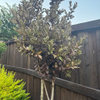
    The supposed 'Violetta' taller than the (one story) house is out the window here. It has become smaller leaved and sparser in recent years, for whatever reason.

    Also it produces lots of seeds. Further suggesting the now apparently discontinued, paler flowered* Blooming offering - of which this is an example - may have started as a seedling of 'Violetta'. But I have no specific knowledge. And it does seem other clonal material of Abutilon has somehow gotten into US nurseries. And hibiscuses, of course.

    Even though these are in the same family as cotton.

    *Maybe the depth of coloring varies with environmental conditions. Temperatures, for instance, with consistently cool Britain having a different routine outcome with this plant than here

    UpperBayGardener (zone 7) thanked Embothrium
0