Software
Houzz Logo Print
brandonmcox

Need St Augustine Sod HELP

9 years ago
last modified: 9 years ago
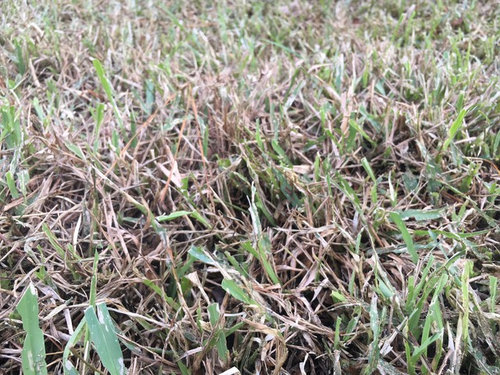


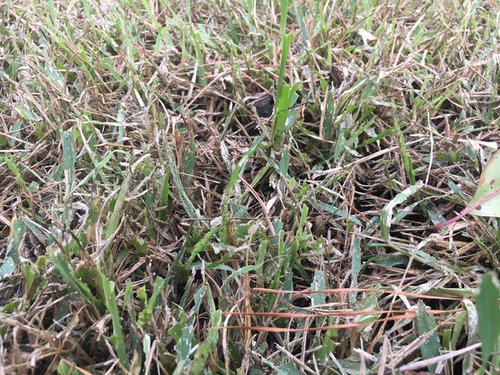
I need help. I'm in Savannah, GA. I paid to have St Augustine sod laid down a couple months back. I went out of town after it had been down about 2-3 weeks and the sprinklers were turned off for 5 days straight and came back to a dead brown lawn. I assumed it dried up. It was hot. Looking back, I'm not so sure.

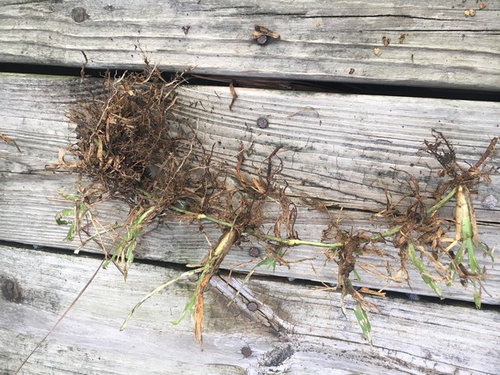
I paid again to have it done. This time I'm watering like crazy. After reading here, I think i watered too much. Maybe even that's what happened the first time? 45 mins every day for 3 weeks at 5 AM and then 15 mins at 2 PM is what I did this time around. It looked great, then I mowed it. I mowed it high - 3.5 inches. A few days later, it looked brown and dead again. It's rooted pretty good. I can lift it up, but I have to pull pretty hard. Any idea of how I can rescue it? One thing to note, this is my back yard with the problem. Back yard is mostly sandy and it's surrounded by tall pines. Sod looks great in the front yard. There is more dirt there. Lighting money on fire in the back yard would be more satisfying at this point.


I will add that this is the worst I'm showing here. It does have quite a bit of green, but I'm losing it quickly. Dark now, but I can add a photo of the whole yard tomorrow if it's helpful. Thanks in advance

Comments (3)

  • 9 years ago
    last modified: 9 years ago
    Pics of the whole yard

  • 8 years ago
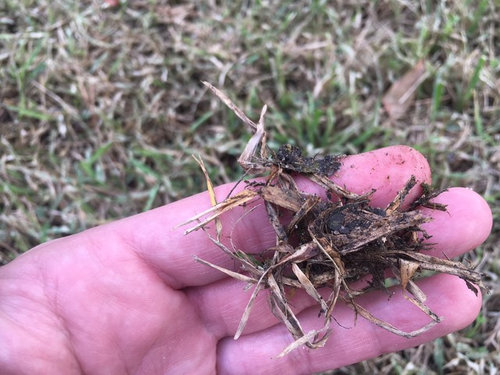
    Looks like it can be fungus problem . Did grass blades turn yellow before it started dying browning? If there are yellow blades now in your yard. Can you gently pull on them and they can be pulled out of the ground? Take a look at the end is there brown black where it was attached to the runner? Take a look at runners are the brown black? Do you notice white fungal like growth on the runner soil or blades? If yes to one or all then google TARR. Take all root rot.
  • 8 years ago

    Once the roots are knit into the soil, then you should have backed off on the watering frequency. The last time I watered my lawn (in the Texas Hill Country) was in August. Granted we got rain in September, but you get the idea. You have probably read about deep and infrequent watering if you have been reading here. If not, here it is again.

    Watering: Deep and infrequent is the mantra for watering. This is for all turf grass all over the place. Deep means 1 inch all at one time. Put some cat food or tuna cans around the yard, and time how long it takes your sprinkler(s) to fill all the cans. Memorize that time. That will be the time you water from now on. My hose, sprinkler and water pressure takes 8 full hours to fill the cans. Your time will likely be less. I like gentle watering. As for watering frequency, that depends on the daytime air temperature. With temps in the 90s, deep water once per week. With temps in the 80s, deep water once every 2 weeks. With temps in the 70s, deep water once every 3 weeks. With temps below 70, deep water once a month. Note that you have to keep up with quickly changing temps in the spring and fall. This deep and infrequent schedule works in Phoenix and in Vermont, so it should work for you. The reason for deep and infrequent is to grow deeper, more drought resistant roots and to allow the soil to dry completely at the surface for several days before watering again. If it rains, reset your calendar to account for the rainfall.

    At this point you need to deal with the problem. I have always had excellent results on fungal issues using ordinary corn meal at a rate of 20 pounds per 1,000 square feet. You can buy corn meal in 50-pound bags at a feed store (call first). Cost should be under $10 and more like $5. If the cost is $20 - $30, they are talking about something else (corn gluten meal).

    Corn meal works biologically. It attracts a beneficial fungus which kills the disease fungus. It takes 3 full weeks and then you should see the new grass remaining green. You can reapply after 3 weeks if you think it needs it. Corn meal works so well for me that I don't even know what chemical fungicides work on St Augustine. If you decide to use a chemical fungicide, then you cannot use the corn meal later, because the chemicals will kill the beneficial fungi that would kill the disease. This will not go away by itself over time or over the winter. You have to kill it one way or the other.

    If you are still watering daily or more than once every 3 weeks (this time of year), then you will have to wean the lawn off the frequent watering. Deep and infrequent works because the roots will grow deeper into the soil where the deep moisture is. But until you have deep roots, you will have to water a little more frequently than for mature turf. I would shoot for one inch of water every 2 weeks this time of year applied twice or at most 3 times. The lawn will be dormant soon and none of this will matter until spring. Then you can start by not watering at all and let the spring rains awaken everything. Then start with deep and infrequent watering as described above.

    If you are not mowing at the mower's highest setting, do that now. With St Augustine you can mow every week or two with no problems.

Sponsored
High Point Cabinets
Average rating: 5 out of 5 stars21 Reviews
Columbus' Experienced Custom Cabinet Builder | 4x Best of Houzz Winner