Software
Houzz Logo Print
lenoreepstein

Freaky root pruning

My old dracaena is five feet tall, rootbound, and top-heavy. It had been blown over before it went out on the porch this summer, but it's been hurting ever since it was blown over and rolled around by the wind a few weeks ago, knocking it halfway out of its pot. I stuffed it in as best I could, but now it sat higher in the pot and my dowel told me there was some empty space in there. Soon it started dropping leaves as though it was underwatered, so I watered more often, and when it stopped losing leaves I decided to de-pot.

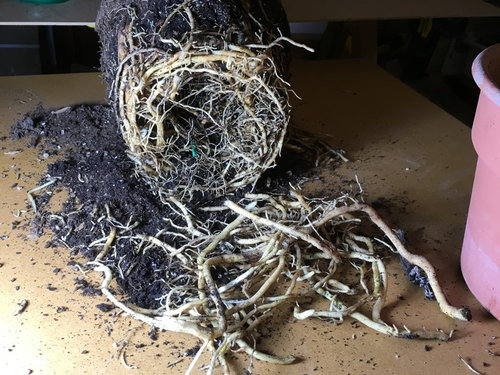
As it turned out, the plant was pretty much standing on two or three inches of thick woody circling roots. The pot was dry when it fell over, so the soil between the roots must have fallen out and collected underneath them when it fell, suspending the root ball and its soil above two or three inches of mostly empty space. I started to cut the roots off....

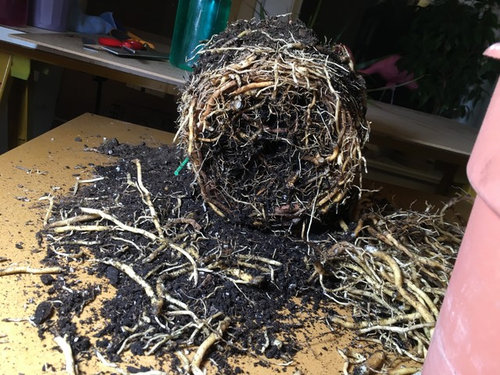
....and was even more surprised to find that the root ball was completely hollow. I could stick my finger in far enough that its tip was an inch or so from the surface of the soil.

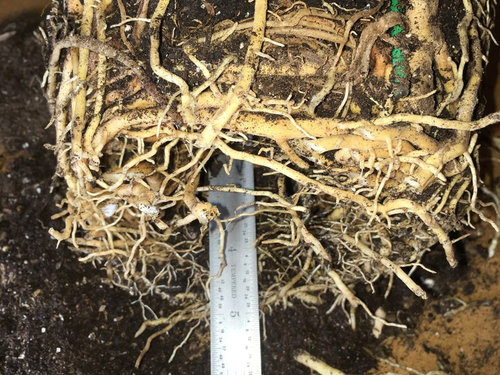
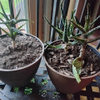
I told myself not to panic, and just kept trimming, spritzing with water to keep things moist, until there was soil between the roots. In all, I think I took three inches off of the bottom of the root ball. (a little more than this photo shows), but tried not to disturb the sides and any feeder roots in there.

I stuffed the middle of the root ball with moistened orchid mix that seemed like it would probably drain about as well as the existing soil and did my best to hold it in there while I set the plant on top of a cone of orchid mix. I tilted the plant a little to make it less tippy, used a chopstick and fingers to get the new mix in the gaps between the sides of the root ball and the pot, and finished by whacking the whole thing on the floor and hitting the sides of the pot with my hands to get things as filled in as possible.


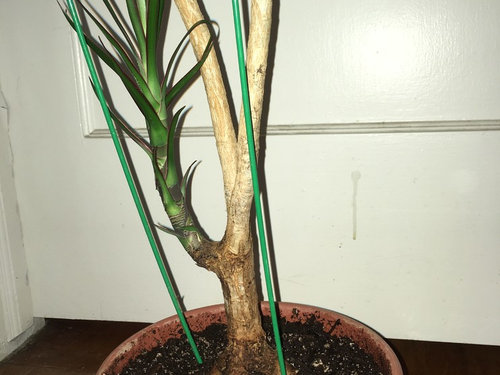
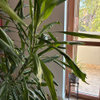
All I can do now is wait to see whether I did a good enough job to keep the poor thing going until next summer, when I'll do a proper repot. I just hope the new branch in this picture, which appeared right after the fall that caused all this trouble, keeps growing.


Comments (12)

  • 9 years ago

    Dracaenas are really tough plants. So long as the drainage is good and you keep it moist it should be okay.

  • 9 years ago

    This one has certainly survived some tough conditions! It didn't much like extreme heat this summer, but overall the plant did so nicely that I have great hopes for it.

  • 9 years ago

    Nice new branch litterbuggy! I'm sure your plant will be happier with what you've done. And you've had a preview of what's in store when time for repot rolls around.

    litterbuggy (z7b, Utah) thanked robin98
  • 9 years ago

    When you use porous soil and watering only when it's almost dry, the root tend to grow quicker to bottom farthest it can reach and start circling. Center of the pot will be hollow and near surface of the pot will be rootless. Root grow quicker under poor nutrients and slowing down when it reach rich nutrients spot.

  • 9 years ago

    Thanks, Robin. The third branch also makes me a little more sanguine (ooh, I don't think I've ever gotten to use that word before!!) about things because I'll still have at least two branches if the weakest of the original two fades. You're right about the preview, too, here I would have been very meets if I had known what I was going to find I would have worried. As it turns out, it wasn't too hard to figure out what needed to be done right away after having read so many posts by Al along with other people's experiences.

    Al, that's a really fascinating sequence of events, and in retrospect it makes perfect sense. I expected to find congestion, but I never imagined this. Here I've been disappointed that the dracaena didn't respond more enthusiastically to improved growing conditions over the past year, and now I'm amazed it was able to respond at all.

    I've felt bad about not being able to repot anything but my rooted ficus cuttings, especially knowing how rootbound the dracaena and my big pot o' ficus was, so it feels good to be at the point where I'm physically able to do something constructive for one of them. I might even pull the bunch planting and the smaller ficus out of their pots just to see what kind of mysterious things have been going on in there.

    Thanks again, Al, for all of your patience and enthusiasm. Especially the patience.

    Lenore

  • 9 years ago

    Sanguine! I love it. Usually read that rather than write or say it. Had to quickly check what it meant! Think I confuse it with "languid" which has quite a different meaning. Good for you, slotting it in there!

    Plants I've had surprisingly hollow in the centre have been from peaty cores being too wet rather than drying out, but same end result I guess


    litterbuggy (z7b, Utah) thanked robin98
  • 9 years ago

    I just remembered that just before I woke up up this morning I had a dream that there was a giant millipede living in that hole. Eek!

    I love language, especially odd or rare words and archaic grammar. Sometimes it gets me in trouble when I mispronounce a word that's been silently rolling around in my head my whole life.

  • 9 years ago

    I know what you mean. I had that from words I'd learnt reading books, rather than hearing. Remember being laughed at first time I tried to pronounce "epitome" as a kid.

    No more plant nightmares now!

  • 9 years ago

    Imagine making 'misled' rhyme with 'whistled.' Oh, the humanity!

  • 9 years ago
    last modified: 9 years ago

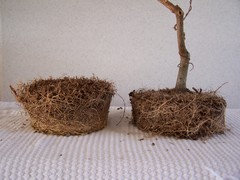
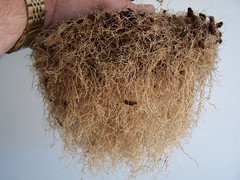
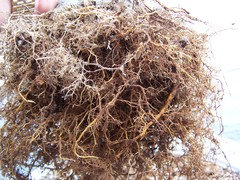
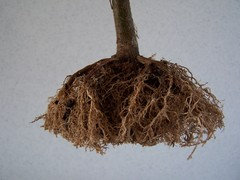
    "When you use porous soil and watering only when it's almost dry, the root tend to grow quicker to bottom farthest it can reach and start circling." This is not true for dracaena specifically, or generally for other plants we grow in containers unless the grower is habitually watering incorrectly (too infrequently). I grow in very fast soils and the entire soil mass becomes evenly and densely colonized by roots before any signs of roots circling just inside the confines of pot walls. I've posted hundreds of pictures of root masses on these fora that clearly illustrate this tendency. A maple just below, a boxwood below that, and the third image is Ficus benjamina.

    "Center of the pot will be hollow and near surface of the pot will be rootless." As noted above, this is not at all the case when using well-aerated, fast draining media. The complete opposite is true. The center of poor, water-retentive soil masses in pots, on the other hand, tend toward a central wasteland with very few roots (for lack of oxygen); and, what roots exist are typically found growing in a circular pattern between the soil mass and pot wall because that's the only place in the pot an adequate oxygen supply can be found. In the picture immediately below (as well as the several above), you can clearly see there is no shortage of fine roots in the middle of the pot, even at the surface. All of these root masses are the picture of health and were grown in Gritty Mix.

    "Root grow quicker under poor nutrients and slowing down when it reach rich nutrients spot." This too is untrue. Roots EXTEND more rapidly under conditions of low fertility; but since the true measure of root "growth" is the collective increase in their dry mass, it cannot be said that roots grow faster under conditions of low fertility.

    Al

  • 9 years ago
    last modified: 9 years ago

    Porous, light-weight, and water when almost dry is so typical for nursery here to plant and distribute non woody plant that have big soft type of root like dracaena, aglonema, many of araceae fam etc. The root pattern is just like what lenore pic above. Your pic above are root of woody plants that actively root pruned, which will show different root pattern. Root naturally will grow randomly, but there's natural selection. Root that grow toward ideal condition will be bigger and dominant. Porous soil will have very different humidity on surface and bottom side if we watering them only when almost dry. The root on top will be less developed, and root that grow toward water grow quicker, bigger and start circling when touch bottom edge. Root pruning is the way to fix it, but you'll have to do it more often compared to other soil type.

    Root grow faster... i mean faster here compared to canopy growth. When plant living in hard condition, they will growing root more to find food, resulting in root-trunk size increase. When you give rich nutrients soil, it will be canopy-trunk mass/size increase. In tropic bonsai training, it's common to plant bonsai in ground with just sand or garden soil for 3-4 years to get huge root-trunk size, with less canopy growth.