Software
Houzz Logo Print
pvecholane

Nuts about grasses

8 years ago
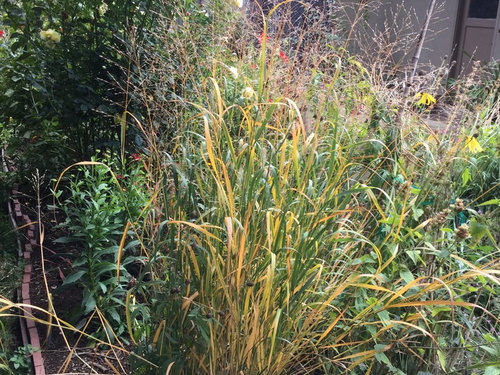
It's my favorite time of year and grasses are very much a part of it because of their colorful change to winter.

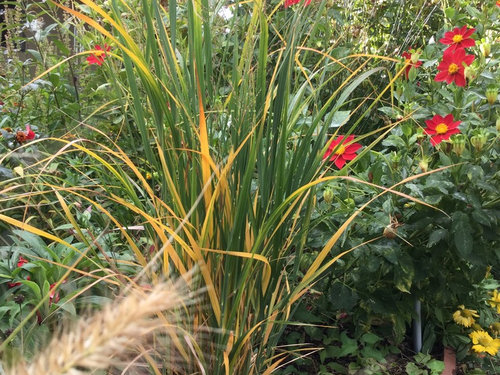
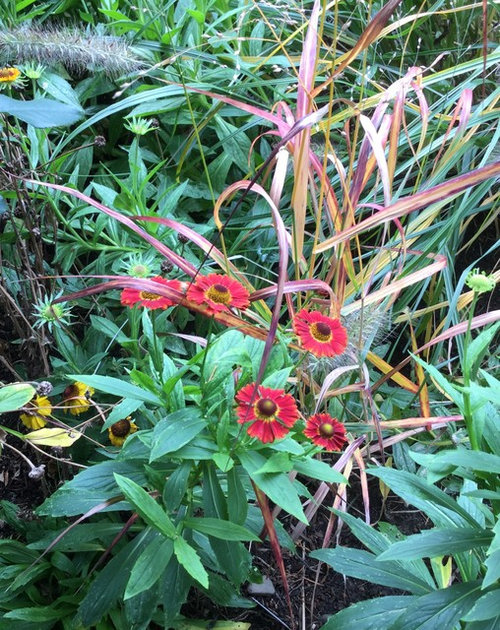
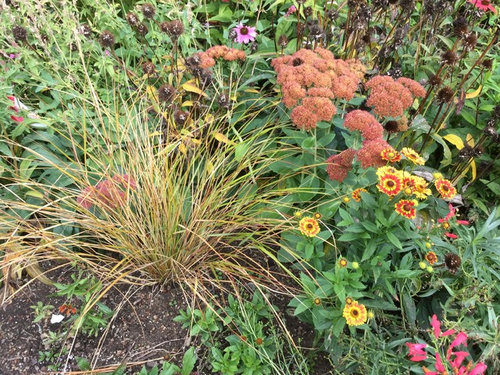
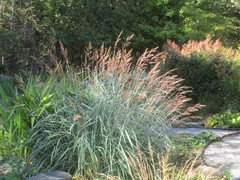
Here are three Panicums in the process of changing color while sporting their pretty flowers. The first is Panicum Heavy Metal, the second is a very young Panicum Northwind. I have a third, Panicum Hot Rod but it is a much shorter Panicum and young, so it's nearly impossible to see buried among other plants but If you look closely it has gone very red.


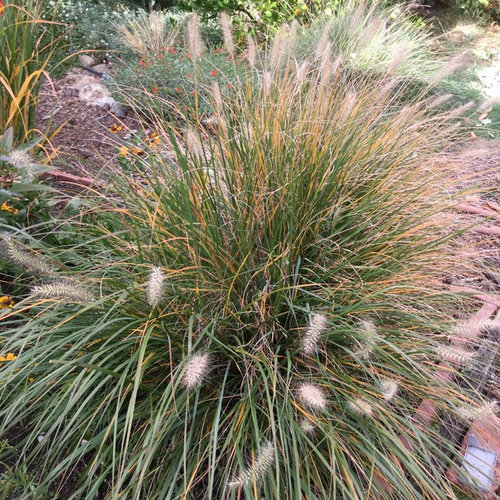
Pennisetum alopecuroides Hameln is the oldest grass in my garden. I've been dividing my original clone for close,to 40 years and I wouldn't dream of not having its graceful fountain shape and colorful fall and winter presence in my garden.

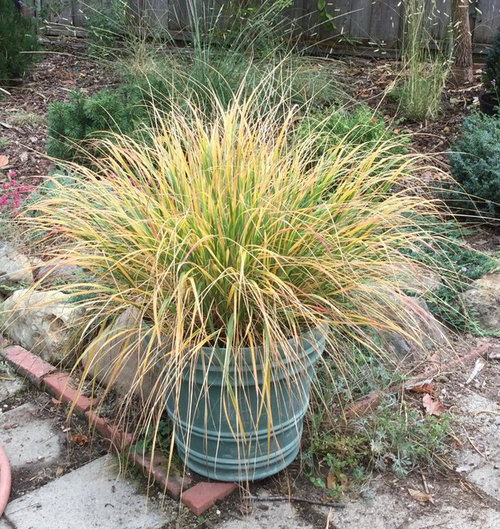
I tried our another Pennisetum cultivar this year, Desert Plains, and it has a lot more fall color for some reason. Disappointingly, it didn't flower for me this year. It's mates in the ground were atypically stingy with their flowers this year. Perhaps there wasn't enough winter chill for this grass which is a shame because I do like it's flowers. Or it doesn't like being pot bound and its mates were much underwatered this year too.

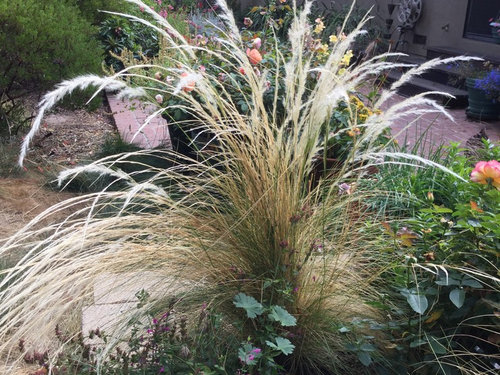
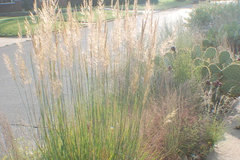
. I went crazy for Stipa ichu last year because of those spectacular flowers, but it has disappointed me this year because the plant and its flowers tend to flop too much. And it seeds about a bit much. But I think I'll always keep one around because it's so colorful.

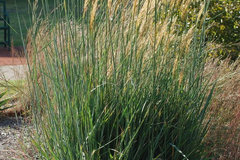
This colorful grass, Stipa arundinacea, is evergreen, though it tends to be colorful all year.

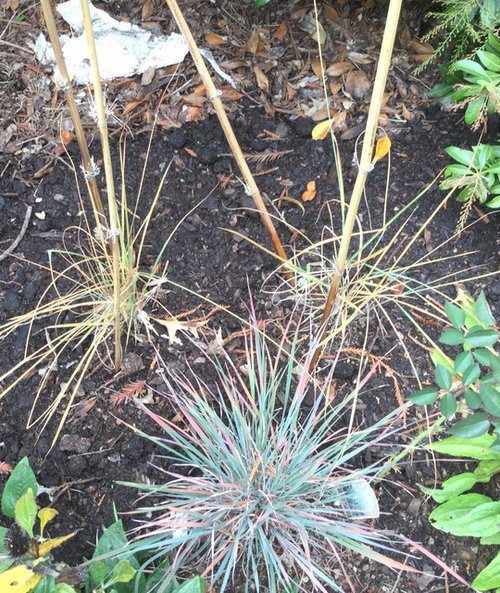
I probably shouldnt include this next Grass, Sorghastrum nutans Thin Man, because it's so puny (those bamboo stakes are to remind me not to step on it!) , but it caught my fancy last year and I just had to have it. It's only source that I'm aware of is High Country Gardens. I ordered just one, but they were so tiny that they sent me two. Tiny was an apt description as they were only two or three strands of grass stems each!!! I've babied them all year and they are still tiny but I have the feeling I'm going to love them. Hopefully, they'll show me more next year.

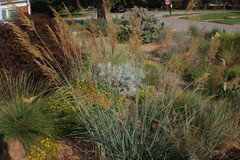
That blue grass in the foreground is a young Little Bluestem, Schizachyrium Standing Ovation. It was also a tiny plant this spring and hopefully will put on a show for me as the season advances.


Comments (17)

  • 8 years ago

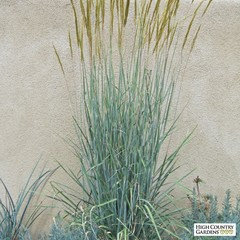
    Regarding that last photo of Sorghastrum nutans Thin Man, which admittedly is not much to look at yet, I thought I'd put a photo up of what It should look like, hopefully will look like. . I think it has great possibilities!

  • 8 years ago

    Judging by how my 'Thin Man' has done, it seems like your Indian Grass should have made a lot more progress than that in a whole growing season. I purchased 3 in late fall 2015 as tiny plants, two didn't survive winter. As warm season grasses, they were planted too late to produce any significant root growth. Below is the survivor shot in September 2016 after one summer's worth of growth. This one is planted at the far end of the Hell Strip by the driveway on the lowest end so the water drains down when it rains, it makes a nice ! mark.

    Below is the same plant shot in September 2017, it has tripled in size this summer but its still a juvenile Indian Grass. I ordered 3 Eragrostis spectabilis which is the low growing pink grass behind it, they make a good combo. The bluer grass in the bottom photo is a Little bluestem that volunteered.

    I had a seedling that I transplanted in the backyard which has put up one bloom stem and its a lot further along than the two you have. Based on my experience, I wonder if yours are happy in the spot where you have them planted.

    ~~~~~~~~~~~~~~~~~~~~~~~~~~~~~~~~~~~~~~~~~~~~~~~~~~~~~~~~~~~~~~~~~

    Below is a mature specimen I shot at the History Museum here in OKC, probably a local type. It was at least 3ft in diameter last year and when we went the other day, I noticed its even wider at the base this year. You might want to reconsider your spacing on the two you have planted as they will end up growing together, one specimen would definitely be plenty in that spot. It looks like it will crowd out your LBS 'Standing Ovation' but its hard to tell how far apart they are, they look like they might be planted a bit too close together.

  • 8 years ago

    I love grasses. I am in western PA. I only have 3 kind ribbon, fountain and zebra grass. We tied up the zebra and fountain grass just 2 weeks ago. They give a nice texture and contrast to the bleak winter landscape with their graceful plums.

  • 8 years ago
    last modified: 8 years ago

    You're right, my Indian Grass should have done much better. Your photos prove it.

    Thr Indian Grass didn't arrive until mid-May, so the mini plants got a late start. . They were also barely alive. I was quite distressed at their quality and size. I immediately protected both little plants from rabbits with chicken wire. I planted them close deliberately, thinking they would just grow together and be one as I don't have room for two. But they refused to grow until late summer and then not much. I gave them special attention with extra water because they are at the outer edge of the sprinklers, but it didn't seem to make any difference. All season I had the impression all the other plants in that area were underperforming.. Seeing your photo makes it even more obvious,

    I've had to be really stingy with water this year so that's probably part of it, but I haven't liked the soil texture there at all. I was unhappy with the soil every time I planted something this season, although the roses seemed to do well enough there in past years..... Last week I had four yards of aged compost delivered and I've added about 2" of compost around all the plants, hoping everything will do better next year.

    Even if that helps the other plants, I'm not sure the Indian Grass will be happy enough to really thrive. My neighbors trees cast more shade every year and the Indian Grass is now in mostly afternoon shade because of the trees and because it's near the fence.

    I don't know where else I can plant them unless I swap two Panicum Northwinds and plant the Sorghastrum where I had planned to plant them. Maybe that's the solution. Assuming those little plants will grow next year........

    I'm aware the Standing Ovation is too close. It's a problem all over my garden because I have too many plants. I do have a better spot for it next season.

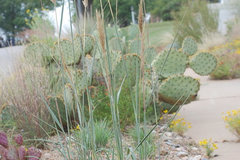
    I saw a beautiful Opuntia at my local nursery yesterday. It had the prettiest reddish purple edges around each "leaf"! I didn't check the species name except that I was told it was a California native. I immediately thought of your garden. It's color seemed made to blend with grasses and it's shape to provide contrast. But I don't know how you manage to live with those spines. Not for me!

  • 8 years ago

    Very happy to meet a fellow grass lover. I don't know much about Western PA except that it is USDA Zone 6a or 6b, which means you can grow lots of grasses. I'm not sure when I realized that grasses could be garden plants but whatever triggered that desire to put them in my garden has never left me even though I've moved on from all sorts of "love affairs" that I've had with other plants over the more than 40 years of gardening at my home. I find most are really beautiful in all seasons. As you mention, even in winter they can be attractive, especially after a snowfall.

  • 8 years ago
    last modified: 8 years ago

    I did a little homework on S. nutans and saw to my surprise it was listed as invasive, seeding into degraded prairies, etc. Also, it says the root system is rhizomatous and difficult to divide because the roots are tangled, which sounds kinda weird, so maybe it's also aggressive in the garden. Incidentally, i read a blog where big bluestem was mentioned as an aggressive grass too (?).

    Tex, does yours seem to grow with above average vigor? I Hope I haven't fallen in love with a grass like Miscanthus, which is too vigorous for my small garden and my aging back. I had a rhizomatous Pennisetum once and it was way more assertive than those grasses described as clumping.

  • 8 years ago

    I'd like to see that site that lists S. nutans as invasive in a prairie. I only got a few seedlings and only one from the 'Thin Man'. "Too aggressive in the garden" depends on the garden and personal taste.

    Little Bluestem is not aggressive. It establishes itself in prairies in well spaced out, individual clumps rather than a thick mass of plants packed together. I see it al lot along the roadsides here and it always looks like exclamation marks growing among shorter grasses. Maybe in a formal garden a person might consider it aggressive since it produces seedlings (which are easy to pull and which I consider welcome since it means free grass plants). Some people consider that 'aggressive'. If thats a concern, just cut it back before the seeds shatter and dispose of them.

    Both grasses are easy to cut back compared to Miscanthus.

  • 8 years ago
    last modified: 8 years ago

    I got the info from a blog Indian Grass and Big Bluestem

    This soon caught my attention:

    "It’s a bit of a two-edged sword. According to its USDA Plant Profile, Indiangrass is listed both as an endangered species then condemned as a weedy invasive — but not, I think as invasive as it’s brother, Big Bluestem."

    I did just now see that confirmed on the USDA website BUT it was referring to Big Bluestem and not S. nutans, so the author of that blog misspoke and I've unwittingly passed it on. I couldn't find anything else that would caution me in the usual sense about either of the two plants being highly invasive.

    Regardless, I am concerned about how Thin Man will behave in my garden. Hopefully it will be a manageable fellow. I like it a lot.

    i don't have a place for a big grass like Big Bluestem so I've never considered growing it. I hope to find room for some Little Bluestem. It's a very beautiful grass. I did ask John Greenlee why I don't see it in California nurseries and he replied that it's fall color display was very quickly over in California. Until recently, he was based in S. California; I'm hoping his remark is only true for S. California and I can prove him wrong in my colder N. California garden.

  • 8 years ago
    last modified: 8 years ago

    The named varieties of Big Blue I bought from SRG are very slow growing compared to other grasses. The foliage is low and grows stiffly vertical more than mounding. All summer the leaves are only about 1.5 ft tall and deep dark green and then in mid August stems start climbing--- they are thin, see-through and turn very deep red. Now the leaves are turning. Blackhawks is very deep red and this one seems less vigorous than the others. I planted several in front of Northwind panicum and it makes a very nice combination in fall for color and texture.

    Indian Grass and Big Blue are both clumpers, neither is a runner type that spreads underground invasively, the clump just gets bigger over time.

    I divided a large clump of Indian Grass late last summer (the new ones took a bit of time to establish this year but are now off and running) and removed another large clump of 'Indian Steel' this year because it was sticking out in all directions. I decided I don't care for that cultivar. I cut it through the roots right below the soil line with a big butcher knife by sections, wasn't too bad and it went pretty quick. I often get rid of clumps like that, it eliminates digging and disturbing my gravel mulch. I replaced it with a 'Red October' Big bluestem.

    There is no way Big Bluestem could be considered or listed as invasive, in fact its rarely seen anymore which is sad because once the tall grass prairie was described as a 'sea of red' in fall by early settlers. Now its cultivated fields or abandoned or cities. The only stands I've seen around here are a spot by Norman and one up just east of Edmond. I see Indian Grass and Switchgrass more often but even so, those are not terribly abundant either, not as abundant as LBS. Indian Grass always stands out along the roadside because of the light blue color & texture, its always pretty even before blooming or going yellow in late fall. A mature clump is much more attractive than a juvenile.

    echolane thanked User
  • 8 years ago
    last modified: 8 years ago

    because once the tall grass prairie was described as a 'sea of red' in fall by early settlers.

    That sounds so beautiful! When I see a phrase like that, knowing that man has destroyed this possibility forever, I get a lump in my throat and tears in my eyes. To think that our government wants to do away with the EPA, sell or allow mining in our national lands, and worse.....well there are not words to describe the anguish and anger I feel at such short sightedness.

    Thanks for passing on your observations about Thin Man and Indian Steel, too, which I had thought about ordering when I saw my puny Thin Man divisions or seedlings.

    I'm wondering if I dare to stress Thin Man by moving him to containers for the winter so he is ready to plant out next spring. Hopefully to a much more hospitable spot where he can put on some size.

    Your comment that Big Bluestem stays small for much of the season surprised me. And I like what you said about being able to see through the stems. Sounds so very pretty. Wish I had more garden space! Just as well SRG is out of all the interesting varieties so I can't indulge myself with plants I have no room for.

  • 8 years ago
    last modified: 8 years ago

    I am always surprised at how slow this forum is. I adore my grasses. I may need to try S. 'Thin Man'. I really like my S. n. 'Indian Steel' but I know what you mean about the splay TR. Mine usually only splays on the north facing side after heavy rain, if I had a strong tallish plant in that position it would support the flowering stems.

    Other grasses have been turning glorious colours. That is the only good thing about fall.

  • 8 years ago

    Just thought I'd add, I have a mass planting (not huge but contains a number of plants) of the little bluestem cultivar 'The Blues'. This year I planted near it Salvia 'Windwalker' a large, open, airy salvia with deep red blooms. The combo has been spectacular for many, many months.

  • 8 years ago
    last modified: 8 years ago

    lacey--that sounds like a nice combination. 'The Blues' produces the most seedlings of all the named types I've bought. The clumps get a lot wider than 'Prairie Blues' which look more like exclamation marks and it gets a lot more stems in late summer--really dense with them. The most delicate and see-through is 'Blue Heaven' which also has the best color in fall, the stems are very deep purple and 'see-thorugh'. It amazing how much variety there is among LBS.

    peren.all---your clump is a lot bigger than the one I removed. Mine started as a seedling last year from the one I dug up and divided. Below is a photo before it rained a couple times. Each rain made it splay out more and I knew it was not going to work, it blocked the path and was overwhelming even at two years juvenile size.


    The airy plant below is palafoxia, its a wild thing and an annual, gets about 2.5 -3 feet tall and wide. I got seeds from wantanamara in Texas last year. The plant looks good in person but its so delicate and I can't seem to do it justice in a picture. I've had some people walking by ask what it is and my husband loves it. It gets covered in tiny pink, puffy looking flowers all summer (its still blooming in fall) but then in fall the stems start turning a dullish purple making it look wonderful among grasses, especially Little Bluestem. Its my favorite addition this year.

  • 8 years ago
    last modified: 8 years ago

    What a shame that Indian Steel splays like that. It would never do in my garden which depends upon overhead sprinklers for summer water. But those flowers are just to die for. Prettier than Miscanthus IMO. And the blue green foliage is very handsome too. I look forward to next year's happier Thin Man!

    I took a chance this weekend and risked moving my tiny clumps of Thin Man to big containers. I live on a flag lot and just sold 7-8 large Blueberry shrubs in 25 gallon containers that were getting too widely overgrown to be good driveway plants. The birds got most of the blueberries anyway. I'm going to have grasses along the driveway instead. Thin Man should be *much* happier there and will have either Muhlenbergia dubia or LBS Blue Heaven on each side for companions; I just need to decide which would be better. I'll have to acquire at least one more Thin Man. The containers are big and at least for a year or two there will be room for some flowering plants to share their space. I was thinking Ratibida columnifera might look good with Thin Man......

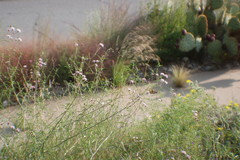
    Tex, your photos are always so pretty and inspiring. I can see why you like Palifoxia. What is the grass growing to its right and in the background with somewhat lax flowers. It looks so pretty.

  • 8 years ago

    I just love it when some plant combination makes you want to stop in your tracks to admire it! I looked up Salvia Windwalker and got quite an education. What an interesting plant. Wonderful color. A hummingbird magnet. Suitable for a very dry site. Looks particularly good with Andropogon Windwalker or Muhlenbergia Undaunted. Too bad it's too big for my garden :-(

  • 8 years ago

    echo, that grass is a volunteer Purple Three-awn gone 'white'. It blooms real early and re-blooms several times a season (whenever it rains) with purple awns that turn white. Its got fine hair-like leaves. I get quite a few volunteers down on the strip and let some stay but pull out others. Very drought hardy, cool season, great for tough spots. Its the one recommended as a good replacement for Mexican Feather Grass in California. The grass in the picture volunteered this year, thats how fast it grows.

    echolane thanked User
Sponsored
Franklin County's Heavy Timber Specialists | Best of Houzz 2020!