Software
Houzz Logo Print
eclectictransitional

Landscape choices for a long, steep path

9 years ago

Let's say you have a 300-400' long path with a 70' rise. Steep forest slope--it actually goes down the slope obliquely. It is about 3' wide at the narrowest points. Edges were stabilized long ago by rough poured concrete. Steepest sections are about 30 degree slope but mostly less.


You would like to further stabilize the path and, ideally, pave it. But you need to keep the ability to get a wheelbarow up and down! You would also like to not spend a house's worth of money on it. :)


What would you do?

Comments (32)

  • PRO
    9 years ago

    Are you in Alaska or Florida? By "further stabilizing" do you mean pave? Why do you think paving would impede a wheelbarrow? In order to understand your conditions better, please add a photograph that shows the setting. (not a close-up of dirt, please.)

  • 9 years ago

    I'm in the Midatlantic.

    I mean discourage erosion. I'm thinking decomposed granite with steps, stone, or concrete pavers.

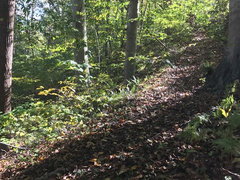
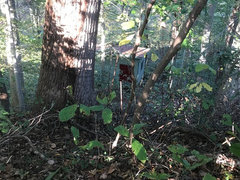
    Part of the path, looking up:

  • 9 years ago

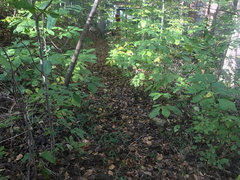
    Looking down:

  • 9 years ago

    Gardengal, it IS zigzagging! Lol. The slope is much steeper.

  • 9 years ago
    last modified: 9 years ago

    The actual slope ranges from 30% to 60%....


    The photos lose all perspective and are very uninformative.

  • 9 years ago

    Photos don't show it very zigzaggy :-) If well done, the slope of the pathway itself should be minimal and if standing at the top of the slope, you will see only a very short extension of the path before it veers off in another direction. That's not what I'm seeing.

  • 9 years ago

    That isn't possible. Tighter zigzags would increase the pitch of the path by a lot.

  • 9 years ago
    last modified: 9 years ago

    Trying to explain... Think of the path like a contour line on a cliff. Moving it up the cliff would require major excavation and disturb mature trees stabilizing the steep slope. Then it would hit the 60 degree portion and need all kinds of excavation and reinforcing. It has a very tame slope compared to any alternative that wouldn't instantly call for major retaining walls.

  • 9 years ago

    I am going to assume you are suburban Philly.

    My DH is still complaining about trails that were washed out by Floyd. Here, wooded trails frequently end up 'paved' with rocks that have eroded from further up. Given that this is where the major bluestone quarries were, you can end up with quite walkable paths that way. SEPA just doesn't have that type of rock for the paths to automatically stabilize. Given the amount of water a good tropical storm can dump, I've seen erosion undermine poured concrete without much trouble. Logs across the path held in place with rebar can help, but those are basically steps. They also need regular maintenance.

    For the wheelbarrow, are there other access points?

  • 9 years ago
    last modified: 9 years ago

    Very close, yes! Unfortunately my hill is all sand and clay

    aAnd no, there isn't a better access point. It would have to be by water!

  • 9 years ago
    last modified: 9 years ago

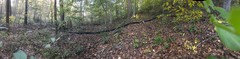
    Maybe this panorama is better? Very top:

  • 9 years ago

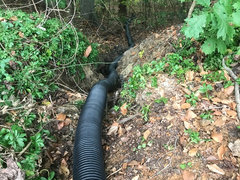
    Very bottom. The pipe is temporary. It is capturing natural water flow but preventing erosion

  • 9 years ago


    Playhouse from the edge of the lawn. It's about 1/3 to 1/4 down the slope.

  • 9 years ago
    last modified: 9 years ago

    Oh, and logs rot REALLY fast here.

    I need to maintenance the stream below, which requires the wheelbarrow.

    More kid elements are going on part of the slope, like a 40' plus slide. The kids are renovating the playhouse this year. Slide probably next year. But I will also eventually have a woodland garden. I want to do a section of natives and a section of not-so-natives. Lol.

  • PRO
    9 years ago

    Maybe steps 2.5’ across and widen path to 4’ so wheelbarrow is along side U only need a small channel for a wheelbarrow. Humans can walk in smaller areas. normal paths are 3’ across.

  • 9 years ago

    Exactly what 'maintenance' does the stream require? Twigs and leaf dams can just be shoved off to the side. Trash should be removed, but I can't imagine you are really getting wheelbarrows of that.

  • 9 years ago

    Why not purchase a plastic-bodied type wheelbarrow to leave overturned near the stream with necessary tools underneath for use as needed during stream maintenance? This would allow constructing steps where necessary in your present path of "switchbacks" needed to control erosion, etc. problems. This is a forest situation. There ought to be a spot of concealment near that stream somewhere.


  • 9 years ago

    Stream steward, and woods with lots of paths person here. That slope is not something I deal with, but the rest is all very familiar. I would leave it as natural as possible, paving wouldn't even be allowed here. Rather than stabilize or repair for a wheelbarrow, consider just pulling a tarp along the path when you need to do maintenance. It is lighter, can hold pretty much whatever you are bringing or taking. Fallen tree bits make excellent path steps, and leaves are amazing path carpets...Warning they are slippery when wet though.

  • 9 years ago
    last modified: 9 years ago

    Mad gallica, it is a shallow stream. When it gets blocked by debris, the area turns into a swamp. A mosquito infested swamp. It gets so unspeakably bad! Chainsaw and digging is regularly required. I check over about a quarter mile of channel a year.

    The streams is new. It formed naturally a few years ago and enormously improved the bottomlands, and I'm helping it along. A 3' diameter tree really messes with the stream bed! We also get trash from flooding that messes up the flow, and I haul that all the way out.

    We have neighbors scared of "chemicals," so they have blocked the county mosquito spraying program in the neighborhood. (These are also people who will tell me I am selfish for having too many children and need to adopt because I'm destroying the environment, earnestly and with no comprehension that they're being offensive...but that's another story! Believe it or not, I get along with them fine. I just nod and smile. Lol.)

    The surface is just too freaking slippery. I can't strip the leaves right now because they help hold the soil, but I fall on my backside all the time.

    I think I'm going to try natural stone step/erosion control barriers with stabilized decomposed granite, at least on the steepest bits. I fell twice today. :P. It's not bad when you're just walking, but carrying stuff kills you.

    Stolen identity, the tarp would cause severe erosion on the slope.

    Nandina, i need tools that would rust or are gas powered. And I need to take supplies down the path. For example, I'm restoring an eroded face with fill and then installing a natural-looking dry waterfall/stream bed. Doing that on this surface will be brutal.

    I am also putting a plankway along the stream. This will also require a ton of hauling.

    We are not in a conservation easement! Our stream isn't even legally a stream yet.

  • 9 years ago

    Oh, and I have excluded the hungry overpopulated deer population from several acres. This means that the deer's favorite native trees can finally take their proper place in the succession, but I have to go in and do selective pruning once a year to make the understory semi-natural. Can't exactly burn the understory like would happen 400 years ago!

  • 9 years ago

    I think you need a professional to come help you Milly, our woods and stream are living things that need little help beyond clearing beaver dams, keeping the dropped nature from blocking the flow, etc. Seems your situation is requesting ideas for service to the humans...sorry I am no help, I do wish you and your stream health and happiness.

  • 9 years ago
    last modified: 9 years ago

    Keeping the stream from being clogged by storm debris and fallen trees keeps a lot of us from having to constantly fog our lawns.

    I got cellulitis from a mosquito bite this year. A lot of us react to the invasive tiger mosquitoes like this: http://tiger-mosquito.info/files/2013/03/tiger-mosquito-bite.jpg

    The stream is technically a runoff only stream--it dries up when there has been a long period with no rain. So it's considered not a permanent stream since it can't support fish. As time goes on and I guess more of the upstream runoff patterns are getting consolidated, it's drying up less and less. Nature caused the stream, but the stream is killing trees as it forms at their roots--trees that are okay in a swamp but not next to a stream. This causes the stream to puddle and eventually reroute...killing more trees. If I have it a century, it would carve a nice, deep streambed on its own. The invasive mosquitoes have made life hell, though, and I hate spraying because we have hundreds of native bee species. I prefer to clear out the clogs caused by the trees that are being killed by the stream, instead.

    I was already advised by an expert in native plants that the forests in the area were not renewing correctly because of 50 years of extreme deer pressure. I was originally planning to save thousands of dollars and only fence my yard. At the expert's advice, I changed my plan to help a correct succession forest develop, if only on my little corner of land. I have can only choose between "way too many deer" and "no deer at all." So by excluding them, I now have to thin if I want the succession forest to form.

    I am perfectly happy to alter a lot of things in my patch of forest. I will plant non-natives near my yard. I will weed invasives--and all the greenbrier and poison ivy, too! They have many other acres of woods to cover. And I will happily pave my little path with stone dust and rocks and create a walkway by the swampy creek so the neighbors can enjoy it and I can easily manuveur and collect trash and clean out blockages without waiting for a drier spell. I'm using the same techniques for it as the national park service does.

    The original owners of the house, who were from a second world country, seat with some things well but other things badly. They threw certain kinds of trash in an area that was eroding to try to stop it. I have to figure out how to deal with it now and also stop the erosion there properly (done now) and attractively (not done) so it looks like it fits in.

    I did not ask for or need help with my stream. I was just looking for options I hadn't thought of that would preserve the path and make it less slippery and dangerous while keeping it blended into the environment.

  • 9 years ago

    For the mosquitoes, try bat houses, and attracting birds that eat them. Spraying seems counterproductive. For traction on the path (similar to some I have), I find gravel, embedded rocks on vertical faces as well as surfaces, and soil-holding ground covers to be most effective. I also use wheelbarrows. You don't need more than a few inches of smooth width for the single wheel, which you can almost always find on the side. Or you gently lift the barrow over the rounded log hump. Would ferns be appropriate to plant on the slope and around the stream? Deer don't eat them and they hold the soil. It is hard to rebuild an understory with deer but there are options. If you find tree seedlings, make cages to protect them. I think you are wise to be learning from the park service. You know there are programs for volunteers in trail building all over the country and the world. Make that your next vacation! And make friends who would be thrilled to come to Pennsylvania to do the same with you! Good luck, and get that big brood you apparently have out there to help!

  • PRO
    9 years ago

    A common device for lessening the slope of a path in a "natural" area (in addition to creating a switchback layout) is the step-ramp. It is merely laying a log crosswise across the path, and embedding it into the earth so that 50% of it is above grade. Each end of the log can also be held from moving down the hill by driving 4"x4" treated stakes in front of it, one at each end of the log. The back (uphill) side of the log is filled with soil (minimizing the slope) such the the front of the log becomes a curb-like step. These are placed according to where slope needs minimizing in order to make the path more hiker-friendly. Typically, they might be 6', 10' or 20', or more, apart. (They are usually not placed at close intervals like a set of steps.) A wheelbarrow could go down a step-ramp with little trouble because the nose of each step is rounded. In order to go up them, you'd need to build a ramp alongside the path at each step (on the uphill side.) Building it out of a log section with a flat face cut into it for the "path" would work. It's just a fact that these wooden structures need occasional replacement since they are made of whatever is available within the woods.

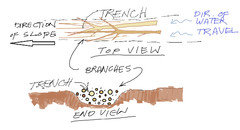
    In treating the erosion, one scheme that may help you is to lay cut forest debris (logs, limbs branches) LENGTHWISE in the path of erosion. The root end is placed uphill. Then, the debris has enough traction from downward aiming twigs and branches that the running water will not dislodge it. In a particularly difficult situation, some of the first installed debris may need to be "pinned" to the earth with stakes. Because the length of the debris is the same direction as the flow of water, the debris does not offer maximum resistance to the force of the flow. As dirty water flows over it, particles in the water begin to settle out and lodge at the base of debris, burying and further holding it in place. A gully can be filled up with soil using this method, and it's a good way to get rid of cut forest debris.

  • 9 years ago

    Yardvark, I am fascinated by your strategy of laying logs lengthwise to the slope, rather than crosswise as I have always done with idea of creating terraces to slow down and absorb some of the flow. Is your idea to speed up the water by creating a channel? What is the gully you are referring to in this case - the swampy bottom that forms when the stream is clogged with debris? I am confused..

  • 9 years ago

    The usual recommendation for dealing with mosquitoes is BT dunks. Draining the channel is only going to work if you can get serious machinery down there. Flooding it is more effective, but it sounds like there may not be enough water for that. I don't remember when, exactly, the last serious drought was, but think it was recently enough that the water tables may still be recovering.

  • 9 years ago

    My impression is that this is moving water - except when it is dammed by debris and then the OP labors to get it moving again - so that the dunks won't work. Or am I mistaken?

  • 9 years ago

    Unless you have beavers, which are an entirely other problem, this isn't really moving water since it dams so easily. At first, I thought we were talking about a stream like that which runs through my neighborhood. It is about 20 ft across, and usually around 4 ft deep. It was once dammed by debris, which consisted of two 40 ft trees coming down in full leaf right into the stream. Now it sounds more like what I have in my side yard, which I usually refer to as 'the swamp'. There is a small stream running through there during the spring thaw, and after major rain events. But usually it is better described as various forms of squish. If the mosquito dunks are placed decently, they spread the Bt into all the pools when the water rises.

  • PRO
    9 years ago

    @ Kitasei, the scheme of using cut brush laid lengthwise in a trench is for an already existing, eroded gully ... not the creation of a trench for this purpose. The brush does not "speed up" the water flow but slows it down. You might think of it as a large filter of sorts whose purpose is to become clogged, whereas the length of the brush-filled channel is the "filter's" thickness." Instead of clogging at its inflow surface, as would a typical filter, it "clogs" at its lowest elevation first and builds upward. As sediment settles out at the bottom, it further holds/embeds the trapped brush. If there is enough sediment in the stormwater, the eroded gully can fill up completely in a short time. It may take a single, or several rain events, depending on the applicable conditions. It is like a self-healing wound; one must install the filtering brush in such a way that it isn't dislodged by moving water (thus root end uphill.) The principle is similar to snow fencing, and like it the snow fence wouldn't be effective in "trapping" snow if it blew away in the process. (I hope this explains...)


  • 9 years ago

    thought provoking

  • 9 years ago

    I don't know why MadG. thinks you live near Philly, but if you do, I think Wissahickon Park has done a lot of work on their eroding trails with decomposed paving stone. It was several years ago but I vaguely remember attending a presentation there somewhere near the treehouse area. All about preventing erosion. Might be worth a call.