Software
Houzz Logo Print
lisadlu16

4" backsplash?

9 years ago

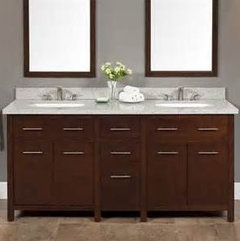
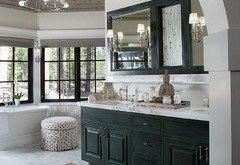
Is the 4" bathroom backsplash very dated? I see a lot of photos in Houzz with a tile wall backsplash but I am not going to tile the whole wall and don't like the look of just a few rows of tile. I am going to do the 4" backsplash for the back wall but am debating on leaving it off the side walls. Opinions?

Comments (20)

  • 9 years ago
    last modified: 9 years ago

    You can leave off the side splash if the water splash won't reach the walls.

    lisadlu16 thanked User
  • 9 years ago
    last modified: 9 years ago

    it's not about "dated" to me it's just the size often looks awkward. and I understand not wanting to do just several rows of tile-some places it works, some doesn't, and you know yours.

    I'd do a tweak. Can you ask your granite guy to make it lower I mean shorter? say, 3 inches instead of 4? To me it looks better..actually I don't know where these 4 inches came from. I'm sure there's no code abouit it in the bathrooms. And why they decided it's the most eye pleasing height.

    And yes, I'd leave side walls completely without it. (And I did. actually I don't have backsplash in any of our baths. We did take mirrors down to the countertop in the master)

    As long as the space is properly made and you're not leaving there puddles of water every day-I don't see a problem, personally

    (then I grew without backsplashes, sidesplashes, and vanities, and tiles anywhere, so maybe I'm more relaxed because of that fact)

    lisadlu16 thanked aprilneverends
  • 9 years ago

    Thanks all! Enduring - I think your counter/splash looks great! I am doing two vanities, one is 89" long and has walls on either side. The other is 60" long with only one wall and the other side open like yours. I think I am going to look for more photos showing the backsplash in back and leaving the side walls naked. I think I would like that look more if it doesn't look unfinished. Thanks again everyone!

  • 9 years ago

    Enduring I love your bath too!..example how 4 inches looks totally natural probably because it quietly dissappears into the wall..and the heigh of the faucet is perfect with it. Proportions and relations between objects matter a lot-and yours are very well considered.

  • PRO
    9 years ago

    I do like the shorter 3" splash as well ( unless you are doing vessel sinks or a higher faucet ).

    But I also love a tall splash with a detail or up to a mirror....

    Good luck!

    lisadlu16 thanked Debbi Washburn
  • 8 years ago

    I think it's dated. But I'm not a fan, and my bathroom that has it is dated, which may be why I think it is.

  • PRO
    8 years ago

    backsplash ideas

    Http://www.bhg.com/bathroom/remodeling/bathroom-backsplash-ideas/?slideId=c84c3d1b-f0e3-4b0f-ae55-177b988ca8d5


    SECTION P2705 INSTALLATION


    P2705.1 General.


    The installation of fixtures shall conform to the following:


    3. Where fixtures come in contact with walls and floors, the contact area shall be water tight.


    This requirement has not changed since the first edition of the IRC in 2000 and was also in the predecessor code (CABO 1 & 2 Family Dwelling Code) since the early 80's.


    There may be other ways to make the joint water tight but a backsplash is the easiest and most effective method since counters and cabinets move and shift over time. The code appears to be concerned with water running down the wall and causing deterioration of the wall and perhaps even the structure.


    Local codes can vary so much from county to county, you might try calling your local building inspections department and actually TALK with an inspector about it.


    Function of the backslash is to protect the drywall from mold. Whereever counters with water touches walls some type of waterproof barrier is required. Another option is tile.


    lisadlu16 thanked Business_Name_Placeholder
  • PRO
    8 years ago

    I knew someone who did not get backslash and when they wanted to sell home, the home inspection didn't pass code. They had to fix it.

    Also, My contractor told me a story how a bath vanity did not have backsplash and caused mold inside walls and damaged the floors under cabinet overtime.

    I design bathroom vanities often.

    Waterproof around water

    lisadlu16 thanked Business_Name_Placeholder
  • 8 years ago
    last modified: 8 years ago

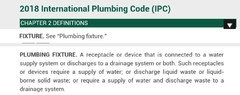
    Is a countertop a fixture? Then, is the cabinet under the countertop also part of the fixture? Tile and grout are not water tight. The code is referring to caulking the fixture to whatever it is mounted to.


    Since the fixture is in contact with the countertop, and the countertop is in contact with the wall, and the wall is in contact with the floor, and the floor is in contact with all other walls in the house,.... then all walls shall be watertight to the floor?

    .

  • 8 years ago
    last modified: 8 years ago

    The counter isn’t a fixture, Sharon!!! Fixtures are tubs, toilets, and sinks.

    You don’t have to have a backsplash even behind a wall-mounted sink. There is nothing in the code about backsplashes. Home inspector was lying or dumb.

    What the ‘water tight joint” refers to is caulking your fixtures to whatever they touch. Tile isn’t “water tight.” You aren’t REQUIRED to caulk the vanity to the wall, but it’s conventional.

    I would get another contractor. He isn’t very bright.

  • PRO
    8 years ago

    I have never heard of a home failing inspection because of a back splash. The countertop gets caulked in place.


  • 8 years ago

    we're in CA-the land of the strictest codes(or so it seems)..we passed 6 obligatory inspections..if backsplash would be required on the vanity I bet we'd be informed:) the amount of things we had to do to comply to the code was very extensive. and right, it's not required to caulk the vanity either. out of three vanities we've got we caulked one.

  • 8 years ago

    As a side note, there have been requirement such as caulking to get FHA or VA loans in the past.

  • PRO
    8 years ago
    last modified: 8 years ago

    fix·ture

    noun

    a piece of equipment or furniture that is fixed in position in a building or vehicle.

    The countertop is part of the vanity & is therfore a fixture.

    Milley Ray is incorrect.

    Also in real estate, fixtures go with the property, that's why vanities & cabinets go with the home sale.

    I sell real estate for years & deal with appraisers, home inspectors, and contractors often. I design kitchen and bathroom for a living as well. I know what I'm talking about.

    Yes, I have witnessed more than 1 vanity fail inspection here. It may be different where you are at. That's why I recommend calling the county the vanity will be in.

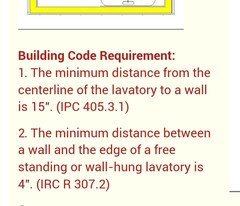
    Each county has it's codes. Example, Here if there is no backsplash, it must be 4" away from wall or fail.

    Water must stay away from drywall to prevent mold or damage, It's logical.

    How it's done is optional.

    It doesn't have to be backsplash. It could be another waterproof surface sealed/chalked correctly if it is against a side wall or 4" away from side wall. The back wall must be protected.

  • PRO
    8 years ago

    All I'm trying to do is help the nice lady who asked a question. I'm disappointed in the rude criticism I'm getting from other commentors. We're all trying to help.

    I suggest calling the county you reside in to get the facts in the area you reside in or call a local contractor for their opinion. When I studied interior design, I was always taught function 1st then asthetics.

    My dad has been a license contractor for over 25 years. I use to work on the field with him as well.

    Beware there is a lot of opinion on Houzz by non pros that think of looks over function.

    So, I highly suggest asking a local pro for peace of mind.

    Happy Thanksgiving to all.


  • 8 years ago
    last modified: 8 years ago

    Sharon, nobody is saying that you should not protect the wall in some fashion, even if it is just caulking the joint. Some things are just not "required by code".

    CODE is a written and published law passed by the legislative branch of govt. FHA and VA loan requirements are not "codes". Neither is something a random inspector might try to make you do.

    You can not just look for ANY definition of the word "fixture" to suit your belief.

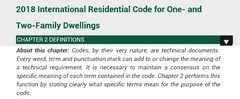
    As far as the 4" rule, you are probably referring to this, which was taken out of the code many years ago.

    If it is really a "code" where you are, then you should be able to look it up and give us a code number. Does the VA in your name represent Virginia?


    https://codes.iccsafe.org/public/document/VRC2012/chapter-3-building-planning

    https://codes.iccsafe.org/public/document/VRC2012/chapter-27-plumbing-fixtures

  • 8 years ago
    last modified: 8 years ago

    You’re mixing building terms with general use terms. If you just use common sense for five seconds, you would realize that a built in hearth, for instance, is not required to be caulked to anything and that no one is caulking the toekicks of stained cabinetry to the floor.

    This is ridiculous. Sticks-in-the-mud passing off what they like as a requirement! This isn’t even a functionality issue. Modern paint is plenty good enough not to need any backsplash, much less a tacky 4” one from the 80s.

    TILE IS NOT WATER TIGHT. If you get nothing else from this, please, please understand this!!!! Tile over drywall (or green board or cement board with nothing under or over it) will never pass any requirement for waterproofing anywhere.

  • 8 years ago
    last modified: 8 years ago

    "no one is caulking the toekicks of stained cabinetry to the floor." I silicone seal the bottom of every toekick that sits on a surface that is likely to be mopped. Sloppy moppers squeeze water under the toekick which will eventually start wicking up into the wood.

    And, tile backsplashes have been around just as long as 4" ones, and has been deemed just as tacky in different decades, whether you know it or not. I personally prefer a sleek linear splash over the current trend of gauding up the whole wall with tile that doesn't even go with the countertop. It reminds me of a great aunt that always wore 2 pounds of makeup.

    Don't get so uptight.

  • PRO
    8 years ago
    last modified: 8 years ago

    In regards to vanity cabinets with countertops, protecting the walls from water. I deal often with a company that specializes in water/fire damage often, so I hear lots of situations on water damage. The clients often remark, I had no idea water had leaked there or I didn't know a small leak would cause so much damage. So, Proper sealing is necessary. Now how it is done, is obviously debatable.

    Over time sometimes cabinets will shift & the seal will be broken which sometimes not visible.So, checking the seals once in awhile and wipe down sink cabinets to check moisture, is a good habit.

    If it's a heavy used bathroom, especially with children, I suggest backsplash. It adds an extra barrier. Like a mini dam of extra protection, because it is sealed onto countertop and the countertop is sealed under backsplash against wall.

    There has been a lot of talk that backsplash is not necessary. Maybe not in some areas. I have seen some strict home inspectors fail 2 vanities within 10 years, due to water damage which a backsplash could of prevented it. Codes do change, & that's why check rules beforehand. Home inspectors can be strict and codes can vary & be interpreted differently, as we have seen in this thread. Lol.

    I also suggest tiling or waterproofing under cabinets to protect floors. Can also use sticky tiles in cabinet under sink to protect the bottom of cabinet. Now I know you don't have to do all these preventive measures, however prevention is a good rule to have years of use.

    Hope this helps you enjoy your future vanity for years.