Fall is here so it is time to start thinking about building a Mason Bee house or two.
I am by no means a
master gardener nor am I very experienced in keeping bees. When I was a
teenager, I kept honey bees because my grandfather was a beekeeper and told me
that honey bees were the best pollinators around. However, my research on the
internet and my discussions with other gardeners has shown me that Grandpa was
wrong.
I grow lots of fruit
and vegetables that require pollination.
I have persimmons, apricot, Asian pears, plums, jujubes, peaches,
cherries, paw paws, raspberries, figs, blackberries, blue berries,
strawberries, pomegranates, and kiwis. My vegetable garden sometimes includes
eggplants, melons, tomatoes, potatoes, peppers, squash and beans and all need
pollinators.
So you can see I have
an interest in pollinating all of the above, otherwise my garden would be
adversely affected. Since honey bees are
a social bee, they communicate with each other about where to find the sources
of pollen, nectar and water. Therefore the first blooms to open get the first
attention. If you watch closely, the bees will exit from the hive and go
straight to the blooms that opened first during the season. Bees become
fixated, when a nectar source opens, the bees concentrate on that source,
becoming fixed on that and little else until the bloom period for that plant is
over. If your blossoms open a few days after your neighbor’s blossoms, by the
time your neighbor’s blossoms have finished, your blossoms are half over, and
old blossoms do not pollinate well, if at all.
A bee that flies in
cool, damp and cloudy weather of spring, which honey bees don't, is also
needed. It is also important that the maintenance of the bees doesn't require a
great deal of time, which most gardeners do not have. Since the blooming period
is often short, the bees need to be able to work quickly and not get fixated on
one nectar source. Mason bees are the ideal solution. Mason Bees (MB) only fly
approximately 300 yards from its nest site, thus helping to ensure pollination
of your blossoms, not your neighbor’s.
MBs are solitary and there
are numerous strains. They do not need a nest site with thousands of worker
support. While they do prefer others of the same strain around, mainly for
mating purposes, the females do most of the work in provisioning the nest tube.
The males are good pollinators in their own right, but their forage is for
their own use, and not for their offspring.
MBs nest in tubes, under natural conditions, mainly those left by
burrowing insects. With the removal of mature trees there has been serious
habitat loss, so MBs are in short supply and nest sites should be encouraged.
These nest sites can
be simple blocks of wood up to 6 inches deep, holes drilled approximately
5/16ths inch in diameter. The females will first close off the back of the nest
tube with mud on the bottom plug she will use pollen as the feed plus a small
amount of nectar, and lay an egg. This section is then sealed with a mud plug,
then immediately she will start on a second nursery cell and so on till she
gets towards the front of the tube at which time she will lay unfertilized
eggs, creating males. Under good conditions MB females will lay at least 3
females and 2 males per tube, after which she will seal the end and move to a
second nesting tube.
Unlike honey bees that
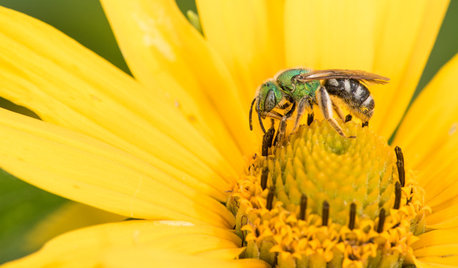
carry pollen on their legs, MBs carry the pollen in a sac beneath the abdomen.
When a female lands on a flower she dives in belly first, right in the middle
of the blossom stamens. Whereas a honey bee lands on the side and walks down
looking for the nectar site, possibly brushing past the stamen in passing. Each
blossom needs up to eight visits to effectively pollinate them. An individual MB
will do a better job, purely because of her approach to each blossom. It should be obvious that MBs main interest
is pollen whereas honey bees interest is nectar for honey making. So with honey
bees pollen transfer is accidental, but with MBs, transfer is deliberate.
The MB is a hard
worker, visiting hundreds of flowers to charge each egg site with pollen and
the increase in fruit crops using them is well documented, in some cases up to
a 4 fold increase. Unlike honey bees, they will start earlier in the morning,
finish flying later in the day and cool damp weather doesn't prevent them from working.
In a few short weeks,
the nest tubes are sealed and the larvae will eat through their stores, pupate;
and wait in the tubes till next spring before emerging. The outer eggs turn
into males, which emerge a few days before the females, then hang around
waiting to mate with the emerging females.
Caring for MBs cannot
in any way be considered labor intensive. They work without supervision,
sealing off their young from predation with mud plugs. Some provision should be
made to stop wood peckers accessing the nest site. This is a learning experience and ideally a
search on the internet for Mason bees or Blue Orchard bees will supply sites
where more information is available and where bees can be purchased.
I personally decided
not to purchase MBs, but to construct bee boxes to attract the native ones. I
have two nest boxes so far and one is populated from last spring. Another is
located very close to the old one and is ready to accommodate MBs this spring. My intention is to cover the populated box
with a cardboard box, with ½ inch holes in it, on or about March 15 to allow
the MBs to exit but to discourage them from using the old box during this
spring and encourage them to use the new box.
Next, I will remove the old box around May 15 and clean it to kill mites
and put it up again the next spring.



gardengal48 (PNW Z8/9)
Related Professionals
Fayetteville Landscape Architects & Landscape Designers · Galveston Landscape Architects & Landscape Designers · Amarillo Landscape Architects & Landscape Designers · Provo Landscape Architects & Landscape Designers · Dover Landscape Contractors · Springfield Landscape Contractors · Florence Landscape Contractors · Bartlesville Landscape Contractors · York Landscape Contractors · Spring Landscape Contractors · North Adams Landscape Contractors · Syracuse Landscape Contractors · Hot Springs Architects & Building Designers · Emporia Architects & Building Designers · Altoona Architects & Building Designers