Software
Houzz Logo Print
ain_ash_shams

electricity???

8 years ago
last modified: 8 years ago
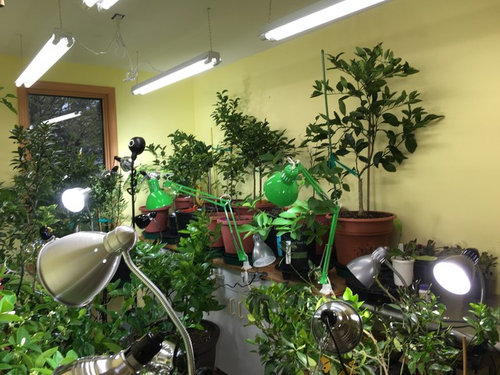

I'm adding more lights to my room all the time and now starting to wonder, how the heck are you all doing it with the outletts and cable? And how much can the circuit take?

Maybe putting anothe rrow of lights on the ceiling?

but definately two more floor lamps and maybe two clip lamps on each pole


Comments (47)

  • 8 years ago

    Easy answer to how much can the circuit take. Volts X amps = watts. The amps of your fuse/breaker, times the volts (probably 110) = the number of watts the circuit can support. Lights are measured in watts; so multiply the breaker by 110 and that will tell you how many watts of light that circuit can support. Depending on your wiring, you can maybe increase the size of the breaker.

    Susanne Michigan Zone 5/6 thanked johnmerr
  • 8 years ago
    last modified: 8 years ago

    I had the same concern so I got lamps with multiple bulbs. They don't have as much range to be bent down as the Ikea ones but for my taller tress they should be great.

  • 8 years ago

    I just counted 20 lamps plus the eight on the ceiling and the fan. Six more going in for sure and then new assessment.

  • 8 years ago

    Try not to "max" your breaker out. If I am using a 20 amp circuit I don't use but 80% of it (16 amps).

    Susanne Michigan Zone 5/6 thanked Angela Piedmont NC zone 7b
  • 8 years ago

    Angela,

    This is a citrus forum... Unless you are a licensed electrician, I might refrain from giiving electrical advice.

    Susanne Michigan Zone 5/6 thanked johnmerr
  • 8 years ago

    Sorry John, wasn't trying to hand out electrical advice. I'm not a licensed electrician but I do my share of electrical work. I was thinking more along the lines of safety. Using more than 80% is something I just pay attention to.

  • 8 years ago

    Angela,

    You are being doubly careful.... that "80%" facture (safety factor) is already engineered into the product, if it is for home consumption.

  • 8 years ago

    John, are you a licensed electrician? Because your suggestion about maybe upsizing breakers seems careless and dangerous in a forum like this. Angela's was good advice, you can push it further if you want to, but it doesnt hurt to play it safe.

    Anyway, if people are pulling that much current for lighting, perhaps an electrician should install a dedicated circuit for that alone.

  • 8 years ago

    Yes John I am being doubly careful. I have a mobile home park in which I own most of the homes in it. Other than heating & air I handle all the maintenance myself, plumbing, remodeling and about 95% of electrical problems. I take being a landlord real serious especially where electrical matters are concerned. Lives of people are at stake, I am more than doubly careful. When Susanne made her post it caught my eye because I do a lot of electrical work. When I read your post I just thought to myself that you were correct but just forgot to tell her to not max it out. I could have been rude and jumped all over you but I'm not here to be rude to anybody. I really like this forum and all the people who participate. I don't know Susanne personally but I didn't want her to overload a circuit and possibly start an electrical fire or possibly damage her breaker box. It would be terrible if all her citrus trees burned up in a fire wouldn't it? When dealing with a "continuous run" (anything that is going to be running for more than three hours) like water heaters and lighting, you are only supposed to use 80% of the breakers capacity. It's about heat building up. John your comment to me was sort of on the rude side but it's all good. Yes this is a citrus forum but also electrical matters comes in to play at this time of year. I've dealt with the "male ego issues" my whole life and I'm used to it.

    Jaydub, thanks for your kind words. Installing a dedicated circuit is exactly what I did in my little grow room.

    Angela

  • 8 years ago

    Tropicofcancer I just now seen your post. Thanks

  • 8 years ago

    Angela, I am in a similar line of work, and I've seen enough burnt wiring, outlets and fires to know that safety and caution come first.

  • 8 years ago

    I've seen plenty of that too. I had a breaker box to burn up one time. The overloaded breaker failed to trip. I'd rather take a beating than to replace a breaker box!

  • 8 years ago

    Thank you all for your advice. Will watch for capacity. Not near the 80% yet but glad I asked

    How about my other questions about all the cables and available numbers of outletts? How do handle the cable salad?

  • 8 years ago

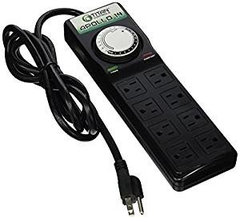
    Susanne - Since I have my stuff on a timer...this one (4 sockets are tied to the timer and 4 are steady power) -


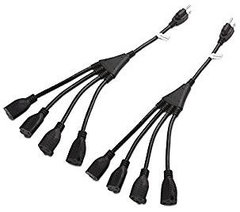
    I ended up getting a couple of these -


    and running cords or strips to them. I have a couple 2ft T5 Jump starts, the 4ft (2 bulb) T5 larger unit, plus that 2-tier shelf unit (with 4, T5 3ft bulbs), and finally 6 clamp-ons with LEDs and twisters (on their own surge strips, with a few more clamp-ons to come) - all running into the splitters on the timer.

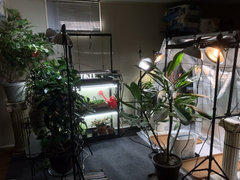
    My setup at the moment (citrus are still outside but I have a plumeria
    down there under some lights until the inflo is done and then I am going
    to strip the leaves and let it go dormant in the unfinished part of the basement, where the citrus will go under that reflective structure I created) -

    There are power cord boxes/covers/strips that you could insert the cords in to keep them away from water. When I bring the citrus down, I'll be looking to see if I need to utilize something like that.

    Susanne Michigan Zone 5/6 thanked jenny_in_se_pa
  • 8 years ago

    Suzanne your set up looks fabulous. Your room is much larger than what I have to deal with. Some power strips will probably help in staying more organized. I don't know what kind of flooring you have but if you have to have cords running in walk ways it would help to tape them down to prevent tripping over them.

    Susanne Michigan Zone 5/6 thanked Angela Piedmont NC zone 7b
  • 8 years ago

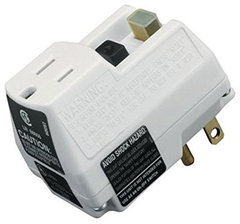
    Looking good jenny. I would also suggest to put GFCI protected outlet. You can also get a GFCI protected multi-outlet strip. You only need one at the source. It will protect against shorts. Actually code requires it for any wet/damp location like kitchen/bathrooms.

  • 8 years ago

    Susanne: To manage cable salad as you put it: Jinny and Angela provided some good suggestions. Generally a tree structure reduces the mess. That is starting from the source keep branching out towards the lights. Say you have one outlet with a timer. Use a heavy duty timer rated 15A. Connect that to a multi-outlet strip like above pictures from jenny and Angela. Get a decent quality one for this one since it is going to handle all the load. Run longer extension cords to several points that each end in another multi-outlet strips. Group the lights together (usually they have short cords and there is a reason for that too) and connect them to the multi-outlets at the end. I guess you get the picture. Raise all plug points and outlets off the floor as much as possible. Hang them vertically or upside down to reduce chances of water getting into those. Zip ties are your friend when you need to tie cords to something like shelf rods.

    If you want to be more safe use outdoor rated extension cords. Their outlet ends are protected better for water ingress. Costco has four pack of 25ft outdoor cords with double outlets for $20.

    Susanne Michigan Zone 5/6 thanked tropicofcancer (6b SW-PA)
  • 8 years ago

    Oh so many great ideas, Thank you all for that :) I have surge protected cords but the idea to get out door cords is great. Will also see where I can tape the cords down. So far I was able to keep the pathway free. And no timer yet. Just love to wiggle through and say good morning or good night ;)

  • 8 years ago
    last modified: 8 years ago

    Hi

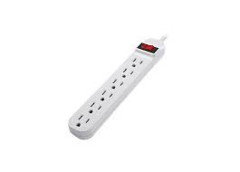
    tropicofcancer - good suggestion. Was hunting around and found this -

    Just added to my buy list! All the lights go into the timer strip at the moment and that can go into the above outlet and then into the wall. I also have a 20" oscillating pedestal fan on a different outlet (not in the pic) and saw a (I think yours) schedule for hours on/off during the day & night. I used the fan down there last year and kept it on most of the time, although randomly turning it off for a day or so each week and moving it around to hit the plants at different angles. I have an extra timer around but because the fan is digital (came with remote) and has its own "timer", I'd have to manually set the fan's own timer daily (i.e., it won't turn back on if an external timer cuts the power and then restores it)... otherwise would have to get a purely analog/manual fan (e.g., elevate a floor fan or box fan). Finally I have a humidifier (not turned on yet) that will be in the area. I am in a rental with central air and being that I have never dealt with that type of system before, it has been an eye-opening experience the past year in terms of temps and humidity in the house (have probes all over).

    Susanne Michigan Zone 5/6 thanked jenny_in_se_pa
  • 8 years ago

    Good find jenny. Remember to test/reset the GFCI device once in a while to confirm that it is working correctly. My fan schedule is just what I cooked up - not much science behind it. I am always experimenting and so some things I do may seem strange. This winter my project is to hack my own timers and temp/humidity sensors that will be accessible over wifi and eventually controllable from my phone. Plus I will be building my own led lights and other such distractions.

  • 8 years ago

    Electric code calls for 80% load max per breaker rating.

    Angela is correct.

  • 8 years ago

    Bob are you Dutch? Yes lights are a bit high but I also have a lot of small lights directly at the plants. Time will tell if that is enough.

  • 8 years ago

    Susanne: I would echo what Bob said - if you can bring the overhead fluorescents closer to the plants. They can be as close as few inches although the coverage suffers at such close distance. That may be that is a bit too much involved operation for you. But you and your plants will be happier.

  • 8 years ago

    Bob, what kind of lights did you get?

  • 8 years ago

    Hanging the lights down will not be practical as my trees are very different in hights. I need to go through too.


  • PRO
    8 years ago
    last modified: 8 years ago

    Susanne, light intensity drops off as 1/(distance)^2 (known as the inverse square law)... with your lights at those distances the plants are probably getting very little out of them... So it is not a matter of if you want to put them closer, scientifically, they need to be a close as possible if you want your trees to benefit from them.

  • 8 years ago

    Tropical I have a lot of extra lighting, might not show well in the picture?

  • 8 years ago

    Susanne - you could consider getting an inexpensive lux meter just to get some comparisons of light levels in the various parts of your room by the trees. I decided to get one last week just to see what to aim for compared to outside. Although I know with my current setup, I'll never reach anywhere near "outside" light levels but definitely want to get it to a higher level than normal home lighting and see where any dark spots are. The more expensive ones can better handle/detect/correct for mixed types of lighting beyond incandescent (LED, fluorescent, HPS, metal halide, etc), but I am just using my cheapy for comparison between locations around the trees. I got this one - https://www.amazon.com/gp/product/B004K0A7I6/ref=oh_aui_search_detailpage?ie=UTF8&psc=1

    Susanne Michigan Zone 5/6 thanked jenny_in_se_pa
  • 8 years ago
    last modified: 8 years ago

    Brilliant idea. Thank you Jenny :) Have you used this one yet? Happy with it? Something you like and something not so nice?

  • 8 years ago

    There is no need for a light meter. If your plants grow well then you are fine. If the light meter shows to little you'll worry about nothing all winter while your plants grow fine. It none of your plants grow well add light. It is not important that your plants grow all the time so iff you loose a month no problem. I inherited a light meter and don't use it.

    Steve

    Susanne Michigan Zone 5/6 thanked poncirusguy6b452xx
  • 8 years ago

    Hey Steve - it's more for piece of mind. You have your amazing growth on your trees when you put them under your bucket lights where you know the vast majority of the light will hit them to give them fast growth, and then out they go in the ground (where they get real sun)! :-D I wouldn't take a meter reading as "too little" being a death knell but more as a gauge for configuring a new (or adjusting an existing) lighting setup. Once you've done it a few times, you start learning what trees seem to handle certain conditions better than others and you can move stuff around. :-)

    Susanne Michigan Zone 5/6 thanked jenny_in_se_pa
  • 8 years ago
    last modified: 8 years ago

    Susanne - I just saw you had a follow-up. I had actually tried it out yesterday in the area where my citrus were sitting (NE-facing near the house wall). It was overcast at the time, just after 1:30 pm, and I got a reading of ~"12,800" (average, because the readings continually fluctuate). Just tried it this evening downstairs in my lighting structure in the center (directly under the 2, 4ft T5s with no trees there) and got a reading of ~"8,800". And the "150W equivalent" LED bulb in the lamp on the table next to where I am sitting was "260". lol So it makes sense that even overcast sun will be much "brighter" than the artificial lighting (and obviously the sun also provides all the other parts of the EM spectrum on either side of visible light that the meter won't detect).

  • 8 years ago

    Vlad, my lights are just regular shoplights either from Lowe's or Sam's Club. Sam's are led's and lowe's fluoro's. I have replace my t-8 with led's tubes from Sam's, these are 2 for $10.00. My total lights in the shop are 11. This set-up is been going for the third year, no problem with the tree's not likened,all low tech.

  • 8 years ago

    Bob, did you install the LEDs into the T-8 fixtures?

  • 8 years ago

    I guess it requires rewiring, though.

  • 8 years ago

    You can get bulbs that run on the ballast or direct wire to 110. Those set to 110 must be rewired to bypass the ballast. I suggest getting the 110 that need to be ballast bypassed

  • 8 years ago
    last modified: 8 years ago

    Vladimir: There are some good articles on the web on the types of T8 led retrofits. The new ones do not require any rewiring but will run more efficiently without the fluorescent ballast. The type led tubes determines type of wiring. The single ended tubes need live/neutral to be wired to a specific end of the tube. The double ended tubes require live and neutral to be on the opposite sides. They cannot be interchanged though.

    Tropical Paradise: The inverse square law theoretically only applies to an ideal (pin)point source of light and not generally applicable for all light sources. Sun being very far behaves like an ideal point source. The shape, size, lenses, reflectors, etc alters this behaviour mainly closer to the light. Roughly speaking, for most light sources, the light intensity reduces somewhere between linearly (half intensity every double the distance) to quadratically (one quarter intensity every double the distance). Once you go past about 10 times the size of the light source, inverse square law starts dominating. I do not have an handy article to illustrate this but I will try to look for one if anyone is interested. The science behind is quite a bit complex. An extreme example is a laser pointer where the light intensity does not drop off significantly over a long distance.

    jenny: Although not a very big deal but lux meters are tuned to human eye response to light. Our eyes tend to favour green more than the other spectral components. Whereas plants tend to favour red and blue side of the spectrum more. Kind of opposite to our eyes. So those red/blue led grow lights will always tend to show lower lumens/lux readings. If interested look up Photosynthetically active radiation (PAR) and Photosynthetic photon flux density (PPFD). Probably overkill for hobby growers.

    Sun is way too bright - we all agree. So bright that many plants would reach photo-saturation by early afternoon. That is they had enough light for the day and start shutting down there photosynthesis machinery. Heat also plays a role in this shutdown process. This is the reason that it is advised, for many plants, to provide morning sun and afternoon shade since some can actually stress-out with that much of light and heat. Since our indoor lights are much lower it is also advised to run them 12-16 hrs per day to compensate for the lack of intensity. This helps them meet their daily quota which in science parlance called Daylight Integral or DLI.

    I know it may seem like a bit too much info but I hope it is useful to some.

    Susanne Michigan Zone 5/6 thanked tropicofcancer (6b SW-PA)
  • 8 years ago

    Hey tropicofcancer - I'm a former (now retired - yay!) chemist so know about EM spectra from using all types of spectrometers with detectors for different ranges to do analyses. One would need a very expensive meter to do precise measurements but my aim was to do "relative" comparisons of light levels (illumination) vs "actuals". If anything, I think it's a bit better gauge than going by lumen output of a bulb. And yup, I run my lights at least 14 or more hours a day for that very reason of reduced output. :-) What is great nowadays is the fact that you do have cooler lighting from LEDs (or even CFLs) vs the metal halides or HPS lamps. I used to have a reef tank about 15 years ago and the metal halide pendants required for them back then were huge and hot. At least the newer bulbs are much smaller, although still have that heat output.

  • 8 years ago

    So, just to make clear I understand, the reason we let the lights on for more then 12 hours is to compensate lower light levels?


  • 8 years ago

    Yes. That way the plant gets chance to absorb more photons from the artificial lights over that longer period time (whereas outside they normally get a huge blast of them from the sun)!

    Susanne Michigan Zone 5/6 thanked jenny_in_se_pa
  • 8 years ago

    I ran my lights last winter as Silica suggested for 14-16 hours/day. Great explanation tropic and Jenny! Susanne, I also put my lights as close as I can without burning the leaves - usually with 6”. I do have accidents sometime and have had a few burned leaves, but I can live with that. I am about to rig up more clamp lights and am using the tripods (was it you Jenny?) that were recommended. I try to point them different ways periodically to spread out the light. We’ve had nothing but cloudy days since my trees have been inside, but so far, so good.

    Susanne Michigan Zone 5/6 thanked Laura LaRosa (7b)
  • 8 years ago

    yeah, had my first burned leaf on my calamondin. Need to be a bit more careful I guess.

  • 8 years ago
    last modified: 8 years ago

    jenny: I am always happy to find that there are quite a few forum members like you who would get what I am trying to say right away. You are absolutely right that a light/lux meter is a very practical way to judge the relative levels of light from different sources. I also have a half decent (and very old) light meter for the same purpose. I am also slowly changing to led lights to reduce the energy/heat footprint. Problem with any new tech is wading through a lot of hype and inflated/unverifiable claims.

    Susanne: Some people have even experimented with running 24 hrs for some plants with good success but I think most plants will benefit from a dark period. 16 hrs seems to be a sweet spot for light loving plants. I run mine for 12 hrs. I have probably more lights but I also do not want my plants to grow for space reasons. Although not always practical, making surroundings/stuff as white/reflective as possible is also quite effective in redirecting light hitting "useless" surfaces back to the plants.

    As you are finding out it needs to be getting used to different light sources. A tube like light tries to increase "coverage" at the expense of intensity a location. It makes them ideal for lots of small plants. A more focussed light like a CFL inside a reflector is sacrificing coverage to reach farther through the canopy. But it can burn leaves at close distances. I think I have one of those situations in the making myself with one of the lights. I am waiting bit to see signs of it and then adjust placements.

    As you can imagine a judicious use of a number of each type provides you with some flexibility. I also have 600W metal halide. I had been wanting to get rid of it for a while. But both its coverage and reach are incredible. The heat also raises the temperature of the unheated room and is a benefit but for some of you that may be a disadvantage. I am playing with a new led light that may rival the metal halide in light output at a lower wattage.

    Susanne Michigan Zone 5/6 thanked tropicofcancer (6b SW-PA)
  • 8 years ago

    Laura - yes the tripod poles were what I tried last year and recommended here and I ended up buying more this year (I now have 6 so far - 3 pairs). I was able to adjust & tighten the legs on the base for a couple of them placed in a space-challenged area so that the bottom of the center post rests on the floor even with the 3 legs (giving you 4 "legs" on the floor for more stability and a smaller stand profile). Doing that still allows the extension tubes in the pole to be fully raised if needed for multiple clamp lights. Alternately, you can fully extend the legs and tuck pots in the spaces between the tripod legs when placed in the middle of rows of plants.

    tropicofcancer - Your info is much appreciated! In my case, being in a new (rental) home, I have created a makeshift experimental "grow area" in the basement with reflective material around it, that is about 4ft wide, 3ft deep, and 5ft high (in the front), so want to see how that does in terms of getting light all around my small trees. In a room like Susanne has, I think it would be good to see if the relative light levels can be tweaked to be even across the expanse and that lets her know where an additional light might be added given the tube fixtures are up on the ceiling and can't be adjusted lower for practicality purposes.

    I don't have nearly as many as you guys have mainly because of an "opposite" problem - not enough space outside to put them... lol. I have space inside to overwinter but very little room outside due to a patio that is only 10ft deep by 17 ft wide, where my other containers of hardy shrubs/perennials (at least 20+) compete for the best positions for sun with some other tropicals, my veggies & herbs, and the citrus. :-D

    Susanne Michigan Zone 5/6 thanked jenny_in_se_pa
  • 8 years ago

    i havent been around here lately but this one i have to chime in on. Im a 20 year licensed electrician. There is a ton of bad information in this post. I suggest anyone who needs work done or has a concern that you contact a local pro and not take advice from a bunch of citrus growers.

  • 8 years ago

    mksmth: May be it would be more helpful if you pointed out the incorrect and/or correct info. I am not trying to be contentious but a forum like this becomes more useful if mistakes are corrected. I am certain that most of us are violating code somewhere and creating unsafe situations.

Sponsored
Snider & Metcalf Interior Design, LTD
Average rating: 5 out of 5 stars25 Reviews
Leading Interior Designers in Columbus, Ohio & Ponte Vedra, Florida