

Columnea brenneri to bloom
At least I think this is Columnea brenneri. If you disagree, please let me know. Here's the story: a friend and I were visiting Martin Grantham at the greenhouses at SF State University. I had to move my car, and my friend saw some areas that I didn't. He was offered a couple berries of an odd Gesneriad and gave them to me. The Gesneriad was one that had arrived as a stowaway in a plant shipment, I think from Ecuador or Peru. My friend didn't take a picture, but I was able to get close with his description. I later saw that an Ebay seller who knows Martin G. was selling what appeared to be an identical plant labeled Columnea brenneri.
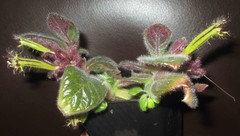
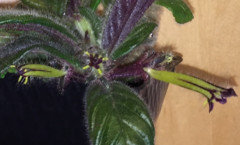
I could show a blooming picture from a past year, but I just wait until these open. It doesn't look like very long:
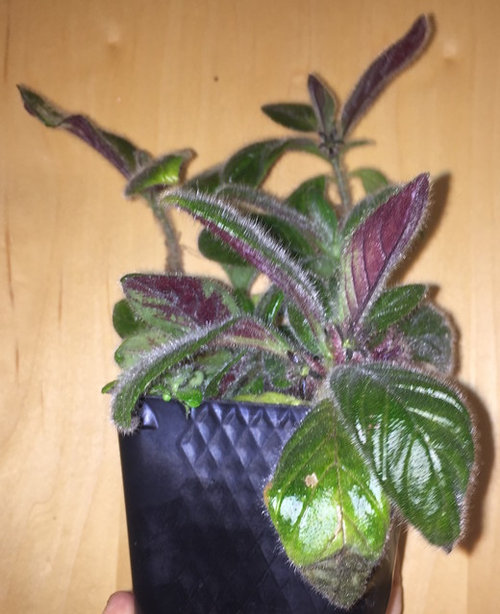
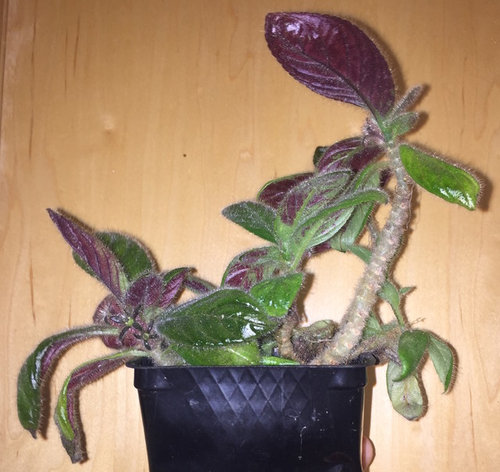
The shortest growth appears to have most obvious buds, and they sort of look like black stars.
There are at least 3 plants in that pot, and maybe some seedlings. Fruit doesn't form if I do nothing. Hand pollination of the different clones does give fruits. I'm not sure if it requires different clones, or whether it's the act of hand pollinating. Regardless, this is another one where I have tons of seedlings. And Possibly some seeds still.
I really pretty much neglect this plant. It lives in terrarium conditions (a propagator) and maybe it would like more light. However, it does bloom pretty faithfully, although it may be seasonal (?).
Propagation from seed is very easy. I assume stem cuttings as well. Leaves have always failed for me. I suppose I could try the paper towel/ziploc method, but I'm not sure I want to generate a lot more of these, since I already have so many.
The flowers really look a lot like Columnea purpureovittata, and I assume they are very closely related.
Comments (19)

mark4321_gw
Original Author8 years agoC. purpureovittata doesn't look as good for me. I got it a couple months ago from Chris Mende's Nursery (the Tiny Jungle) in Daly City, California and although it's growing right next to C. brenneri it shows no signs yet that it will bloom any time soon. I also have seedlings from the seed fund. I have yet to figure out exactly what makes the C. brenneri seedlings happy, but it they find the right spot they look good. If not, they seem to struggle.
Related Professionals
Pensacola Landscape Architects & Landscape Designers · Savannah Landscape Architects & Landscape Designers · San Antonio Landscape Architects & Landscape Designers · Los Angeles Landscape Architects & Landscape Designers · Grand Junction Landscape Architects & Landscape Designers · Bend Landscape Architects & Landscape Designers · Mason City Landscape Contractors · Augusta Landscape Contractors · Norfolk Landscape Contractors · Altoona Landscape Contractors · Eugene Landscape Contractors · Baltimore Architects & Building Designers · Brainerd Architects & Building Designers · Lebanon Architects & Building Designers · Mission Viejo Architects & Building Designers- 8 years ago
Generally high humidity, barely humid soil and cooler temperatures. So - SF area suits them perfectly. My C.purpureovitatta comes from a friend from Santa Rosa, CA. He grows his gessies either outside or in an unheated greenhouse.
mark4321_gw
Original Author8 years agoYeah, mine have been inside, but I've been tempted to try one outside. Actually I did once, but I put it in my afternoon sun area (not full sun, anywhere in my growing area, but a little bit--I likely tried to put it in a shaded spot, just to get it acclimated to outside) and it died. Bad choice. I should try again. I have plenty to try it with. Santa Rosa is both considerably warmer and colder than me. I'm warmer than SF, though.
mark4321_gw
Original Author8 years agoI think I'll reverse what I said before and post a photo of the plant in bloom from a previous year. The reason: I have seeds which have limited viability (I take no special steps to store them) and I should get more seeds when it blooms again. I really don't want any more seedlings myself: ~70 seedlings is more than enough. But I hate to waste seeds. So I'll send the seeds off, either for free (if sent with a 49 cent stamp) or postage (if in a bubble envelope--I'd probably have to add something else). Anyway, I had broken up the seeds into sets a while ago--each one does not have many. The May 22 ones actually look better, as they lighter in color. I'm a bit suspicious of the others, although for free they are probably worth it.
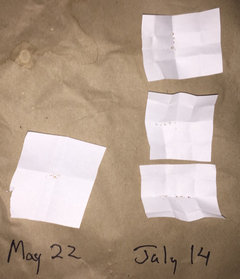
When fresh, I got close to 100% germination of the May 22 seeds. I don't think I ever planted the July 14 seeds myself.
Seedlings: I have some that look better than others. The ones pictured are kind of in the middle. I think I don't have the light level right, and I need to fertilize more (more than nothing...). I need to give the ones on the left individual pots--I think there are about 6 or 7 seedlings in there. Those in the 2 1/2 inch pots (except for the one in the upper right) are from last year, and again would probably benefit from fertilizer and higher light levels... Anyway, I would trade seedling(s) for the right plants. In general I'm pretty full, so my interests are pretty limited. I'm looking for more micro mini Sinningias, Petrocosmea begoniafolia (I lost mine), Pearcea hypocyrtifolia (I do have Pearce abunda for a possible trade), Kohleria warszewiczii and of course maybe I could be interested in other things. And I have many other things I could add to a trade: Gesneriads, Begonias, etc., but not limited to those. I have a ton of cold group (Sphaerocarpium) Brugmansia seeds from my crosses, for example.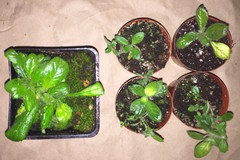
And as promised, here's a blooming plant of Columnea brenneri;
mark4321_gw
Original Author8 years agoI should get in the habit of keeping some seeds cold. To do that with all of them would be unmanageable, and I'm not that organized. Plus, I would rather have seeds that are a couple months old and stored at room temperature instead of seeds that are 3 years old and stored properly. That's just my bias, and most things I have either make seeds continuously, or yearly.
Around here we are pretty oblivious to winter. That's the time we get our rains, and the coldest time--highs in the mid to upper 50s--is usually restricted to December until mid January. I'm aware that there is some risk sending plants out of here in the winter. When they are here, they are basically fine, either coming or going. A few minutes for a box in the 40s is usually OK. I get packages delivered to our parking area, which I think is about 60-70 all year. I think in general USPS does a good job keeping packages from freezing. There are plenty of things that can freeze which are sent by mail. I suspect a bunch of frozen packages would lead to a ton of insurance claims, which USPS would like to avoid, of course. I think the greatest danger is upon arrival, if a box is left to sit outside when it's too cold. The best way to avoid that is to have the plant(s) sent to a workplace or a P. O. Box.
My personal experience: I've had a fair number of problems in summer due to the heat. Again, packages left in the sun are the big culprit. I am not aware of a single problem I've had with plants sent in the the winter. Here's an extreme example. A woman was looking for Begonia leaves in December. Everyone told her to wait until Spring. Since shipping would only be $4 for a first class package, we decided to go for it. I sent mostly leaves, a few stem cuttings. Everything made it, and if I remember correctly, all but one yielded plants. She was excited and got a huge jump on the season. She lived in rural Idaho, and high temperatures were about 20 F when I sent. i think it went to a P.O. box, but I'm not sure.
I don't do much mail order, but a couple things I received in the middle of winter were Petrocosmeas from the Violet Barn (received in December, I think), and tropical plants, including a Medinilla in bud (which bloomed and gave viable seeds) from Accents for Home and Garden, I believe in January.
Except for the rain, it's too nice here to shut down in winter, even if it's cold elsewhere. Yes, it's risky. So is heat. So is receiving poorly packed plants.
Of course, sending plants within California, or to the PNW if timed properly, is not terrible risky.
mark4321_gw
Original Author8 years agoBut back on the seeds. The May 22 seeds are really not that old. They are probably viable (they "look" good), and if they are not, it doesn't matter, they are free. And we could just try again when I get fresh seeds.
- 8 years ago
The most dangerous time - is when the parcels are loaded to the plane. It is about midnight. If it is done fast, fine. And if not - when it in 20s... you will get a gesneriad mash.
USPS is going to cover your losses only if the parcel is lost. Otherwise... too bad.
You can cut styrofoam panels for the insides of the box. But ... if it is above 95F and below freezing - it is not worth it. Violet Barn ships all winter - Priority Express, in styrofoam cooler - and at your own risk. So the shipping itself will be about $30.
Regarding the seeds. One shelf on the door of my fridge... is filled with bags with seeds. Better actually keep them in a freezer. 20 years life expectancy. The tip - get them out of the fridge, take your 10 seeds out - and immediately put back - they do not like to warm up. It breaks their dormancy.
Some seeds will last longer in room conditions, some - not. Probably depends on the natural habitat of the plants. The reason why AV seedpods take 9 months to mature - so they open at the beginning of the next wet season.
mark4321_gw
Original Author8 years agoOne point is that there are plenty of items besides plants that can freeze and be damaged when shipped by mail. Is no damage, ever, grounds for a claim, only loss? I would find that surprising. But regardless of whether the claims are credible, it's in USPS's best interest to not freeze and damage the contents of packages. Even frivolous claims would create a lot of headaches, and potentially damage their reputation compared to other carriers.
The bottom line is that if something ships to/from a mild winter climate like much of California, the danger of damage due to cold is roughly halved. That is significant. Again, the damage I've encountered (or been told of) has been due to heat, not cold. Of course, cold can kill plants pretty quickly, but I think a lot of people are more aware of that.
I wouldn't pay $30 to get plants shipped from the Violet Barn. I don't remember how it worked, but I got regular Priority Mail. OK, I just checked old emails. It says it was shipped 12/17/2014: "Your order was shipped via US Postal Service via Priority: your risk". I figured they knew what they were doing on their end, and any risk on mine is from things other than cold.
- 8 years ago
I've also ordered things during the winter, and received them safely. Usually the only danger of freezing was on the other end (NE US), and they shipped when above freezing weather windows were available as I recalled.
- 8 years ago
My worst experience was with heat packs. They either overheat the plants - or stop working at all.
- 8 years ago
I've never received anything with heat packs...which leads me to believe that the growers usually aren't too fond of them either.
mark4321_gw
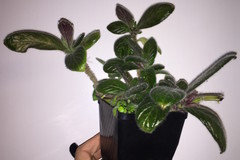
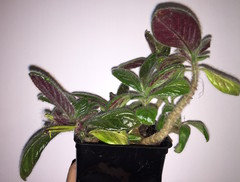
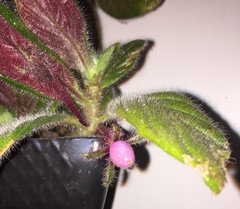
Original Author8 years agoThe flowers are starting to emerge on this guy. When two appear on different plants, I'll start pollinating. I suppose I should try regardless, just in case they are self fertile but not self pollinating.
mark4321_gw
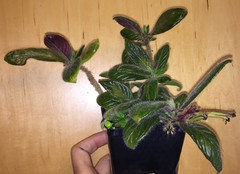
Original Author8 years agoStill just flowers on one plant are open, so no pollination yet.
- 8 years ago
Most of neotropical Gesneriaceae exibit protandry - pollen gets ripe first, stigma gets receptive later - a natural mechanism to prevent self pollination and promote cross pollination. I think with your attention to detail ... you can keep the records how old should be the flower to harvest anthers - and how old should be the flower when the stigma is ready and glistening. Every species has its own schedule.
mark4321_gw
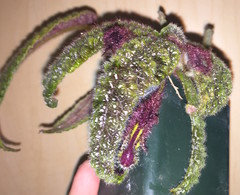
Original Author8 years agoBerries are forming, and there are plenty more buds. The story has gotten more interesting because my Columnea purpereovittata (a recent gift from Chris Mende/The Tiny Jungle) has at least 3 buds, so I'll have to chance to get seeds from that as well as try the hybrid. Columnea purpereovittata is closely related to Columnea brenneri. Patrick Worley says: "It should make a fertile cross" on a Facebook Gesneriad forum.
mark4321_gw
Original Author8 years agoThis plant continues to do well, and I counted 19 berries just now. They are still small and hard--hopefully they will swell soon, indicating the seeds are ripe. Still more buds as well.
mark4321_gw
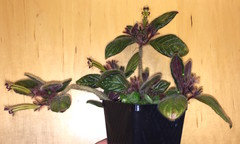
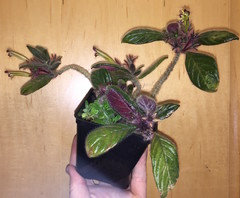
Original Author8 years agoThe first of the berries is ripening, and I count a total of 23 and 2 buds at this point. Unfortunately Columnea purpureovittata aborted its buds.

irina_co