

Misshapen Acer
I bought three young 18 inch high acers 2 years ago. Two showed slow growth but one shot up spindly growth in the centre to over 3 foot quite quickly. Within a couple of months this growth died. I cut back the dead wood to about 12 inches above the ground. Not long thereafter the tree threw out two long spindling branches, each about 2.5 foot long from a point about 8 inches above the ground. This year these have persisted and now have the most brilliant read leaves however the overall appearance lacks any shape.
My question is whether I can do anything with these branches to start again to achiever a better shape, either by grafting or pruning and trying to grow?
I can picture how beautiful the tree would be if it had any shape to it and would really like to try something. The other two bought at the same time have not had anything like the growth and do not have anything like the colour.
Any advice gratefully received
Comments (18)
 8 years ago
We really need to see what you see to provide any sort of meaningful advice. Can you post photos?
Related Professionals
New London Landscape Architects & Landscape Designers · Waterbury Landscape Architects & Landscape Designers · Elmira Landscape Architects & Landscape Designers · Florence Landscape Contractors · Beaumont Landscape Contractors · Enfield Landscape Contractors · Chicago Landscape Contractors · Mobile Architects & Building Designers · Fort Smith Architects & Building Designers · Georgetown Architects & Building Designers · Parkersburg Architects & Building Designers · Stamford Architects & Building Designers · Alexandria Architects & Building Designers · Glenwood Springs Architects & Building Designers · Leamington Architects & Building Designers 8 years agolast modified: 8 years ago
Also, what kind of Acer and where are you?
Bonsai practitioners frequently do what is called a "trunk chop", which is basically cutting ALL the branches off, which will make the tree produce leaves/branches from dormant adventitious buds along the trunk. I'm not saying you should do this, just pointing out what can be done...But yes, you can definitely prune it for a better shape.
You have till it comes out of dormancy in spring to figure out how to proceed.
I suggest you do some reading on Bonsai pruning to learn how to manipulate branches to grow where and how you want them to grow.

rogergoldie
Original Author8 years ago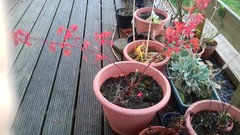
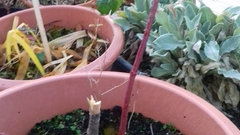
Please see pics attached. I do not know what type of Acer however it is not a bonsai - am I in the wrong forum.
In Scotland heading into winter at the moment.
Many thanks for your interest.
Roger
- 8 years agolast modified: 8 years ago
Potting medium looks old and decomposed, I would replace that also. If dying back occurred in autumn then that may have been caused by bacterial blight.
- 8 years ago
Judging by the looks of your other containers, it looks like you may be using dirt from your garden?
 8 years ago
Which was your first cut? Was it the larger splintered trunk behind or the middle of your two shooting branches? If it was a grafted, named tree, it appears that is gone as the new growth originates just about at the root flare.
tj
rogergoldie
Original Author8 years agowith apologies I was offline over the weekend.
gardengal, many thanks. It is not a grafted plant, but I do like the idea of staking one to encourage it upwardsmblan13 I used a mix of planting mixture and soil (dirt) - mostly as I had both rather than any particualr scientific reason.
tsugajunkie - good point - it shot up in the middle - very tall and willowy much like the current growth but vertical, then died. It also had thrown out a side shoot (which I think people are thinking looks like a scion but actually isn't). This side shoot flourished and then died but two side shoots had spurred of that which is what i am left with. Feels a bit like there is a root there that wants something to grow but I am perhaps getting it wrong above ground.
Apologies again for the delay in responding and very many thanks for your comments.
- 8 years ago
If you used garden soil, it probably has root rot and anything you do will be useless until you get it out of the garden soil and into a propper potting mix.
A pot is not like the ground and garden soil will retain too much moisture. Repot in a free draining mix like 5-1-1 or gritty mix. Good article copied and pasted below and a link CONTAINER SOILS - WATER MOVEMENT and RETENTION XXII
Why the Earth Is Not Like a Pot
by Brent Walston
Introduction
In bonsai we work very hard to create and maintain highly aerated soils, yet when we plant in the earth, the soil is incredibly dense. How can this be? The answer to this and other soil mysteries are below.
A Pot Isn't Like the EarthThe major difference between a pot and the earth is that a pot has impermeable sides and bottom. This reduces air exchange in two ways. First is the obvious, air cannot pass through the plastic, thus we have a contained volume of soil encased 75% with air tight plastic or high fired ceramic (low fire ceramic will breathe). This is why I design my soil mixes and other environmental factors to 'dry out' the pot once a day during the growing season. Each time the plant is thoroughly watered, it pulls a new charge of air in behind it as the water drains.
Secondly, we have to visit our old pot size argument again. When a downward moving table of water reaches an impermeable layer (in this case the plastic pot bottom) it will not drain until the layer just above the impermeable layer (pot bottom) is saturated. Once this lower layer of soil is saturated, excess water will drain out, but a column of saturated soil will remain since the moving table of water has stopped at the impermeable layer. This means that the soil in the bottom of the pot remains saturated at this lowest level after watering, and stays saturated until something happens to change that condition. That 'something' is primarily absorption from the roots in the bottom of the pot, the secondary factor is (or should be) evaporation. You will probably want to read this paragraph again, and perhaps a third time, it is not obvious.
Over PottingMost of the water in the pot is removed from the pot by absorption by the roots and not by evaporation. If you overpot, it will take a long time for roots to colonize the bottom of the container and consequently it will take much longer for the saturated layer to become fully aerated (the only factor at work is evaporation). Overpotting will generally lead to too wet conditions and eventually root rot.
This phenomenon is also true of planting in the earth, but only when stratification of the soil is present to cause an impermeable layer, such as when you are planting on a layer of clay or hardpan, or you create a boundary between two dissimilar soil types. Otherwise, there is no impermeable layer and the water continues its downward movement into the earth, creating no saturated layers. This is why (along with the absence of impermeable walls) that we can, and do use denser soils when planting in the earth: no saturated layers are formed (until the water table is reached).
Creating Aerated Earth SoilsI have seen saturated layers created in the earth kill plants just as heavy soils in pots do. I was once asked to examine a dying Rhododendron which was planted in a straight fir bark bed. I knew that the area had heavy clay native soils. I dug up the Rhododendron, and sure enough, about a foot down was a layer of solid clay and the fir bark layer just above it was saturated with water.
Other loose experiments I have been conducting involve using highly aerated soils in growing beds. From the above argument you can see that we can use heavier soils in beds, but will using the same highly aerated potting soils that we use for containers improve growth rates? I think the answer is yes, I have had Chinese elms grow about twice as fast in a highly aerated bed than in a creek side silt bed loaded with natural nutrients from yearly flooding, but comprised of mostly fine silt.
The problem with the highly aerated beds is that they will require a lot more water and nutrients than a good garden soil, for example. And again, you must be careful not to create a boundary between a dense soil and the amendments at the bottom of the bed or you will create a saturated layer at the bottom. You can usually avoid boundaries by loosening the native soil at the bottom of the bed and mixing a smaller percentage of the amendment in with the native soil. This will give you a transition zone rather than a sharp boundary.
What About that Saturated Column Thing?Ok, just how high a column of saturated soil do you get in a container? The height of the column of water retained in the soil by an impermeable layer is related to size of the particles. Sound familiar? The denser the soil, the higher the column will be and the more water will be retained. Large particle, highly aerated soils will not support a large saturated volume. This is what we mean by 'well drained'. You can test this for yourself. Take a regular sponge, soak it with water. Rest it in your hand horizontally until the water stops running out. Then tilt the spronge upright. You are now increasing the saturated column. The sponge density won't support a column that high and water will drain out.
This experiment also shows that pot shape is related to water retention. A broad shallow pot will retain more water than a tall narrow pot of equal volume. Although it is counterintuitive, a shallow pot will retain more water and 'dry out' more slowly than a tall narrow one (of equal volume). Another reason we use such coarse soils for bonsai, and also why bonsai can survive in such tiny containers on very hot days.
- 8 years ago
Not necessarily. Many plastic pots have a recessed drainage hole that is about 3/8 to 1/2 inch higher than where the pot touches the ground, creating a void. If a screen or rock drainage layer, or even grass will create a disconnedt and not allow propper drainage.
Regardless of the location of the pot, it is a bad idea to use garden soil in a pot.
- 8 years agolast modified: 8 years ago
I mix sandy pond muck with a lot of wood chips and no fertilizer. Works for me. I grow a lot of maples in pots and have for a long time. Straight garden soil is a no no. It's too dense for good root development.
If you don't have wicking going on or you break the wick, of course it won't work.
- 8 years ago
I use Bonsai mix (aka Al's Gritty mix and variants) that consist of 32% pine bark, 32% grit (granite or haydite), 32% diatomaceous earth and 3% horticultural charcoal for my JMs, and I repot every 3 years.
I figure if the Japanese and Chinese bonsai practitioners have trees not only living, but flourishing in pots for 400-500 years or more, they must have figured something out, and that's proof enough for me.
Granted there is more work in using bonsai mixes. Repotting, branch pruning, root pruning, increased watering and fertilization, but it's not a chore, it's a hobby. I enjoy doing it.
rogergoldie
Original Author8 years agoWell every day is a school day as they say. I have learned a huge amount from your feedback here, so am very grateful that you have taken the time.
mblan13, as I am sure you realised I was unaware of the potential impact of using a soil mix. Many thanks for taking the time to outline the importance - I shan't forget in a hurry! Mike also appreciate your comments re potting materials, interesting to hear of other things that work.
The plant stands a considerably better chance thanks to everyone's contributions.
Very grateful
- 8 years agolast modified: 8 years ago
Perched water table in bottom half of container always occurs because water doesn't pass through drainage holes until enough water backs up behind the holes for the water to then flood out, due to "field capacity" having been reached. And has nothing to do with how big the contained soil volume is relative to the size of the plant - millions of plants have been produced by commercial operations plantings small starts in large pots. Instead of wasting money frequently moving potted crops up through close increments in container sizes.
This is why when particularly aeration sensitive - yet frequently watered - items like rhododendrons and azaleas are purchased and planted by the final consumer it may often be found that the bottom half of the container is unoccupied, with loose potting medium plopping out of this zone when the specimens are tipped out of the pots. Because that perched water table is always there, to some degree - with any subjects that are kept moist at all times.
- 8 years agolast modified: 8 years ago
Glad to be of help, RogerGoldie.
Good point Embothrium, Also, Potting mix is generally made to be a little on the water retentive side so the nurseries don't have to spend the time and money watering them frequently, with minimal loss. Most plants will live longer in soil that is too moist than too dry. Pots are meant to be purchased and planted in the ground by the consumer or landscaper within a short time.
If one intends to keep the plant containerized long term, IMHO the nursery soil it came in is just as unsuitable, and sadly, most commercially produced potting mix is just as unsuitable as well!
- 8 years agolast modified: 8 years ago
It also depends what you're growing in the pot. Rhododendrons don't like perched soil, Thuja tolerate it rather well. Salix roots thrive in it.

gardengal48 (PNW Z8/9)