Software
Houzz Logo Print
jwpjr

Composting in Winter - Nitrogen sources

8 years ago

Hello,

I built a compost tumbler a few years ago, and have been making great compost with leaves, grass clippings, and food waste (and also some shredded junk mail).


this year, I didn’t make much compost, so I filled the bin up this weekend with leaves that I had raked up. Didn’t really think much about the lack of Nitrogen, but now I realize I’m going to need to add some.

We don’t produce a ton of food waste and here in Michigan, grass clippings won’t be an option (it’s getting very cold very quickly) so i would like to put some Nitrogen rich fertilizer in the tumbler.


im looking at this Urea Nitrogen fertilizer on Amazon, and it seems safe, but how much should I add? I really don’t want too much Nitrogen and end up with a slimy mess.

the Urea is 46-0-0.

thanks in advance for any advice

Comments (120)

  • 8 years ago

    Yeah, mine usually is not even warm, mainly because of volume.
    I just wanted to gain more understading.

    If one were to frequently "feed" a collection of garden-ready mature
    by means of mixing in a little moisture and bioavailable N,
    would decomposition continue to the point of reducing all to dust?

  • 8 years ago

    "Can you get a hot pile going with only shredded leaves and ucg?"

    I have had a hot compost pile that was composed of only shredded leaves, C:N ratio of about 40:1 even though the Nitrogen level is less than 1 percent. Used coffee grounds test out at pH of 6.2, N at 2.28, P at 0.06, and K at 0.6, but whether they will be a major food source for the bacteria depends on the volume in the pile.

    But, yes you can get a hot pile going with only shredded leaves and used coffee grounds.

  • 8 years ago

    Update : More voluminous; plus much coffee.
    I made a small corral, emptied the containers into it,
    mixing in UCG as I went.

    Now it is what I would call hot. Will get a thermometer.
    Give some opinions -- Hot (above quite warm) would start at what temp?

  • 8 years ago

    According to this glossary of composting terms from Cornell University:

    MATURE COMPOST - the stabilized and sanitized product of composting;it has undergone decomposition and is in the process of stabilization. it is characterized as containing readily available forms of plant nutrients; it is low in phytotoxic acids.


    STABILITY - the degree to which the composted material can be stored or used without giving rise to nuisances, or can be applied to the soil without causing problems due to incomplete degradation of readily biodegradable materials.

    http://compost.css.cornell.edu/glossary.html

  • 8 years ago

    I suddenly had a vision of this thread as Compost TV and you all as the roundtable commentators. I cannot wait for spring!

  • 8 years ago

    Hot compost = 130-140F for at least a week. Even better if you can get it up to 160F for a day or two - that would guarantee all weed seeds and pathogens are extinguished.

  • 8 years ago

    A thought : I imagine that worms do not like even 130.

  • 8 years ago

    Yes, compost worms do not like it that hot. But unless you're getting it that hot in a worm bin, don't worry about it. Worms will move pretty fast out of hot areas to cooler areas - and there are always cool areas in a larger pile, especially one that has access to the ground. Then they move back in after it's cooled down. The heat can be an advantage in colder climates, as they'll head for the "just right" zones - invertebrate Goldilocks (just like all the other compost fauna, really). Worms also tend to like it wetter than a hot composting pile.

    Keep in mind, though, vermicomposting is more of a cold-compost process - the worms will not be as central to the action in a hot composting process as in straight vermicomposting. So basically: don't worry about the worms, they'll figure out for themselves what works for them. You figure out what works for you, and let the worms join in when they want.

    That said, nothing wrong with adding a handful or two of worms to a pile if you have them - they won't hurt anything, and will probably go furth and multiply, if they're given a bit of privacy.

  • 8 years ago
    last modified: 8 years ago

    Commercial vermicomposting operations often use a two-step process of hot composting the feed stocks first for a few days, and then using the cooled pre-composted materials to feed the worms. Of course such a short period of pre-composting does not produce "finished" compost but it does speed up the breakdown of materials to the point where the worms can easily eat them, and has other benefits like killing unwanted seeds and many pathogens.

  • 8 years ago

    @theparsley, that's a good point. What I meant was that the 'worms' part of vermicomposting typically takes place at cooler temperatures - nothing wrong with combining the two (quite effective actually), whether at home (by worms finding their own way) or commercially (by physically separating the hot and cold parts of the process).

  • 8 years ago
    last modified: 8 years ago

    I am going to follow up on your idea of adding some worms.
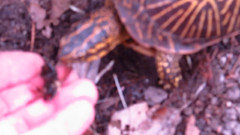
    I keep some handy for the turtle that visits the yard on occasion.
    When it sees me from a distance, it comes right up and begs.
    I give it a worm or two, and it follows me around for more.

  • 8 years ago

    four... i need a video of a visit.... that's awesome.

  • 8 years ago

    Worms are only one 'degrader' in a compost pile. There are all kinds of insects as well as a host of microbes that can do the job. Nothing wrong with putting worms in of course, but they're not essential to composting.

  • 8 years ago

    I agree overall, worms aren't essential. They may, however, speed things up in certain circumstances by physically breaking stuff down, moving air around, and by spreading microbes/bacteria/fungi. Plus they're cool.

    That said, sometimes it seems there's magical thinking about what worms can do. They're pretty good composters but compost happens regardless, and while their castings have excellent properties for soil, they won't magically transform the Sinai desert into a land of milk and honey or create peace in the mideast.

    My approach is still the same: want to add worms to your compost? It certainly won't hurt, but don't spend money on it or rely on them to transform your compost into gold thread. (And it seems everyone who has seen compost worms in actions thinks it'd make a great business - so no, you're not the first to have that thought, and it doesn't look like it's an easy business)

  • 8 years ago
    last modified: 8 years ago

    I always try to compost in the chicken house in the winter, but this year I tried harder. I expect heat in January. There was a red worm on the threshold one day, and I tossed her in the house. I I think it will just turn into a ruthless massacre, but I'm going to add a ton of them next fall under their deep litter, I think, and give the chickens something to do for their winter blues.

  • 8 years ago
    last modified: 8 years ago

    In the past and still to some extent today, there have been some notorious pyramid schemes involving worm farming. So it's good to be aware of extreme claims regarding the magic worms can do. They do work relatively slowly and with a small output (that is, in any reasonable home setup rather than the commercial large-scale operations I described above).

    I am a big fan of my personal worm bin denizens, but I don't have a worm bin primarily because it produces lots of compost or because it magically builds soil. It produces a relatively small volume of vermicompost, small enough that my postage-stamp patio garden and some sharing with family and neighbors takes care of all my output. My *primary* reason for having a worm bin is so that I can dispose of my food waste in my own basement year-round with a very minor amount of expense and effort, rather than consigning it to the landfill. And because it's geeky fun.

    A worm bin is a specialized and controlled environment and you do need a particular kind of worm to function well there (that you may or may not be able to identify and gather outdoors for free), but a compost pile outdoors just naturally attracts suitable local worm helpers all on its own whenever it's not "hot", no "starter" worms required.

  • 8 years ago

    "And because it's geeky fun."


    BINGO!

  • 8 years ago

    Not that there's anything wrong with geeky fun...

  • 8 years ago

    Plus, worms really like ground up leaves and will work them if they are damp. Leaf mold is better than compost in my opinion.


  • 8 years ago


    Fungal flowers this morning; mushrooms with petals:

    (Just because it looks cool.)

    Maybe in appreciation for the coffee.

  • 8 years ago

    Re Kimmq's comment Dec 16........

    I got about 15 gal of UCG from Starbucks last year and dumped them all in a plastic tote until I was ready to use them for a hot compost pile. They sat in there for a few weeks. It was early fall so outside temps were still pretty mild. To my surprise, when I went to use them and removed the lid they had grown a bit of mole on the surface but we're actually quite hot in the middle of the pile. Nothing else mixed in. Had only sifted them through 1/4x1/4 hardware cloth to break up all the espresso pucks. No doubt the sifting added a lot of air too the grounds.

    Harry

  • 8 years ago

    Maple seeds:
    I take pains to exclude other seeds.
    Abundant new maple seeds are on the ground, I am thinking of adding them.
    Should be good source material, both those that decompose soon, and
    those that sprout in the heap.
    Agree? Disagree?

  • 8 years ago

    Yep, maple seeds should be just fine. I don't worry about any seeds in my compost piles. There are a lot of hackberries around the house, and both... through simply falling off the trees, and birds, the seeds constantly land in the piles. Keep in mind that there's always the chance that seeds will make it through the composting process as viable, but such tree seeds bring a lot of potential to the party.

  • 8 years ago

    I end up with quite a few hickory shells in my compost piles every year and some hickory nut meat as well. It will be decades before the shells decompose but usually the nuts are just hollow husks by the time I use the compost the next season. I doubt the nuts add much to the pile but I have transplanted a few hickory seedlings from the piles to areas along the creek bank where I want to establish a new stand.

  • 8 years ago

    You can throw the hard stuff into a bucket or barrel of water. Add weeds etc. Stir occasionally across the warmth of summer. It will get eaten up pretty quick.

  • 8 years ago

    I sifted out very many gallons of fluffy compost from the pile,
    intending to lay it around plants whose purpose is the flowers.

    Yesterday I read an article by an experienced gardener who stops
    fertilizing food plants with compost tea when fruit development will
    begin, because compost emphasizes growth of roots, stems, leaves.

    I would not want to skew my plants away from flower growth
    (which occurs at all times either sporadically or continuously).

    To all readers, what have been your experiences with
    flower plants + compost?

  • 8 years ago
    last modified: 8 years ago

    I wouldn't worry about adding compost to your beds as mulch. The nutrient that can interfere with flowers and fruit development is nitrogen. Compost itself is much less concentrated than 'teas', and in most cases, compost doesn't have super-high levels of N. Compost is usually very balanced, and it's primary benefit is in organic matter. It has a very good spectrum of nutrients and minerals, but unless it's supplemented with high N additives, those nutrients are delivered to the surrounding soil gradually.

  • 8 years ago

    I always mulch with compost......all parts of my garden!! I dislike the look and texture of bark mulch or wood chips, especially with perennials or annuals (OK in a mixed shrub border but still not my fave).

    As mentioned above, compost is really not a fertilizer but a soil amendment. It does contain plant nutrients but in very low concentrations so will not over stimulate plant growth or deter from flowering or fruit/seed set. Even compost tea is not overly nutrient rich.

    Compost teas are just too much trouble for any perceived benefit, IMO. And since I need to mulch anyway, I just use compost for that purpose

  • 8 years ago
    last modified: 8 years ago

    Thanks to both. The information helps, and I am going with it.
    (You probably know that It is the polar opposite of
    information put forth elsewhere.)

    __________________
    A question that I have harbored for a while :
    The hot, dry, light gray smoldering patches that
    look like ashes --- is it ash?

  • 8 years ago

    It's probably actinomycetes, sometimes called fire fungus. It's really a filomentus bacteria. It's associated with high composting temperatures. It tends to contribute a woodsy smell to the pile. It helps with the breakdown as much as any other thing.

    Unlikely that a backyard-sized pile would spontaneously combust.

  • 8 years ago

    Excellent.

    Quite the fitting common name.
    Every time that I uncover patches, the cranial voice says
    "Ashes? Fungus? Fungus? Ashes?".
    When fungus is the transient thought, I figure that the
    localized smoke is spores carried by the rising air.

    _______________
    With regard to combustion :
    In another GW forum, a former fireman maintains that
    many times he experienced residential fires caused by
    compost piles that were not externally ignited.


  • 8 years ago
    last modified: 8 years ago

    I've seen round bales of hay - rolled before it was sufficiently dried out - catch fire, but I haven't seen it happen to compost piles. I'm not a fireman, nor am I saying that it couldn't, just that I haven't yet seen it happen.

  • 8 years ago

    In all the years paying attention to compost piles and compost fires, I have seen many stories of large industrial compost or mulch pile fires but little to none with regard to household composting. I think ONE that I can recall. So it is exceedingly rare. But a good reason not to put your compost right next to a building.

    Spontaneous combustion can happen with the darndest things, like a rag with mineral spirits on it wadded up in a trash can. If that can happen at room temperature, it can't be impossible for it to happen in a compost pile. It's not something we composters worry about much.

    The gray stuff in your compost indicates a fairly high temperature and the 'smoke' you see when you dig into it is either steam or dust/spores of the actinomycetes. I've seen this in very hot piles that I made with a lot of fresh grass clippings. A very hot pile can 1) lose nitrogen as gases and 2) kill off some of the beneficial microbes that prefer a lower temp. I try not to run piles that hot in order to get a better result. Just my two cents.

  • 8 years ago

    I would consider the "smoke"more likely to be steam :-) It is very common to see steam rising from compost piles at all the bulk composting operations around here.

    I would agree that spontaneous combustion of a home compost pile is highly unlikely.......most home composters just can't achieve the temps or conditions that would promote that.

    OTOH, spontaneous combustion of other gardening materials may be somewhat more common. I did some work for clients whose house actually burnt down due to the combustion of a bag of alfalfa meal. It was partially used and the bag was left opened on a covered porch. A combination of moisture, lack of oxygen and the beginnings of decomposition provided the right conditions for combustion.

  • 8 years ago
    last modified: 8 years ago

    My fingers still tingle from having burnt them four minutes ago
    when I momentarily touched the materials where I lifted open the pile
    with a shovel to nest the just-arrived thermometer.
    Like touching a pan on the stove.

    That second placement is necessary because the first one,
    half an hour ago, yielded unacceptable results.
    I thought that 15 minutes in the pile would be sufficient.
    Obviously not, because indicated temp
    1) was far too low to be believed
    2) continued to rise a bit after removal, held, resided very slowly.
    (This digital thermometer has no probe, rather has some internal
    ambient heat sensing component, which the slow response
    gives me to think is a metal piece, not a thermistor.)

    My reason for thinking that the smoke is spores
    is that it is localized to the patches.
    The steam that I saw a number of times a month ago in cold weather,
    and have not seen in recent warm weather,
    was broader.

    I am not focussed on combustion yes or no;
    it was kokopellifevea who got us into that. :>)

    Toxcrusadr, good point about the different temp microbes.
    I figure that both will be at work, the low guys in the outer parts.
    And both, alternately, will gnaw on the same materials, because
    I shift the materials around often.
    Good point also about nitrogen loss. I replenish often,
    by means of UCG.

  • 8 years ago

    I see 'smoke' that is spores more often than outright steam; I find them relatively easy to distinguish as the steam keeps rising/dissipates quickly while the spores sort of settle/float down.

  • 8 years ago

    Today I pruned an oak.
    Add these leaves, or not?

  • 8 years ago

    Off course add them. Anything which ever lived can go in a compost heap.

  • 8 years ago

    Yep, add 'em. If you can run over them with a lawnmower or otherwise chop, they'll break down more quickly - but they'll compost fine in time whatever you do.

  • 8 years ago

    My explanation of my observations in use of UCG :

    Our ingredients both are sources of the nitrogen and carbon,
    and become the mass which is the finished compost.
    When the leaves, stems, sawdust, rinds, coffe, grass
    have become granules of finished compost,
    all granules are practically of same size, which is
    the size of fine UCG (beginning and ending).

    Large amount of UCG heats the pile fast and high. Initially.
    I think that, after they have given out their nitrogen,
    which seems to be relatively soon,
    the large amount of small non-contributing particles
    both turns the pile's N/C ratio on its head, and
    suffocates the process by impeding air flow.

  • 8 years ago

    Isn’t that true of all nitrogen sources?


  • 8 years ago

    No. Other plant sources are not this small /dense, neither at beginning
    nor at point that their nitrogen is gone.

  • 8 years ago

    Maybe it’s just a matter of the amount of ucg you are adding to you carbon base. I could see by adding to much you might choke out the air of your carbon base... but I would think you could do the same if you scored a couople if pallets of rotten spiniach (that would stink) and tossed them all in too.

    ive added numerous bags of grounds to a pile of year old very finely chopped leaves ( yes I was bored that day and had too many ucg trash bags collected from Starbucks). The pile was from the bottom of my leaf bin and it cooked down perfectly into a nice crumbly black media.

  • 8 years ago

    Yeah, old leaves crumble and decompose readily alright.
    In contrast, my carbon materials mainly are woody stems.

    In your case faster, in mine slower, a very large percentage of the bulk
    of the end media is the grounds themselves.

  • 8 years ago

    > Posted by Nevermore
    > four... i need a video of a visit.... that's awesome.

    Turtle was away for a few months.
    Today when it saw me, I hoped that it not come to me because no worms.
    It did. I thought to find alternative. And I remembered the request for video.

    Carpenter bee.

    Shots are frames from video. Video itself does not show much more.
    Some day when I have worms, maybe I could take video that includes
    turtle's approach.

  • 7 years ago

    Leaves, heat, moisture : Our objective is finished compost, and we do things to optimize the process. Heat is one of our main indicators of decomposition. We are told that dryness is a sub-optimal condition. However, pockets or thick layers of bone-dry maple leaves consistently are the hottest places in piles, and they never regenerate as much heat after moderate irrigation.

    Insights? Information?


  • 7 years ago

    The obvious answer is that 'enough' water is a relative concept - use whatever works. If you want a slightly more serious guess: I suspect the key difference here is the amount of air that's needed/used in a hotter composting process, and the tendency for 'extra' water to cut off air flow and contribute to matting. I have maples and notice that their leaves are amongst the worst for tendency to stick together in thick mats (that can be very slow to break down). There are surely other factors, like it may be that the fungi/bacteria that are working in your dry maple pockets just use/prefer a lot less water. Also worth keeping in mind that sugars/carbohydrates in plants produce water when broken down - granted in small amounts, but it still may be significant for those microbes (and also depending how much water in form of steam dissipates from the pile).

    Still, 'enough' and 'whatever works for you' are the key operative concepts. Personally, I've rarely had to add water to compost piles, and far more frequently come across 'too wet' conditions (a lot of my compost contributions have a lot of water in them, none of my piles are entirely out of exposure to rain/snow, and climate not the driest) - so I almost never 'water' my piles.

  • 7 years ago

    Good stuff in that insightful and informative reply, which fully satisfies the inquiry.

  • 7 years ago

    Something related to this thread's title, nitrogen sources, is a source of confusion to me. It is a case of absence of any "nitrogen" material, i.e. the only nitrogen is in the high carbon material : piles of wood chips. They are known to heat up, even though the C:N ratio is in the hundreds. Is it simply that dry wood presents an exception to the norm, the exception being certain organisms that need abnormally little N?

  • 7 years ago

    Depends on the wood chips and where they're from (and other factors). Chips from live branches and skin of the tree and whatnot will have more green material, sap likely has nitrogren, whereas stuff from the centre of a trunk - dry, hard - will have less. The 'greener' wood chips are, more likely they'll heat up. Chips from (for example) trimmings by electrical crews - who are removing live wood and branches - clearly have more greens (I think this is called ramial).

    Other factors: air, more surface for microbes to get to/consume the wood, ability for bacteria/microbes to physically move in (bringing their own nitrogen with them, possibly some nitrogen-fixing fungi or bacteria are present, etc. Once there is 'enough' nitrogen, it gets recycled in the pile (less any losses to the air); so the way I think about it is that adding nitrogen (like urea) to a wood pile just kick-starts the process a bit early.

    Another key point: a big enough pile will simply physically retain more heat (the chips themselves act as insulation) and allow it to build up, which creates good conditions for heat-loving microbes, who add more heat, etc.