Software
Houzz Logo Print
webuser_9296072

What was this kettle used for?

8 years ago
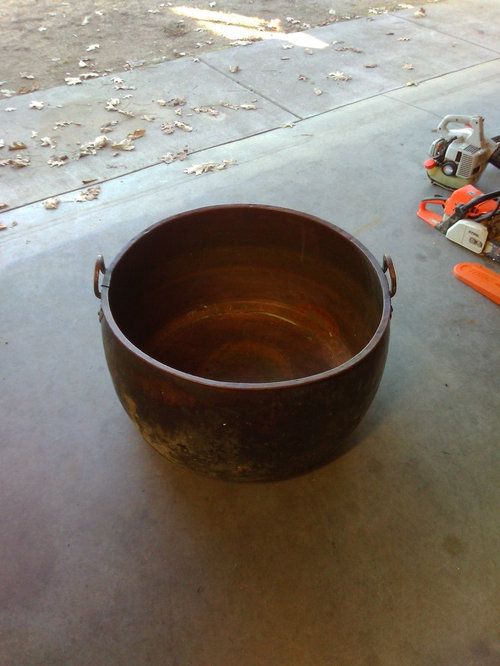


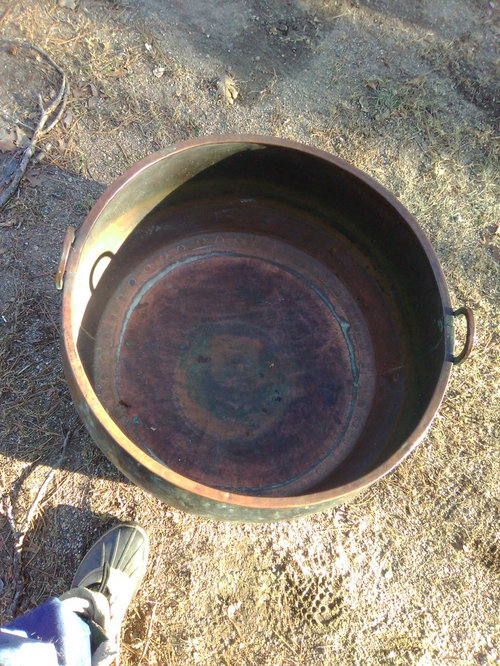
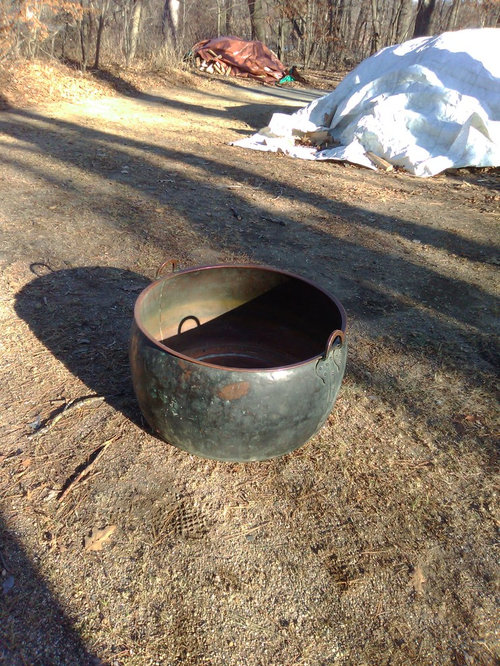
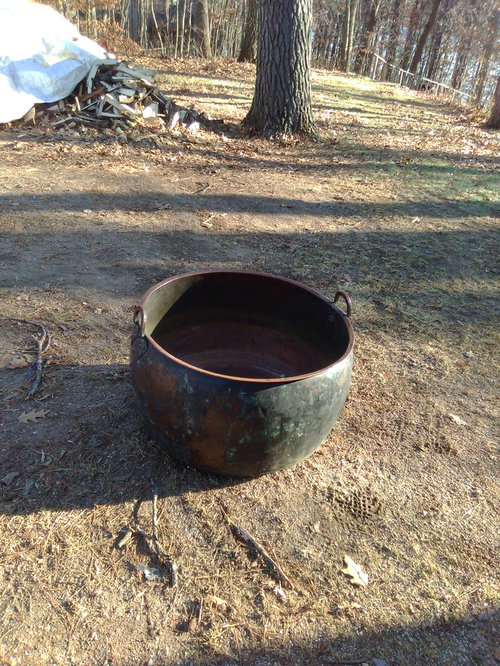
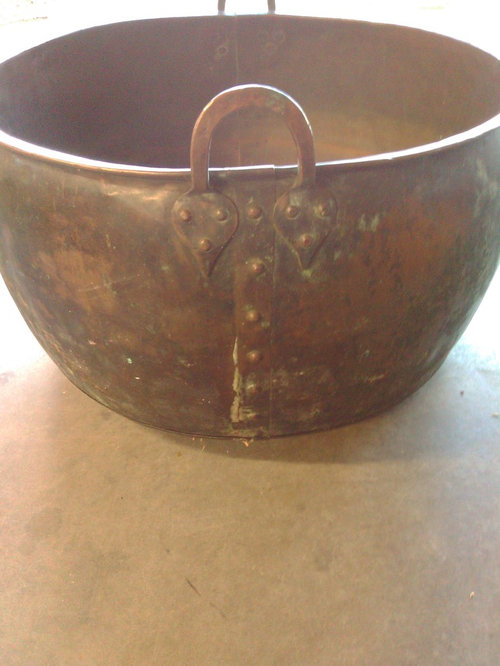
I have a large copper kettle. I have no idea how old it is, but my parents had it when I was a baby. So, It is a least 65 years old. It is heavy copper, 29 1/2 inches in diameter and 18 inches tall. Heavy riveted and soldered construction.

Comments (23)

  • 8 years ago

    Perhaps candy making? Any evidence it's been used to cook? Fire marks on the bottom?

  • 8 years ago

    No evidence of fire marks. However cannot tell for sure due to heavy copper oxidation. I would think that heating the pot would melt the solder. Also lead poisoning due to the solder. (If course, I realize they didn't always consider that in those days!)

  • 8 years ago

    Bathing ?

  • 8 years ago

    Are you sure it's soldered? ...If it is really soldered, that would indicate it was meant to hold liquid, but not be heated.
    Perhaps it was always purely decorative.

  • 8 years ago

    Bathing might have been the use. It is definitely soldered which would make it water tight. I know it is water tight, no leaks.Take a look at the second picture, you can see the soldered seam. Light Tray color, color of Tim/lead alloy, no corrosion.

  • 8 years ago

    Wondering if that light gray seam might be old copper polish....try scratching on it with your fingernail.
    It's the wrong shape for bathing... The handles mean to me it was meant to be lifted....but it could be simply decorative.
    At least 65 years old, that would put it in the 1950 and before time. Might have been for kindling ( but why solder the seams?)....or even washing....but I have never seen that shape wash tub.
    I know in parts of Europe, easily in the1 950's they used a container to catch rain water and then a sort of dipper to pick up some of the water and throw it on the outside of the windows to wash them....or it could be used to hold coal for a small coal burning fireplace grate.


    HU-9296072 thanked lindac92
  • 8 years ago

    It is definitely metal, it does not scratch away like old copper polish would. When I scratch it, it turns shinier. Also, due to the seams of which there are many, it would leak if it wan't soldered.


  • 8 years ago

    Bathing babies. :-)

  • PRO
    8 years ago

    Maple syrup?

  • 8 years ago

    Pretty unlikely...not traditional bucket that attaches to a spile....or a flat boiling pan....but who knows anything is possible.


  • 8 years ago
    last modified: 8 years ago

    I think this probably is a water-heating cauldron, and I would guess it to be of Near Eastern origin, Turkey, Syria, etc.

    Had it been used for cooking food I'd have expected it to have been tinned inside, especially if lead solder was used in construction. For heating water (or any non-acidic food for that matter) the threat of poisoning from either the copper or the lead is really quite small.

    The issue of melting the solder is relatively easily put aside. The melting point of solder is somewhat over 350° F; water boils at 212° F. If the fire is a good hot one and you let the water boil away, you're going to have a problem, but especially if all you're doing is heating the water, and the cauldron is kept fairly full, there will be no problem.

    If it is Near Eastern it's fair to wonder if it was actually made to be used or if instead it's a tourist-trade piece. Tourism in Asia Minor, however, was well-established by the mid-19th century, so even if it was "made for the tourist trade" it could easily be a legitimate antique.

    And regardless of its age and intended use, it's now, given its size and patina, a very desirable object.

    HU-9296072 thanked cgard2
  • 8 years ago

    A pot of that size could have been used during hog butchering to render fatty pieces and produce 'cracklings', however, those kettles were traditionally made of cast iron with a bail instead of handles.

    Because it is thick copper with soldered seams, it may have been used for unheated food processing such as a catch vessel for holding the squeezings from a fruit press. It could have been a water vessel in a kitchen for drinking and cooking water and general use.

    HU-9296072 thanked jemdandy
  • 8 years ago

    I have seen similar, but smaller kettles, described as "Apple Butter Kettles".

    Maybe yours was part of Moon Shine equipment.

    HU-9296072 thanked jemdandy
  • 8 years ago

    Thanks to all for your input! Additional bits of trivia. I dredged something up out of my infantile memory and that is parents used to refer to it as a kettle that was used to make cheese. I don't exactly know why.

    I actually have very bad memories about this kettle! My mother had a suds saver washing machine. (Remember those?) Our basement did not have a wash tub sink, just an old kitchen sink propped up on concrete blocks, so they used this kettle to save the suds. The tub was kept underneath the basement steps. (This was an old house with a coal furnace (Covered in white asbestos! When you banged against it or the ducts, white dust would shower down! But, I do not yet have cancer!) that had been converted to gas.) After many loads of Laundry, when I got home from school, it was my job to use a bucket to empty the cold, slimy, dirty water into the makeshift sink. (At least they had it up off the floor on a sort of stand!) I did this throughout grade school, Junior high and High School! Not my favorite task! At any rate, I survived it. My parents never threw anything away in their life, that is why when My Dad passed away and my mom went into memory care, I got the kettle back. They moved it through 4 houses. My dad always thought it was worth a lot of money, both for copper value and antique value. What do you think it might be worth? Again, I do not know how old it is.

    On another note, I was thinking of polishing it up, but Cgard2 seemed to indicate that the patina/oxidation was desirable. What do all the rest of you think?

    If I was interested in selling it, where should I go to do so? How much should I ask?


  • 8 years ago
    last modified: 8 years ago

    It's folly to try to assess value from a photo, but...

    #1 If I were at an auction and, after examining a copper kettle this size and with this surface decided to bid on it, I wouldn't slow down until the bid (including buyer's premium) was over $300.

    That shouldn't seem like much... Consider (but don't take too seriously) these retail asking prices. (If you see a note on the page that comes up with a link to "more results" click on it.) In general these prices are two and a half to three times what I could hope to get for the same object, but I don't have a venue (or the overhead that goes with it) on this level.

    #2 How much does it weigh? Current scrap price on copper (where I live) runs around $2 a pound.

    #3 If you and the bucket were anywhere near me, I'd want to come and get a good look at it.

    HU-9296072 thanked cgard2
  • 8 years ago

    I forwarded this string to a friend and she quickly replied that, based on the dark brown-to-black patina, the source might well have been Indonesia. A little quick looking around does suggest that such might be the case, but since it's been in your family for so long, unless there was also some connection to or experience in the Far East, it seems a less likely possibility... but I pass it along to you all the same. She had no opinion on what its intended use might have been.

  • 8 years ago

    Boiling water for laundry?

  • 8 years ago

    Why is the tarnish on brass from Indonesia different from brass form England, china or Italy?


  • 8 years ago
    last modified: 8 years ago

    lindac92,

    Although there are naturally occurring crystals of what we know as brass, they are very rare. For all practical purposes brass is a man-made alloy, a mixture primarily of copper and zinc, with lesser amounts of lead and tin and, depending on the raw materials mined and the refining processes later employed, also with any number of trace elements.

    Patina, for its part, is equally complex but simply stated is essentially a layer of "corrosion, the deterioration of a metal as a result of chemical reactions between it and the surrounding environment. Both the type of metal and the environmental conditions, particularly gasses that are in contact with the metal" determine the nature of the patina. (https://www.thebalance.com/what-is-corrosion-2339700)

    Tarnish (on copper and brass) is simply a very thin layer of corrosion.

    The answer to your question, again overly simplified, is that both the mined materials, copper, zinc, et al, and the amount and sophistication of the refinement processes available and used, and the gasses present in the air, and the environmental conditions in the various locales (in this case Britain, Indonesia, et al) together yield patinas (i.e. "corrosion") of different colors.

    Since a great deal of metallurgical study has gone into "induced patina" I'll also add that "deep brown finishes" [on copper] have been associated with the presence of "Ammonium sulfide, (NH₄)₂S, and/or Potassium sulfide, K₂S", while "green patina finishes" [what we know as verdigris on copper] have been associated with the presence of "Ammonium sulfate, (NH₄)₂SO₄, and/or Ammonium chloride, (NH₄)Cl" . (https://www.thebalance.com/what-is-patina-2339699)

    I can only presume that this information is similarly applicable to brass, but we're getting into chemistry that's way over my head, so I'm going to stop here. Carry on as you wish.

  • 8 years ago

    The kettle isn't brass, it is copper.

  • 8 years ago

    The kettle isn't brass, it is copper.

    Uh, yes we know that. Did you read the middle of the last post??

    'Since a great deal of metallurgical study has gone into "induced patina"
    I'll also add that "deep brown finishes" [on copper] have been
    associated with the presence of "Ammonium sulfide, (NH₄)₂S, and/or
    Potassium sulfide, K₂S", while "green patina finishes" [what we know as
    verdigris on copper] have been associated with the presence of "Ammonium
    sulfate, (NH₄)₂SO₄, and/or Ammonium chloride, (NH₄)Cl" . (https://www.thebalance.com/what-is-patina-2339699)'

  • 8 years ago

    I have 2 old (not old compared to that kettle) copper wash boilers that have that dark brown patina.. As a matter of fact, every old wash boiler I have ever seen that has not been polished, has a dark brown patina. My Revere ware pans get dark brown.

Sponsored
More Discussions