Software
Houzz Logo Print
chris_saindon

Battery Backup for Gas Furnace - UPS?

8 years ago

I know this question has been asked many times, but usually it is people trying to run their furnace for hours/days off a battery bank, and that’s not what I’m after.

I have a propane furnace, which is wired to my 2000w Honda generator & Generator Panel. My goal is to avoid sags/brownouts and quick on-off power events to save the furnace electronics. If I can get enough runtime to get the gen setup (~15-20 mins?), that would be a great side benefit. The furnace has a DC blower and draws 30 watts idle, 270 circulating and 450 when heating (both stages). I believe that a 1500VA/900 watt UPS will supply what I need and include the start-up draw from the motor. I’m just wondering if there’s anything I’m missing.

Some thoughts....

  1. Do I need Sine Wave?
  2. Should I get more than a 900watt UPS – Is there a waste (efficiency) to having more wattage than is necessary?
  3. Any special electrical considerations? Grounding issues when running on battery, especially for the piezo/igniter etc?
  4. Any other opinions, things I’m not considering etc?

Thank you everyone!

Comments (32)

  • 8 years ago

    So how would this work? The furnace is normally plugged into the UPS which is fed by a wall outlet. Then during a black out you would start up the generator, and plug the UPS in the generator. Is this correct?

    Chris Saindon thanked mike_home
  • 8 years ago

    Mostly yes, except that the furnace/UPS remain plugged into the outlet as they are when on grid power. I simply start the generator, flip the generator breaker (on the generator panel) and then that same outlet gets powered by the generator instead of the grid. UPS and Furnace remain plugged as they always are.

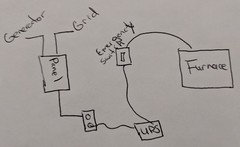
    Now, the one problem I see with this is that my emergency switch will be useless with a UPS at the furnace, at least until the UPS battery dies. So, I will have to run from the breaker to the UPS, then to the emergency switch, which would effectively do the same thing, just with he UPS closer to the panel than it was originally thought at the furnace.


  • 8 years ago
    last modified: 8 years ago

    Yes, you could put a UPS between the outlet and the furnace if that is what you want to do. Dont really need a switch between UPS and furnace, the ability to unplug it from the UPS is disconnect enough.

    You have a transfer switch for your generator correct? This is where you switch the various circuits to generator power when grid power goes out. It is a subpanel next to your main panel. And you hook your generator to the exterior port. Installation Instructions for the transfer switch.

    Chris Saindon thanked Vith
  • 8 years ago

    Thanks Vith, the emergency switch is a legal requirement here in Canada, even though I can touch the breaker and the switch at the same time. I guess it makes it a quick location in case of emergency - even though I'm not sure that any emergency involving the furnace would corrected by turning off the power.

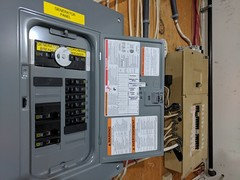
    Yes, I have installed a legal transfer switch/subpanel/pony panel...whatever you want to call it. All my 220v feeds remain on the main panel, and all my lighting, plugs, fridge, chest freezer and furnace run off the generator which is connected via an outdoor plug to the generator. I'm just trying to add surge/sag protection for my furnace, and if I can keep it running while I get the generator plugged in, bonus!

    This is my panel setup:

  • 8 years ago
    last modified: 8 years ago

    If we were talking about an AC motor then you would want the pure sine UPS but typically when power goes through a control board it will condition the power to what the components need. You could consider the blower motor a component running via the control board.

    Chris Saindon thanked Vith
  • 8 years ago

    How about a whole house generator?

  • 8 years ago

    That would work, but I'm not interested in the $6000+ investment at this point as I already have a backup system that works perfectly fine.

  • 8 years ago

    Thanks for your comment Austin Air. A UPS does do a lot more than just run a load for a short period of time. It will also kick over to battery when the power surges or sags beyond a safe level (I believe most kick in around 97 volts and 137 volts). Your comment that a UPS isn't designed to be used with power feeding it is interesting, because that's exactly how UPS's work. They run on grid power at all times, and only kick over to battery when needed. As for the generator sizing, it will run the fridge, freezer, furnace and some other things like clocks, house cameras, phone chargers etc, all at the same time. That said, if the furnace is running and the fridge starts...it will sag during that initial load until the compressor is runnign. Another benefit to the UPS is that the generator will sag, but the UPS may kick in to lighten the load and inadvertently benefit my generator as well.

  • 8 years ago
    last modified: 8 years ago

    Hey SaltiDawg,

    Yes, the protection for the furnace is when I'm on grid power. The furnace running for 20 minutes isn't critical at all, it just saves a power cycle of the equipment if it's not necessary. One less hard shutdown if it can be avoided.

    That said, I wired everything up today and it runs great. I don't have the 900w UPS yet, but I used the 450w UPS from my router/cameras and it worked great (unit is probably 8 years old). It's an 850va pack, and it leveled out at 22 minutes of runtime with the circulation fan running (119 watts). That means a 1500va should get me 35-45 minutes. Perfect!

    One odd thing I noted was that while on the battery power, my Ecobee thermostat had a humming noise...I assume a ground loop. This tells me that when the UPS is on battery, the system is not grounded as it does not hum when the UPS has power. I wonder if a sine wave UPS would prevent this. I'm going to double check that I didn't miswire a ground, but I doubt I did as it only does it on battery power (the UPS hums as well when on battery, so I assume the inverter is doing it.

    Thanks for everyone's input and help! I hope this helps someone else out in the future to accomplish something similar.

  • 8 years ago

    Power cycling electronic components does not shorten their life. Certainly not the number of times your furnace will experience because of power failures. I am not sure about a DC blower motor. Maybe you are extending the life. I would be curious if you have any references on this.

    Your UPS ground is not earth ground. Maybe this is causing the hum. You have to be careful about connecting grounds. They could be at different potentials.

  • 8 years ago

    Hey Mike,

    I don't have any reference to it, I just have personal experience from my career in IT. Brownouts, spikes and abrupt power losses are generally not ideal for computer equipment (including the motherboard for the furnace). Maybe it's better shielded than a PC, but I'd rather not find that out by waiting for the furnace to fail.


    I'm really curious about the UPS ground. I can't see why they wouldn't leverage the same ground that's already connected to the ground prong on the plug for the UPS. It would only seem logical. I'm wondering if my UPS is just old and the inverter is causing the hum. I've left the plug directly into the new outlet I installed until I can get a better/newer UPS.

  • 8 years ago

    Are you sure the UPS you were using was a true sine-wave inverter?

    And those that do power regulation usually cost a bit more. I've got one (two, actually) and it was about double the price of a similar sized non-regulated unit.

  • PRO
    8 years ago
    last modified: 8 years ago

    A UPS does do a lot more than just run a load for a short period of time. It will also kick over to battery when the power surges or sags beyond a safe level (I believe most kick in around 97 volts and 137 volts). Your comment that a UPS isn't designed to be used with power feeding it is interesting, because that's exactly how UPS's work.

    Chris, this is true to a degree... but there can be vast differences from one so called UPS to another. My post was intended to show really the only reason why someone would buy a UPS and that is for it to take over in running a load when there is no other power source available --- either grid power, a generator, solar, wind power etc.

    If you are running sensitive equipment, that is an entirely different conversation.

  • 8 years ago

    Might something like the Intermatic Compressor Defender serve this purpose?

  • 8 years ago

    I know, Salti, but Chris wrote that he is less interested in backup than avoiding sags and surges. If he and others are after that, a UPS battery is a cost that could be avoided.

  • PRO
    8 years ago
    last modified: 8 years ago

    Saltidawg,

    Any battery backup system will require on going maintenance, not to mention battery replacement at some point. Typical warranty on a UPS is merely 2 years and these aren't cheap batteries you can pick up at your local walmart.

    It would be cheaper to move to a better location with less power problems. In 23 years I've only seen extensive UPS backups in commercial type settings only protecting mission critical data centers.

    So while you 'could' do this at your house... it wouldn't make good financial sense to protect a 'furnace' with a battery backup system. Simply because the up keep of the battery system will far out weigh the cost of a new furnace or a repair to that furnace.

    Now if you're doing it to be able to run the furnace during a power outage... that's a little different, but still costly.

    If you're doing this for the surge protection, you simply buy a surge protector and then you don't have the continual maintenance cost of the batteries.

  • PRO
    8 years ago
    last modified: 8 years ago

    Saltidawg,

    Did I not say on Wednesday at 5:31am that

    " If you are running sensitive equipment, that is an entirely different conversation."

    You are talking about AV equipment in a forum for Heating and Air Conditioning.

    In my discussions on this board, I am only referring to Heating and Air Conditioning.

    If I pick up a hammer, it's not because I need a screwdriver. Can I make this any more clear?

    Edit: Ok try and run a furnace on a $116 dollar UPS.

  • PRO
    8 years ago

    Fine, whatever makes you happy.

    22 minutes of run time... to 35-45 minutes of run time by increasing it marginally.

    We both know power outages can and do last far longer.

    Repeated drains of the battery below 50% level does what to said battery?

    But I am the bad guy for pointing out these limitations?

    Thanks. Have a Merry Christmas and relax a little ok?

  • PRO
    8 years ago
    last modified: 8 years ago

    OP original post:

    My goal is to avoid sags/brownouts and quick on-off power events to save the furnace electronics. If I can get enough runtime to get the gen setup (~15-20 mins?), that would be a great side benefit.

    Save furnace electronics.

    That was his goal. This could be done by adding a surge protector to the furnace.

    Merry Christmas.

    *15 to 20 min of run time is pointless, doesn't even amount to 1 degree of temperature change, worst case scenario. But this point is obviously drowned out in your spiel of turning an ant hill into a mole hill.

  • 8 years ago

    Hey guys,

    I appreciate both of your inputs, however I've managed to get what I was after. I wanted surge/sag pretention and enough time to get my generator online. I've accomplished exactly that, and got my 20 minutes of run time off of a much smaller battery pack than I was planning. Going from the 850va UPS to a 1500va UPS will offer me nearly double the runtime. I have zero interest in using the UPS to run my furnace, it is just to keep it running while I get the generator hooked up.


    Easysimple solution... Consider this question resolved.


    Thanks again to everyone who has contributed to this question.

  • 8 years ago

    I am a fan of UPS for both protection and battery backup, have multiple computers, various gaming consoles I use them for. I also have two garage doors that each have a UPS which serves the purpose of them operating if power goes out. Had not thought of putting one on the furnace but I think its an ok idea 1. if the furnace is running while power goes out it wont get harshly interupted 2. you get that brownout/sag/surge protection for your board

    AAC, surge protectors dont monitor the incoming voltage and activate battery support if the voltage fluctuates beyond running threshold. This is called power conditioning. A standard surge protector does not do that, all it will stop is a large surge.

    Small fluctuations in voltage can affect sensitive electronics over time.


  • PRO
    8 years ago
    last modified: 8 years ago

    Power sags, brown outs aren't damaging to furnace, AC electronics. Restoring power to proper voltage typically fires them off no problem. I can't tell you how many times I've come across homes in which house had power but not enough to run the equipment. (dropped leg or similar problems)

    Power surges can damage equipment, I have seen that first hand.

    However, that kind of damage associated with HVAC equipment is pretty rare to find and there is nothing that will ultimately protect your sensitive equipment from that of a 'DIRECT LIGHTNING STRIKE'. Guess again.

    What I present in this thread is merely a difference of opinion. The power surge protection I am talking about is surge protection that is reasonable in cost, fairly easy and simple solution to give you 'some' protection.

    Nothing will likely save you from a 'close by' and certainly not a 'direct lightning strike'... since we're now on the misconception kick that I am somehow spreading 'fake news' or whatever. I stand by what I said in this thread. You can choose a different path if you so choose.

    This isn't an attack on you or anyone. I am just defending what I have already said in this thread. If you choose a different way > GOOD FOR YOU. Whatever makes you happy.

    Surge Protection & Battery Back Up --Lightning Myths

    You can get some decent protection from something like this protects your whole house. Just realize lightning strikes will render anything ineffective.

    If you have fallen for the gimmick and you're here scratching your head, you'll have a better understanding where you went wrong.

    Merry Christmas EVERYONE!

  • 8 years ago

    It appears to me that the OP is between two extremes in this argument and neither extreme fits the original need/wish list. By my read the OP made avoiding voltage variations and surges top priority with some run time on battery backup AS A BONUS.

    On the one hand, surge suppressor does nothing for voltage and frequency variations. I don' t know a lot about UPSs, but it appears that they must be chosen with care if you are backing up anything but electronics. (The manuals that I've looked at specifically say no motors. Note that I understand the difference between running an AC motor and a DC motor off of a power supply.) I believe that frequency variations are often a harbinger of voltage failures and are certainly bad for motors on their own. It would be nice to monitor frequency as well as voltage for obvious reasons. I don't think that even less common OTS, built for home or office use, UPSs do that.

    The expressed need for monitoring voltage variations with accompanied cut-off of equipment for a period was why I mentioned the Intermatic equipment. It monitors voltage and disconnects the attached equipment so it should work for a furnace or boiler. It has a three-minute time-out which might not be ideal in this situation, but would help with repeated surges in a short period and allow time for someone to pull a disconnect or breakers. There is no battery to buy or keep up which cuts expense.


    Intermatic solution


    Note that an item on my wish list is an inexpensive device for lower power applications that would turn off power to small pieces of equipment (think [not plasma] televisions, cable boxes, other home entertainment and associated gadgets in terms of power demand.) and leave them off until reset manually. I have lots of lab equipment that is normally plugged in on standby 24/7/365 but it would not hurt anything if it shut off in response to dirty power.

  • 8 years ago

    I'm out. lol

  • PRO
    8 years ago

    It's such an interesting subject but quite complicated to say the least. I've learned a few things along the way. Such as the difference between electronics type loads and loads that run motors. So here's a few more things I've stumbled along the way in the event someone is needing this type of arrangement and 'money' is no object. [Like you run a business from your home or something similar.]


    Then there's this...


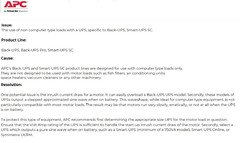
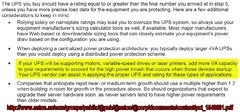
    Don't forget the generator in relation to the battery UPS solution.


    Should you trust a Joule rating? [Surge Protection Fundamentals]

    It's 50 min video below, that should give you even further information on how far this rabbit hole runs.

  • 8 years ago

    Yes, the UPS sucks a lot of power while recharging itself. That is something that people often forget when deciding what to plug into an outlet along with the UPS. After a power failure is easy to exceed the capacity of a 20 A circuit that is not challenged under normal circumstances by the combination of battery recharge and equipment load passed through the UPS. Add to that something else plugged into the duplex outlet and you're done.

    Sine wave inverters are much more costly than square wave and that is one reason that inverter generators, portable for home backup, are so expensive compared to the more common constant speed generators. I think that the comment about motors and inverters is good, but soft-peddles the problem. I understand that poor inverters overheat motors and wreck then.

    I've learned that the Intermatic CD1-024R will only work as designed if the system is controlled by a common, snap-action thermostat or, perhaps, something in the circuit that emulates that in some way. It is designed to prevent operation by cutting that connection. I suppose that a relay could be added to it to cut the main power, but that adds both complexity and expense. It is possible that someone might go into the circuits in more complex "communicating" thermostat systems and find something that would work.

  • 8 years ago

    During SuperStorm Sandy, I had a total power outage for about a week. My gas fired boiler uses electricity for only the control circuits and for opening the gas valve. So I purchased a 115 volt inverter and ran it off a car battery. I disconnected the 115 volt line from the house circuit and connected it to the inverter. This was able to run the boiler for that week. The system has no pumps (the water flows to the radiators by convection).

  • 5 years ago
    last modified: 5 years ago

    I ended up with a similar problem about wanting a longer runtime than what a UPS supplied, my solution was to add bigger batteries, lead acid, and wiring the UPS in so that the APC would just kick in. This while respecting the emergency shut off switch. After testing it, it should supply a few hours of continuous use. I did take a video of what I set up, hopefully it helps get you on the way.


  • 5 years ago

    I would want something that gives more than a few hours, especially if you live in a area with hurricanes!

  • 5 years ago

    I know it's not days, but 3 to 4 hours of continuous use should last me for at least a day. We'll see how it goes, I might add a gas generator for the long haul. I wanted something very low maintenance and automatic for when I'm not at home, a bit of peace of mind for the family.

  • 5 years ago

    The obvious advantages of a battery backup are it is located indoors, does not emit any fumes and works silently. A disadvantage of course is once the battery runs flat you need to find a way of recharging it, which can be tough during a widespread blackout.


    First, for easy connection of a backup power source I did some re-wiring around my furnace. I had to break the connection between the AC line and the master switch and install an additional electrical box with changeover switch and inlet as shown in the diagram. Note that I run only electrically “hot” wire through the switches; the neutral is continuous. To use the system during a power outage I need to flip the changeover switch to isolate the rest of the house (and utility lines), and then to plug into the inlet an extension cord from an inverter.

    https://www.centralacwarehouse.com/