Software
Houzz Logo Print
carlaa2016

3-point locking system

8 years ago
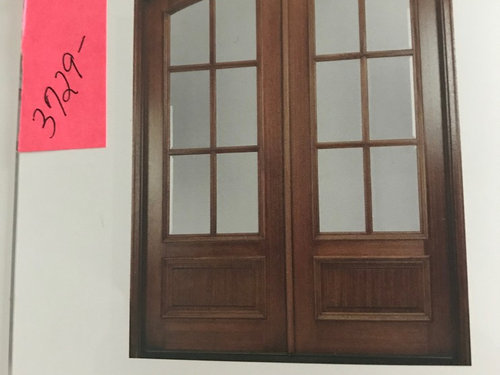
We need to order a front door for our new build and are trying to decide whether or not to get a 3-point locking system (1/3 the cost of the door). Its an eight foot double door as pictured.


We are not worried about safety as we live in a very safe community. More so worried about R value and heat (don't need a draft).


Anybody put in 8 foot double doors without 3 point locking system? Are they at least stable and a form close.


Comments (14)

  • PRO
    8 years ago


    No. Want to save money? Design and install a single door. Even a custom 4' pivot mounted door.

    The challenge with double doors (besides the fact that both doors will seldom ever be used) is that the first door must be secured to the floor and head of the opening, so that the remaining door may be secured to the first door.

    There are various ways to achieve security with double doors, but a cremone bolt is a common approach.

  • 8 years ago

    Have you considered a 36" or 42" wide door with sidelights instead?

  • 8 years ago
    last modified: 8 years ago

    I installed doors like that in my last house, and it was not 1/3 of the cost of the doors to secure the doors. For about $20, you can get two concealed bolts that are just as secure as a fancy, surface-mounted bolt system: Concealed door bolts. You just mortise the edge of the door at the top and bottom, screw the bolts in place, and install the strike plates in the top jamb and the threshold. Had that house for more than 20 years after the doors were installed and never had an issue.

    We weather-proofed the edges of both doors and never had any drafts or energy loss. We also liked the cleaner look of not having all that surface-mounted hardware (like the cremone bolt system).

  • 8 years ago

    kudzu - I would argue that you had energy loss. But given your name, it didn't matter that much.

    In cold areas, the infiltration of a large wood double french entry door is significant. I suppose that the changes in temp might cause more problems. Triple point helps with single doors too of course.

    Carla - if you are really concerned with heat loss, a triple point is not going to fix those doors. IMO (they look similar to our last house), the doors themselves are pretty bad. Wood has a horrible R value - and that is a lot of surface area. And then the glass was even worse for our doors. It was single pane. So our foyer was noticeably colder after a really cold night. Infiltration - sure. But also the large near zero R value didn't help.

    Now - it depends where you live. We never had a draft with our doors but there was a lot of energy loss.

  • 8 years ago
    last modified: 8 years ago

    David-

    You're correct, that my doors had energy loss (like all doors do); I meant to imply that the energy loss around the edges was no different from any other door that was properly weather-sealed, but could have been clearer. My response was focused on reassuring the OP that an expensive, three-point locking system wasn't needed to ensure that the doors could be made as free from drafts as other styles of doors.

    Regarding the issue of energy-efficiency of the doors themselves, vis-a-vis materials of construction, I would not be quite as negative about this style as you, but I can understand why the doors you had in your last house would color your view about this style. I would not want single-pane, double doors either, particularly if you had cold air infiltration. But I think that modern doors, with energy-efficient glass and proper seals, don't constitute a terrible choice if this is the look one wants for an entryway. In addition, specifying glass with triple panes, and/or low-emissivity coatings, and/or low-conductivity glasses can improve the energy performance of glazed doors substantially.

    Since the OP is getting new doors, I assumed that they would come with standard energy efficiency features, such as thermopane and modern door seals. I also assumed that the OP prefers this style over a door that, say, has no lites. When I decided to install similar doors years ago, I did some calculations and determined that the surface area of the doors only constituted about 2% of my house's total wall area, and only a small fraction of the total glazed area of the house. The door lites were double-wall thermopane and the R-value was about 2.5...not as much as a modern, insulated door, but not "near zero." So, while the doors were not as energy efficient as a door with an insulated core, they also accounted for a relatively small portion of the house's energy loss because they were such a small part of the building envelope. I also chose these doors because I wanted natural light in my entryway, to be able to easily see who was at the door, and a style that matched the aesthetic of the rest of the house. In terms of the overall energy budget for a home, I don't think this style of door should be ruled out, particularly with the design improvements available these days.

    And just so you don't think I am too blase about the need for energy efficiency, I should mention that for a number of years of my engineering career I managed a multi-state, home weatherization program (including Alaska), and after that was in charge of managing a department that designed new residential energy conservation programs for a city of half a million people. So, while I am a firm believer in energy conservation, I also think that one can make small compromises and still not be irresponsible. Lastly, despite the screen name, I do live in the North and worry about my energy bill every winter... :-)

  • 8 years ago

    No disagreement that they do not have to be terrible and an acceptable compromise in energy use but OP was asking about energy use.

    I do think there is typically a small amount of warp on these doors. This happens on both sides differently so maintaining a decent seal is an order of magnitude higher than other doors. Also - when I built last - 8 years ago - our codes ignored doors for the most part. So the biggest solar gain in the house was a glass door that had a terrible SHGC and the coldest windows were those on doors. A quick look today and our code looks better but is that enforced or checked?

    For modern northern construction 2.5 is pretty close to zero and I really doubt that door is 2.5. I could be wrong of course. An inch of hardwood is .7 so probably 2 inches.

    I had a reasonably tight house but the front door was terrible and no adjistments and weather stripping got it right for long. So I am jaded.

    Building a single solid door this time. Reasons - trend is over in our area for double, security, privacy, noise, and air infiltration. A no brainer. We lived in a neighborhood with similar to OPs doors - fun to see the 40 different ways people got privacy.

  • 8 years ago

    Anything less than 3 points will not seal well and result in a lot of air exchange. Unless you're in an extremely temperate environment where you can have doors and windows open all year then 3 points would be a minimum. 5 is better. We're installing doors with 8 point latching. In colder or hot/humid climates the extra costs should likely pay for themselves.


  • 8 years ago
    We are just finishing a new home (moving in next week!) and had a 8 ft front door with this locking system installed. This was new to us and we questioned it with several different people. We were told that if we didn’t use this 3 point locking system with a door this big and heavy (ours is a solid walnut) , eventually the door would warp and not close correctly. We love it and it feels so secure having locks in three places. Not sure if this is true for every 3 point system, but ours required a handle, not a knob. This wasn’t a problem for us, since we were using a handle anyway, but make sure your handle will work with the system. We were buying emtek handles throughout the house and only certain ones work with the system.
  • 8 years ago

    opaone-

    I agree that you need the door that is normally in the closed position to be secured at sides, top, and bottom, but there are ways to do that much more cheaply (and aesthetically) than the surface-mounted hardware that costs and arm and a leg.

    spaknitter-

    As far as warping, I am not convinced that any particular locking system is better at preventing warping than another, or can necessarily even safeguard against warping. Wood is a natural material; some doors warp and some don't depending on many internal factors in the wood's structure, how well the door finish seals the wood and is maintained on all surfaces (including the four edges), seasonal variations in temperature and humidity, amount of direct sunlight on the door, etc. I can tell you as a woodworker of several decades that, if a door is going to warp, attached hardware is not going to prevent the wood from moving. With double doors, securing the normally fixed door at the top and bottom can help this from becoming a problem with the interaction of the other door and/or compromising the integrity of the weather seals. But warping forces in wood can be incredibly strong and there is no way to guarantee that you can prevent all warping, no matter what you do.

  • 8 years ago

    Wow - 8 point locking. That seems like some overkill. I like that your recs make me seem soft...

    Climate does matter a lot of course.

    We did not have drafts for sure. Did they form a stable close? Depends on your tolerance for such things. I think most would say they were stable.

  • 8 years ago

    @David, they're actually designed for passivehus. We're not doing passivehus but the doors alone provide a significant improvement in energy use and comfort and are worth the extra cost. We're also using triple glaze windows that are close to passivehus though not quite there.

  • 8 years ago
    1. I have Mahogany Double door entry as in your picture, and it is far from energy efficient. Wood doors swell and contract and its almost impossible to get a tight seal.
  • 8 years ago

    The door we have coming is solid mahogany and it goes through a "torrefication" process..supposedly to prevent warping , rot, etc.

    we shall see.