Software
Houzz Logo Print
marieclaire_fontaine

Staining Uneven Wood

8 years ago
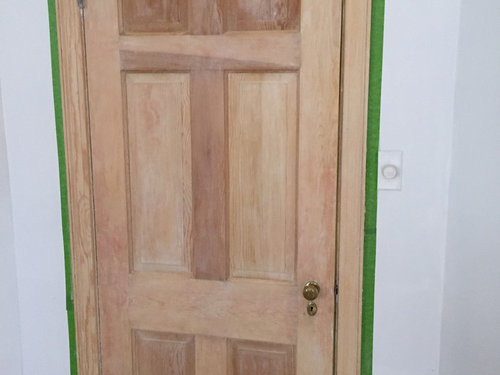
Hi Everyone,

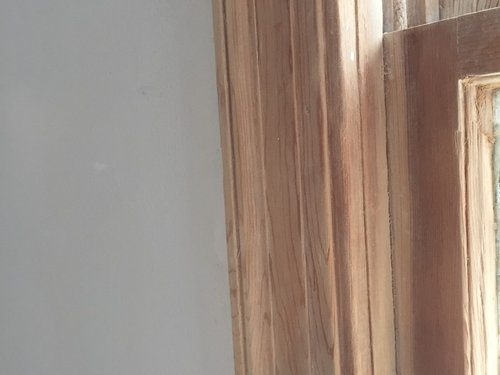
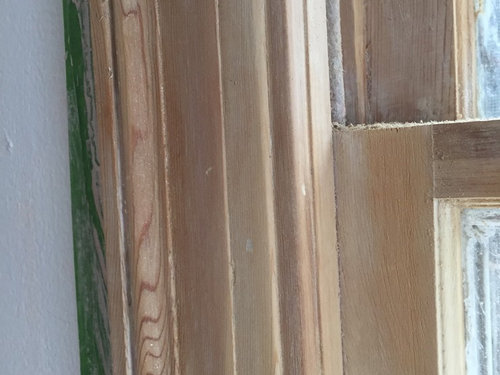
I stripped the paint off the windows and doors in a bedroom and the wood underneath is uneven. I can't tell if the wood (pine, I believe) is just that way, or if there was some staining under the paint that has not come off with the stripper (I used a very powerful stripper). I would like to keep the wood as light/natural as possible, but I recognize that I may have to darken it to even it out. I'm afraid that whatever stain I choose will make the darker parts of the wood even darker, thus not correcting the problem. I would appreciate any suggestions on how to make this wood look as uniform as possible.

Comments (13)

  • 8 years ago
    last modified: 8 years ago
    • Hi marie,welcome. Had you asked before you started about striping paint in hopes of getting wood clean enough to stain,I would have told you to forgetaboutit. It's next to impossible,regardless how many recommend doing it. It's simply too labor intensive for my liking. As it is,I take my hat off to your effort which is as close as I've ever seen. Because I admire the determination and hard work you've put into this,you deserve to understand as much as possible about your project and what can be done with it. You will in fact hear more than you asked for(not just from me,but others as well) but it will help you with this project but more so with future projects. The dark in your wood is natural,not stain and evening it out is daunting. Fresh,new pine and a few other woods absorb more stain (paint also) in some spots while resisting in others. That's ash in far left of last picture,it stains very nice,note the difference between it and softer woods on window. For that reason,we prepare unfinished wood by applying a light coat of shellac or other sealer that even's out absorbsion of stain/paint. Unfortunatly that usually will not help when wood has already been finished,striped and prepared for new finish. There is an exception that applie's to your project,IF YOU THINK YOU WILL LIKE THE RESULT. Many cabinets and furniture are origionally finished with what is commonly called white wash. If you were to seal and clear coat your project,it would be an example of white washed finish. Some love it so well they do it on new wood,others hate it and believe it to look messy. Those are a few of my thoughts,let's hear from others before giving up or taking action. As they say"there's more than one way of skinning cats". I'd add that if you forsee much finishing in your future,after completing this project and before getting this deep into another,EXPERIMENT with all the different approaches you hear for different people. There isn't a RIGHT way and a WRONG way,we just like different things.
  • 8 years ago

    Thanks for the response, Klem. Yes, stripping down to the bare wood was hard, but it was peeling badly, so I decided to strip down to the wood.

    I don't really understand what white wash will look like. When I google the term, it always seems to involve using white paint (for example:

    https://www.apieceofrainbow.com/whitewash-wood-3-ways/). Is this what you're talking about?

    If I don’t want to white wash it with white paint, do I have any other options? Would applying several coats of stain to the lighter parts and only 1 coat of stain to the darker parts work? In the alternative, could I stain just the light areas with a color as close as possible to the dark areas, and then put a clear coat over the whole thing? I’m not expecting a perfect result, but I’m wondering if there’s anything I can do to make the wood look more uniform. Also, if I apply a stain and I don’t like the color, will applying stripper remove the stain so that I can try again?

  • 8 years ago

    The answer to "If I don’t want to white wash it with white paint, do I have any other options?" is yes.

    The other answers are no. I'm sorry I failed to connect (my fault,not yours) so I will step back.

  • 8 years ago

    Hey Klem, thanks for your response. I'm sure that it's my fault and not yours. I am just totally new to this, so I have trouble understanding. As I said, I really backed into this project, but I have now put a lot of time and energy into it. I've been trying to search google to get information, but I haven't had any luck. Thank you for letting me know that the things I planned to try would not work. You do say that I have other options. If it would not be too much trouble, could you let me know what those options are?

  • 8 years ago

    Hi HandyMac, that is very, very helpful. I had no idea what went into making a door or that there was such a thing as paint grade wood. I had seen things faux finished in terms of making something that is not wood look like wood (I saw a video of a woman make white particle board look like oak), but I never thought about faux finishing something that already really was made of wood. While I have been impressed by the faux finishing videos I have seen, I'm not sure I could pull it off myself.

    As I look at it, I'm not totally hating the door as is. I live in an older house, so it is consistent with the character of the house. I might be all right with just putting a clear finish over it. That said, do you have an opinion of Zinsser 300451 Wood Bleach (2 part) to lighten the panels before putting on a clear coat? Or is the bleach so strong that the wood would deteriorate/look horrible?

  • 8 years ago

    I have never tried to lighten dark wood, so have no experience with that process. Might try YouTube, there are many videos there about all kinds of woodworking/finishing.

  • PRO
    8 years ago

    How much time, effort and money do you wish to invest in this project? If your time is valuable, you will have some very expensive trim in your house. This can be quite a time consuming and never ending project to tackle so think carefully before going further

    I added crown molding to my 30s tudor house and it was quite a project to match the existing woodwork. The previous owner had left some equipment and materials behind and I bought more. Much of the work is trying to find the right mix of products and processes to get the desired result. I experimented with 4 different types of shellac, 3 different colors of liquid dye, unknown number of colors/types of oil stain applied by spraying, brushing, padding. Lots and lots of hours and the result is fantastic but unrealistic for most situations.

    I wanted to work with new materials and techniques and I had the time and equipment available to use. If you wish a project to occupy hours of your evenings and weekends, you can get some great results. You can try to darken the light areas with dye before staining to even out the color if you want to get into a new hobby. If you just wish for a historically authentic result, repaint the door. I doubt that particular door was meant for a stain finish given the large amount of color variation.

  • 8 years ago
    last modified: 8 years ago

    It looks like the natural variation in that type of wood - and on the door it looks like you may also have white paint thats gone deep into the pores of the wood, which would create an uneven staining surface. How old is this wood? Possibly it was always painted, or heavily stained to conceal the variation - as above poster stated "paint grade".

    Even so, you might be able to get some reasonably good effects by using a more heavy bodied gel stain -- experiment on scrap pieces of wood first. These are semi-opaque, would conceal a lot of the grain (depending how many coats) but still let some of it show through - unlike paint.

    May have to apply something first to even out the porousness (to some extent). If it was me, Id do some sanding (on door, the trim looks nice) and then simply apply an UNWAXED shellac thinned a little bit with denatured alcohol (Id have to look up the exact diultion). It really helps you see more objectively what the wood is like and what a clear finish would look like. And then if you want you can apply either more shellac or another finish or stain over - your first thinned out coat will have helped to even out the porosity of the wood. Did I say it must be UNWAXED - or other finishes wont stick.

    PS - have you done any sanding yet? Youd want to do that no matter what finish, even if its paint - get a good orbital palm sander with a thingie that attaches it to a shop vac to suck up all the sawdust - you wont regret it! You have a lot of wood work and you know.... you might just get hooked on wood refinishing - it can be addictive!

  • 8 years ago

    Hey Linda, yeah, I know that HandyMac obviously knows what he is talking about when he says door was made with "paint grade" wood and never meant for staining. I have already invested so much time on this that I know I'm being ridiculous. I do know that I can't go down the path of liquid dye.

    Current Resident, I couldn't handle gel either. I'd mess up the thinning it out part. I have a 1/4 sheet sander and a corner cat sander. Should I use that before applying a clear coat? I was afraid to use it because I tried it on the interior of the windows and it seemed to sand out the grain. I'm not sure what an orbital sander is or how it is different from the 1/4 sheet sander and cat sander that I have. Should I be using the pre-stain conditioner?

    The most that I can imagine doing at this point is trying some wood bleach on the darker parts to lighten up the dark panels of the door or maybe the interior parts of the window, but as the days pass, I'm even doubting I'm going to do that. What HandyMac said is sinking in, and I'm thinking I'm either going to paint it (probably not because I put toooo many hours into stripping it), or just put a clear coat on top of it (with the color variation representing an "artistic" choice).

  • 8 years ago

    There are three types of power sanders. Rotating/random orbit, vibrating, and belt. There are air/electric powered varieties that rotate only, used more in automotive body work or metal fabrication. These are sometimes used by wood turners to grind away excess turning stock. These are very aggressive and seldom used by woodworkers.

    The most aggressive are belt sanders. Palm sanders(vibrating 1/4 or 1/2 sheet sanders) are the least aggressive. The corner/triangular types are also vibrating.

    Random orbit sanders(ROS) are round and come in several sizes. These are the preferred sanders for wood working because they can be aggressive(with low grit sandpaper) or as finished sanders(with high grit paper). The random orbit minimizes the scratches often caused by palm(vibrating) sanders. There are two types of ROS because of how the sanding paper is installed. Pressure sensitive adhesion(PSA or Peel and Stick) paper has a pressure sensitive glue and is stuck on a flat pad. Hook and Loop(Basically velcro) uses the stickiness of the two parts. Most folks I know favor the H&L type.

    Sanding is one of the worst ways to remove most finishes, both in time and money. The finish heats up from the friction and clogs the paper. That means changing the paper often. More changes means more time and money spent on paper.

    A mistake many people make when sanding is sanding the wood surface too fine. That impedes stains and can cause finishing problems. To stain/paint your door, sand only to a final 150 grit level. Clean with the disolving agent of the primer/finish. Damp rag for water based primer/finish, paint thinner(not a green type) for oil based, lacquer thinner for lacquer, and alcohol for shellac. That minimizes fish eye(little spots caused by contaminants) and helps prep the wood. Not a fan of tack cloths due to possibility of leaving material.

    One nice thing about your door. You can try one or more shots at faux finishing(might be fun) and if they are not what you want, prime with BIN(shellac variety) and paint.

  • PRO
    8 years ago

    Good luck with your project. I've never tried to lighten wood with bleach instead I have gone the darken the lightest part with dye route. I have used high strength hydrogen peroxide to bleach out stains in oak flooring and it worked amazingly well

    Projects like this can be frustrating. It's difficult to know whether to stop or continue since you don't know what the final result will be until you get there. In hindsight, I have found that much of the wood stripping is lots of work and many objects don't justify that much labor. I have stripped beautiful wide crown that was worth doing and I've stripped pine that could have been replaced more cheaply.

    One approach with old overly painted materials is to remove the paint that leaves easily and then repaint the object without all the years of accumulated chips, scrapes, drips, runs and other ugliness. I do suggest researching lead paint and how to avoid needless problems with spreading lead dust. Be very cautious with sanding old painted wood

  • 5 years ago
    last modified: 5 years ago

    Hi. I'm sure you'll have to replace the paint. And next time I advise you to take high-quality doors. In general, you can even try to make the door yourself. However, this will require good equipment. I remember a year ago I decided to make a work desk for myself and my child a computer desk. I went down to the basement to get a saw, a jigsaw, a drill, and sandpaper. But the most basic tool was a saw, and it was very old. Then I started looking for the best table saw for myself. As a result, I went around a lot of stores, but I never found it. Suggest a good store.

Sponsored
AIS Renovations
Average rating: 4.5 out of 5 stars15 Reviews
Custom Craftsmanship & Construction Solutions in Franklin County, Ohio