Software
Houzz Logo Print
briceunland

Granite - Tiny Rust Spots?

8 years ago
So we just had Galaxy White granite installed in our house (first granite kitchen for us) and we love it. We picked out the slabs, the contractors were above awesome, and we like working on the material!

However, I noticed after sealing the granite last week (two days after install), there are tiny orange (rust?) spots in areas of our granite. I didn’t think much of it. My wife says she saw them in the granite right after install and was surprised because she didn’t see them before but assumes she missed them on the slab picking day. She doesn’t mind them. I don’t really mind them.

But what’s driving me crazy is if more are appearing! Is my granite rusting? In all my searching I only found “large” rust stains on granite and many of them surface. These are below surface and not large (many are just pin hole size). Is it possible water (which we don’t leave on the counter other than wiping down the granite) is making its way in and reacting with iron after install (and after sealing)?

Or, that’s highly unlikely, I just never noticed them before, and they are not spreading and/or this is common in Galaxy White?

If it’s likely/possible that they are developing now, thoughts on stopping them/removing them?

Thanks folks!

Comments (40)

  • PRO
    8 years ago
    last modified: 8 years ago

    Learn to decorate with and love orange, because that's the nature of this beast. It will rust from the moisture in the air. You could have the worst offenders drilled and filled, but I wouldn't. Try a little oven cleaner on a spot in an inconspicuous area, please.

    If you're willing to trade orange for bright white, try a drop of toilet bowl cleaner that contains hydochloric acid, again in an inconspicuous area. The gloss will not be affected.

  • 8 years ago
    Thanks Eam44 and Joseph.

    It’s not so offensive to drill out, more of a peace of mind thing (I.e. I didn’t seal it right or something).

    So Joseph, your understanding is that this is 100% natural and nothing I can do to prevent/stop it? I.e more sealant won’t do it?

    I certainly understand the moisture in the air causing it, but is there really that much more moisture in my house than at the warehouse or at the quarry?
  • 8 years ago

    I actually picked out some slabs of Taj Mahal quartzite for my kitchen because they contained some small veins in that rust color! It ties other elements in the house together.

    Granites can look very different once intalled horizontally in your space and with your own lighting.

  • 8 years ago

    Iron rusts. No matter where the iron is located. Iron in stone rusts. Normal. Accept it or pay to replace it.

  • 8 years ago

    I have a white granite called Arctic Cream. I love it. Yes, there are tiny-ish rust spots throughout it. When it was first installed I wondered if maybe I'd spilled sauce or something and didn't wipe it up. Nope - just Mother Nature at work.

    I seriously don't mind it at all. Mine hasn't really gotten any worse over the years. You can see a little spot in the middle bottom third of this photo. There are some spots that are bigger, but again, they are just a natural part of the stone. It doesn't looked etched or "wrong" to me.


  • 8 years ago

    It's a nice effect. And orange always looks good with wood.

  • PRO
    8 years ago

    "So Joseph, your understanding is that this is 100% natural and nothing I can do to prevent/stop it? I.e more sealant won’t do it?"


    Yes, nothing you can do and yes, more sealant won't do it.


    Wipe up every drop around your sink too, please. I've seen these rusty stones self-destruct near sinks.

  • 8 years ago

    I know this thread is a few months old, but to the O.P. Brice - can you update us on this issue?

    I ask because we are experiencing the same problem with a newly installed white granite. It had no rust spots whatsoever when we selected the slab. But approximately 1-2 days after install, it started showing rust dots around the sink rail. Those dots have expanded outward, and are now cropping up in other areas throughout the counters. The counters were sealed with a solvent-based impregnating sealer, and we never leave water or anything else on the surface. We too, don't mind a few small dots, but the fact that they are spreading is cause for concern.

    This may be a natural process, but I have to believe that most home owners who choose white granite, would not have done so if the installers/fabricators had said "Oh by the way, it's entirely possible your stone will start rusting/changing color as soon as we install it. You can seal it all you want, but there's not much to do about it."

    Anyway, I'd love to read an update!

  • 8 years ago
    An update as requested:

    I certainly “feel” like more spots showed up for the first couple weeks, in different places here and there. Most places only have a random dot or two and nothing concentrated (other than the one main area by the sink where I first noticed it). To ease my mind, after posting my initial question I did three things: 1. I saw only two spots on one side right below the sink we do the dishes in. The opposite side, which is a different part of the slab (the seam is located at the sink) is where I first noticed them all. I noted the location and size of these two dots. If the granite was severely reacting to water I predicted this area that is wet more than any other would increase in spots. Since that time those two dots are all that are present and have not grown. I feel vindicated that personally I couldn’t do anything about their location and appearance. 2. I looked around at other granites in the big box stores, while most samples are very small, and or perfect, I did find some white granites with the rust spots. 3. I looked under my granite slabs (under the eating bar and edges) where they are not polished and certainly have not been exposed to water (from me at least), under there there were a few spots that had the orange rust dots. Again, this eased my mind that I did not need to be overly cautious about water droplets being left on the surface.

    In the end, as other have noted/posted, I have grown to not notice or care about them. The granite looks great, we continue to get comments about how nice it looks, and the dots have become a non issue for the most part. I wish you well with being at ease after such a big purchase that seems to not be perfect. I’m a pretty particular guy, and it was driving me nuts, but not so anymore. I wouldn’t change it if I could do it over, though, as you mention it sure wouldn’t hurt to have the suppliers and installers let you know it’s possible and to be expected.
  • 8 years ago

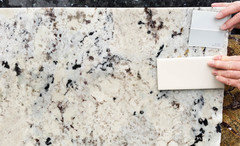
    We just picked a remnant for a vanity and it was IDed here as Galaxy White. Does it look like your granite, Brice? Do you have photos of your counter that you could share?

    The corner where I'm holding the samples has a little rust but I didn't see any elsewhere. The remnant has been out in the Oregon rain all winter so I don't think I need to worry about it rusting in my home.


  • 8 years ago
    Looks like Galaxy White to me! I have seen a couple different “versions”, but the one you have there looks to be in the same style as ours. If those are the rust spots in the upper right near your paint chips, those are larger than what is on ours. I’ve seen rust spots like that on a friends (not Galaxy White), but ours tend to be quite small - large pin head sized. Looks nice to me though!
  • 8 years ago

    Thanks for the update Brice! I'm glad to hear that the rust hasn't progressed on your counters. It gives me hope that the rust dots appearing on ours stabilize and stop spreading; the latter is our greatest concern. However, I'm now seeing small, subtle spots of orange in quite a few areas that aren't even exposed to water (other than an occasional wipe down). If it doesn't get worse - fine. But if it continues to spread, I cringe to think of what the counters will look like in a year or two!

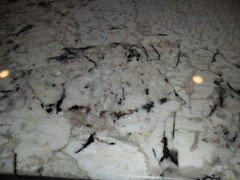
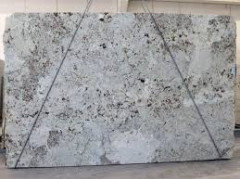
    I've included a couple pics for others who might read this thread. Our granite is called "Antique White" from Brazil. It's beautiful - lots of mica, quartz crystals, iridescent swatches, taupe, grey, black and white. If not for the darned rust and some resin lines that have a greenish/yellow cast in bright daylight (couldn't see it in the slab warehouse) I'd be really in love. For us though, the new granite experience has not lived up to its hype. We've also had install issues that are still in the process of being corrected, but that's posted on a different thread :) Best of luck with your granite!


  • 6 years ago

    Any update on this post? We had white ice granite installed a few month ago and dealing with orange rust spots appearing. How bad will they spread over time?

  • PRO
    6 years ago

    "How bad will they spread over time?"


    Difficult to say. Learn to like them please.

  • 6 years ago
    last modified: 6 years ago

    "All light-colored granites including White Ice have more porosity than the dark granites"

    For the benefit of people looking at light-colored granites, I need to point out that is not true.
    You cannot paint such a broad brush with the word "All". The light-colored granites like Alaska White, Bianco Antico, Lennon, White Springs, Bianco Delicatus, Piracema White and some other names I cannot remember, have low absorption rates which means they are not porous. A person looking at granite counters should google the names of the granite(s) they are interested in to see whether it is porous or not.

    Alaska White:


    Piracema White:


  • 6 years ago

    We have not had any more spots develop or grow. Still the same as shortly after it was installed. I buy and large don’t notice them anymore.

  • 6 years ago

    I will say that nearly a couple of years later, the rust spots on our Antique White have not progressed. They developed over the first month or so, but have since remained the same. Our spots are around the sink, so I suspect it was from the cutting process. Thankfully, the granite does not seem very porous, so despite having water on the affected areas frequently, the problem has not worsened.

  • 6 years ago

    Thank you for this update.

  • 6 years ago

    @Miranda33 thank you for your clarification - you are correct. Some light colored granites can be porous, but certainly not all.


    And just to add another clarification, the oxidizing iron spots are not necessarily related to porosity. It can happen right on the surface of the stone, where iron-rich minerals are exposed to air and moisture.


    Although there are several instances of people concerned with rust spots spreading or multiplying, I have not seen people follow up and say that it actually has gotten worse. One of these days I'll do a test on this and see if I can get some real data, because I'd love to have some more definitive info on this topic.

  • PRO
    6 years ago

    karin_mt:


    Thanks for the input.


    While it wasn't rust spots, back in my stone restoration days I was called to a granite top that was self-destructing from water at the sink and moisture in the air. Nothing I could do except recommend replacement.


    With the natural stone industry pushing the limits of stone countertop suitability, I'm sure these jobs are out there, but finding them will be problematic. If I can assist in any way, please don't hesitate to contact me.

  • 6 years ago

    I’ve been wondering the same thing about my granite. At first I thought they had installed the wrong granite it was nothing like the sample and now these orange spots are starting to come out. So this is normal?


  • PRO
    6 years ago

    Yep, it's normal. Keep your dehumidifier running and wipe up all spills immediately please.

  • PRO
    6 years ago

    HU-248426005

    This is rust stains, it is caused from when the granite is originally cut into slabs from a block, Via a shot or gang saw.


    embeds micro iron particles into the stone when it is processed.


    Any stonemason will know how to get these out, very simple process. Email us directly or message us on here and we can let you know how to get it out.

  • PRO
    6 years ago

    QSCCRE:


    What are you saying? Sawing leaves rust in stone? What, do the teeth break off and imbed in the stone?


    Granite is full of mica, feldspar, and natural iron which rusts.

  • PRO
    6 years ago

    See Link

    https://youtu.be/7Mi1sFm8NRU

    Traditional natural stone is cut into slabs using a steel shot gangsaw. Not all granites are cut using this system. But cheaper processors in china where 95% of granite blocks are cut into slabs is processed by a gang saw and 50% of them use a steel shot gangsaw


    NO... not teeth, Why I said iron or steel micro particles. Then embed into the stone via this process. When exposed to water through cleaning they will oxidize. Especially if the stone is not sealed or is not resealed every 12-18 months. Though Dry Treat- Meta Creme sealer will stop this permanently.


    The top surface or work surface is the one getting wet... not the bottom of the stone .... Why you will not see it generally on the underside of the stone. If rust is present on the surface.


  • PRO
    6 years ago
    last modified: 6 years ago

    Ps you missed the other two main elements of granites used for dimensional stone.

    Quartz &

    There is four main components of dimensional stone granite

    1) Quartz

    2) Feldspar

    3) Mica

    4) hornblende

    But 80% or more, of dimensional granite is Quartz & Feldspar - Potassium and Sodium Feldspar

  • 6 years ago

    1. If saw blades were causing the problem, then the rust spots would be in any part of the stone.


    But they're not. The rust spots are specifically around the dark minerals, which are iron-rich. You don't see rust spots in the middle of a quartz or feldspar crystal.


    2. If saw blades were causing the problem, you'd see it on all kinds of stone.


    But that's not the case. You don't see this in stones that don't have iron-rich minerals in the first place.


    3. It's not saw blades.

  • PRO
    6 years ago
    last modified: 6 years ago

    karin_mt

    Not correct, but yes could occur where there is a mica with some iron content. But rare.


    This rust spotting not only occurs in granite, but also marble and quartzites which have NO IRON Content. It is because they have been steel shot gang sawn. Any stone wholesaler who has been around for a long time will be able to confirm that.


    It occurs where the stone is wet constantly, it is common on most granite where the sealers have not been applied or failed.

    This is usually a high use area or from high use cleaning.

    Sorry that is incorrect .... in this case cashmere white as the granite appears to be ,... is 99% of the time cut with a steel shot gang saw in india as it is an indian granite.

  • PRO
    6 years ago
    last modified: 6 years ago

    karin_mt just curious... what is your qualification or validation on knowing how stone is quarried, cut and polished. We assume you can quarry, process dimensional stone or have done.


    We have over 35 years in doing so across all these fields.

  • PRO
    6 years ago

    QSCCRE:


    You're poking your credential stick into the wrong cage, trust me. Karen's a geologist. She's written extensively about stone here and elsewhere. She's forgotten more about stone than you soap-peddlers ever knew.

  • 6 years ago

    For some reason I find posts that are in all bold type to be annoying, regardless of their content.

  • 6 years ago

    Quartz - Stone Care, Cleaning & Repair Experts -


    Show me a photo of a stone that has "NO IRON" (your words) that is stained with iron oxide. I'm a scientist. If you want to make a claim like that, you need to show us some evidence.


    Most marbles and quartzites do contain some iron, btw. Nevertheless, I've yet to see this problem in any stone that doesn't contain iron-rich minerals. I'm happy to be proven wrong and I always have more to learn, so if you have actual photos showing iron staining on an iron-free stone, please share them.


    But regardless, in the photos posted above, it's abundantly clear that the iron oxide is originating from the dark-colored minerals, and they are the source of the issue.


  • 5 years ago
    last modified: 5 years ago

    Karen What is your thought on this rust stain :-\ Help please


  • PRO
    5 years ago

    Undermount a Kohler 3821 with a faucet deck. The rust spot is cut away and now your faucet is mounted on stainless steel instead of rusting natural stone.

  • 5 years ago

    Michelle, what is your question? Karin doesn't seem to be around much, but there are others here who can probably help you.


    I have those rust spots scattered around in my white granite. I would say learn to love it, or replace the sink per Joe's advice above. Mine don't bother me and haven't seemed to grow in 10 years now. Karin said they don't tend to grow or spread much bc there isn't usually a lot of iron in the granite. Thus far that has been my experience. I have one right on an edge like you. It's fine, no one has died. ;)

  • 5 years ago

    Thanks PatriceNY! I pop in from time to time but not too regularly. I totally concur with your advice. :)

  • 4 years ago

    I have the same problem with a recent installation of Dallas White. In my case, the contractor DID NOT Seal the granite and the rebuild of the house took 5 months. The granite was exposed to paint dust and lots of other things. When we moved in, we found the rust, which had definitely not been there earlier. I thought I would remove it by reading about Bellanzoni Rust Eater, but found it didn't have any effect and I ended up reading this blog. My plan is to seal it now after as good a clean as I can get. I do plan to leave unsealed a section of green bloom around the seam which has been growing and the installer said he didn't know how to fix except cut away, which we didn't want to do. I thought I would try Mangiamacchia.


    Any advice would be appreciated. Here are some pictures.


  • 3 years ago

    bellafrancene, I’m reading this blog two years later with a newly installed Dallas White granite, which was installed yesterday and going to be sealed today. Over the last couple of years, how has yours on your Dallas White progressed?

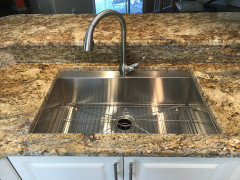
    I too don’t recall seeing this on the slab when we picked it out. I do see these scattered all over, with the largest one in this picture by the sink. And by the way, this is a new house, and the sink hasn’t even been hooked up yet to the plumbing, so it’s not due to water exposure.

  • PRO
    3 years ago

    It started rusting after it was fabricated wet. That's why you never saw it on the slab. I'd think apron front sink if I were you 'cause that's only going to get worse.