Software
Houzz Logo Print
somegu7

Cover trunk with soil

8 years ago
last modified: 8 years ago
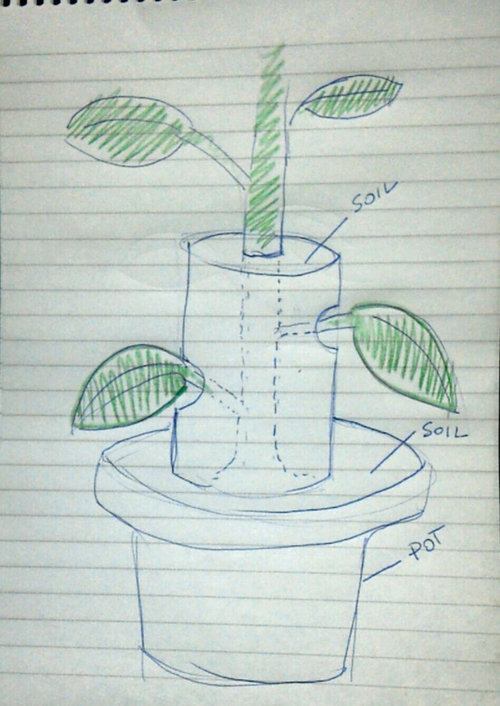
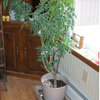
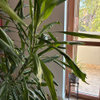
What would happen if I cover the trunk of a rubber tree (or other tropical) with potting mix? Wrap a light aery potting mix around part of the trunk. Keep all leafs pass trough. Water it occasionally. Like air layering but with out the cut.

Would it be a way to develop more root mass? Air roots? Would it be a good thing for the plant?

Comments (12)

  • 8 years ago

    May I pls as what your objective is in doing this?

  • 8 years ago
    last modified: 8 years ago

    You’d likely starve the roots of oxigen, not let the lower soil dry out and your plant would start to decline.

    If you want to air layer, great. But this isn’t a good method for that.

  • 8 years ago
    last modified: 8 years ago

    Certainly a novel idea, haven't heard of it being done before. My guess is that the leaves protruding out the sides would drop off. The trunk would sprout new roots near the top of the soil and lower parts of the trunk and roots would rot away. If you used purely organic materials the roots would spread through that. The organic material would soon rot away and you'd have your aerial roots. But the easiest way to get aerial roots is to keep the plant in very high humidity, Ficus are good at that even without having soil piled up around them.

  • 8 years ago
    last modified: 8 years ago

    It's something common when design root over rock or root over wall ficus bonsai. On raft bonsai even more. Bonsai specimens not always straight up so covering trunk with soil sometime unavoidable. But what you get isn't aerial root. Just common root that branching out since beginning and will dry when u uncover the soil. Aerial root need high humidity environment, not covered soil. Aerial root is a long root that only start branching out when touching soil or water.

    I grow this benjamina on clay base soil, but surrounded by lava sand. It's keep the root on relatively high humidity but excess water come out freely from surrounding. Aerial root come easy this way, at least for mine.

  • 8 years ago
    last modified: 8 years ago

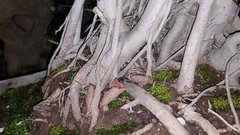
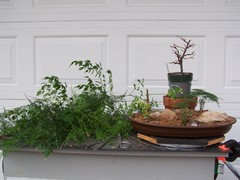
    I do this all the time. In bonsai, the nebari (the exposed roots radiating out from the trunk at the soil line) are a very important consideration when assessing the quality of the composition. I find it's usually easier to get rid of an ugly root system by growing an entirely new root system above the old, then removing the old roots entirely. The tree in the stacked pots is growing a new root system in the top pot, while the old roots live on in the bottom pot.

    The roots in the lower pot will rot ONLY if the soil is saturated. If you are using something like the gritty mix, that doesn't support any appreciable amount of perched water, you'll end up with roots from the bottom of the bottom pot, to near the top of the top pot. There is no advantage in that for the plant that couldn't be had by increasing the volume of soil the plant is in and simply allowing the original root system to enjoy the freedom of room to run.

    Also, as mentioned, the leaf petioles will rot, so removing them before you undertake such an experiment makes good sense.

    The tree below was layered using a configuration almost exactly like the one you drew above, with the addition of a tourniquet. You can see the heavy wire I used for the tourniquet still attached to the base immediately above the point of separation from the old/original trunk and root mass.

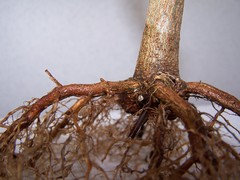
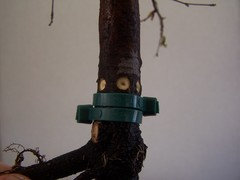
    This (below) is another picture of how I prepare a tree before I start to layer the top of a tree (and its new root system) off the old, lower root mass.

    The holes drilled through the cambium will be filled with rooting hormone, which helps to ensure the new root system will be evenly spaced and radiating outward from the trunk, as in the image above it.

    Al

  • 8 years ago

    AI could you share your experience, whether some plants died for the holes drilling procedure? Just curious :)


    After reading much of your contribution in gardenweb, my courage is on the upwards curve trying some of the concepts you have shared... Killed one Kalanchoe blossfeldiana after repotting (my mistake). Good outcomes: transferred my lime, ficus into 511, African Violet into gritty...


    Do plants die in your hand in last 5 to 10 years?

  • 8 years ago

    Thank you all.

    Im wondering how to keep the leafs from rotting and still have roots out of the trunk.

    What would happen if i do not water the additional top soil? Or water it very very little? Also what if i just add inorganic mix?

    Or another question, what if i just wrap part of the trunk with plastic foil (not covering leafs/petioles at all) in order to rise the humidity on that part?

  • 8 years ago

    Yenniesg - I've never lost a plant (so far) that I treated that way, and it's very rare for me to lose a plant to something other than stupidity or laziness. Example: I lost a really nice portulacaria I'd been working on for 5 years to frost because I took a chance it wouldn't drop below the 36* predicted (it dropped to 27*).

    The worst that's ever happened to plants I've prepared to layer off (with the holes)was a hole or two healed over w/o producing a root and I had to drill again. Healthy plants are VERY resilient if you pay attention to timing.

    Al

  • 8 years ago

    Somegu - are you trying to stimulate growth of aerial roots?


    Al

  • 8 years ago
    last modified: 8 years ago

    yes. regular above ground roots out of the trunk would also be cool.

  • 8 years ago

    As noted upthread, you can stimulate formation of adventitious roots by elevating relative humidity levels. You can do this by burying the stems or trunk, but it's important that whatever medium you bury the trunk in is highly aerated. If it's not, you can easily kill the cambium by depriving it of oxygen and gas exchange. High levels of ethylene gas can also stimulate stem cells and axillary buds to differentiate/redifferentiate into root tissues and adventitious roots. When you bury the trunk to stimulate growth of roots, you'll need to raise the tree up to expose the roots later.

    Start a cutting in a very tall pill bottle (4-6") with the bottom cut off and the cap in place. Drill a hole in the cap (drainage) and flip it over so the cap is the bottom. Let the cutting grow for a year or so, then unscrew the cap and nestle the bottle in a regular container full of soil. The roots will grow out of the bottle into the soil. A year or 2 later you can break the pill bottle off of the roots. Gradually, the soil will fall away from the roots and you'll have a small, interesting plant with exposed roots.


    Al


Sponsored
Peabody Landscape Group
Average rating: 3.5 out of 5 stars8 Reviews
Franklin County's Reliable Landscape Design & Contracting