Software
Houzz Logo Print
hzdeleted_35844888

Propagation tent humidity levels.

8 years ago
last modified: 8 years ago
Hi,

After almost 2 week after sticking, I decided to put a tent over my Tsuga canadensis cuttings to help keep them from drying out too quickly.

I have no idea how 'humid' they should be and all my web searches left me with no real information about this particular species.

Just to give an idea about the conditions here. The ambient temperature in the basement hangs between 55-60df, this time of year (with very cold temps outside the house). The new hygrometer showed 49% R.H. after 24 hrs. out of the package.

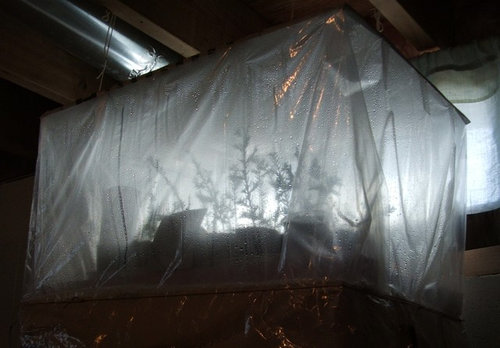
When I added the tent (a one piece sheet of plastic, tied around the bottom snug to the table top) the temp inside the tent went to 60-62df and the R.H. shows around 70% +- a couple percent.

There is a heat mat under the trays that runs steady and my soil temps are generally between 68df and 72df. with one or two places on the mat a little warmer @79df and cooler @66df.

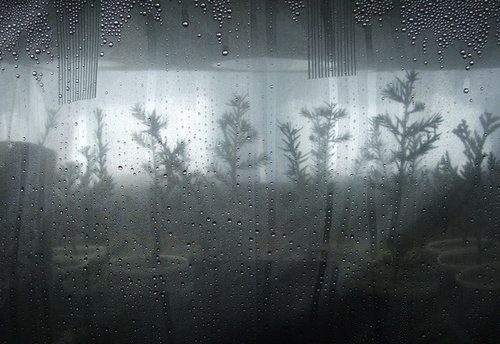
For the last few days of using the tent there's always a fog and small droplets on the inside of the plastic and these drops do precipitate down on the plastic and drip some on the countertop that the small table is on. And if you look at the plants inside, they look uniformly damp and have tiny droplets of water that glisten in the indirect sunlight that penetrates the curtain.

Is this too much moisture? Should I vent the tent every day or so? Do I need the tent at all figuring the cool range of basement temps? Any opinions or suggestions from experience would be welcome. I think the tent is working but maybe just too wet?


Comments (18)

  • 8 years ago

    Thanks. I had an idea it would be somewhat of a juggling act and I'll know more next time around but didn't want to assume anything. These are hardwood cuttings and bottom heat is highly recommended. Tsuga c. does not seem to dry out easily. I've thrown pruned branches in summer and they've stayed green for two months laying in the bushes. I'll keep an eye on them until either someone can say for sure about this species or they sprout roots. :-)

    I may even cut back on R.H. by leaving the tent a little loose at the bottom.

    Any more comments or input welcome.

  • 8 years ago

    I did as exhaustive of an internet search as I could and everything seemed to point to the dangers of having water drops persisting inside the walls of a humidity tent. I don't know if that means it can spawn unwanted pathogens? Seems likely it would in time.

    It also seemed apparent that you don't want the plants (needles in this case) to stay wet all the time (after all, green plants have to breath so water coating the needles 24/7 is probably like drowning them).

    Those things, added with other tidbits of information I've gleaned viewing research docs about rooting Tsuga Canadensis, caused me to open up the tent this morning and let things dry out for a while.

    From all my reading, Eastern Hemlock may not need a tent at all if you have cool temperatures along with bottom heat (some research showed the best rooting occurred with b.h. at 68df).

    I may leave the tent in position for a while in an attempt to raise relative humidity up to around 60% but will leave some sort of ventilation so fresh air can circulate at the same time. If that can't be done without a lot of fuss, I'll just remove it.

    This is my first serious attempt at this so my ideas may change depending on the success or failure of this project but for now this is where I'm at.

    bill

  • 8 years ago

    I'm not an expert on this but I believe the extra humidity and temperature gives bacteria and fungus spores a perfect environment to thrive. Also, this is just in my experience, but as long as the air isn't completely dry, it doesn't help to have extra humidity.

    I think the main problem you'll face is the soil drying out. The droplets you see on the plastic are from the soil heating up higher than the air temperature and that causes it to evaporate faster. It can dry out from the bottom up, where a lot of the new roots will try to grow. As long as you keep the soil uniformly moist, you shouldn't have an issue. I keep all my propagation containers in a larger container so I can just water them from the bottom up.

    User thanked iandyaz
  • 8 years ago
    last modified: 8 years ago
    I agree about the bacteria and fungus. I've read that fungus likes anything over 60% R.H. Maybe with cuttings that root in a couple of weeks, it wouldn't be as much of an issue. In some cases, softwood cuttings may require very high humidity idk.

    I started with all new components and sprayed the cups with a bleach and water mix and let them dry before I filled them and watered the new perlite and peat with water laced with hydrogen peroxide before sticking.

    I'm using 70% perlite and 30% milled peat. What I've noticed is, when I water, it easily drains right through and comes out the bottom. So I can pretty much tell when it's watered all the way to the bottom and have to careful on how much each cup gets. I haven't got my watering regiment completely figured out yet but it's looking like a couple times a week at this point.

    I left the tent up for now but it's loose around the bottom. There is only a light fog inside the plastic now and the R.H about 60%. The plants don't look 'soaked' anymore and air is circulating some through the tent.

    Sometimes I wonder if high humidity on tops can actually slow root development on hardwood cuttings but I have no personal experience on this so will stop talking lol.

    Thanks again!

  • 8 years ago

    Did quite a bit of reading about 'transpiration of cuttings'.

    From what I could understand, there are 3 things that control transpiration (or loss of water). As temperatures go down, so does the rate of transpiration. As humidity goes up, transpiration goes down. These first two are minor players though when compared to the third item. The biggest factor affecting transpiration is Photosynthesis. 90% or something to that effect of the water a plant gives off is because of the plants interacting with light. I found that quite interesting.

    Just an update on method I'm using:

    I'm continuing using 'the tent'. I added a few quarter sized holes around the top of the plastic, giving the tent some air circulation while holding at least some of the humidity around the plants. The relative humidity has roamed between 50% and 60% for a couple of days now. The trade off is the tent does keep things a few degrees warmer than outside the tent.

    I feel this is more of a balanced approach to temps and humidity but the proof is in the pudding so we'll know more in a few months. :o)

  • 8 years ago

    Just to add: At the R.H. mentioned above, there is only a nice fog inside the tent and the fog is only around the upper half of the tent, around the tops of the plants. There is no more dripping of water down the plastic.

  • 8 years ago

    'I keep all my propagation containers in a larger container so I can just water them from the bottom up.'

    Thanks! That statement finally sank in.

    My cups are sitting in trays... So far, they have been staying fairly moist, even after a few days. The worry was, that they were drying out at the bottom, where they contact the heat. Then it finally hit me, I can add water a certain depth in the trays, and the water wicks up through the drain holes in the cups. It doesn't replace watering the entire cup but I shouldn't have to water as often. Helps keep the humidity up too.

    If I do this in the future, I'll no doubt have a different set up. For now I'm just solving the little problems I'm having as I go along. :)

  • 8 years ago

    Humidity tents are a really bad way to do cuttings, albeit they are the best way that most people have to do SW cuttings. They are just mold waiting to happen. I say go with HW cuttings, which require no humidity, or get a misting system. Sure, you'll have some success with humidity domes with really easy to root stuff, but you'll also battle mold constantly--and lose your fair share of battles.

    User thanked CPTK
  • 8 years ago

    Thanks CPTK! You expressed exactly what the direction of my thinking has been on this subject so that helps a lot. More than one source I've read previously, has implied that with SW and SHW cuttings, high humidity is crucial, so it made me a little leery about simply plunging my HW cuttings into the same environment. One of the reasons I started this thread....

    I've been monitoring my setup regularly. The relative humidity stays between 50% and 63%. And there is ventilation with the few holes I cut in the plastic so things inside the tent do seem to dry off well between watering.

    I finally put the heat mat on a towel. I think the resin impregnated plywood that the table is made of is why I had 'hot spots' in the mat. It was just too hard in places to absorb the heat. I also put the mat on a timer. One hour on and one half an hour off. This seems to have evened out the temperatures quite well. Between 68f and 72f.

    The basement temps have been staying very consistent with 55f to 59f round the clock with the inside of the tent around 61-63f.

    No more I can do, just keep them watered and wait. Been one month now since I stuck these.

  • 8 years ago

    I am curious what attention is paid to cleanliness and sterilization by those who complain about heavy losses due to mold etc. when rooting softwood cuttings under humidity domes. Are you sterilizing your cutting instruments? Keeping your preparation surfaces so clean you could eat off of them? Dipping your cuttings in a diluted fungicide before sticking them? What are you using as your potting media? What temperatures are you dealing with inside your humidity domes?


    I've spent the last three years propagating softwood cuttings under humidity domes, and haven't noticed any mold problems.

    User thanked User
  • 8 years ago

    I don't know enough to get into a mold argument. I haven't seen any yet but then I did follow the advice to sanitize everything as I described earlier in the thread including my clippers that I took the cuttings with. I even used a mild mix of fungicide to water the pots @ the three week mark and plan to do it again at that interval.

    From what I gather, even if you do everything right, you can't just close the lid and forget about everything for two or three months and come back to find rooted cuttings. Mold is like any other malady, if you find it early, you have a chance to cure it. If you wait until it has a good hold on everything, your chances go way down for recovery.

  • 8 years ago
    last modified: 8 years ago

    Yep, it's a constant battle. This isn't a closed system. It's not like when you put something in a zip lock bag with spagnum moss and spray some hydrogen peroxide in there and seal it up. Mold spores are everywhere. Sanitizing once will not stop mold from forming. The entire focus of your efforts becomes holding back something you don't have to worry about with hardwood cuttings or a mist system.

    I'm not trying to argue with anyone. I'm just giving you the best information I have from my experience and research. I have definitely had success using a humidity dome, don't get me wrong. Specifically, I've had success with hydrangea, dwarf korean lilac, spirea, and rose. Easy to root stuff. I'm not saying you won't have success, depending on the species. I'm just saying that you'll be battling mold the whole way. What do I mean by battling mold? I mean exactly the sorts of things you're describing. Hospital level sanitation efforts, constant use of fungicide, careful monitoring of humidity, etc, etc. You're intentionally creating the ideal environment for mold growth. It only stands to reason that mold growth will be a problem.

    User thanked CPTK
  • 8 years ago

    Thanks for the warning. I'll be checking things on a regular basis. I don't know what area of the country you are but maybe mold is more of a problem in that area? We're so cool and dry here for the majority of the year that we only get a remnant of the things we hear about in other parts of the country, that goes for some of the diseases too. But I better not talk too loud, just about the time I think there's nothing to worry about, I'll get blasted by some super mold that eats everything including the pots, ha ha! :-)) But that's life, anything you do has it's drawbacks, not a perfect world by any means.

  • 8 years ago

    CTPK,

    I'm beginning to understand. I'm going to have a real babysitting job with this set up. Watching for mold, checking for moisture everyday....over the next 3 to 6 months? I don't mind but can see better ways of doing this.

    I wonder if I should just put these pots in bags and seal them up? Or maybe it's been too long and I've lost the advantage of a sterile environment? I can leave them the way they are but just wonder if I can improve on what I'm doing or just do it a different way next time?

  • 8 years ago

    The only better way to do cuttings with leaves is with a mist system. What you're doing will work--at least to an extent--it's just that there are a lot of variables that can go wrong or that need constant attention. That's why I have gone to doing nothing but hardwood cuttings. But I'd stick with this now that you started it.

    User thanked CPTK
  • 8 years ago

    okay, thanks!

    I'll have to think about this because I'll be busier with nicer weather coming and whether the cuttings are under the tent or inside of bags, the mold/pathogen problems could happen either way. Just won't be as much work maintaining them in bags imo.

    My biggest problem with the tent in how fast water disappears from the trays when I bottom water. I'm just afraid that if they do start to root, they may find dry areas in the media and die.

  • 8 years ago

    I bagged them. Now I won't have to worry if I go away for a few days. :-)

    I posted details in my "Rooting Eastern Hemlock" thread.

    Thanks again for the help.

Sponsored
Peabody Landscape Group
Average rating: 3.5 out of 5 stars8 Reviews
Columbus' Reliable Landscape Design & Contracting
More Discussions