

Started compost in winter...unsuccesfully
I recieved a compost tumbler at christmas this year and eagerly started using it about 4 weeks ago. I started it with shredded leaves that I'd bagged in the fall, and layered kitchen scraps, leaves, and shredded paper, trying to maintain a ratio of 1:2, N:C. I added a little bit of garden soil too. I didn't really add additional water since the kitchen scraps had moisture in them and the leaves were still damp. I didn't want to make it too wet so I figured better err on the side of drier. I've been checking on it every 5 days or so and everything looks slightly damp.
It's just not heating up at all. We've had such a mild winter, reaching the 50's for days at a time, I thought it wouldn't be a problem. I'm not sure what I'm doing wrong here. Today I went out and the entire outside of the bin was covered in tiny maggots, so that was awesome. Not sure what that indicated other then something is rotting. But there's no heat, sooo...
Any advice? I'm really feeling discouraged. I've wanted to start a compost bin for about 8 years now and have read so much, but apparently I can't execute. TIA!
Comments (42)
 8 years agolast modified: 8 years ago
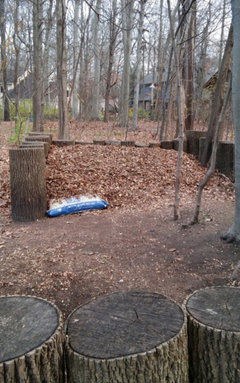
You won't like my comment but I would ditch the tumbler..to be fair I've never had one but I've been composting successfully at least 16? 17? yrs..I forget exactly when we started..I took some gardening classes last spring and one class was devoted to composting..nobody liked tumblers..there were several in attendance that had tried them..both instructors preferred open piles..I think ground contact is important..good for drainage, biological activity and wouldn't ground contact create more heat?..I think a tumbler sounds like more work..I would need 10 tumblers to hold the amount of debris that we have..we're blessed with millions of leaves..I don't turn it or water it and our compost is still great..and it has NEVER smelled bad..I'm very particular about what I put in it (no meat,dairy etc)..we chip the debris..when I want some compost I grab from the bottom..this is our compost pile..a pile surrounded by free logs from the neighbors..
hope someone that uses a tumbler can give you advice..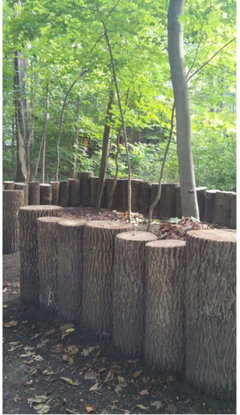 found a better pic showing the pile..unchipped the leaves take up 10 times more space..
Bobbie (8b)
Original Author8 years agoThank you for the quick response. I fear you may be right about this. But I'm really hoping to make it work because, quite frankly, it wasn't a cheap gift. I also have no idea where I would put a pile on my postage stamp sized city yard.
Related Professionals
Cookeville Landscape Architects & Landscape Designers · Gary Landscape Architects & Landscape Designers · Oshkosh Landscape Architects & Landscape Designers · Palm Desert Landscape Architects & Landscape Designers · Alexandria Landscape Contractors · Elizabeth City Landscape Contractors · Portsmouth Landscape Contractors · Kalispell Landscape Contractors · Wenatchee Landscape Contractors · Myrtle Beach Stone, Pavers & Concrete · Ottumwa Stone, Pavers & Concrete · Saginaw Stone, Pavers & Concrete · New York City Stone, Pavers & Concrete · San Bernardino Stone, Pavers & Concrete · Pocatello Stone, Pavers & Concrete- 8 years agolast modified: 8 years ago
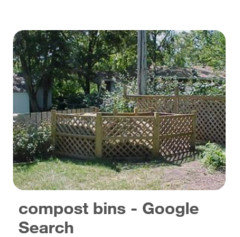
I have half an acre now but the yard where I started composting was small..we put the pile in the side yard..we had a privacy fence so it wasn't an eyesore..is it possible to return the tumbler?..you can put fencing or shrubs around a pile to disguise it..to be honest I prefer to see a nice looking boundary around an open pile rather than a tumbler..we planted shrubs last fall around our bin..someday it will be hidden..maybe a smaller version of this?..
Bobbie (8b)
Original Author8 years ago8B
I did go out and check on it again after this post and when I started digging around in it, I realized it had somehow gotten WET inside. I think at some point I must have left the door side a little too upward and it caught rain. Anyway, I've added more shredded paper and aimed the door down so hopefully it'll start drying out a bit. Not sure if that's enough though. I may need to leave the door open on a dry day so make any progress on that.
 8 years ago
I've never used one but have heard many times from others that the contents of tumblers are frequently too wet. They just don't evaporate water away like a regular pile will; evaporation will condense and stay in. Wet leaves likely mean it is very wet for hot composting. Figure that kitchen scraps are probably 90 percent or so water. I doubt this info helps much but if you want to keep using it, inputs as dry as possible.
Bobbie (8b)
Original Author8 years agoI think you're right. At this point, I'm hoping I can leave the door open during these sunny dry days we've been having and let some of it evaporate out. I'm not sure what else I can do. If I add much more paper, I'll throw off the N:C ratio.
Bobbie (8b)
Original Author8 years agothere is 1 small air vent on each side. Probably not enough to help with the amount of moisture that's in there. So it sounds like I need to 1, make a habit of letting the kitchen scraps dry out for a while before adding them, and 2, figure out how to get rid of the extra moisture that's already in the tumbler. That's the part I'm really not sure about. And, is that moisture my primary problem?
- 8 years ago
Bobbie, can you post a photo? As armoured mentioned, the number 1 complaint among tumbler users is too much moisture. An image of the entire tumbler, as well as one showing the vent holes, could help us give better advice. I'm inclined to suggest that you drill a few more holes (as well as get practice on leaving the door open,) but I hesitate to say that with confidence until I see what it looks like.
There are tricks... for example, one of the top ingredients from kitchen scraps is coffee grounds. The good thing about that is they are easiest to dry out without molding or offensive smell before being added to the tumbler. Once dry, they can be added straight to the tumbler and will help absorb moisture from the mass. - 8 years agolast modified: 8 years ago
OK. I've been using my compost tumbler (a big one) for 20 years and I love it. Here's how to make it work (for me, anyway.)
I have two big piles outside of the tumbler, one is autumn leaves from last fall. It's a huge pile. The other is mowed grass (or mowed weeds and grass. I'm not one for "lawns.") I combine the two ingredients, 3x the leaves than grass (3:1, C:N). I wet it all with the hose...a lot of water, maybe 3 bucketsful. Then I turn turn turn till all is well mixed, turning backwards and forwards.
After a few days, I feel it and it's hot in the middle. Yay! I let it sit a few more days and then turn it many times to mix again. Let it sit for days. Mix thoroughly again. It's wet and it has lost half the volume already. After about 3 weeks, it's as broken down as it's gonna get in a tumbler. At this point it makes fantastic mulch for the garden.
I dump it all out onto a tarp, cover it with another tarp, and keep adding to it all summer. It finishes breaking down into beautiful compost. By fall I have used up all the leaves. The grass is still coming which gets saved on its pile for next spring.
Only once in 20 years did it turn moldy. I just let it sit longer and turned it more, and the mold disappeared and it was just as beautiful as all the other times.
I love this method because I don't have any backbreaking mixing to do. The tumbler is EASY. I use a small trug to load the stuff from the piles into the tumbler and also into the garden. That's the hardest part of the labor.
- 8 years ago
susanzone5..you said "it's as broken down as it's gonna get in a tumbler" tells me that a tumbler doesn't do a complete job..you're doing much more than tossing debris in a tumbler..we chip it and forget it..I still say an open pile is easier..mother nature does the work..my only complaint about it is that it's not pretty..but tumblers aren't pretty either..I'm working on a disguise..logs surrounded by a mixed shrub hedge..
- 8 years agolast modified: 8 years ago
Nicholsworth, do your thing! Whatever works for you. I use the product for mulch which breaks down in the garden. I can't stand turning piles with a fork. This works for me. My tumbler and piles are behind my garden out of sight.
I used to do piles on the ground but they take all year to make compost. The tumbler takes a few weeks for usable mulch. Yes, there are pros and cons to any method. We do what we like as gardeners.
Bobbie (8b)
Original Author8 years agoI'm really not concerned about what's easier. I just want to get this to work. I have the tumbler and have no intention at this point of giving up on it. It's my very first batch and only a few weeks in, so I think there's plenty of room to learn and tweak what I'm doing. At some point, I may find a place to start a pile as well, since that no doubt has some unique benefits over the tumbler.
I appreciate the advice I'm getting so far, and will post some pictures tomorrow!
- 8 years agolast modified: 8 years ago
susanzone5..Agree that each of us garden as we like and do what works for us..I like hearing what others do..this is a fall pic of our house..trees are bare but can you imagine the amount of leaves that we get?
NO tumbler could accommodate them..because we chip our debris it breaks down well..we could turn it but it didn't seem to matter so we don't bother..I admire your effort to compost..actually after we chip the debris can be used immediately..it's mostly leaves and shredded leaves make great mulch..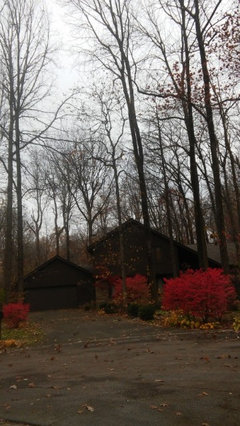
 8 years ago
Chiming in! I got a small compost tumbler for my birthday, and after i got it, I heard all about how it is impossible to get compost from these. However, here is how i use it, and why it works for me. I wanted to primarily have a use for the kitchen scraps and did not want to deal with the negatives of a pile in the back yard (mainly critters and a curious dog). I also have limited access to leaves. So everyday I throw my kitchen scraps (chopped up as much as i have time for), coffee grounds, and about thrice as much shredded paper, cardboard, or leaves. The first time in summer, I had a nice sweet smelling compost in about 3 months. After that it's been slower, but I am still throwing my things in there, the volume as they disintegrate shrinks and lets me add more, and I turn it a few times when I add the new stuff. It's all slowly turning into compost. I plan to stop adding to it when it is nearly full, and then fill up the second chamber, in which I already have a pile of shredded paper waiting.
So yes, my compost tumber does eventually work, is odor free, rat free, bug free. Is it fast? No, but does it take care of my primary purpose, a place to dump my kitchen scraps and coffee, yep! It will eventually get used like the first batch I made, but is way slower.
I think the key to not having odor or maggots is to make the ratio closer to 3 or 4 time as much paper/leaves as kitchen waste (by which I mean vegetable trimmings and fruit peels etc) and that has kept me and my tumbler busy!
Hope this helps in not making you feel like the tumbler is a waste or can't be used!
- 8 years ago
kcandmilo..I lived in San Mateo for 5 years and I remember talk about rats on the news!..probably good that you don't have an open pile..I live in a woods but we've never had rats..we have owls and hawks that attack rodents..
Bobbie (8b)
Original Author8 years agothanks kcandmilo! Yeah I have 1 small maple tree for leaves and will be using primarily shredded paper after that. I did read that with tumblers it's more effective to add batches all at once, otherwise it goes more slowly if you keep adding to it. So my plan is to get one chamber full within 1 week, and then not add to it until it's ready to be turned out. Even if it shrinks down to half full. My city collects and composts all my yard waste and kitchen scraps in a 90gal bin every 2 weeks so luckily I'm not really wasting anything in between batches. At this point, I'm wondering if I should dump what I have into my yard waste bin, let the city take it, and start over.
- 8 years ago
Nicholsworth, exactly!! Also my house backs onto a creek which seems to be the local critter highway. I have raccoons that play in my water fountain, skunks that terrorize me and the dog at night, a possum family and two ducks which land in the yard and fly away at night with a whoosh that scares the life out of me when I go out late!
Bobbie, I would just add a load of shredded paper or sawdust, and keep going! I think you're problem is too much green and moisture! Too much paper will at worst slow down the process, but not cause any other issues!
KC
- 8 years ago
kcandmilo..when you mentioned raccoons I remembered that early one morning in San Mateo we heard some noise and there was a mother raccoon with 3 babies sitting on the fence..and we lived in a typical city neighborhood..few trees..no creek..just houses too close to one another..
 8 years ago
I am happy to make the case for compost tumblers. If you live in the city or suburbs and want to compost, building a pile on the ground isn't always practical. The biggest issue is rats, followed closely by racoons. The third issue is the neighbors - not that they are pests, but they may object to seeing your compost pile out their windows or complain of you attracting critters that also visit their yard.
In this circumstance, a tumbler is the best alternative because it is off the ground and enclosed and critter-proof.
However, the the rules of composting still apply and to get heat you need a minimum critical mass of material of at least a meter cubed. And bigger is better - especially if you want to keep them going through the winter.That rules out 90% of the compost tumblers sold. They are too small to get hot. That doesn't make them useless - but it does mean that they will really only work during the summer and will take longer to process a small amount of material than if that same material were in a bigger active pile.
Of course bigger size also means harder to turn when it is full. That might not be a problem for a young healthy adult male, but others might want to make sure that there are large handles, gears, or an otherwise well balanced mechanism for turning that much material.
You also have to consider how long you want the tumbler to last. Most are very cheaply made and with weather and the pressure of being full the plastic will split and weak parts will break off and need to be replaced in a couple of years.
If you want a tumbler that is big enough to heat up, reasonably easy to turn, and made of strong materials that will last a decade, you can find them. But they are expensive. An example is this Jora model which sells for about $400.
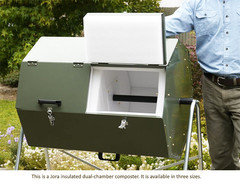
(I know! I can buy a lot of bags of compost for $400.)
So, that's the pros and cons of tumblers. They are perfect for city composting, but good ones are expensive and cheap ones usually fail to keep up with even the kitchen scrap output of your average couple, much less a family.
- 8 years ago
Thanks for the recommendation of a good model, Richard. Will drop notes with the details around the home around birthday time...
KC
Bobbie (8b)
Original Author8 years agolast modified: 8 years agoI'm confused about the cubic meter part. A m3 would be 260G or 35ft3. It would be impossible to get a tumbler that size. The jora doesn't appear to be any larger then any others, with the max size being 104G/14ft3. (for $800!!). The example shown is only 70G, 9ft3. So I'm wondering how important this truly is. It seems like no compost tumbler would actually work if this was the case.
- 8 years ago
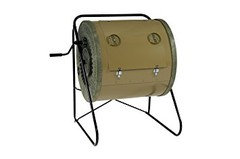
Here's the one I have used for 20 years (see post above.) It's a Mantis CT02001, 88 gallons. Turns easily. Empties easily. $344 on Amazon.
- 8 years agolast modified: 8 years ago
The cubic meter rule of thumb is basically about having sufficient mass to retain heat and allow the temperature to get up and stay up (heat loving microbes reproducing fast enough and digesting fast enough to keep the temperature in the right range). Smaller piles will lose heat more quickly, outdoor temperature and sun exposure will make a difference, effectively parts of the pile serve as insulation. So as I understand with some of the tumblers, the idea is that insulation keeps enough heat in to allow this chain reaction to keep cooking away. How well it works, I do not know. Since a common complaint about tumblers is that they don't get to hot composting, not all work well at this - but keep in mind of course the ability of a pile to get hot is also dependent on the ingredients.
- 8 years ago
Nicholsworth, I live in the woods, too. When all the leaves have fallen, we mow and collect them. The pile is HUGE, about 12 feet across and 3 feet high. That, with all the "grass" gets used up by the end of summer. It goes fast.
I don't use any paper or cardboard. I did a search for chemicals used in paper manufacturing and didn't think I wanted to eat food grown in it. There must've been 100 chemicals. There are people who will argue this but I remain firm. No paper.
I used to pick up leaves my neighbors left on the street for pickup when I did compost in the city neighborhood I used to live in. - 8 years ago
"There are people who will argue this but I remain firm. No paper."
Lol... don't worry, you're not alone! I feel exactly the same way. I don't post my preference here because so many people are adamant about it not being a problem, but I leave paper and card board either for recycling, or the wood stove. When I was younger I did a study on paper manufacturing, and oh my... the chemicals are horrific! It's one of the most polluting manufacturing processes being practiced today.
I won't even use cardboard for weed suppression. In fact, the only paper products that enter my compost piles are the filters from one of the coffee shops that save me their grounds. And even then, I pull them out when I see them.
Oh well, it's a personal preference, each person can do as they wish. - 8 years ago
susanzone5..I have never put paper in my pile..I never run out of organic matter haha..that pic I added above shows the CHIPPED leaves..even chipped they wouldn't fit in a tumbler..but all of yours don't fit either right?..we both have so many leaves..
- 8 years agolast modified: 8 years ago
Nichols, it only takes a few weeks to get what I want out of the tumbler. I fill it many times. So by the end of the summer, I've used up all the leaves. The tumbler is BIG, too, which helps.
- 8 years agolast modified: 8 years ago
susanzone5..so you fill, empty and refill until all of your leaves go thru the tumbler..I admire your effort but I don't want to move it so much..we're lucky in that we have space for a bin..no problems with rats..lots of organic matter..we own a chipper..we're physically able to do it..last fall I planted 5 climbing hydrangeas next to it to climb up the logs..a rose of sharon, 2 viburnums, a paniculata hydrangea and 3 euonymous shrubs..someday it will be out of sight but in our wooded setting it fits in even right now..
- 8 years ago
Not to hijack the conversation, but since i have limited access to leaves, I researched paper and cardboard in compost a lot, and found that the information about toxic chemicals is pretty outdated, and OSHA and other environmental reasons meant that the toxic dyes and chemicals were no longer used, and that paper was just as good or bad as grasses and leaves. I know there are contrary opinions as above, but I thought I would add my gleanings from the world, included the Sierra club, which I have not added as one of the links refers to it.
http://greenactioncentre.ca/reduce-your-waste/myth-you-cant-compost-paper/
https://www.the-compost-gardener.com/-composting-paper-is-it-safe-.html
KC
- 8 years ago
CHEMICALS USED IN PULP & PAPER MANUFACTURING AND COATING
From a pulp and paper manufacturing website:
Common NameChemical NameChemical FormulaUsed ForSpecific DensityOther CharacteristicsAgalite or TalcSilicate of MagnesiaMgO-32%, SiO2-62%It gives paper a greasy or soapy feel. and enables it to take a high finish.2.6 - 2.8A natural fibrous form of talc, gray in color.AKDAlkyl Ketene DimerSizing
AlumSulfate of AluminaAl2(SO4)3.18H2OFor alkaline sizing along with Rosin1.62AlbarineNatural Sulfate of LimeCaSO4.2H2O - 100%A calcium salt that is used for a variety of purposes including: building materials.2.4
Ammonium Zirconium Carbonate(AZC)Ammonium Zirconium CarbonateCH2O3NH3ZrUsed as in-solubilizer, crosslinker & hardener1.36AZC is a clear, usually colorless solution, having an odor of ammonia and a pH of approximately 9.5. As a carbonate, it will react with acids, and so should not be used in coating systems below pH 7. In storage, it is stable for up to six months.AnthraquinoneAnthraquinoneC14H8O2Added to white liquor (alkaline cooking liquor) to improve pulp yield and to increase the rate of delignification.1.44yellow crystalline powderAnti-Foam/Defoamer
To prevent foam (anti-foam) or to destroy it once it has formed (defoamer).Surface active, but highly insoluble in water.AsbestineSilicate of MagnesiaMgO-32%, SiO2-62%It is used as a loading agent in paper manufacture, particularly for blotting papers and board.2.6 - 2.8A mineral compound of almost pure fibrous magnesium silicate, which possesses physical characteristics between those of talc and asbestos.APEAlkylphenol EthoxylatesCH3(CH2)n(C6H4) (OCH2CH2)m-OHUsed as cleaning agents or surfactants
ASAAlkenyl Succinic AnhydrideSizing
Barium SulfateBarium SulfateBaSO4 - 100%Used as a pigment4.2-4.5White insoluble powder.BarytesBarium SulfateBaSO4 - 100%Used as filler4.2-4.5Blanc FixeBarium SulfateBaSO4 - 100%Used as a base for watercolor pigments and as a filler in paper.4.2-4.5Powdered barium sulfateCaseinA milk phosphoprotein Binder or adhesive in coating formulation CMCCarboxy Methyl Cellulose
Sizing
Caustic Lye or Caustic Soda or LyeSodium HydroxideNaOHPulping and to maintain pH
Chalk (Precipitated)Precipitated Calcium CarbonateCaCO3 - 100%Filler particularly with acidic sizing coating pigment2.7-2.9High Brightness & OpacityChalk (French or Spanish)Silicate of Magnesia4MgO+5SiO2+H2O; MgO - 33%; SiO262%2.6-2.9A soft white compact talcChina Clay, KaolinHydrated Silicate of AluminaAl2O3-40%; SiO2-46%; H2O-13%Filler, Coating2.4-2.7
Chlorine DioxideChlorine DioxideClO2In Pulp Bleaching2.86
Chlorine GasChlorineCl2In Pulp Bleaching and water treatment2.86
DolomiteCalcium Magnesium CarbonateCaMg(CO3)2Filler, Coating2.86
DTPADiethylene Triamine Penta Acetate
Used for chelation (removal of transition metals from pulp).
EDTAEthylene Diamine Tetra acetic AcidUsed for chelation (removal of transition metals from pulp).
Guar GumNatural PolymerDry Strength Additive
cationic derivativeGypsum or Mineral White or PlasterNatural Sulfate of LimeCaSO4.2H2OGypsum board,2.4
Hydrogen PeroxideHydrogen PeroxideH2O2In Pulp Bleaching3.13-3.4
LimeCalcium OxideCaOAlkaline Pulping Process Chemical Recovery, Bleaching3.13-3.4
Lime StoneCalcium CarbonateCaCO3To make Lime Precipitated CaCO3 is used as Filler and in Coating
MagnesiteMagnesium CarbonateMgCO3 -100%2.5
OxygenOxygenO2In Pulp Bleaching
OzoneOzoneO3In Pulp Bleaching
RosinAbietic AcidC19H29COOHSizing
Rosin SoapSodium AbietateC19H29COONaSizing
Salt CakeSodium SulfateNa2SO4. 10H2OMakeup chemical in sulfate pulping chemical recovery (Na2SO4. --- Na2S)2.4Soda AshSodium CarbonateNa2CO3Makeup chemical in alkaline pulping chemical recovery (Na2CO3 +Ca(OH)2 ---2NaOH+CaCO3)2.43-2.51
Sodium DithioniteSodium HydrosulfiteNa2 O4 S2Bleaching2.20White crystalline powder with weak sulforous odorSodium SilicateSodium SilicateNa2SiO3In waste paper deinking for wetting, peptization, ink dispersion, peroxide stabilization.
Starch.Comprised of glucose units linked together by oxygen bridges called glycosidesWet and dry end additive
SulfurSulfurSTo make HSO3 for bi-sulfite pulping
TitaniaTitanium DioxideTiO2Filler to increase the opacity and brightness of paper. Used in coating also.3.84-4.26 - 8 years agolast modified: 8 years ago
The problem with links to websites is that there are just as many that say exactly the opposite. Here's just one... Why Your White Toilet Paper is Toxic
Here's another... http://www.nontoxicliving.tips/blog/let-natural-cloth-wipe-away-paper-towel-waste
Yet another - from Rodale no less... Should You Be Worried About Chemical Exposure From Your Toilet Paper?
One of the issues that make a group, or even an individual, look at the subject in different ways is in their motivation. Paper is one of the most discarded substances on the planet. It contributes to landfill space, and roadside pollution. If this is the most important issue in a person's mind, or a group's agenda/motivation, then composting paper is a good thing.
However, for those of us who grow food for health and wish to avoid such chemicals as dioxins and formaldehyde, then putting paper in our compost piles is a big "no thank you".
- 8 years agolast modified: 8 years ago
I do put the small brown cone shaped coffee filters that we use into the bin..I tear them up and they completely disintegrate..that's the only paper I've used..in fact I forgot they're paper when I said I don't compost paper..I have plenty of debris and didn't need any paper..are coffee filters safe?..I buy brown Melitta..the info on chemicals in paper is disturbing..
- 8 years ago
Oh I totally understand, but felt that for people reading these threads, as I do, it's useful to have a contrary opinion, so that they can be motivated to make their own investigations. I know that my readings led me to think that adding paper was the lesser of evils, and obviously the ones above disagree.
- 8 years agolast modified: 8 years ago
Nicholsworth, your question about coffee filters illustrates an important point.
You drank what leached out of that paper. If THAT was safe to drink, why wouldn't the paper be safe to put into your compost, which you don't plan to eat anyway? In fact, it is - it's food grade paper to begin with, because it's in contact with food.
I don't want to take this thread farther afield, but as an env. chemist interested in the safety of products and the fate of chemicals in the environment, I feel a LOT better about paper than I would have 20-30 years ago. Many of the 'chemicals' in the list posted above are benign - minerals that occur in soil naturally. Others like detergents are in many products we use every day. As for dioxin, it was vanishingly small to begin with, and the paper industry worldwide has shifted almost entirely from chlorine bleaching (which is how it forms) to oxygen bleaching. No chlorine, no dioxin. Dioxin in paper is a bit of a red herring in this day and age. It would be better if we didn't demand 'white' everything. Who cares if the TP is white as the driven snow? What would be so bad about tan unbleached TP?
That said, if I had reasons to compost paper, I'd use paper with minimal colored inks and coatings. Plain newspaper and corrugated. BTW the glue in cardboard is made mostly from tree sap.
- 8 years ago
toxcrusadr..your explanation makes perfect sense..I laughed at my question after reading your answer..I've been composting filters and grounds forever and never noticed any problems..I've always used brown filters..I love the compost we make..
- 8 years ago
It's a legitimate question for the average gardener to ask though. I just happen to work in the biz, so to speak. A similar question is whether the peelings from non-organic fruits and vegetables are safe to compost for an organic garden. The issues of concentration (of toxins), dilution, media transfer, degradation, plant uptake, etc. are somewhat complex. Not that I have the final word on everything. ;-)
- 8 years agolast modified: 8 years ago
My tumbler is empty from October to April. Doesn't work over winter. I have a huge pile of finished compost/mulch under a tarp waiting to go into the spring garden and a huge pile of autumn leaves waiting for the first mowing of green stuff to begin the mixing for this year.
Bobbie (8b)
Original Author8 years agookay Irving and Susan, you guys have confirmed what I was thinking. I'm going to start trying to dry it out, and see what happens in April. I may end up emptying it and starting over then, but I'm willing to give it a couple weeks once things heat up, to see what it can do. In the mean time, I'm definitely going to start leaving the door open on dry days. THANKS!
- 8 years ago
Trouble is, what do you do with your kitchen scraps in the meantime? Irving is right.
Re susanzone5's post, compost may not do much over the winter but unless you're in a totally frozen climate, it will do something, even if slow. I don't have a tumbler but I layer my kitchen scraps into my bin with fall leaves, all winter. Whenever the temp is above freezing the microbes can work a bit. And the freezing and thawing breaks up cells and fibers to make the organic matter more accessible to microbes later.
If you have somewhere to put this half done tumbler batch to finish - a small wire cage on the ground, or just a pile - you can start a new batch in the tumbler so you don't have to throw out that valuable organic matter.
That's kind of the problem with a tumbler, or any compost bin really: once you have one, you kinda need a second to keep things moving along.






Irving Ragweed (Austin 8b)