Software
Houzz Logo Print
chelsea_913

Composting tree stump grindings

8 years ago

I could post this on the Soils and Compost forum but this one is more active right now. Last week we had an ailing elm tree cut down as it would have become a safety issue within a year or two. The branches were chipped and are going to be used as mulch in the garden because they’re still quite large (1-2”). The company also ground out the large stump and left us a large pile of stump grindings which are darker in color and much finer (the pieces range in size from grains of rice to about Tic Tac size). From my reading, it seems that the stump wood contains more nutrients than the limbs and branches, so I’d love to compost some of the stump grindings for use next spring. Also, there is quite a bit of topsoil mixed in with the stump grindings, especially at the bottom of the hole.


Question: Is one year too short of a timeline for composting wood shavings? Given that they are heavy in carbon, should I just make sure to mix plenty of nitrogen into it when creating my new pile? How will I know next spring if they’re composted thoroughly enough? I’d hate to put unfinished wood chip compost into my beds because I know it could tie up nitrogen.


During the winter when it was too cold to trek out to our other compost pile, I would put kitchen scraps in a plastic bag labeled “compost” and stick it in the basement freezer :-) If I thawed out all of these, it would be a significant amount. I could also ask for coffee grounds at local shops around my house.

Comments (10)

  • 8 years ago

    Just mix it in with the rest of your active compost. Wood shavings of that size will be gone/digested in no time! Just keep your C:N ratio in the suggested range and the compost activated or turned.

  • 8 years ago
    last modified: 8 years ago

    As to composting wood chips, that can happen at high C:N. It just takes more time. I routinely compost pure fallen (brown) leaves. It works. When the chips lose their physical identity, such that you have thoroughly soft and not clumpy or chippy material, it's pretty well cooked. If you don't happen to have lots of green around, certainly throwing some lawn fertilizer (ammonium nitrate or urea) on the pile will help speed things up.

    Maybe someone has the answer to this. I've always been puzzled about
    greens turning into browns, and what actually happens to the nitrogen,
    which is mostly in chlorophyl. Where does the nitrogen go? Certainly
    chlorophyl breakdown is a well established biochemical process. I once
    heard that the process of leaf senescence (as in, leaves turning color and falling off) involved nitrogen-containing proteins being sucked back into the tree branches. If so, one might assume that trees whose leaves have naturally fallen off might have quite a bit of nitrogen in them. Conversely, when green leaves form in the spring, where does the nitrogen come from to make the chlorophyl? It's certainly not getting pulled out of the air. But the standard assumption is that C:N in wood chips is huge. Any smarts out there on this point?

  • 8 years ago


    Thank you both! My two current compost piles (built in mid-summer last year) are almost finished up so I’ll empty those in a month or two and start a new one for the wood chips now. Anything from last year’s piles that hasn’t finished composting will go into the new one as well.


    Dan, I am very curious about your questions as well since about 70% of my almost-finished compost piles are brown leaves. The other 30% is plant trimmings from last fall and kitchen scraps.


    Since it’s spring here and the tree that was cut down was about to leaf out, surely there’s some nitrogen in the branches somewhere…or in the trunk…because the only other place that we didn’t grind/chop up is the roots. Anyone have experience with biology and/or arborist training?

  • 8 years ago
    last modified: 8 years ago

    "Of course, that means that adding a branch-worth of green leaves to help compost that branch isn't going to help much."

    Agreed.

    I've read that wood chips come in at 100 - 700::1 (C::N); with an average of like 400::1. This is borne out by experience. Every summer, when the green leaves are chipped along with the branches, I get truck loads of wood chips delivered by the company that trims the utility lines. The material sits all year until spring (it gets very hot, fairly soon after dumping, but I neither have the means, nor the space to turn the piles to speed up decomp.) By this time of year (this is the end of Feb. of course,) the piles are ready to be sifted. I get lots, and lots of excellent compost from the pile. However, I also get lots of large chips barely reduced in size for use as mulch on paths. These large chips are a little decomposed, but there is just not enough nitrogen in the green leaves of the chipped branches to finish the job. In fact, I use these chips (especially the smaller 'fines') in the next year's yard-waste compost piles as a 'brown' ingredient. I surmise that the compost I extract is, in fact, mainly made-up of the formerly green leaves - with some of the exterior of the wood chips (as well as the smallest of twigs.)

  • 8 years ago

    That makes sense. You can compost the lot, and then just sift out the bigger chunks that didn't finish composting. But it sounds like the pile the OP is referring to is all pretty small stuff.

  • 8 years ago

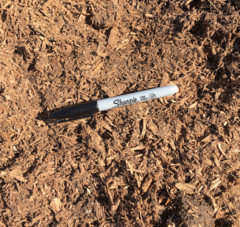
    Thanks for the info, rgreen! I did notice the larger pile of wood chips steaming two or three days after it was dumped. For reference, here's a picture of the stuff I'm thinking about composting. Sharpie for scale. Now that I look at it, it's a little larger than I originally described, but the majority of the pieces are quite small. I'd describe it as a "fine mulch."


  • 8 years ago
    last modified: 8 years ago

    Composting that stuff should work fine. Just be aware that it's mostly carbon, and since it's so small, it looks like it will compact when wet (too wet, and too compacted, are not the best circumstances.) I'd use it as a base carbon for high N materials, and I'd turn the pile fairly often - keeping it loose, and mixing in air as needed. With enough nitrogen, it should breakdown fairly readily. You'll know it's ready when it has the look and consistency of other finished composts, and has a nice earthy smell.

    You could also use it as a mulch if you wished.

  • 8 years ago
    last modified: 8 years ago

    The Ask-the-Expert response was as I anticipated. Yes, trees do suck nitrogen back into their branches when the leaves undergo senescence. So, in principle, branches from trees that already lost their leaves have a bit more nitrogen in them than branches that were harvested when full of leaves. But the nitrogen so absorbed doesn't change the C:N ratio of the branch wood all that much.

  • 8 years ago

    That's very interesting! Thanks for asking the experts, Dan! I'll start a compost pile with some of the fine wood chips this weekend and use the rest of them as mulch!