Software
Houzz Logo Print
mattp321

Shrub transplanting

8 years ago
last modified: 8 years ago

Okay I’m planning on transplanting a bunch of shrubs tomorrow... you all talked me into waiting til now and not doing it in the fall... I just want to ensure I’m doing this correctly:

First I dig the destination hole. (I should or should not dump some biotone pellets into the hole?)

second, I dig up the shrub, by using a spade to cut a circle around it (what diameter circle??)

third i lift and position the shrub in the new hole... backfill with dirt. (Same ground level or a few inches higher???)

last, i water it heavily. (Do I need to continue to water even in late winter, or just one and I’m done?)

thanks!!!

Comments (16)

  • 8 years ago

    How large are the shrubs you are moving? How long have they been in the ground?

  • 8 years ago

    1) have no idea what biotone is but root simulators or starter fertilizers are not needed when transplanting.

    2) can't tell you - have no idea how big the shrubs are you intend to move. Generally you will start out at the dripline but some shrubs will have a root system that will extend beyond that. Just try to take as much of the root ball as you can possibly manage.

    3) I prefer to plant everything slightly high.....it's always preferable than too low.

    4) Water thoroughly after planting and then again as often as needed.

  • 8 years ago

    if you link to the old post.. you might not need to repeat the history.. type of plant.. soil type ... flowering info, if any ... etc ...


    i like the planting guide below ..


    ken

    ps: if they were doing fine in your native soil ... why would you now need to juice them ... fert is not really a response to the stress they will be going thru ...


    https://sites.google.com/site/tnarboretum/Home/planting-a-tree-or-shrub

  • 8 years ago
    last modified: 8 years ago

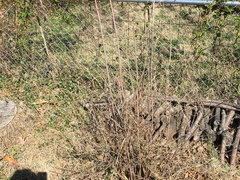
    I just went outside and took a photo, here’s an example of one getting moved. It’s currently 48” tall and 36” wide (at widest reach). Was planted in spring 2015. Mail ordered this from Gary at classicviburnums.com so it arrived bare root and cut to maybe 16” tall.

    V. Dentatum

    PS - ken your guide has me rethinking my transplants as there are indeed overhead wires... need to ensure I put something short right at that spot... forgot about that.

  • 8 years ago
    last modified: 8 years ago

    If these are all deciduous shrubs bare-rooting would be preferable to cutting the roots way back in order to get an intact soil ball that you are able to move (dirt is heavy). Otherwise this is yet another one of those subject areas where comments on a web forum can unfortunately only do so much to make up for a given poster's lack of personal experience with a particular operation. One point I will however bring up at this juncture is if you are going to be cutting around these with a spade, digging them with soil balls do not pry until you have first cut all the way around. I mention this because the common tendency to stab in the spade (or shovel), then pry each time before going on to the next insertion of the tool into the soil can easily result in the breaking up of the ball - or worse - before you even get the plant out of the ground.

  • 8 years ago


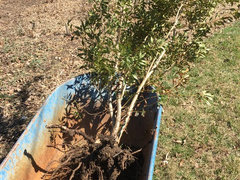
    Embothrium I tried to do it your way but we have our first casualty here... an inadvertent bare rooting of a morella cerefia... do you think this will survive or have I killed it? Should I immediately cut back the top growth?

  • 8 years ago

    No cutting back of top growth!! The shrub needs those leave to feed the root system and encourage root regrowth.

    The Myth of Top Pruning Transplanted Material

  • 8 years ago

    though there may be leaf loss .... and perhaps some future loss.. but the shrub is in charge of that ... we can prune it clean next season ...


    even if it loses all its leaves.. look for new buds or growth ... to show you the root mass moving was a success ...


    ken

  • 8 years ago
    last modified: 8 years ago

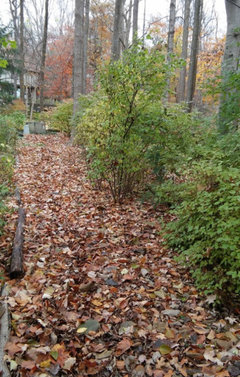
    we moved this very large viburnum dentatum (center of pic) last summer..it has an imperfect shape but we didn't remove one leaf..as ken said prune it next season..we used a garden fork and loosened the dirt completely around the shrub before attempting to lift it..we left a large root ball..moved it in our sturdy garden wagon..husband pulled the wagon I walked alongside holding it upright..we watered frequently and it seemed fine..we beefed up the back hedge with a "free" plant that was instantly big..we didn't want it where it was so if it dies we'll live with that but I think it's going to be fine..it's not planted too deeply (we're aware of that)..we dump leaves in that path and it's full in this pic..this is our back property line..we've successfully moved a fothergilla, limelight hydrangea, snowball viburnum, 3 burning bushes and now this dentatum..ALL were large..IF you're patient AND careful it can be done..FYI we didn't fertilize but did put homemade compost on the surface after planting..

  • 8 years ago
    last modified: 8 years ago

    Embothrium I tried to do it your way but

    Notice I said if these are deciduous shrubs bare-rooting would be preferable. And that the advantage would be a larger root system than when chopping roots down to get an easily lifted soil ball. You instead took an evergreen shrub and dug it with a significantly reduced ball, which you bare-rooted on top of it. This takes us back to what I said about the limitations of trying to find out how to do certain things via a web forum.

  • 8 years ago

    btw .. some of the conifer mavens. ... rig up a shade cloth for the first year or two .. in an effort to reduce leave sun stress during that first season ...


    its can be as simple as two tall stakes with burlap ...


    the idea is to reduce direct sun impact while the roots have time to restart.. and to grow enough to support the leaves ...


    ken

  • 8 years ago

    @gardengal48 (PNW Z8/9), I would have argued this theory until recently. We transplanted several large shrubs, and did it both ways. All were what are thought of as not great candidates for t-planting (3 different raphiolepis varieties). All have survived 6-12 months later. The one that did the best was a large (8'w x 5'h) majestic beauty that we pruned <5%. Never skipped a beat. Those we pruned >50% did the worst, and their likely level of successes may have been due to the quality of rootball retained.


  • 8 years ago

    re pruning


    gardengal

    I looked up the link you gave which is great

    read the article about pruning


    would you treat roses differently? (tea hybrids or polyantas)


    so far I had great success when planting bare root or transplanting older ones, pruning off most canes, like 3/4.


    they all regrew nicely and with vigor.


    and I watched a group of transplanted roses (about 5), unpruned, which were not watered after transplanting (well logistics) they shriveld away.


    in this case I think they would be alive had they been pruned.


    hmm, difficult to throw overboard long-ago-learned stuff, though I`m all for asking WHy etc.

  • 8 years ago

    I'm pretty sure it was the failure to water which finished off your roses, not the lack of pruning. You absolutely must water transplants.

  • 8 years ago

    when i did foo foo roses .. almost all were mail ordered ... and came with 6 inch canes ... and a root mass .. i never lost one at planting ... but i did water them ... besides the fact.. that time of year.. the soil was constantly moist ... but for a splash of water at planting.. to settle the soil ... i usually dint have to water for a month or two ...


    when moving anything.. TIMING is the key ... the mail order came.. a couple weeks after the ground thawed .. and had at least 6 to 8 weeks before summer heat started to build ...


    if i had ever wanted to move one.. i would have done it at the same time of year.. and after i had dug it up.. i would have pruned it to look like the mail order ...


    i would never have tried to do such.. in my zone ... between june and sept ... i just couldnt control the important variables.. like water ...


    in the OP ... i think his timing is spot on.. hes giving the plants the best he can.. in regard to timing ...


    ken

Sponsored
Miller Woodworks
Average rating: 5 out of 5 stars23 Reviews
Franklin County's Trusted Custom Cabinetry Solutions