Software
Houzz Logo Print
oladon

What Are You Growing?

8 years ago
last modified: 8 years ago

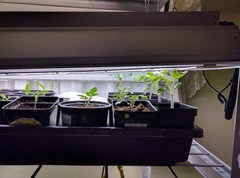
This year I went all out on my planning spreadsheet... and as you can see, I'm doing a lot better than last year in terms of what I've started so far.

Peppermint, lavender, basil (sweet and cinnamon), and rosemary are doing well, if growing slowly -- that's what they do, as I understand it. (The basil's growing faster than the rest, of course.)

Onions seem to have stagnated around 2.5", which seems to happen every year... not sure what I'm doing wrong there.

Tomatoes are having a great year so far, with quick germination for most of them. I'll see if I can put up some pictures tomorrow to brighten up the thread. :)

What's everyone else growing, or planning?

Comments (16)

  • 8 years ago

    So far I have lettuce, arugula, bok choy, Swiss chard and rosemary in the cold frame. Indoors onions and a few cool weather greens. Soon peppers will be started. I'll wait until about April 7th to start tomatoes. The mid tunnel with the automatic opener will be ready for transplants and direct seeding in about a week.

  • 8 years ago
    last modified: 8 years ago

    Wow, Oladon - that's a lot of work! Nicely done! I wish I was organized enough to update something like that regularly. I've tried numerous times with good intentions, but poor outcomes.. :)

    So far I've started onions, peppers, micro tomatoes and herbs (basil, oregano and thyme) indoors. I transplanted the tomatoes and most of the peppers into 3" containers yesterday. I'll start my garden tomatoes in mid-late April for plant-out the Thursday before Memorial Day.

    I was going to start my direct sowing outside today, but had other household chores to get to and now the wind is really starting to scream. I will start radishes, lettuce, peas, cabbage, etc. next weekend in earnest.. or maybe a few evenings this week after work if I feel so inclined. I'll also begin transitioning my onion seedlings outdoors during the next week, though they are VERY tough and probably don't need much hardening off.

    Next weekend will also be a good time to pull last season's root balls out of all of my containers and get the soil refreshed. I always struggle to get myself motivated to do it, but once I get going, I'm relatively efficient. :)

  • 8 years ago
    last modified: 8 years ago

    Oh no! Emma reminded me that I didn't say anything about potatoes! Or, creamed new potatoes and peas! Have to watch my p's and potatoes ...

    Peas - three: shell, snap and snow. Green Arrow, Super Sugar Snap and Oregon Sugar Pod.


    Potatoes - hopefully, the garden centers will have an early russet this year, hopefully! Always early varieties so that I can use the ground for late crops of Asian greens. What should be on-hand are Purple Viking and Yukon Gold.


    Steve

  • 8 years ago
    last modified: 8 years ago

    I only have peas, tomatoes, and watermelon planned for now. Might add some peppers and beans. Growing 'Mosco' pepper again. Need to get some Big Jim / Anaheim and some Poblanos.

    So here is my tentative pea growing list. Space is of concern so i
    figured i can reasonably plant 10-12 varieties. But looks like i'm
    pushing that to 14. The rest will not be grown unless i have room. They
    are more or less in preferential order by priority. Since i do not have
    many varieties with highly wrinkled seeds, and since highly wrinkled
    seeds correlate to one form of sugar genes i have separated out only the
    most highly wrinkled for three populations.

    One is from the unknowns that got all mixed up when sorting last
    fall. These could be anything really, but probably have some Opal Creek
    and some snap peas as those have generally had the most white and
    wrinkled seeds. Then i separated out the population i have been calling
    "Joseph's yellows" into basically highly wrinkled seeds, snap shaped
    seeds (bullet shaped and flat seeds), and the rest. I am planning on
    only planting the highly wrinkled seeds and am hoping for some really
    good yellow snow peas. Good Yellow snap peas would be fine as well and
    any yellow snap peas from this population are bound to be better than
    Opal Creek. Then i also did the same with the "purples", a population
    that is mostly Sugar Magnolia, some purple-pod parsley, some residual
    Midnight Snow (bred by Dan Quickert of Purplepeas.net),
    and some potential mixed in red-podded peas or partially-red podded
    peas from mis-identification. These had very few snap shaped seeds so i
    only really separated into most-wrinkled seeds and others. I'm actually
    hoping some of these are Midnight Snow. I'm also hoping to recover only
    hyper-tendrilled plants for those that are Sugar Magnolia as my original
    population had all types. But regardless i figure the most wrinkled
    seeded ones might taste the best. So seems like a good idea. Trying to
    grow so many pea varieties with limited space is tough, so just have to
    prioritize this year. Last year was a good year for seed multiplication.

    Nap Gene (potential open keel trait)*

    Wrinkled Seeds (selected from unknowns)*

    Biskopen's Hybrids*

    Purple Passion hybrid*

    Joseph's Red-Podded*

    Josdeph's Yellow-Podded (most wrinkled seeds)*

    Purples (most wrinkled seeds)*

    Joni's Taxi*

    Jupiter*

    Heavily-Branched*

    Orange-Pod*

    Mighty Midget*

    Large Podded*

    True Mummy's (including a purple-pod crown pea, and a red-seed crown pea)*

    ---

    Delta Dusk

    Heather

    unknown mottled (maple seed coat)

    orange coteleydons

    Pink Flowered Yellow Snow (golden sweet? from ethin)

    Triple Treat

    [s]Dwarf Gray Sugar[/s]

    [s]Biskopen's[/s]

    [s]purple passion[/s]

    As for Tomatoes i am diving back deep into the wild tomato species and domestic-wild tomato hybrid swarm again. For domestics i am driving to Boulder again to get some 'Anasazi' tomatoes again. Still my favorite variety thus far. Good Flavor and has the green shoulder gene. Last year i found a dwarf variety that did fantastic for me in my climate and conditions. I am calling it 'Aft' but it's really known as LA1996. It was a pre-bred line that eventually was used to breed Indigo Rose and the other blue tomatoes. It has the "aft" gene that codes for anthocyanin fruit but it is not a blue tomato, more a dirty speckled color. But did well for me in terms of production, growth in my poor soil, and just overall health. Charming. I would love to cross 'Anasazi' with 'LA1996' and breed a better tomato sited to me. I also have a sprawling yellow cherry tomato i like. I may also plant Joseph Lofthouse's 'Big Hill'.

    As for the wilds I'm helping the large wild tomato project working towards tomatoes that have large genetic diversity, are highly attractive to pollinators, are self-incompatible and thus would be mandatory outcrossers, would be pest and disease resistant, and able to thrive in my lazy / poor soil conditions unlike most highly inbred tomato varieties that generally do poor for me anyway. These are the species / crosses I'm planning on planting this year:

    Solanum galapagense

    Solanum cheesmaniae

    Solanum habrochaites

    F3 Domestic Fern Tomato x S. habrochaites (grew F2 last year)

    Solanum habrochaites aka. Neadermato

    F2 Domestic tomato x S. pennellii (did fantastic for me last year!)

    Solanum peruvianum

    Solanum chilense (did not get flowers or fruit last year)

    and new for this year:

    Different F1 line of Domestic x Solanum pennellii

    F2 Solanum corneliomulleri x Solanum peruvianum

    Solanum lycopersicoides

    Solanum sitiens

  • 8 years ago

    Ya know. Some of us will need education on what you will be doing with these tomato relatives in the kitchen, Keen.


    Wikipedia wasn't any help to even get a glance at several of these plants before I became distracted.


    It's only been a few days ago that I learned that there is something called, "corona," link. There is some information on its use on that webpage. baker Creek sells the seed.


    Steve

  • 8 years ago
    last modified: 8 years ago

    Well I've started a wiki of my own since Wikipedia is so out of date, but it's not perfect (biolumo.com).

    But basically most of these are inedible until hybridized with domestic tomatoes and selected back for edibility from there (for some will take several generations). Joseph reports that some are already edible when fully ripe like S. Peruvianum, and are sweet and fruity. By hybridizing there is the potential new tomato flavor and sweetness can be transferred to a domestic-like tomato but one that has more disease resistance and that grow like weeds in poor soil.

    The F1 S. Pennellii hydrid that i grew last year is a good example, its fruits were cherry size but not quite edible, but it grew like a monster even in my crappy soil that most tomatoes grow like puny plants and the bees LOVED it. So continuing selection is exciting and now that I've reached the F2 that's when i can start selecting or at least looking for combinations that have domestic edibility and/or fruit size but retain pennelli monster growth and salt and drought resistance.

    Joseph is ahead of the game for some other tomato hybrids, check out his website at (garden.lofthouse.com).

    The tomato i mentioned earlier LA1996 got its anthocyanins fruit gene from S. Chilense. Perhaps it retained some of those other chilense genes for drought tolerance and is why it does so well in my garden. This one is basically a domestic tomato in all culinary respects.

    Didn't mean to hijack the thread. Looking forward to hearing what others are planning to grow this year. The watermelon project is going well too, check out my blog if you want more info on that, (keen101.wordpress.com).

  • 8 years ago

    So far just lettuce

  • 8 years ago

    Finally got a few pictures for you all...


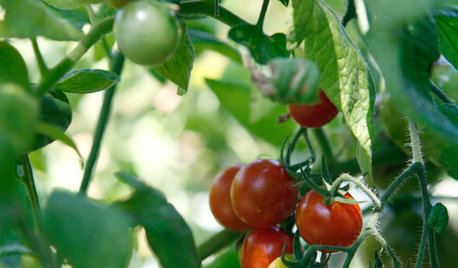
    Baby Cherokee and Crnkovic tomatoes, and a few peppers!

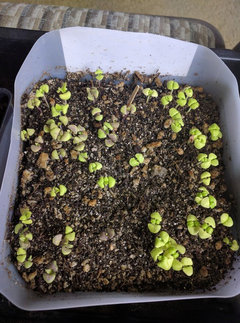
    Sweet and Cinnamon Basil! (Bigger now... picture is a week or two old.)

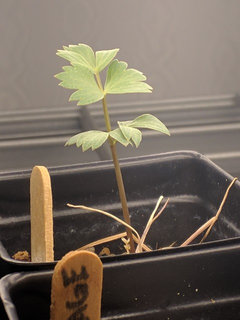
    Lovage that amazingly came back from the starter pot that I never transplanted last year!

  • 8 years ago

    If you go to the link I have for my tradelists, you can see my growlists. :)

  • 8 years ago

    I’ve started tomatoes, hot peppers, cosmos, snapdragons, and cilantro. I’ve killled some sunflower seedlings and cosmos and had failure to germinate dahlias and petunias. Everything that’s still alive seems happy in the greenhouse. I’m feeling a little late this season but life gets in the way what can you do?

  • 8 years ago
    last modified: 8 years ago

    Some plants finally sprouted in my unheated 6'x5'x3' greenhouse (today and/or yesterday—I didn't check yesterday): Green De Belleville sorrel, Alisa Craig onion, Dwarf Greek basil, Santo Domingo Winter watermelon, and a couple weeds in my seed-starting mix. They each took about 8 to 11 days to sprout—so, longer for the okra than in 2017, and longer for the watermelon than in 2016. That's pretty quick for basil and onions, though if I remember right (compared to Spicy Globe Bush basil last year, and He Shi Ko bunching onions last year). I'm guessing the reason for my hypothesis about magnetizing the seeds increasing germination speed of large-seeded species may have been due entirely to other factors. There are some okra varieties, Torpeda melon, White Scallop squash and I believe other things with roots growing, though (roots have been there for a while), but last year, the okra took about 3 days to sprout; in 2016, watermelon took about 4 days to sprout. However, other variables were in play here (this year, the soil dried out a lot faster and that may have impacted germination). Last year, I planted everything in early April instead. In 2016, I probably planted the watermelon a couple weeks later than this year (but still in March).

    I'm pleased to find that Santo Domingo Winter is my first watermelon to sprout, this year, since it was a favorite last year.

    Yes, I know people usually start onions much earlier—but this is a long-term onion project (I don't intend to harvest them this year). I want to see if I can get them to grow like potato onions, since I've read that people have done so with regular onions that most people assume are biennial.

    Note that I don't keep things in the greenhouse. I transplant them in the garden usually in May or so.

    Anyway, I planted lots of stuff—so these things are the earliest of the earliest to sprout.

  • 8 years ago
    last modified: 8 years ago

    Dolly and Nufar basil are coming up and went out to the South Window, today. Need to get some Siam Queen and Lemon basil seed in the mix.

    The SunSugar seedlings are showing up, much/much later than other tomato seeds in their container. I'm not sure if they will make it because the competition can begin to retard their growth. The Anait cherry tomatoes are the only ones off by themselves ... Let's see: I have some later-started Anaheim and Early Jalapeno in separate containers, also. Opposite reasons for those: The Early Jalapeno are so rambunctious and the Anaheim so slow to get started, this year. I've tossed the old Anaheim seed and bought new for this second go-around. Seems like it has been slow to start even with fresh seed so I'll coddle it in its own crib.

    Starting numerous varieties together is a bit problematic. Separating them is a bit bothersome. Always, it's attention to detail and timing with these things.

    Need to locate my seed tater choices. I'd just as soon leave them at the garden center right now but I'd better plan on showing up and "inspecting them"several times over the next few weeks if I leave the potatoes with them.

    Steve

  • 8 years ago

    The peach tree was blooming today. And since today was a nice warm day with it now slightly overcast with moisture in the air and feeling like rain tonight i decided to plant the watermelons. So the main patch of watermelons is now planted. A bit haphazardly but whatever. Felt good to plant them. Snow is supposed to come Saturday and night temps get below freezing so hopefully we will still get peaches this year.

    Even if the worst were to happen with the watermelons and all of them died i still have the best and selected seed from last year so i'm good. This is the old seed from two seasons ago that still needs some selection to continue to remove more that are prone to fruit blossom end rot or other traits. Mixed in some yellow-rind seeds so perhaps i can re-introduce that trait to the landrace. Even better if it crossed with a well adapted yellow fleshed. Yellow flesh and yellow-rind would be pretty cool. But i think yellow-rind is a recessive trait so might be hard to find it again except by chance several seasons from now. I expect a higher percentage of red flesh in this batch of seeds than from saved seed from last year.

    But i'm optimistic. Can't push watermelon to love cooler weather without starting somewhere. I plan on planting two smaller patches of the citron-melon hybrids later. Not sure when, maybe a few weeks, maybe wait until early May. Whatever feels best.

    P.s. The peas are doing great. :)

  • 8 years ago
    last modified: 8 years ago

    Whoa. That's really early. Isn't it? I've never been to anywhere in Colorado but the Denver airport.

    So, we got a hard freeze the other day. It wiped out most of the plants in my unheated greenhouse (with the exception of hardier plants like sorrel, onions, sunroots, and a few other things). At least one tomato survived (a Green Tiger seedling). Don't worry about the tomatoes; I think they've all resprouted (I overseeded), most of them the next day. However, the okra, the muskmelons and the watermelons really suffered (overseeding isn't always as helpful there, since severe cold seems to impact germination rates a lot). The peppers mostly hadn't sprouted, yet.

    The only okra to survive was Louisiana Green Velvet (a plant in each of the two containers for it survived). It definitely seems to have more cold tolerance than the other okras.

    The watermelons pretty much all died, but a few had some live seeds that managed to sprout afterward, and those were Hamby (lots of these sprouted), Black Diamond, Sugar Baby Bush, and maybe Congo. I replanted mostly everything else that I had seeds for (and some of the Black Diamond and Congo).

    I took the opportunity to plant some different kinds of watermelons, muskmelons, and okra.

  • 8 years ago
    last modified: 8 years ago

    Lol. Yes it is way early. But i partly get away with it because i direct seeded and i didn't water the ground. So basically i plant before a big rainstorm and the watermelons sprout on their own when they want to. I don't remember when i planted them last year but it also was too early and some died when a late snow came, though some survived. Many sprouted after the snow storm. My traditional watermelon planting is the first week of May as we get either a rainstorm or generally our last snow on May 10th. Though we can get one by May 20th.

    I have some of the wild tomato species sprouted inside but i won't plant them until May when it is safe.